
Life Sciences
Validation for clinical AI

We deliver production AI engineering as fixed-shape, outcome-priced packs. Each one ships with a measured outcome artefact and a verifier you own and can re-run — no open-ended retainers, no engineer-rental. The pack is the contract.
Production AI work moves in four directions: cost, portability, reliability, and trust. Every engagement we accept sits under one (sometimes two) of these and ships as one of five packs, each with a concrete deliverable you can measure and re-run yourself.

Production AI bills and latency are usually fixable before the model is. We profile the workload, find the bottlenecks that matter, and ship the changes (batching, caching, kernel work, serving topology) with a measured before/after on the requests you actually run.
Realised by: Inference Cost-Cut Pack.

AI workloads stall when the deployment target is anything other than the cluster they trained on. We assess the constraint set, port what needs porting (native, WASM, WebGPU, embedded, novel silicon), and benchmark on the actual target hardware.
Realised by: AI Porting & Deployment Pack.

AI systems regress in ways unit tests cannot catch. We build eval harnesses, drift checks, release gates, and validation packages, the production-side infrastructure that turns a working demo into a system your on-call can actually defend.
Realised by: Production AI Monitoring Harness.

Buyers, auditors, and compliance owners need the artefacts around the model: eval reports, comparisons, lineage, readiness scoring against named published rubrics. We design and build that evidence pack so the AI system is approvable, not just functional.
Realised by: LLM Selection Pack · AI Readiness Scorecard.
Each pack has a fixed scope, a price tied to the outcome, and a deliverable you keep and can re-run. See the full catalogue, bridge scopes, and the routing aid for “not sure which pack” →
Validation for clinical AI
Inference cost, MLOps, porting, LLM evals

Pipeline cost-cuts & eval harnesses

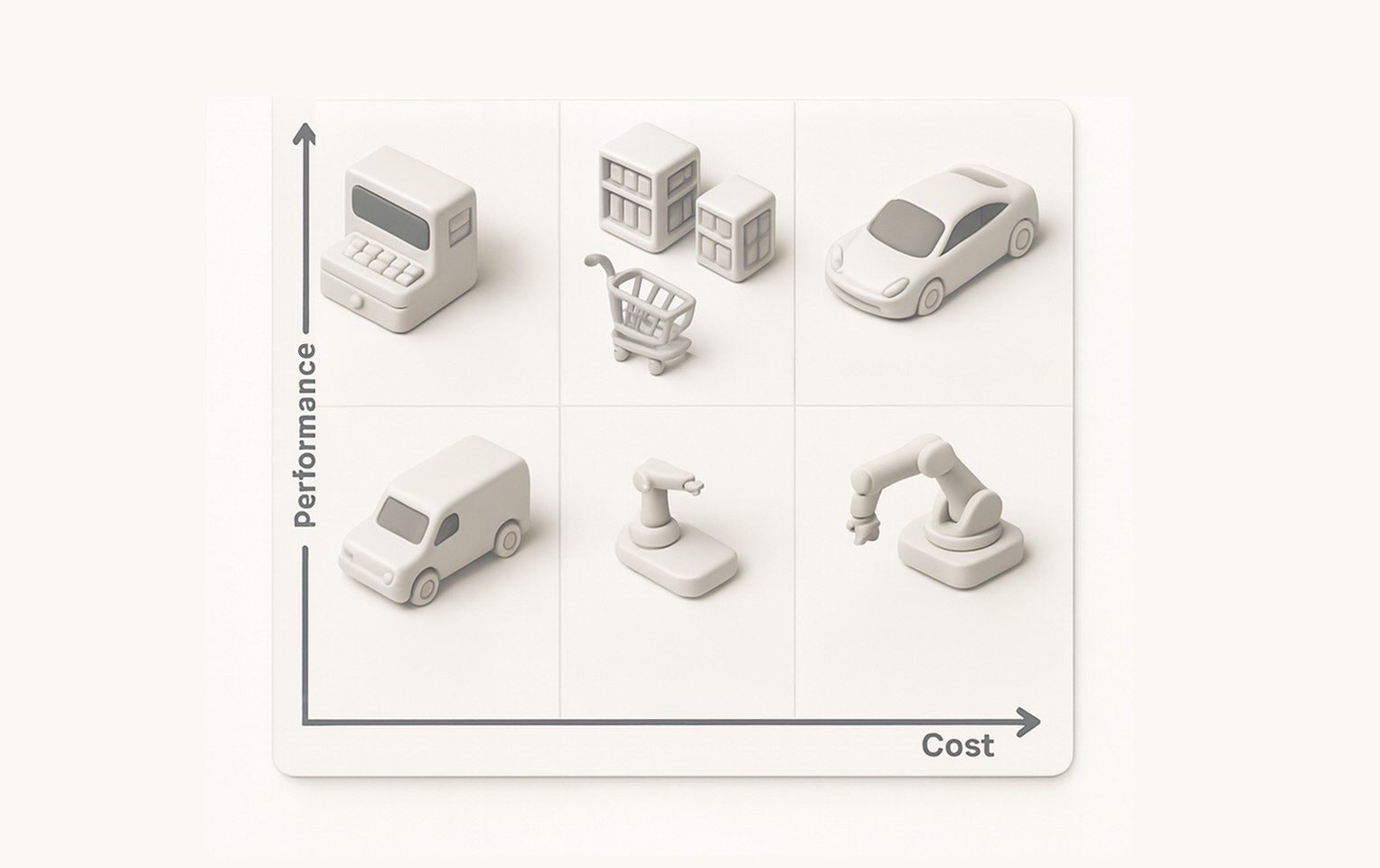
Shelf & catalogue, not shoppers

Inspection & perception evidence
If you know which vertical you sit in, the industry crosswalks pre-filter the packs to the wedges that matter there and route each wedge to its owning pack.
AI-infrastructure & SaaS: inference cost, MLOps hardening, porting, LLM evals
Life Sciences: medical-imaging validation, HIPAA / GxP boundary work
Manufacturing & Automotive: industrial CV inspection, automotive perception
Media & Telecom: video pipeline cost-cut, content moderation, operational anomaly
Retail: shelf-execution validation, visual-search cost-cut; scoped to stock and catalogue, not shoppers
Plenty of teams can train a model. Fewer can make it survive production, prove it to an auditor, and hand it back so you can run it without us. That gap is where we work.
We take one client per technology niche. The advantage we build for you, we never rebuild for a competitor.
We assess data, evaluation, and integration cost up front, and we say so when the model is not the bottleneck or the brief points the wrong way.
Every engagement ends in something transferable (a benchmark, an eval harness, a runbook, a scorecard) that you own and can re-run without us.
Scoped to the problem and priced against the result, not engineer-weeks billed against a backlog.

We engineer for production: observable, testable, and defensible months after handover, not a demo that quietly regresses.

The work we will not take on is explicit. Where we draw the line, and why, is published on our values page.
Before we propose a pack, the work has to clear a simple bar: a concrete deliverable, a fixed scope, a price tied to the outcome, and something you can re-run yourself. The work we won't take on is just as explicit, and the eval discipline behind it all ships as a benchmark you can install, run on your own machine, and check the published results of.
LynxBenchAI
Specifications don't predict how a machine handles real AI work, so we built a benchmark that measures it instead. LynxBenchAI installs with one pip command and scores the machine in front of you on training, inference, and compute in 15 to 30 minutes, then submits the result to a public board where it sits beside every other machine measured under the same release. The Personal Edition is free for non-commercial use, and one methodology covers NVIDIA, AMD, and Intel GPUs as well as CPUs.

Who We Are
We are a team of engineers, researchers, and creatives driven by a shared passion for visual computing and high performance. With roots in deep tech innovation, we help companies create computer vision and immersive solutions, with or without AI.
TechnoLynx delivered the project on time and provided quality outputs that met the client's expectations. The team was proactive in providing ideas and suggestions, and they were careful at properly planning the tasks. The client also praised the team's expertise in GPU programming and AI.

TechnoLynx's skill in low-level software development was impressive. TechnoLynx was able to create four prototypes with common components and an interface for easy maintenance. The client was extremely happy with the solution's speed. Moreover, their communication was seamless and straightforward.

TechnoLynx's unique aspect is that they're able to transform complex theories into practicable and applicable results. TechnoLynx provides research reports and architecture planning documents. The team is able to transform complex theories into practicable and applicable results. TechnoLynx's project management is strong and delivers work on time without hardware issues, being responsive through virtual meetings.
I’m delighted with our collaboration with their team. Thanks to TechnoLynx's work, the client has been able to co-author two patents. They lead responsive project management to solve problems quickly. The team also praises their skilled and knowledgeable team.
We had high-efficiency meetings. TechnoLynx’s work resulted in a successful breakthrough, and their input improved the client’s app. Their flexible and organised project management cultivated a healthy collaboration experience. Ultimately, their professionalism and commitment were impressive.
Feasibility comes before scope. We assess data, evaluation method, integration cost, and operational constraints up front and refuse engagements that depend on super-human-level performance to deliver value. See how to evaluate GenAI feasibility before you build and why most enterprise AI projects fail.
You do. We work in outcome-owned engagements: every deliverable and the underlying IP belong to the client. We sign NDAs first, work with one client per technology niche to avoid conflicts of interest, and structure milestones so each one produces a packageable, transferable artifact rather than only a future promise.
Yes. Validation pathways under CSA, CSV, GAMP 5 second edition and Annex 11 already accommodate well-scoped AI/ML systems, and the regulatory perimeter is often narrower than internal teams assume. See why pharma delay costs more than adoption and our life sciences practice.
It depends on what you need. A Technical Business Analysis or feasibility assessment usually takes a few weeks; an R&D Sprint or proof of concept is typically a few weeks to a couple of months; a full development engagement runs over several months. We scope each phase explicitly so you know what is committed before work begins.
Yes. We sign mutual NDAs before exchanging confidential material, and we apply tight IP clauses with both our clients and our own employees so anything generated within a project is owned by the client. For regulated work we operate under CSA, CSV, GAMP 5 and Annex 11 frameworks, and for personal data we apply GDPR-compliant pipelines including data minimisation, de-identification and human-in-the-loop review where appropriate.
Engagements are scoped to your problem, not sold off a price list. A short feasibility assessment is a low-cost entry point that de-risks larger commitments; sprints and full developments are quoted against a written scope and milestone plan. Talk to us with a one-paragraph problem description and we will reply with an indicative range.