
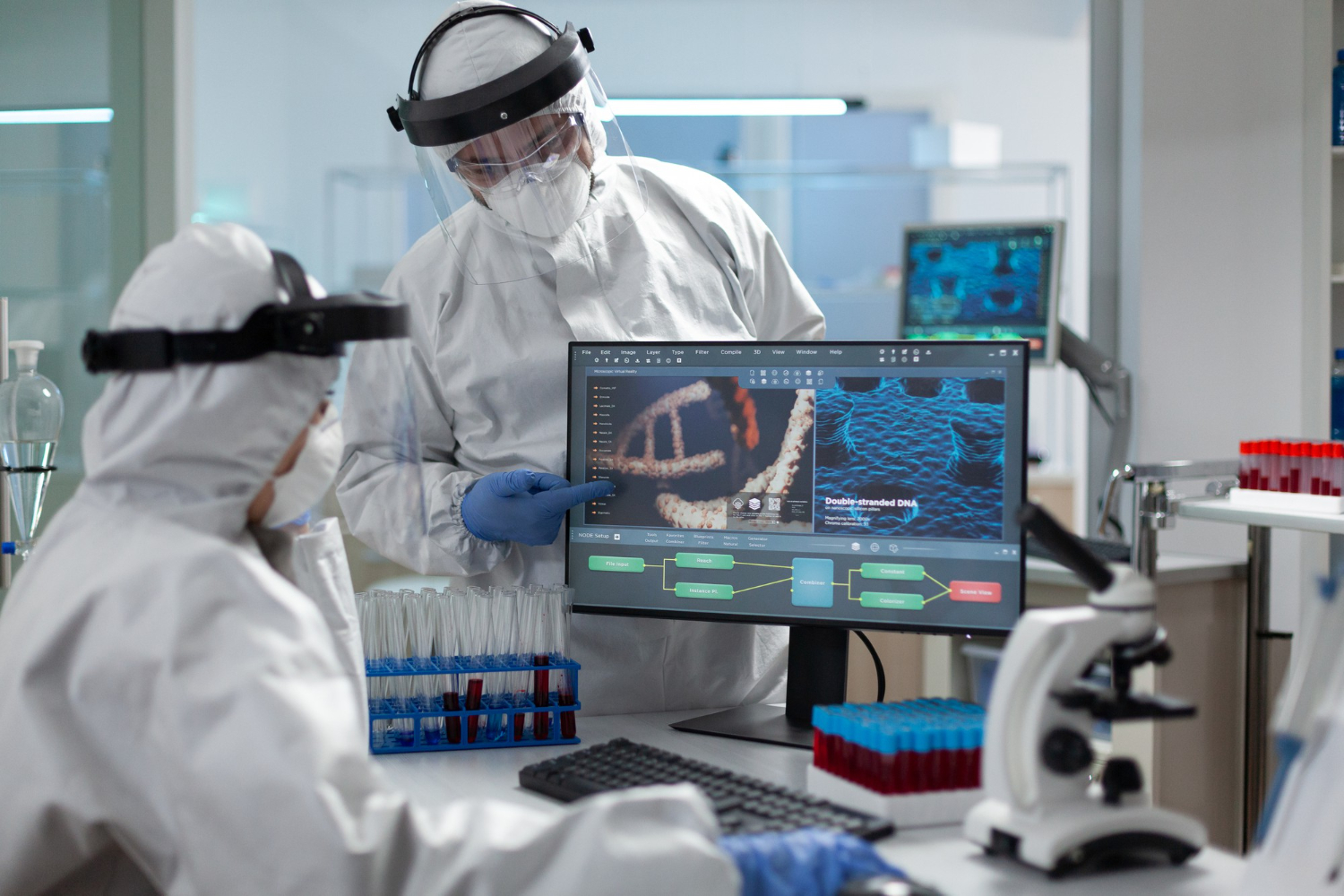
Most “AI in pharma analytics” pitches conflate two very different jobs. One is the moonshot — a generative model that proposes a novel molecule, or a digital twin that replays a Phase III. The other, far less photogenic, is the analytical-operations layer: the bioinformatics queue, the QC review desk, the regulatory writing pool, the supply-and-demand model behind a manufacturing site. The durable ROI in pharma data analytics today sits in that second pile, where reviewer time is the bottleneck and the unit of value is hours-per-readout, not headlines.
We see this pattern regularly when scoping pharma engagements: a sponsor wants to talk about drug discovery, and a workflow audit puts the highest-yield AI work two or three steps upstream of the discovery narrative. The methodology is workflow-stage-first — pick the analytical step where reviewer hours dominate cycle time, instrument it, and only then ask whether AI augmentation pays for itself.
What does AI actually do in pharma analytics today?
Reality delivers a narrower scope than marketing departments advertise. AI in pharma analytics is, in practice, four working clusters:
- Pattern recognition over high-throughput readouts. Image-based assays, sequencing pipelines, mass-spec traces — anything where a human reviewer would otherwise eyeball thousands of curves or fields. Models like convolutional nets and transformer encoders, trained on labelled internal data, triage routine reads and surface the edge cases.
- Natural language processing over the document layer. Regulatory guidance, adverse-event narratives, scientific literature, clinical notes. Modern NLP stacks (transformer-based language models, retrieval-augmented over a controlled corpus) summarise and cross-reference what used to be done by analysts with highlighters.
- Predictive analytics over operational data. Enrolment forecasting, supply-chain demand, equipment-failure prediction in manufacturing. These are classical machine-learning problems — gradient-boosted trees on tabular features, time-series models, occasionally graph models — wrapped in monitoring rather than presented as standalone products.
- Generative components in well-bounded niches. Molecular structure proposal, synthetic data for rare-disease modelling, first-draft regulatory writing. This is the work that grabs attention; it is also the work that requires the most human gating before output reaches a regulated decision.
Everything else is downstream of these four. Personalised dosing, virtual control arms, digital twins of patients — all interesting, all dependent on the analytical layer being reliable first.
Where predictive analytics earns its keep — and where it doesn’t
Pharma predictive analytics carries reputational baggage; the journey from PowerPoint to sustained KPI movement spans a chasm. Because monthly KPIs expose the gap between presentation and performance. Monthly KPIs expose the distance between presentation slides and operational truth. The discriminating question is whether the prediction enters a decision loop that someone owns.
| Use case | Owner of the decision | Predictive analytics earns its keep when… | Slide-deck claim when… |
|---|---|---|---|
| Patient enrolment forecasting | Clinical operations lead | Trial-site selection is tied to model output; the model is retrained per indication | The forecast is a one-off slide; sites picked by relationship |
| Supply-chain demand prediction | Site operations | Output drives PO timing and inventory thresholds; error tracked against actuals | “We use AI” with no link to reorder logic |
| Equipment failure prediction | Maintenance engineering | Alerts integrated into the maintenance ticket queue; mean-time-to-detection logged | Dashboard nobody opens between audits |
| Adverse-event signal detection | Pharmacovigilance | Triage queue measurably faster on labelled retrospective set; false-negative rate audited | Counted as “AI coverage” without rate measurement |
| Trial success probability | Portfolio/finance | Model influences go/no-go, with explicit uncertainty bands shown | Used to justify a decision already made |
The pattern is observed across our pharma engagements (not a benchmarked rate, planning heuristic only): predictive-analytics projects that survive the second budget cycle are the ones whose owner can name the decision the prediction changes. The ones that don’t survive are usually fine technically — they just never got wired into a workflow.
Biomarker analysis and adverse-event prediction: the analytical-ops view
Biomarker analysis and adverse-event prediction command most analytical-operations discussions. Both are pattern-recognition problems wrapped in regulatory expectations, which means the engineering work is more about reproducibility than about model novelty.
Biomarker analysis typically involves multimodal data — sequencing output, imaging, sometimes proteomics or metabolomics — joined to outcome labels. Machine-learning models here do two useful things: they propose candidate signatures and they triage the volume of candidates so that biostatisticians focus on the few worth a formal test. The hard part is not the model. The hard part is the pipeline: getting the input data versioned, the preprocessing reproducible, the model artefact pinned to a specific feature set and software environment. Without that, a biomarker finding is not auditable, and an unauditable finding cannot survive a regulatory submission.
Adverse-event prediction is a different shape. The label is noisy, the class imbalance is severe, and the cost of a false negative is asymmetric. Most of the engineering work goes into the data pipeline — extracting structured features from free-text narratives in pharmacovigilance databases, normalising to MedDRA terms, and maintaining a holdout set that reflects current product mix rather than five-year-old reporting patterns. The model is, again, the small part. The pipeline is the work.
In both cases the question for a pharma analytics team is not “can we train a better model?” but “can we retrain this monthly with the same numbers coming out twice?” Until the second answer is yes, the first one doesn’t matter for regulated use.
Why is reproducibility the actual constraint on pharma AI?
Regulatory submissions demand a defensible lineage from raw data to final result, not merely the result itself. This is true whether the result came from a t-test or a transformer. The implication for AI-augmented bioinformatics outputs is concrete: any model output that feeds a regulated decision needs the same provenance scaffolding as the rest of the analytical stack.
In practice that means a few things. The training data set is versioned and frozen for each model release. The preprocessing code is in a pinned environment — a container with explicit library versions, not “we used PyTorch and scikit-learn.” The model artefact is signed and stored alongside the data version it was trained on. The inference run logs the exact artefact used, the inputs, and the outputs. The thresholds that turn a continuous model score into a decision are documented separately and version-controlled, because moving a threshold is itself a change to the analytical method.
None of this is glamorous. All of it is the difference between an AI feature that survives an inspection and one that quietly gets reverted to manual review the week before an audit. This is also why the artefact connection for this kind of work points to GxP regulatory scope analysis — labs need to declare upfront which outputs feed regulated decisions and which support exploratory research, because the validation burden diverges sharply.
Where does AI sit against data engineering?
Scoping pharma analytics projects benefits from a clear boundary definition. Data engineering is responsible for everything before the model: source systems, ingestion, cleaning, joining, versioning, the lineage graph. AI work is responsible for the model itself, the feature representation chosen by the model, the training loop, the evaluation harness, and the monitoring of model behaviour in production.
In most pharma settings the data-engineering layer is the larger and less negotiable investment. A well-built feature store and a versioned data pipeline make multiple downstream AI projects feasible. A weak data layer makes every AI project bespoke and fragile. We pay close attention to this boundary at the start of an engagement because mislabelling data work as model work is the most common reason pharma analytics programmes stall in year two.
Integration without theatre
Pharma AI integration carries more operational weight than brochures acknowledge and less novelty than they claim. The work is:
- A connector into the source-of-truth system (electronic health records, LIMS, MES, regulatory submissions repository) — usually a periodic export plus a change-data-capture stream for the systems that support it.
- A staging area where the data is versioned and the join keys are normalised.
- A model service that consumes the staged data, returns a prediction, and writes a record of what it did.
- A reviewer interface that exposes the prediction with enough context for a domain expert to accept, override, or escalate it.
- A monitoring layer that compares the model’s behaviour over time against the labelled feedback the reviewer interface produces.
The last point — closed feedback from reviewer to monitoring — is where most pharma AI integrations leak. Without it, model drift goes unnoticed until it shows up in an audit finding. Standard MLOps tooling (MLflow for tracking, ONNX for portable artefacts, Kubernetes for serving, structured logging into the observability stack) is enough to do this well; the difficulty is organisational, not technical.
What about generative AI and digital twins?
Analytical-operations work encompasses these domains, though at smaller scale than promotional materials imply. Generative AI is genuinely useful for synthetic data in rare-disease settings where real-world samples are too few to train on, and for first-draft regulatory writing where a human reviewer is the final author. Digital twins are useful for manufacturing process simulation and for in-silico trial planning, where the cost of a poorly chosen protocol is high enough to justify the modelling overhead.
In both cases the test is the same as for any other pharma analytics work: does the output enter a decision loop with a named owner, and is the path from input to output reproducible enough to defend? If yes, the technology pays for itself. If no, it is a research project, which is fine — but it should be funded as one and not as production analytics.
FAQ
Which bioinformatics workflows have the clearest ROI for AI augmentation today vs which remain experimental?
The clearest ROI today is in pattern-recognition over high-throughput readouts (image-based assays, sequencing QC, mass-spec triage) and in NLP over the regulatory and pharmacovigilance document layer. De-novo molecular design, virtual control arms, and full patient digital twins remain experimental — useful for specific niches but not yet a productivity layer in routine analytical workflows.
How is pattern recognition deployed at scale across high-throughput screening pipelines without introducing reproducibility debt?
By pinning the training data version, the preprocessing environment, and the model artefact together for each release, and by treating the decision threshold as a versioned analytical parameter rather than a tunable knob. Without that scaffolding, scale multiplies reproducibility debt rather than amortising it.
What does a modern automated biotech lab actually look like in 2026 from a data-flow perspective?
It looks like a LIMS-anchored data backbone with versioned feature stores feeding model services, reviewer interfaces that capture accept/override decisions back into the training loop, and a monitoring layer that watches for drift. The instruments are visible; the data plumbing is most of the work.
Where does predictive analytics earn its keep in pharma analytical operations vs being a slide-deck claim?
It earns its keep when the predictive output is wired to a decision a named owner makes — enrolment forecasts that drive site selection, demand forecasts that drive reorder logic, failure predictions that drive maintenance tickets. It is a slide-deck claim when no decision changes regardless of the output.
How do AI-augmented bioinformatics outputs satisfy reproducibility expectations for regulated submissions?
By treating the AI artefact like any other analytical method: versioned inputs, pinned environment, signed model, documented thresholds, logged inferences, and a clear declaration of which outputs feed regulated decisions versus which support exploratory research.
What is the boundary between data-engineering and AI work in a working biotech lab?
Data engineering owns everything up to and including the versioned feature store; AI work owns the model, its training, evaluation, and monitoring. In practice the data-engineering investment is larger and enables multiple AI projects; weak data infrastructure makes every model project bespoke and fragile.
How TechnoLynx can help
We collaborate with pharma and biotech analytical teams on the unglamorous infrastructure: versioned data pipelines, reproducible model artifacts, feedback-enabled reviewer interfaces, and GxP-scope decisions that separate full-validation requirements from lighter oversight. Our engagements are scoped to your problem rather than to a platform, which means the choice of tooling (PyTorch or scikit-learn, MLflow or an in-house tracker, Kubernetes or a managed inference service) follows from your existing stack rather than the other way round.
If your team is deciding where to spend the next analytics budget cycle, the question to bring is not “which model should we train?” but “which reviewer step is currently the bottleneck, and what would change if it were ten times faster?” That framing tends to point at the projects worth funding. It is the same framing that guides the rest of our life-sciences AI practice.
References
- Beam, A.L. and Kohane, I.S. (2018). Big data and machine learning in health care. JAMA, 319(13), 1317–1318.
- Rajkomar, A., et al. (2019). Machine learning in medicine. New England Journal of Medicine, 380(14), 1347–1358.
- Topol, E. (2019). Deep Medicine: How Artificial Intelligence Can Make Healthcare Human Again. Basic Books.
- Vamathevan, J., et al. (2019). Applications of machine learning in drug discovery and development. Nature Reviews Drug Discovery, 18(6), 463–477.
Image credits: Freepik.