
Introduction
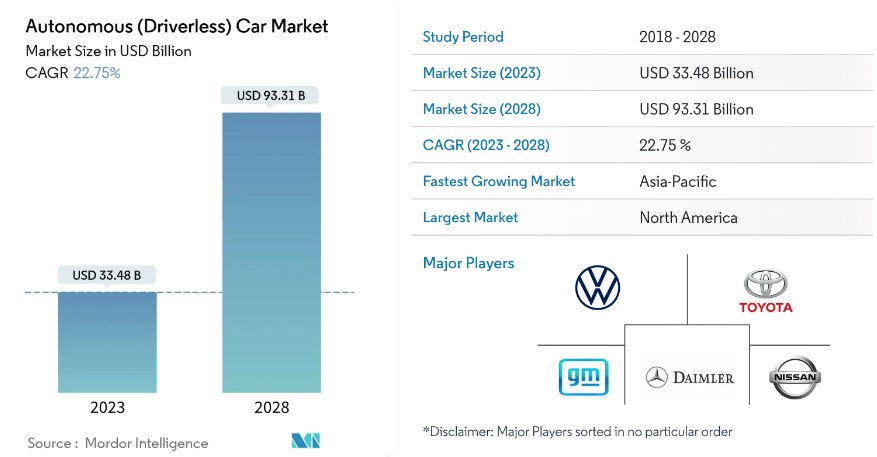
Twenty years ago, vehicles that drove themselves belonged in films, not on public roads. With the help of AI, autonomous vehicles are becoming a reality on public roads — slowly, unevenly, and with more caveats than the press tends to acknowledge. The autonomous vehicle market is projected to reach roughly USD 93 billion by 2028, growing at a CAGR near 23% through the forecast window (directional industry-scale estimate, Mordor Intelligence 2023; not an operational benchmark). The number itself matters less than what is driving it: a stack of AI techniques that have finally become workable in real-time inference on vehicle-grade hardware.
The path is not clean. Regulatory frameworks lag the technology, ethical questions around fallback behaviour remain unsettled, and the cybersecurity surface of a connected vehicle is much larger than a traditional car. Progress happens because tech companies, automotive OEMs, and regulators are negotiating in parallel rather than waiting on each other. Having said that, the engineering reality underneath those negotiations is what most readers come here to understand.
This article walks through the AI techniques that actually carry the load: computer vision and GPU performance engineering for perception, generative AI for simulation, IoT and edge computing for connectivity, and the failure modes that still keep these systems supervised rather than fully autonomous.
What AI Techniques Make Autonomous Driving Possible?
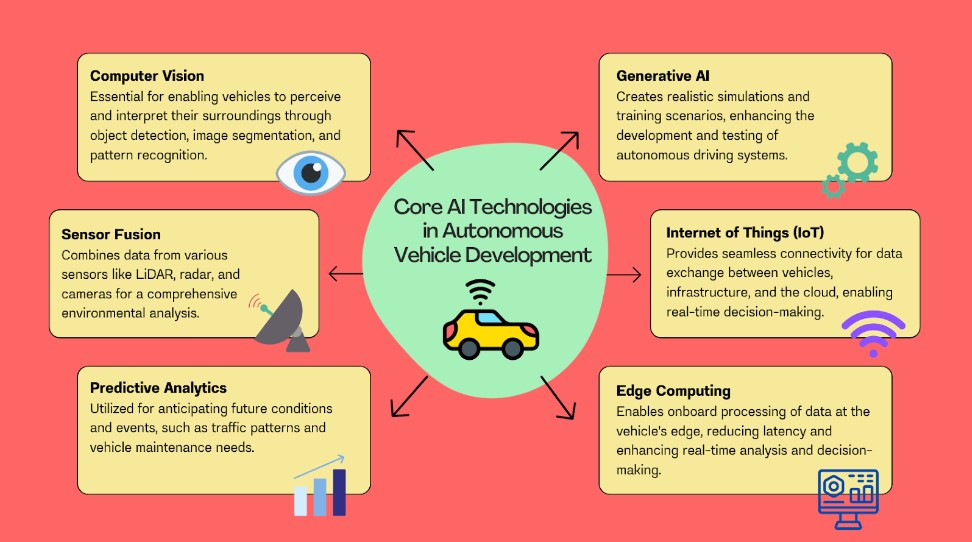
No single neural network powers a self-driving car. It is a layered system: perception, prediction, planning, and control, each with its own latency budget and tolerance for error. Computer vision and sensor fusion handle perception. GPU performance engineering keeps the perception stack inside its real-time deadline. Generative AI builds the rare scenarios the on-road fleet will not encounter often enough to learn from. IoT and edge computing carry the messages between vehicles and infrastructure when local sensing alone is not enough.
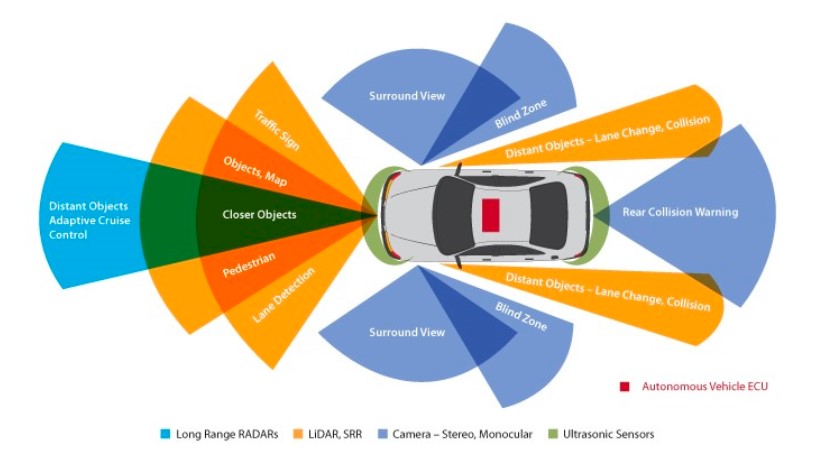
The sensor stack on a typical L3+ vehicle combines cameras, LiDAR, and radar, and the combination matters more than any single modality. Cameras capture dense visual information across the full visible spectrum, including colour and texture that LiDAR cannot resolve. LiDAR emits laser pulses and measures return time to build a 3D point cloud with centimetre-scale accuracy, independent of ambient lighting. Radar uses radio waves to detect range and velocity through fog, rain, and snow where optical sensors degrade. The three are deliberately overlapping — that redundancy is a safety property, not an inefficiency.
Survey data from late 2023 suggests roughly 38% of US consumers say they are open to riding in autonomous vehicles, and forecasts place the global fleet above 33 million vehicles by 2040 (directional industry-scale estimate; not an operational benchmark). The interesting question is not adoption velocity but what each layer of the stack has to do to make adoption survive contact with edge cases.
Computer Vision and GPU Performance Engineering in Autonomous Navigation
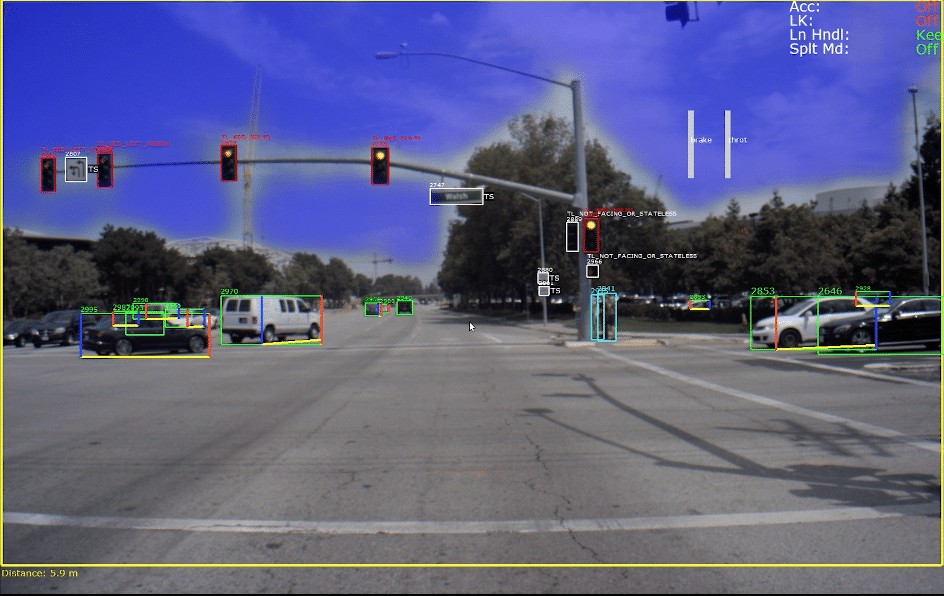
Every control cycle demands perception of surroundings, prediction of nearby agents, trajectory planning, and actuation—compressed into milliseconds. Perception is the dominant compute load. Without GPU-class hardware sized correctly for the workload, the rest of the stack starves.
Modern perception pipelines use deep neural networks to detect and classify objects, segment drivable surface, estimate depth where LiDAR is sparse, and track motion across frames. The networks are not exotic — most use variants of the same convolutional and transformer architectures running in datacentres — but they have to execute under a fixed power envelope, a fixed thermal budget, and a hard real-time deadline. Missing the deadline is not “slow”; it is a control-loop violation.
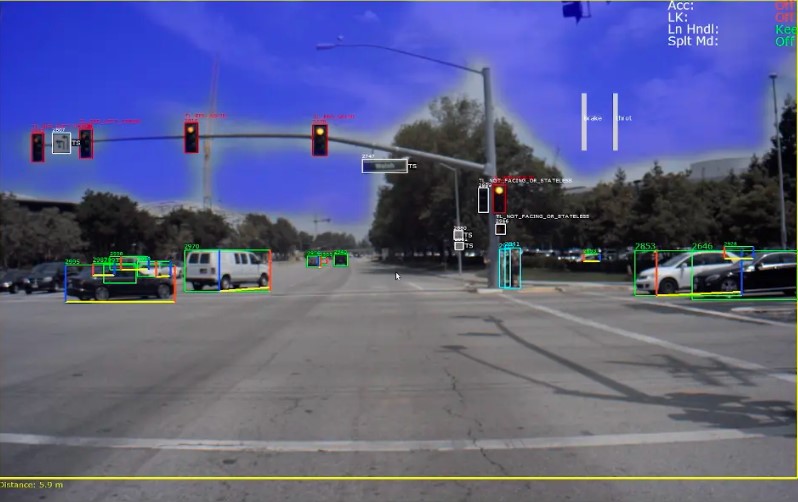
This is where GPU performance engineering stops being optional. Parallel execution lets a GPU run the dense matrix multiplications behind convolution and attention orders of magnitude faster than a CPU, but raw throughput is not the operationally relevant measure. Sustained throughput under realistic load — multiple cameras, multiple LiDAR returns, fused inputs, mixed-precision inference — is what matters. We have seen in our engagements that naive deployments leave large fractions of theoretical throughput on the table because of memory-bandwidth bottlenecks, kernel launch overhead, or poorly chosen batch sizes for the latency-bounded path (observed pattern across our automotive and robotics work; not a benchmarked rate).
Tooling matters here. PyTorch and TensorFlow handle training. ONNX provides a portable intermediate representation. TensorRT, CUDA graphs, and quantisation-aware compilation turn a research model into something that meets the latency budget on an embedded inference target. None of this is glamorous, but it is the difference between a demo and a deployable system.
A pedestrian stepping off the kerb is the canonical hard case. The vehicle has to detect the motion, classify it as a vulnerable road user, predict the trajectory under uncertainty, and decide whether to brake or steer — all before the geometry forces a worse outcome. Every millisecond of avoidable latency in the perception stack narrows the planner’s options.
Generative AI for Simulation and Testing
Rare edge cases define system safety, yet occur too infrequently to accumulate statistically significant test data. You cannot accumulate enough miles to encounter them at a rate that supports robust evaluation, and you cannot reproduce them safely on real roads. Generative AI has become the practical answer.
Wayve’s GAIA-1, a world model trained on video, text, and action inputs, generates realistic driving footage that can be conditioned on specific scenarios — heavy rain, an obscured intersection, a vehicle behaving erratically (published-survey: Wayve technical disclosures 2023). The model produces multiple plausible futures from the same starting state, which is exactly what evaluation requires. Two cars approach the same crosswalk; in one rollout a child runs out, in another the path stays clear, in a third the lead vehicle brakes hard. The autonomy stack under test sees all three.
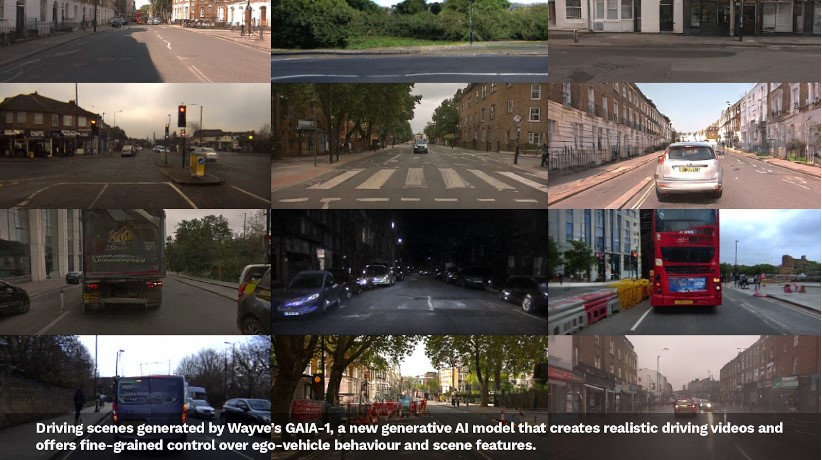
The value is not photorealism for its own sake. It is the ability to enumerate “what if” branches that would be unsafe, unethical, or simply too rare to stage. A simulation-first methodology lets engineering teams measure how the system behaves at the long tail of the distribution, which is precisely where field data is thinnest.
| Testing approach | What it covers well | Where it falls short |
|---|---|---|
| Closed-course physical testing | Repeatable scenarios with real sensors and dynamics | Limited scenario diversity, slow, expensive |
| On-road fleet testing | Real distribution of common cases | Rare events under-sampled, dangerous cases unreachable |
| Generative simulation | Long-tail and dangerous cases at scale | Sim-to-real gap; model biases inherited by evaluation |
No single mode is sufficient. The robust pattern is to use simulation to surface candidate failures, validate the worst on closed courses, and confirm distributional behaviour against fleet data.
How Do IoT and Edge Computing Enable Vehicle Connectivity?
Coordination between autonomous agents generates network chatter, not eerie silence. Vehicle-to-vehicle (V2V) and vehicle-to-infrastructure (V2I) messages let cars share intent and observation in ways that no on-board sensor stack can replicate. A vehicle around a blind corner can know about a stopped truck before its own LiDAR sees it.
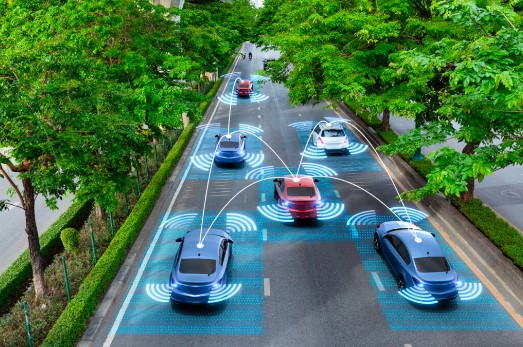
IoT provides the connection fabric — cellular V2X, dedicated short-range communications, and increasingly 5G — that links vehicles to each other and to traffic infrastructure. Edge computing handles the processing that cannot afford a round trip to a datacentre. When the latency budget is measured in milliseconds, the only viable place to process data is close to where it was generated: on the vehicle, at a roadside unit, or in a metro-scale edge node.
The economic projection follows the technical reality. IoT products and services for autonomous vehicles are forecast to reach roughly USD 110–130 billion by 2025 and USD 240–300 billion by 2030 (directional industry-scale estimate; not an operational benchmark). What matters operationally is that the latency profile, the security model, and the fallback behaviour when the network degrades are designed in from the start, not patched in later.
Edge processing also acts as a containment boundary for sensitive data. Raw camera feeds and detailed location traces do not need to leave the vehicle to be useful to the planner. Pushing inference to the edge keeps the data minimal, the latency low, and the privacy surface narrow.
What Are the Main Challenges in Autonomous Vehicle AI?
Engineers lose sleep over mundane perception failures, not pedestrian-detection drama that sells newspapers. They are the everyday ones the system has to handle without supervision.
Roads are non-stationary distributions. Construction zones move, lane markings fade, weather changes the appearance of the same scene from one hour to the next. A model trained on a clean distribution of sunny, well-marked highways will not generalise to a rural road in heavy rain. This is a domain-shift problem, and it is the most common reason autonomy stacks underperform field expectations.
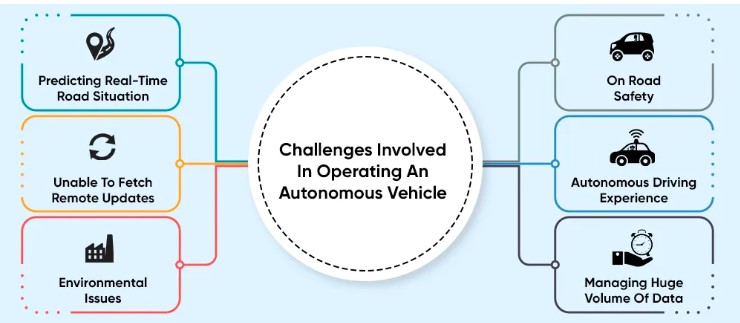
A second cluster of challenges sits in the data pipeline. A modern instrumented vehicle can generate on the order of terabytes per hour of sensor data, with reports of single multi-hour journeys producing close to 100 TB (observed pattern from published OEM disclosures; varies widely by sensor configuration). Storing, labelling, and learning from that volume is its own engineering discipline. Most of the data is uninteresting — straight highway, steady traffic — and the useful signal is concentrated in a small fraction of frames. Filtering, prioritisation, and active learning are not optional.
Then there is the handover problem. Most deployed systems are not fully autonomous. They are L2 or L3, which means a human is expected to retake control under conditions the system cannot handle. The transition is well-known to be unsafe: a driver who has not been engaged for twenty minutes is poorly placed to make a split-second decision. Designing the human-machine boundary is at least as hard as designing the perception stack.
Finally, cybersecurity. A connected vehicle is an attack surface with safety-critical actuators on the other side. Threat models for autonomous fleets cover everything from sensor spoofing to compromised over-the-air updates. The required posture is closer to aerospace than to consumer electronics.
Addressing all of this requires deep engineering across perception, infrastructure, and deployment. At TechnoLynx we work with teams on the parts of the stack where we have direct experience: real-time computer vision pipelines, GPU performance engineering for inference workloads, and edge deployment for latency-bounded systems.
What TechnoLynx Brings to Autonomous Vehicle Engineering
Our expertise at TechnoLynx centers on vision pipelines, GPU optimization, and edge inference—the triple constraint consuming most AV development budgets.
Our object detection work has covered lane and pedestrian detection pipelines, multi-camera fusion, and the inference-side performance engineering that lets those models meet a latency budget on embedded targets. We work in PyTorch and TensorFlow for training, CUDA and TensorRT for deployment, and ONNX where portability across hardware targets matters. We come in as a research and development partner with outcome ownership, not as a generic dev shop.
For teams whose perception stacks are technically correct but missing their latency targets, or whose sensor fusion pipelines have unexplained accuracy drops in adverse conditions, those are the engagements where our experience compounds. Contact us to discuss the specifics.
Conclusion
Dozens of interlocking technologies, refined through iteration, underpin every deployed autonomous system. They are the convergence of computer vision, GPU performance engineering, generative simulation, and edge computing — each mature enough independently that the integration is now tractable. The work that remains is engineering work: closing the sim-to-real gap, tightening the perception stack against domain shift, designing the human-machine boundary so that handover is actually safe, and treating cybersecurity as a first-class concern rather than a release-time afterthought.
The interesting question is not whether autonomous vehicles will arrive. It is which parts of the stack will turn out to be the binding constraints, and how the engineering teams that ship first will have solved them.
Frequently Asked Questions
What AI techniques are used in autonomous vehicles?
Modern autonomy stacks combine computer vision with deep neural networks for perception, sensor fusion across cameras, LiDAR, and radar, generative AI for simulation and testing, and IoT and edge computing for vehicle-to-vehicle and vehicle-to-infrastructure connectivity. GPU performance engineering sits underneath all of it to keep perception inside its real-time latency budget.
Why are GPUs important for self-driving cars?
Perception runs deep neural networks on multiple camera and LiDAR streams under a hard real-time deadline. GPUs provide the parallel throughput needed to meet that deadline within the vehicle’s power and thermal envelope. The operationally relevant measure is sustained throughput under realistic fused-sensor load, not peak benchmark numbers.
How is generative AI used to test autonomous vehicles?
Dangerous and rare scenarios — children running into the road, multi-vehicle pile-ups, unusual weather — are too rare or unsafe to encounter at scale in on-road testing. Generative world models such as GAIA-1 produce realistic synthetic driving footage that can be conditioned on those scenarios, letting teams evaluate the autonomy stack across the long tail of the distribution.
What are the biggest challenges for autonomous vehicle AI?
Domain shift between training and deployment conditions, the volume and skew of sensor data, the human-machine handover problem in L2 and L3 systems, and cybersecurity of connected vehicle fleets. None of these are pure ML problems — they cut across perception, infrastructure, regulation, and human factors.
Sources for the images
Bockenbach, O. (2019) Autonomous Driving and Artificial Intelligence — An Approach to Achieve Functional Safety, KPIT Technologies.
Cvijetic, N. (2019) Taking It to the Streets: Ride in an NVIDIA Self-Driving Car with DRIVE Labs, NVIDIA Corporation.
Wayve Technologies Ltd. (2023) Introducing GAIA-1: A Cutting-Edge Generative AI Model for Autonomy.
Mordor Intelligence Research & Advisory (2023). Autonomous Vehicle Market Size & Share Analysis — Growth Trends & Forecasts (2023–2028).
Recogni (2020) Autonomous Vehicles And A System Of Connected Cars, AI Time Journal.
Singh, K. (n.d.) Business Operations On Autopilot: 6 Ways To Overcome The Challenges In Operating Autonomous Vehicles, X-Byte Enterprise Solutions.
Why autonomous vehicle strategy requires local context
ROI emerges only when fleet type, regulation, and rollout schedule align with your capital allocation horizon.