
Introduction
Built form represents cumulative human intention materialized over time. They take centuries to coalesce, and even when they appear finished, they keep mutating — neighbourhoods densify, building stock turns over, infrastructure gets re-stitched around new constraints. Behind that slow churn sit architects and planners, who for most of the discipline’s history worked the problem by hand: blueprints, tracing paper, manual zoning checks, iteration counts measured in weeks.
The interesting question isn’t whether AI replaces any of that. It doesn’t. The question is which parts of the design loop genuinely benefit from machine-driven search and prediction, and where the hype outruns the practical payoff. We see five places where the answer is now reasonably clear: generative layout search, Building Information Modelling (BIM) analytics, bioclimatic design, urban-scale planning, and heritage preservation. Each works for a specific reason, and each has limits worth naming.
Where generative design actually helps
Designing buildings requires navigating a solution space bounded by physics, regulation, and client intent. The constraints are unglamorous — setback rules, parking ratios, floor-area ratios, daylight access, structural spans, budget caps — and the search space is large. That combination is exactly where generative algorithms earn their keep.
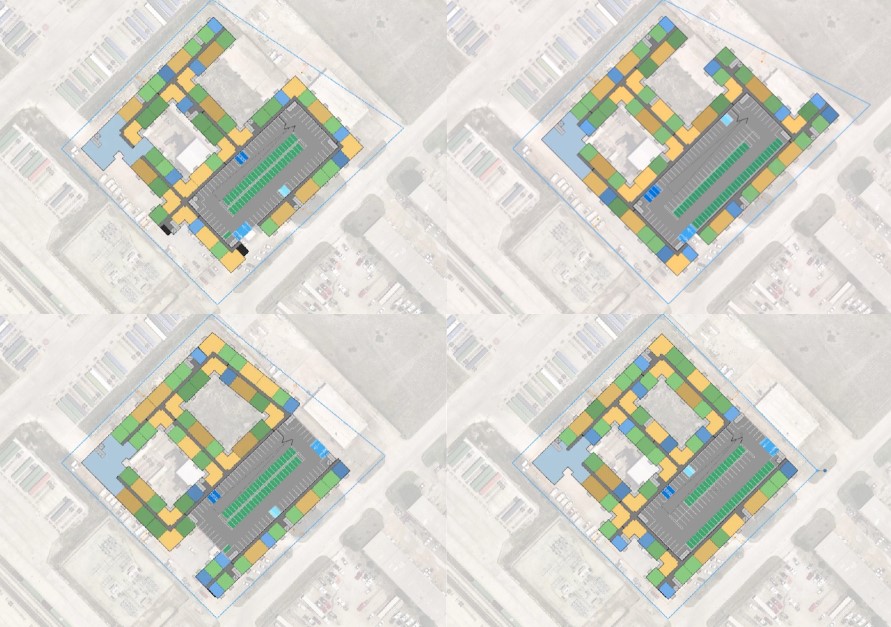
Tools like TestFit automate feasibility studies by enumerating layouts that satisfy a parametric brief: site polygon, zoning envelope, target unit mix, parking strategy. Instead of producing one or two schemes by hand, a team can iterate through thousands of candidates and compare them on yield, cost per unit, or daylight access. The architect still chooses; the machine handles the combinatorics.
The honest framing: this is search acceleration, not creativity. It compresses the early feasibility phase from weeks to hours for project types where the constraints are well-formalised (multifamily housing, parking podiums, suburban subdivisions). For one-off cultural buildings or sites with messy contextual constraints, the parametric brief itself becomes the bottleneck and the value drops.
What generative design is good at versus where it stalls
| Phase | Generative search helps | Why |
|---|---|---|
| Site feasibility (yield studies) | Strongly | Constraints are codified; objective is countable |
| Massing studies | Moderately | Useful for envelope envelopes, weak on cultural fit |
| Detailed design | Weakly | Decisions are qualitative and interlocked |
| Construction documentation | No | Tolerances and exceptions dominate |
BIM, learned from past projects
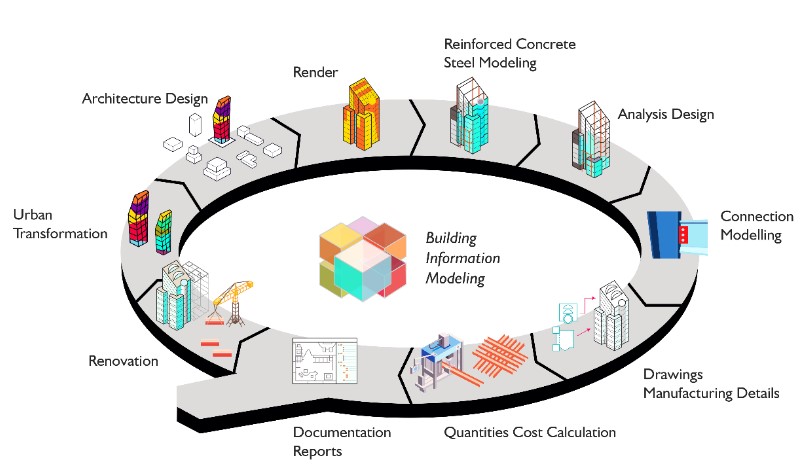
BIM infrastructure serves as the authoritative digital twin for construction projects, encoding spatial relationships, material specifications, procurement data, and coordination warnings. AI enters BIM in two ways: as a predictor (estimating cost, schedule, or clash risk by learning from completed projects) and as a workflow assistant (routing approvals, flagging document conflicts, surfacing schedule risk early).
Autodesk’s BIM 360, now folded into Autodesk Construction Cloud, is the canonical example. It manages permissions, cost tracking, document versioning, and cross-team collaboration in one platform, with predictive layers on top of the project history. The value is unglamorous but measurable: fewer late-stage clashes, fewer document conflicts surviving into construction, tighter cost forecasting.
A caveat worth stating directly. Predictive analytics on BIM data only work when there is enough comparable past data. For repeat-typology developers (large multifamily, healthcare operators, big-box retail), this is real. For boutique studios doing one-off work, the predictive layer adds little — there is no statistical population to learn from.
How AI changes the BIM workflow
- Clash detection moves from end-of-stage audits to continuous background scanning.
- Cost estimation updates as the model changes, instead of being re-priced at milestones.
- Schedule risk is flagged from patterns in document submission and RFI volume — both observed-pattern signals, not benchmarks.
- Document management becomes searchable across disciplines without manual index maintenance.
Why bioclimatic design needs the simulation loop
Environmental performance reduces to measurable inputs: radiative transfer, thermal conductivity, fluid dynamics, and photometric coverage. The traditional workflow ran these analyses once, late, after the form was fixed. By then the cheap moves — orientation, fenestration, shading geometry — are locked in, and the remaining options are expensive (more glazing tech, more HVAC capacity, more insulation).
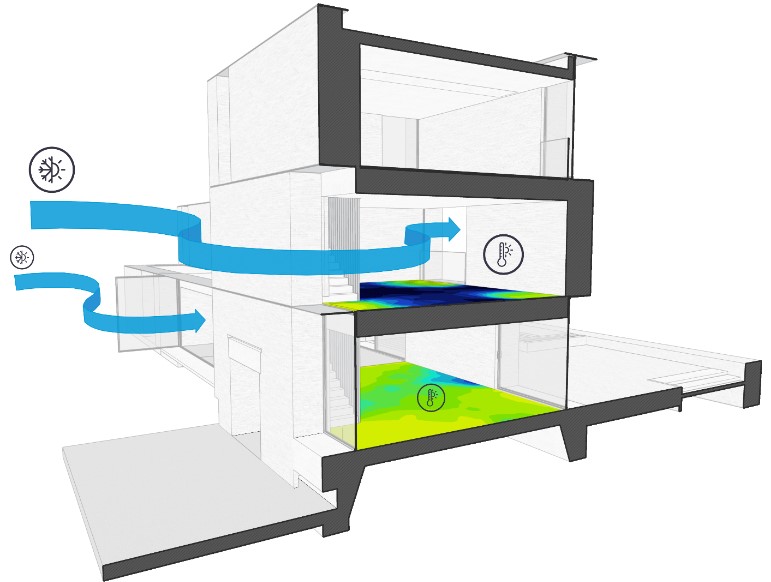
Tools like Sefaira invert that order. They sit inside SketchUp and run rapid energy, daylight, and thermal-comfort simulations as the form changes. The architect can see, in something close to real time, how rotating the building 15 degrees or extending an overhang shifts annual energy use, HVAC load, and daylight autonomy. The simulations are physics-based, not learned, but ML increasingly accelerates the slowest parts of the pipeline (radiance solvers, CFD approximations).
The honest claim here: this doesn’t replace a building physicist on a serious project. What it does is shift the cost of asking “what if” from days to minutes, which means architects ask the question more often. That’s where the carbon savings actually come from — not from one heroic optimisation but from hundreds of small early decisions made with feedback.
For renovation work, the geometry can be captured on-site via lightweight scanning, and the analysis runs on portable hardware. GPU-accelerated solvers and edge inference make this practical even outside the studio — the same pattern we cover in our work on GPU-accelerated computing.
Urban planning as multi-objective optimisation
Regional planning operates at population and infrastructure scale, where systemic interactions dominate. Demographics, traffic, hydrology, climate hazard, infrastructure capacity — none of these reduce to a clean objective function. The planner’s job is to navigate trade-offs that no algorithm can resolve, because the weights themselves are political.
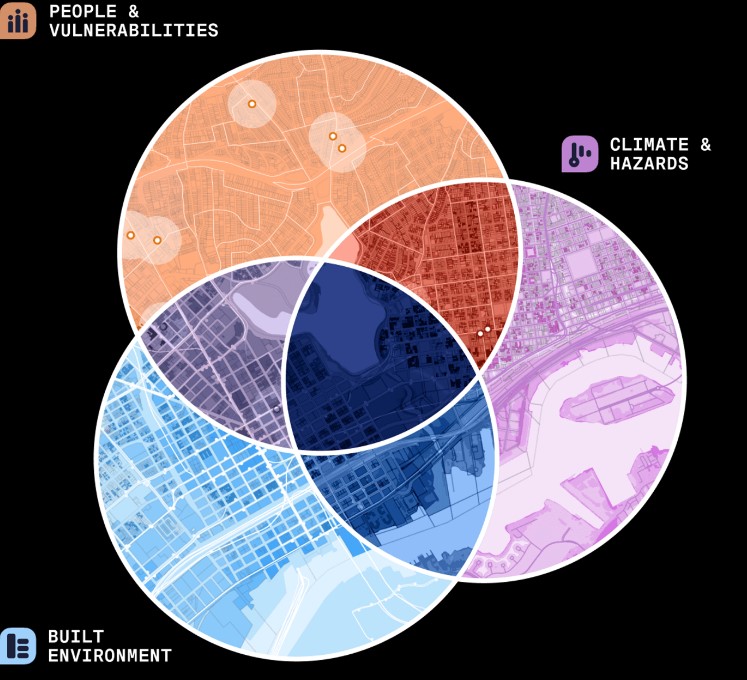
Where AI helps is in the descriptive and predictive layers. Platforms like UrbanFootprint pull GIS data, demographic feeds, and environmental layers into one analytical surface and run scenarios across them. A planning team can ask: if this corridor is upzoned, what does flood exposure look like? If this transit line is added, which neighbourhoods lose what travel time? Which census tracts already carry disproportionate climate-hazard load?
The model doesn’t pick the answer. It makes the trade-off visible. That sounds modest, and it is — but it replaces a previous workflow where each question took weeks of manual GIS work and was therefore asked rarely. When the cost of asking drops, more questions get asked, and the resulting plan tends to be better defended.
Preserving what cannot be rebuilt from drawings
Existing buildings lack the structured, version-controlled digital artifacts standard in contemporary practice. A Romanesque church, an Ottoman bath, a medieval town centre — these exist as physical artefacts whose dimensions, materials, and damage states have to be measured rather than read off drawings. That measurement problem is now mostly a 3D scanning and computer-vision problem.
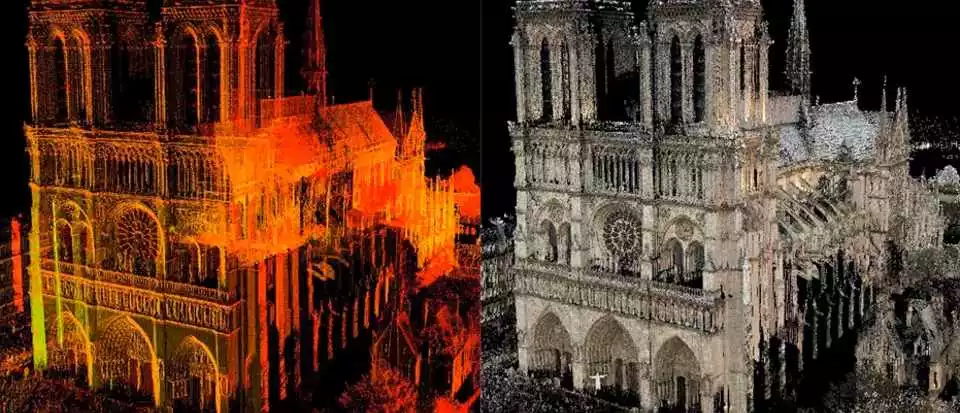
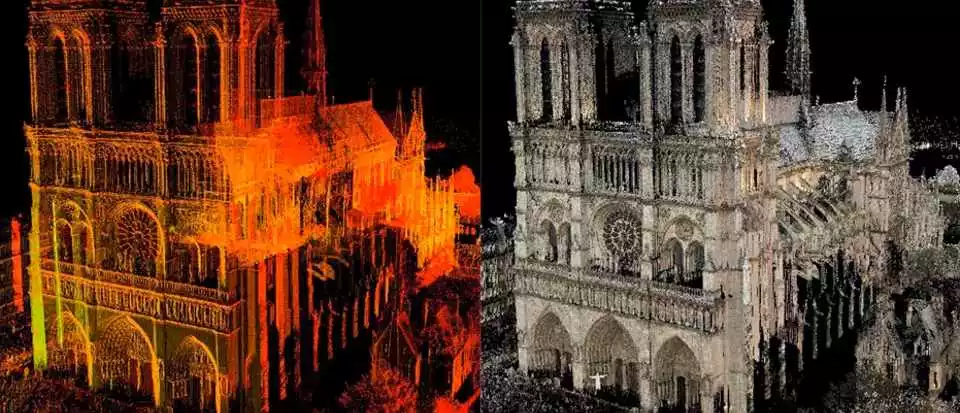
Organisations like CyArk use terrestrial laser scanning and photogrammetry to produce dimensionally accurate 3D models of heritage sites — sub-centimetre point clouds that capture geometry, surface texture, and material condition. The models serve two distinct purposes: digital preservation against loss, and a working substrate for restoration teams.
The Notre-Dame restoration after the 2019 fire is the clearest example. Pre-fire laser scans of the cathedral gave the restoration team accurate geometry for elements that no longer existed in physical form. Without that prior data, the structural reconstruction would have relied on inference from photographs and historical drawings — a much weaker foundation.
A second use, often overlooked: the same scans enable material-ageing studies. By capturing the same surface at intervals over years, conservators can quantify weathering rates, pollution impact, and structural settling. That moves restoration from reactive (fix what is visibly broken) toward predictive (intervene before damage compounds).
What stays human
Whether generating floor plans, enriching information models, running climate simulations, analyzing mobility networks, or scanning heritage sites, neural methods compress iterative loops that previously consumed weeks. AI compresses the cost of search, simulation, and measurement. It does not generate judgement. The architect still chooses which scheme reads well on a difficult site. The planner still negotiates the political weighting of trade-offs. The conservator still decides what authenticity means for a damaged stone wall.
What changes is the texture of the workflow. Questions that used to be expensive — “what if we rotated the massing?”, “what’s the flood exposure under upzoning?”, “how is this lintel weathering?” — become cheap enough to ask routinely. That’s where the real gain sits, and it doesn’t look like the AI hype curve at all.
What we offer
Our engineering work at TechnoLynx powers these applications through GPU-optimized vision pipelines for site reconstruction, bounded generative engines for layout synthesis, and compact inference runtimes for field deployment. Our focus is the part of the problem that needs careful engineering — model selection, data integration, performance on real hardware — not the part that benefits from generic AI marketing. If you have a specific design or planning workflow where you suspect the bottleneck is computational rather than creative, we are happy to look at it with you.
Frequently Asked Questions
How is AI used in architecture today?
Generative layout search, Building Information Modelling analytics, simulation-driven bioclimatic design, GIS-based urban planning scenario analysis, and 3D scanning for heritage preservation represent the five operational domains where architects deploy AI today. In each case the technology compresses the cost of asking a question — search, simulation, or measurement — rather than replacing design judgement.
Does generative design replace architects?
No. Generative design accelerates the combinatorial part of early feasibility work, where constraints are codified and the objective is countable (yield, cost per unit, daylight access). It is weak on qualitative decisions, contextual fit, and detailed design, all of which remain human responsibilities. The architect picks among machine-generated candidates rather than producing them by hand.
What is BIM and how does AI improve it?
Building Information Modelling is a shared 3D project model annotated with materials, schedules, costs, and clash data. AI improves BIM by predicting cost and schedule risk from past projects, continuously scanning for design clashes instead of running batch audits, and surfacing document and approval conflicts before they propagate. The predictive layers work best for repeat-typology developers with enough comparable project history.
How does AI help with sustainable building design?
AI-accelerated simulation tools run energy, daylight, and thermal-comfort analyses as the design evolves, rather than once at the end. That lets architects ask “what if” questions — orientation, shading geometry, glazing ratio — hundreds of times during early massing, when the cheap sustainability moves are still on the table. The carbon savings come from many small informed decisions, not from one heroic optimisation.
Can AI preserve historic buildings?
Yes, primarily by producing dimensionally accurate 3D scans before damage occurs. Terrestrial laser scanning and photogrammetry capture sub-centimetre geometry that becomes the working substrate for restoration if the building is later damaged — the Notre-Dame restoration after the 2019 fire relied directly on pre-fire scans. The same scans, repeated over time, also let conservators quantify weathering and intervene predictively.
Sources Consulted
admin (2022) ‘Using Lasers for Notre Dame Cathedral Cleaning and Restoration after Fire’, Laser Safety Certification, 8 February. (Accessed: 18 August 2024).
- Construction Management Software. Autodesk BIM 360 (no date). (Accessed: 18 August 2024).
- CyArk (no date) CyArk (Accessed: 18 August 2024).
- Energy Efficient Design Software - Green Design - Sefaira. SketchUp (no date). (Accessed: 18 August 2024).
- TestFit Generative Design (no date). (Accessed: 17 August 2024).
- TestFit: Real Estate Feasibility Platform (no date). (Accessed: 17 August 2024).
- UrbanFootprint. The Resilient Decision Intelligence Platform (no date) UrbanFootprint (Accessed: 18 August 2024).
- What is Building Information Modeling (BIM)? Idecad (no date). (Accessed: 18 August 2024).