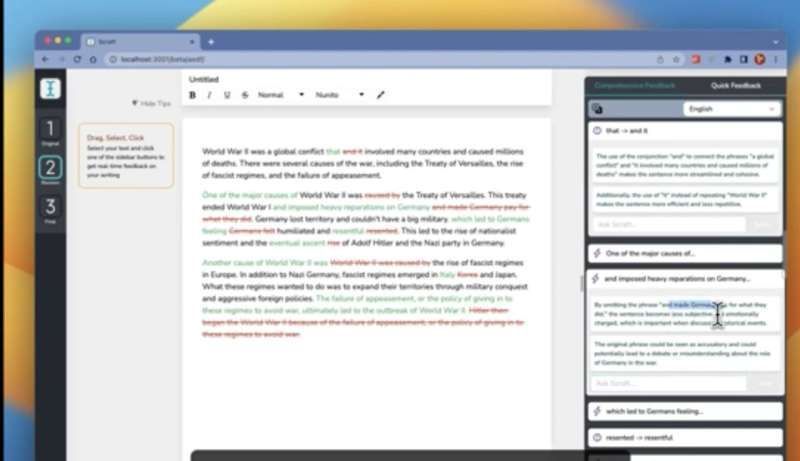
A student submits an essay. The teacher runs it through a detector, the tool flags it as 87% AI-generated (an illustrative figure), and a meeting is scheduled. The problem is that the number means almost nothing. AI detectors do not measure whether a person used a language model — they estimate how statistically “predictable” a piece of text looks, and predictable writing comes from many sources, including non-native speakers, careful editors, and students who write in plain declarative sentences.
That gap between what a tool appears to say and what it can actually support is the recurring story of AI in education right now. The technology is genuinely useful in places. It is also routinely deployed against questions it cannot answer, framed with confidence it has not earned. Sorting one from the other is the whole job.
What Is Education AI, Really?
Under the “education AI” umbrella sit divergent technologies: spaced-repetition algorithms, automated grading, real-time tutoring bots, and campus chatbots. It spans at least four distinct things that get collapsed into one phrase: content generation (drafting lesson plans, quiz items, explanations), adaptive learning systems that adjust difficulty based on a learner’s responses, conversational tutoring that answers questions in natural language, and administrative automation that handles scheduling, grading rubrics, and feedback at scale.
These rest on different technical foundations. Adaptive learning platforms have used statistical models — item-response theory, Bayesian knowledge tracing — for well over a decade and predate the current wave of large language models entirely. The conversational tutor a student talks to today is usually a transformer-based model such as those underlying ChatGPT or open-weight alternatives like Llama, often wrapped with retrieval over a curriculum corpus so the model answers from approved material rather than its own parametric memory. Lumping these together obscures the fact that they fail in different ways and need different evaluation.
When a school says it is “adopting AI,” the first useful question is: which of these four? The answer determines almost everything about whether the deployment will help or quietly create new problems.
Can Teachers Tell if You Used ChatGPT?
When students ask whether detectors work, the evidence-backed response remains uncomfortable: sometimes, with caveats that make enforcement policies fragile. Not reliably, and certainly not without corroborating evidence.
AI text detectors work by measuring properties like perplexity (how surprised a language model is by the next word) and burstiness (variation in sentence structure). Human writing tends to be less uniform; model output tends to be smoother. But these are tendencies, not signatures. The detectors produce false positives on human writing that happens to be clean and structured — which disproportionately flags non-native English writers and students taught to write in a plain, organized style. They also fail to catch lightly edited model output, because a few human revisions push the statistics back toward the human range.
A teacher who knows a student’s prior work, voice, and reasoning can often sense a sudden shift. That is judgment, not detection. The detector score is at best a weak prior that should never, on its own, trigger an academic-integrity case. Treating a probability estimate as evidence is a category error, and it is one of the more damaging patterns we see when institutions adopt tools faster than they build the policy around them.
Can AI Replace Teachers?
Ask instead whether introducing the tool distorts learning objectives or whether it genuinely reduces friction in achieving them.
A language model can explain a concept, generate practice problems, and answer a factual question at any hour. What it cannot do is notice that a quiet student has stopped participating, decide that today’s plan should be abandoned because the room is confused, hold a class accountable to a shared standard, or carry the relationship that makes a struggling learner keep trying. Teaching is mostly the second category. The first category — information delivery and practice generation — is exactly where AI tools are strong, which is why the useful framing is augmentation, not replacement.
The realistic near-term effect is a shift in where teacher time goes. If a tool drafts a first-pass quiz and a feedback template, the teacher spends less time generating material and more time on the parts that require human judgment. Whether that trade lands well depends entirely on implementation: a poorly grounded tutoring bot that confidently states wrong facts creates more correction work than it saves. The technology does not decide this. The deployment does.
Advantages and Disadvantages of AI in Education
Most rollouts involve staged access—faculty pilots, opt-in cohorts, or use cases limited to research and revision rather than graded assessment. It is a set of trade-offs that play out differently for content generation, adaptive systems, and conversational tutoring. The table below is a planning aid, not a verdict — the right column depends on your subject, learner population, and how much review capacity you have.
| Dimension | Where AI helps | Where it fails or backfires |
|---|---|---|
| Content generation | Fast first drafts of lesson plans, quizzes, worked examples; frees teacher time for instruction | Plausible-but-wrong facts (“hallucinations”) slip into material if no expert reviews output |
| Adaptive learning | Adjusts difficulty per learner; surfaces who is struggling and on what | Optimizes for measurable progress, which can quietly narrow learning to what is easy to score |
| Conversational tutoring | 24/7 availability; patient, repeatable explanations; lowers the cost of asking “dumb” questions | Confidently wrong answers; can hand students conclusions instead of building reasoning |
| Accessibility | Real-time captioning, translation, reading support, alt-text generation broaden access | Over-reliance on imperfect translation can mislead learners who cannot check it |
| Assessment / integrity | Faster rubric-based feedback drafts | Detection tools produce false positives; bias against non-native writers |
The pattern across the table is consistent: AI in education is strong at producing and adapting content, and weak wherever a confident output is mistaken for a correct or fair one. Every advantage has a paired failure mode that shows up when the output is trusted without review.
How Is Generative AI Being Applied to Language Learning?
Vocabulary drills and grammar correction have always been automatable, but open-ended conversation practice only became scalable with large language models. A learner can hold a low-stakes conversation in the target language at any time, get corrections, and rephrase — the kind of repetitive, judgment-light practice that is hard to staff with human tutors at scale. We explore this in more depth in our look at generative AI applied to language learning, including where automatic correction helps and where it misleads.
The caveats matter. A model fluent in producing grammatical sentences is not the same as a model that reliably teaches a specific curriculum’s grammar progression, and pronunciation feedback depends on speech recognition that varies in quality across accents and languages. The strongest implementations pair the conversational layer with structured curriculum content rather than letting the model improvise the syllabus.
AI Tools for Teachers and Students
Evaluate tools by their pedagogical function and data privacy stance rather than by brand, since acquisitions and pivots happen faster than procurement cycles. For teachers, the highest-value, lowest-risk uses are first-draft generation (lesson plans, quiz items, rubrics) and feedback scaffolding — always with the teacher as the reviewer of record. For students, retrieval-grounded tutoring (a model answering from the actual course material) is far safer than open-ended chat, because grounding the model in approved content sharply reduces confident fabrication.
A short diagnostic for evaluating any education AI tool:
- What is it grounded in? An open model answering from its training data will fabricate; one retrieving from your curriculum is far more trustworthy.
- Who reviews the output? If the answer is “no one,” the tool is a liability for anything graded or factual.
- What does it do with edge cases? Does it flag uncertainty, or assert wrong answers with the same confidence as right ones?
- What population does it disadvantage? Detection and assessment tools especially tend to misjudge non-native writers and atypical learners.
- Does it narrow or broaden learning? Adaptive systems that optimize a single metric can quietly teach to that metric.
A tool that answers these well is worth piloting. A tool that cannot is worth skipping regardless of how impressive its demo looks.
The Question Worth Holding Onto
Hallucination risk connects education deployments to every domain where models generate consequential outputs—energy dispatch decisions and hospitality recommendations included—a pattern we examine in AI in energy and conversational AI in travel and hospitality, with grounding and verification as the consistent mitigation. The technology is not the deciding factor in education; the design of the review around it is. For a broader view of where automation genuinely lifts learning platforms, see our perspective on how AI is smartening the education industry.
The honest framing is not “will AI transform education” but “which specific task, grounded in what, reviewed by whom.” Every time a school answers those three questions before buying the tool, the deployment tends to help. Every time it skips them — runs the detector, trusts the score, schedules the meeting — the tool creates the problem it was supposed to solve.
FAQ
Can teachers tell if you use ChatGPT?
Not reliably from a detector alone. AI text detectors estimate how statistically predictable writing looks, which produces false positives on clean, structured human writing — and disproportionately flags non-native English writers. A teacher who knows a student’s prior voice can sometimes sense a shift, but that is judgment, not detection, and a detector score should never on its own trigger an integrity case.
Can AI replace teachers?
No. AI tools are strong at information delivery and practice generation — explaining concepts, drafting quizzes, answering factual questions on demand. They cannot notice a disengaged student, abandon a plan because the room is confused, or carry the relationship that keeps a struggling learner trying. The realistic effect is a shift in where teacher time goes, toward the parts that require human judgment.
What is education AI?
It is not one category but at least four: content generation (lesson plans, quizzes), adaptive learning that adjusts difficulty per learner, conversational tutoring in natural language, and administrative automation. These rest on different technical foundations and fail in different ways, so the first useful question about any “AI in education” deployment is which of these it actually is.
What are the main advantages and disadvantages of AI in education?
AI is strong at producing and adapting content — fast first drafts, 24/7 tutoring availability, adaptive difficulty, and accessibility support like captioning and translation. It is weak wherever a confident output is mistaken for a correct or fair one: hallucinated facts in generated material, biased detection tools, and adaptive systems that narrow learning to what is easy to score. Every advantage has a paired failure mode that appears when output is trusted without review.
What AI tools are available for teachers and students?
For teachers, the lowest-risk uses are first-draft generation and feedback scaffolding, always with the teacher as reviewer. For students, retrieval-grounded tutoring — a model answering from the actual course material — is far safer than open-ended chat because grounding sharply reduces fabrication. Evaluate any tool by what it is grounded in, who reviews its output, how it handles uncertainty, and whom it might disadvantage.
How is generative AI being applied to language learning?
Language learning is where generative AI fits most naturally, because conversation practice is the bottleneck and a model lowers it cheaply: learners can hold low-stakes conversations and get corrections at any time. The caveats are that fluent sentence generation is not the same as teaching a specific grammar progression, and pronunciation feedback depends on speech recognition that varies by accent and language. The strongest implementations pair the conversational layer with structured curriculum content.