Where AI is actually changing finance
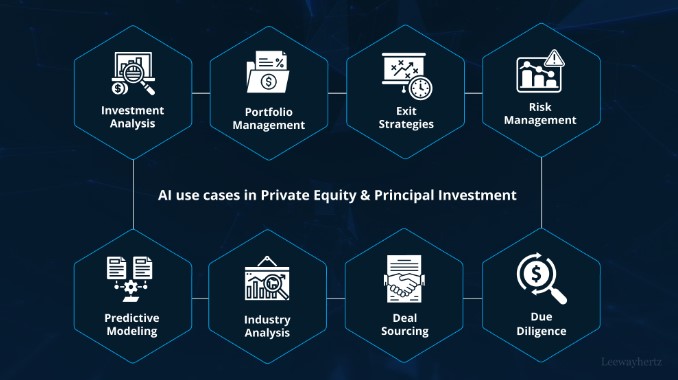
Machine learning in portfolio management enters through a different door: not replacement, but augmentation of judgment with pattern recognition at scale. It is that the operationally relevant work — fraud detection on streaming transactions, document processing for KYC, sub-millisecond execution, personalised advice at scale — is already being done by systems that combine computer vision, large language models, GPU-accelerated inference, and edge compute. The question we get asked most often is not “should we use AI?” but “which of these workloads actually pays for itself, and where does the latency budget come from?”
This article walks through the four technical pillars that matter — computer vision, generative AI, GPU acceleration, and IoT edge computing — and where each genuinely earns its place in a financial stack. It also names the failure modes that get glossed over in vendor decks: bias in credit decisions, opacity in model output, and the gap between simulated and live trading behaviour.
Computer vision: the unglamorous workhorse
What computer vision actually delivers in fintech are fraud-detection systems that scan cheque images, identity verification pipelines that compare documents to selfies, and surveillance tools that watch trading floors for regulatory compliance. It is about three workloads that, run reliably, remove a measurable amount of manual cost and risk.
Surveillance and physical fraud. ATM skimming, tailgating into branch back-offices, and unattended object detection in cash-handling areas are the kinds of events where real-time vision matters. Models built on architectures like YOLO and EfficientDet, deployed on edge devices with TensorRT-optimised inference, can flag anomalous behaviour with the latency a human guard cannot match. We see this pattern regularly in projects that touch computer vision in finance and adjacent retail security work.
Document processing. Invoices, statements, identity documents, and loan applications form a steady stream of structured-but-unstandardised paperwork. OCR has been around for decades; what changed is that transformer-based document understanding models (LayoutLMv3, Donut, and similar) now handle messy real-world layouts well enough to automate the bulk of intake. The win is rarely “no humans needed” — it is “humans only touch the 5% of documents the model is unsure about.”
KYC and AML verification. Identity-document recognition, face matching, liveness detection, and synthetic-identity detection are now a single computer-vision pipeline rather than a chain of point solutions. The interesting engineering problem here is the false-positive rate: too aggressive and you lose customers at onboarding; too permissive and you fail regulatory audits.
Why computer vision pipelines fail in production
The honest answer: lighting, demographic skew in training data, and the gap between benchmark accuracy and live conditions. A KYC model that scores 99.2% on the test set can quietly drop to 94% on customers photographed in low light with older phones (illustrative degradation scenario) — and that four-point gap is the difference between a passing audit and a regulatory enforcement action.
Generative AI: where the productivity actually lands
Generative AI’s real footprint in finance occupies a handful of workflows—draft correspondence, summarise research, prototype SQL—and stops well short of the autonomous analyst some vendors promise.
According to a 2023 Goldman Sachs analysis, generative AI could drive a 7% (approximately $7 trillion) increase in global GDP and lift productivity growth by 1.5 percentage points over a ten-year period (Briggs, 2023). That is a market-direction figure, not an operational benchmark — useful for framing, useless for sizing a specific deployment.
The applications that hold up under scrutiny:
- Customer-service summarisation and routing. LLMs are very good at turning a 4-minute customer call into a structured ticket with the right priority and routing. This is genuinely automatable work, and the failure mode (occasional miscategorisation) is bounded.
- Personalised advisory drafts. Not autonomous advice — drafts that a human advisor reviews. The model handles the writing; the advisor handles the judgement and the compliance exposure.
- Scenario simulation. Generating thousands of plausible portfolio paths for stress testing, anchored to a known macroeconomic model, is exactly the kind of structured generative task LLMs and diffusion models do well.
What does not work as advertised: standalone robo-advisors that promise to replace human judgement, sentiment-trading bots that read Twitter and trade autonomously, and any system whose output cannot be explained to a regulator. The engineering details that matter here — model choice, latency budgets, and audit trails — are what separate production wins from press-release demos.
How does GPU acceleration change the trading stack?
Three separate workloads benefit from GPU acceleration in trading and risk systems, yet vendors and buyers alike treat them as interchangeable, muddying both architecture and procurement.
High-frequency execution. Order-book reconstruction, latency-sensitive feature extraction, and reinforcement-learning policies all benefit from running on GPUs colocated with the exchange. The competitive edge here is measured in microseconds, and the engineering is brutal — NCCL for multi-GPU communication, custom CUDA kernels for tick processing, FPGA fallback paths for the truly latency-critical hops.
Risk and stress testing. Monte Carlo simulations of portfolio behaviour under tail scenarios used to run overnight on CPU clusters. On modern GPUs with frameworks like RAPIDS and CUDA-accelerated linear algebra, the same simulations run in minutes. This changes the operating posture: stress tests become a Tuesday-morning answer rather than a quarterly report.
Fraud detection on streaming transactions. A mid-sized payment processor sees tens of thousands of transactions per second. Running a graph neural network over the full transaction graph in real time was infeasible five years ago; with GPU-accelerated inference and tools like FlashAttention, it is now standard. The model is essentially asking: “does this transaction’s neighbourhood in the payment graph look like a known fraud ring?” Getting the latency budget on that query right — the difference between a colocated single-tenant GPU and a shared inference pool — is the exact scoping question our GPU Performance Audit works through with clients before they commit to a serving pattern.
| Workload | Latency budget | Typical GPU pattern | Failure if you cheap out |
|---|---|---|---|
| HFT execution | Sub-millisecond | Colocated, single-tenant GPU | Strategy bleeds alpha to faster competitors |
| Real-time fraud scoring | 50–200 ms | Shared inference GPU with batching | False positives anger customers; false negatives are losses |
| Overnight stress testing | Hours | GPU cluster, distributed via NCCL | Risk model is stale by the time it ships |
| KYC/AML batch | Minutes per applicant | Single GPU, batched inference | Onboarding queue grows |
IoT edge computing in trading and wealth management
Financial institutions deploy edge computing to co-locate inference with latency-sensitive data streams: tick data at the exchange perimeter, video at the branch, biometrics on the client handset.
The cases where edge actually wins:
- Market-data feature extraction. Computing rolling-window features on raw tick data at the colocation site, rather than shipping ticks to a central datacentre, saves the round-trip latency.
- On-device portfolio monitoring. Running a small recommendation model on a wealth client’s phone, with only deltas synced to the server, preserves privacy and keeps the experience snappy.
- Anomaly detection on trading infrastructure. Predicting hardware failure on a colocated trading server before it costs you a session is a classic edge-AI use case.
NLP and the noisy market
NLP delivers value in finance through document summarisation of earnings transcripts and filings, event extraction from news and regulatory text, and sentiment scoring rigorous enough to function as alpha rather than anecdote.
What it does not reliably do: trade on social-media sentiment in any way that survives a real bear market. The 2023 generative-AI market for fintech is projected to grow at a CAGR of 22.5% through 2032, reaching roughly $6.26 billion (Mehta, 2023) — but again, that is market-direction framing. The operationally relevant question is whether your specific NLP pipeline has a measurable Sharpe contribution after fees, and the honest answer in most cases is “marginal, but useful when combined with other signals.”
The challenges nobody puts in the pitch deck
Bias in credit and underwriting. Historical lending records encode historical discrimination; models trained on that data replicate it. The fix is not “more data” — it is explicit fairness constraints and post-hoc auditing against protected classes. Regulators in the EU (under GDPR and the AI Act) and the US (under fair-lending statutes) are increasingly looking for evidence of this work.
Explainability and the regulatory floor. A deep model that denies a loan must be able to explain why. SHAP values, counterfactual explanations, and model cards are the current state of practice. None of them are perfect; all of them are better than “the algorithm said no.”
The simulation-to-live gap. Trading strategies that look fantastic in backtest behave differently in production because of slippage, market impact, and the fact that your own orders move the price. The engineering discipline here is sequential, walk-forward validation with realistic execution models — not pretty equity curves.
Concentration risk in vendor models. If everyone in the industry is fine-tuning the same foundation model on the same financial data, the failure modes correlate. This is a real systemic concern that the industry has not seriously priced in.
How TechnoLynx approaches financial AI
We begin every engagement by mapping workload requirements before naming technologies. What is the actual decision the model needs to make? What is the latency budget? What is the cost of a false positive versus a false negative? What does the auditor need to see?
From there we choose the stack: TensorRT and CUDA for latency-critical inference, PyTorch and ONNX Runtime for the model-development loop, Kubernetes for orchestrating the non-latency-critical workloads, and increasingly Triton Inference Server for serving heterogeneous model graphs. We treat explainability as a requirement, not a nice-to-have, and we treat the bias audit as part of the acceptance test.
In our experience across financial engagements, the projects that succeed are not the ones with the most sophisticated models. They are the ones where the model’s role in the larger decision pipeline is clearly defined, where the human-in-the-loop boundary is explicit, and where the monitoring is designed from day one to catch drift before it causes a loss.
Where this leaves the original question
Can algorithmic trading and credit optimisation generate sustainable wealth, or do they simply redistribute alpha within an efficient frontier? Not on their own. But a well-engineered AI stack will let a fintech business move faster on fraud, onboard customers with less friction, execute trades with tighter risk control, and serve clients with advice that is genuinely personalised rather than generically templated. Those are real outcomes — and they compound.
The interesting failure mode to watch is not the science-fiction one where AI runs the markets. It is the much more mundane one where institutions deploy models they cannot explain, cannot audit, and cannot fix when they drift. The work that pays off is the work that takes those risks seriously from the first sprint.
Frequently Asked Questions
What are the main applications of AI in fintech?
The applications that consistently earn their place are fraud detection on streaming transactions, KYC and AML verification, document processing, GPU-accelerated trade execution and risk simulation, and LLM-assisted customer service and advisory workflows. The common thread is that each replaces a measurable cost or risk with a system that can be monitored and audited.
How does GPU acceleration improve trading systems?
GPUs compress the latency budget for three distinct workloads: sub-millisecond execution decisions at colocation sites, real-time fraud scoring on the transaction graph, and overnight-to-minutes compression of Monte Carlo risk simulations. The architectural choices differ for each — colocated single-tenant GPUs for execution, shared inference GPUs with batching for fraud, distributed clusters for risk.
Is AI safe for managing investment portfolios?
It is safe when treated as a tool within a human-supervised pipeline, with explicit fairness constraints, monitored drift, and explainable outputs. It is not safe as a standalone autonomous decision-maker — the simulation-to-live gap, vendor-model concentration risk, and regulatory exposure all argue for keeping humans in the loop on consequential decisions.
What are the ethical concerns with AI in finance?
The serious ones are bias in credit and underwriting decisions, opacity in models that affect customer outcomes, data privacy under regimes like GDPR, and the systemic risk that comes from many institutions running similar models on similar data. Responsible deployment treats these as engineering requirements rather than PR talking points.
References
Briggs, J. (2023, April 5). Generative AI could raise global GDP by 7% (a directional industry-scale figure per Goldman Sachs analysis). Goldman Sachs.
Mehta, N. (2023, December 22). Generative AI in Fintech: Game-changer for finance revolution. Techtic Solutions.
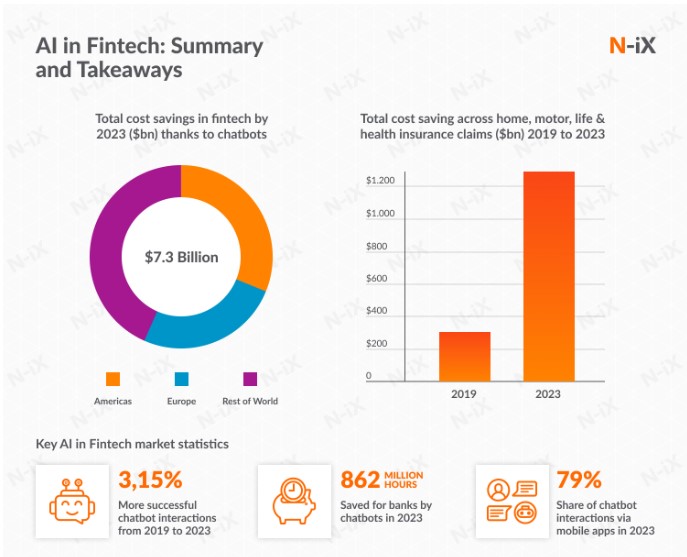
Tymchuk, I. (2021, December 23). AI in fintech: Get ready for a massive shift in financial service. N-iX.
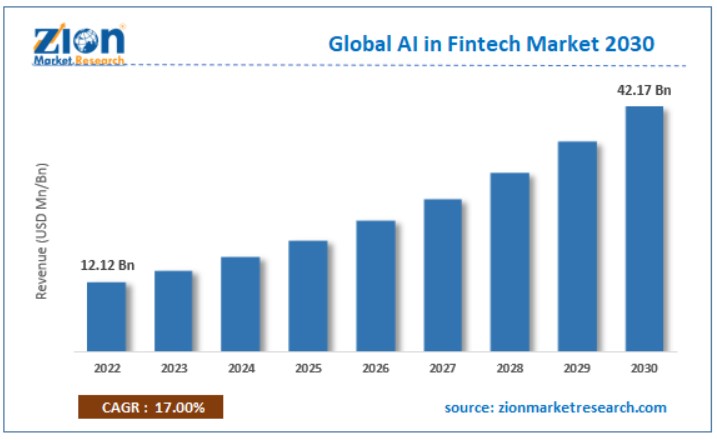
Zion Market Research. (2023, December 4). AI in Fintech market size, share, Growth & Trends 2030.