
Picture a customer holding their phone up to a mirror, sweeping through ten lipstick shades in thirty seconds, then ordering the one that actually matches their skin tone — without ever opening a tube. That is the everyday face of AI in fashion and beauty. According to Statista’s 2022 published-survey on artificial intelligence in the global fashion market, the segment was worth roughly $270 million in 2020 and is projected to reach about $4.4 billion by 2027 — a directional industry-scale figure, not an operational benchmark for any single retailer.
The shift goes beyond marketing gloss. Computer vision, generative models, GPU-accelerated inference, edge computing, and natural language processing are now stitched together into recommendation engines, try-on apps, sizing tools, and design pipelines. We see this pattern regularly when retailers move from rule-based personalisation to model-driven systems: the failure mode is rarely the model itself. It is the gap between what a demo can show and what production traffic actually does.
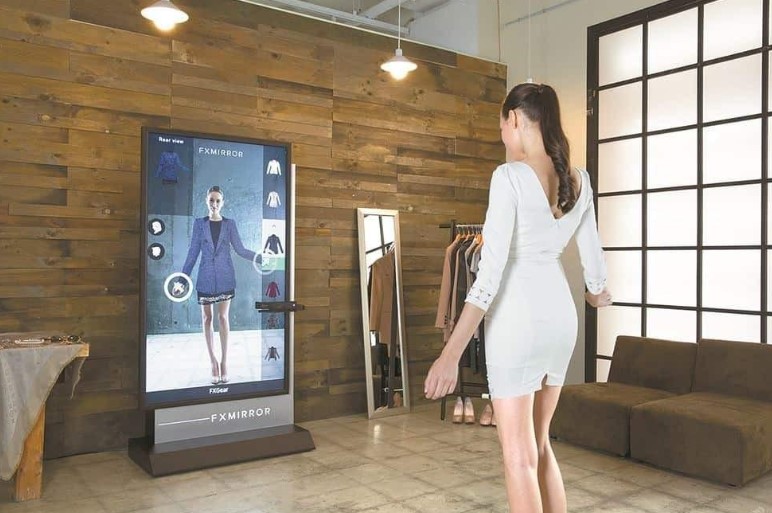
What Is a Virtual Try-On Actually Doing?
A virtual try-on is not “filtering your face.” It is a chained inference pipeline: face landmarks, segmentation, colour-space estimation, shader-level overlay, and frame compositing — all running fast enough to feel real-time on a mid-range smartphone.
The pipeline typically unfolds in five stages:
- Facial detection and analysis. A computer vision model locates landmarks (eyes, lips, jawline) and segments skin regions on every frame.
- Tone matching and product recommendation. Generative AI trained on diverse skin-tone datasets ranks shades against the user’s detected complexion.
- Virtual makeup application. A renderer composites the chosen product onto the segmented region, adjusting for lighting and texture so the overlay does not look pasted on.
- Real-time rendering. GPU acceleration — on-device where possible, server-side otherwise — keeps the loop under the latency that triggers a “this feels laggy” perception (roughly 100 ms per frame).
- Immersive visualisation. AR layers the result back into the live camera feed; VR/XR variants give a 360° view for higher-ticket items.
L’Oréal’s virtual try-on demonstrates the fusion of these layers in production, and Sephora’s Virtual Artist platform is the most cited operational outcome: as reported in the Glimpse Group case study, Sephora attributes a 35% increase in online make-up sales to its virtual try-on experience — a single-vendor, single-channel measurement, not a category-wide benchmark.
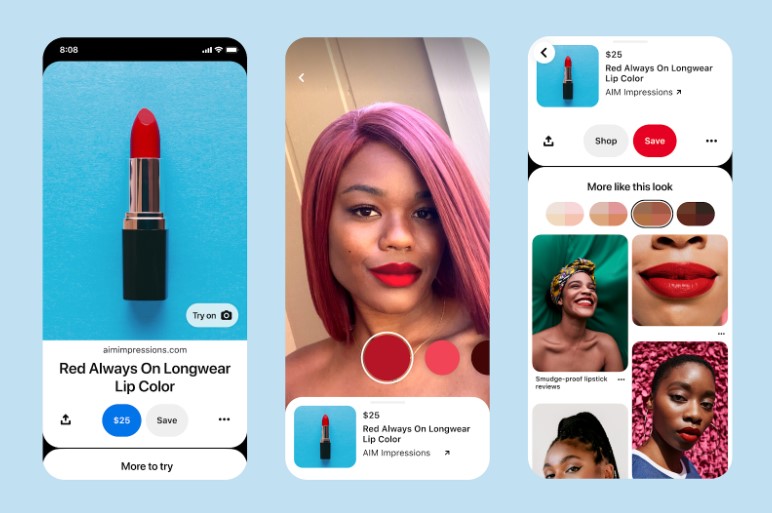
Personalised Fashion Recommendations Without the Theatre
“Recommendation engine” is one of the most overused phrases in retail.
| Component | What it actually does | Where it tends to fail |
|---|---|---|
| NLP on reviews & search | Extracts preferred styles, colours, fits from free text | Sparse data for new users; sarcasm and negation |
| Generative re-ranking | Produces shortlists tuned to budget, size, season | Hallucinated attributes; out-of-stock items |
| Collaborative filtering | Surfaces “people like you also bought…” | Cold-start; popularity bias |
| GPU-accelerated inference | Keeps the ranking under ~50 ms per request | Cost runaway at peak traffic |
| IoT edge processing | Trims latency by processing on-device or at network edge | Model size constraints; sync drift |
Edge computing matters more than it sounds. When a customer interacts with an online fashion retailer — browsing, swiping, abandoning a cart — the response window for an in-session nudge is short. Sending every event to a central server, scoring, and returning a recommendation is workable, but on flaky mobile networks the lag is visible. In our experience, the retailers who keep session-conversion engagement high are the ones who pushed at least the candidate-generation step closer to the device.
This is one of those areas where the published-survey numbers should be read carefully. Deloitte’s 2019 consumer review on mass personalisation is widely cited, but it pre-dates the generative-AI wave by several years. The directional claim — that consumers respond to personalisation — has held up; the specific percentages have not.
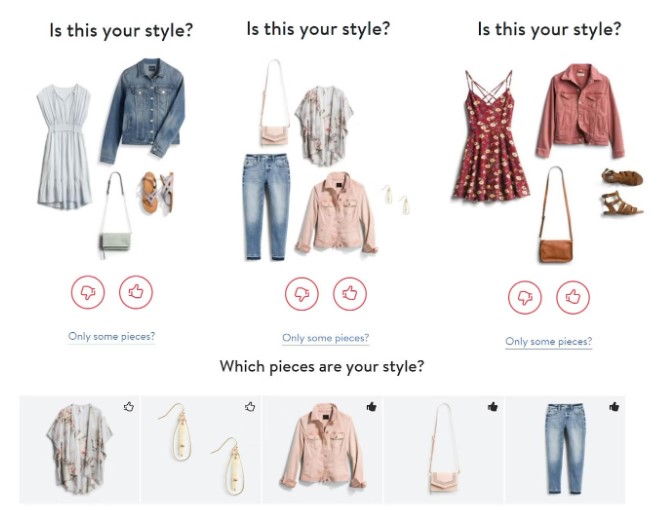
Trend Forecasting: Less Crystal Ball, More Signal Aggregation
Trend forecasting used to be a designer-led practice supported by trade publications and travel. AI does not replace that judgement — it gives the judgement more raw material to work with.
The forecasting stack we typically see deployed runs four overlapping passes:
- Data analytics across heterogeneous sources. Social platforms, runway coverage, historical sales, search-trend exports, and editorial feeds are pulled into a common schema. The output is a set of frequency and momentum signals per attribute (silhouette, palette, fabric, motif).
- Text analysis with NLP. Customer reviews, hashtag clusters, and editorial copy are mined for sentiment and emerging vocabulary. This is where new descriptors (“quiet luxury”, “cottagecore”) get flagged before they appear in retail copy.
- Generative concept synthesis. Once trained on attribute frequencies and brand-style embeddings, generative models propose moodboards and design variations conditioned on a target season and price tier. The output is a starting point for a human designer, not a finished collection.
- GPU acceleration for iteration speed. A designer who can generate, filter, and refine 200 variants in an afternoon is operating at a different tempo from one who can generate 20.
The honest framing here is that this is observed-pattern work, not benchmarked science. Predicting that a colour will trend is not the same as predicting a stock price; the feedback loop is slower and the ground truth is fuzzier. Treat AI trend output as a hypothesis-generator that the design team interrogates, not as an oracle.
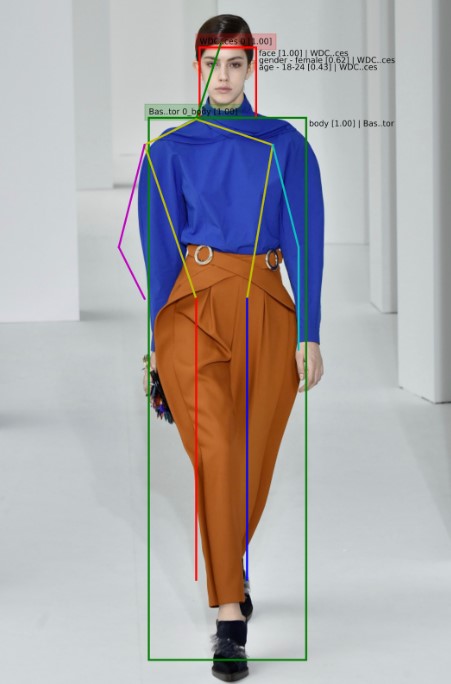
Custom Fit and Tailoring at Scale
Return rates in online apparel sit stubbornly between 25–40% across the industry — a directional industry-scale figure widely cited in retail analyst reports, not an operational benchmark. A material share of that is fit-driven, which is why “measure the customer, not the garment” has become an explicit design goal.
The pipeline reads as follows:
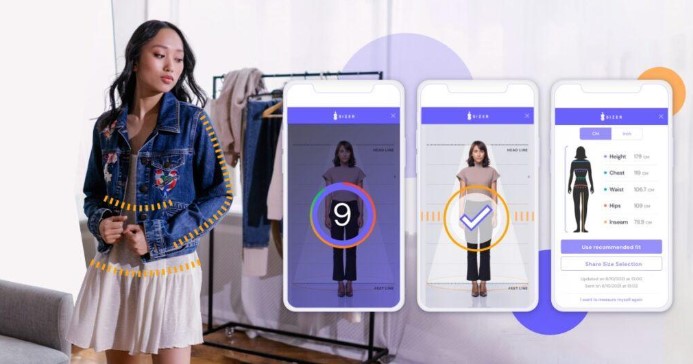
- Body measurement via computer vision. Two or three smartphone photos, captured against a known reference object, are enough for a modern model to estimate chest, waist, hip, inseam, and sleeve length within a few millimetres for most body types. Edge cases (loose clothing, unusual lighting, accessibility needs) still degrade accuracy.
- Local processing with edge computing. Body measurement data is sensitive. Doing the inference on-device — or at least within the retailer’s network boundary — sidesteps a class of privacy issues that arise when raw body images leave the user’s phone.
- Generative pattern adjustment. Once measurements are in, generative models adjust base patterns rather than designing from scratch. This is more reliable than free-form generation and easier to integrate into existing pattern-making workflows.
The structural distinction worth noting: AI tailoring is most effective when it is bounded — adjusting a known garment to a known body — and least effective when asked to invent both at once.
Fashion Image Recognition and Tagging
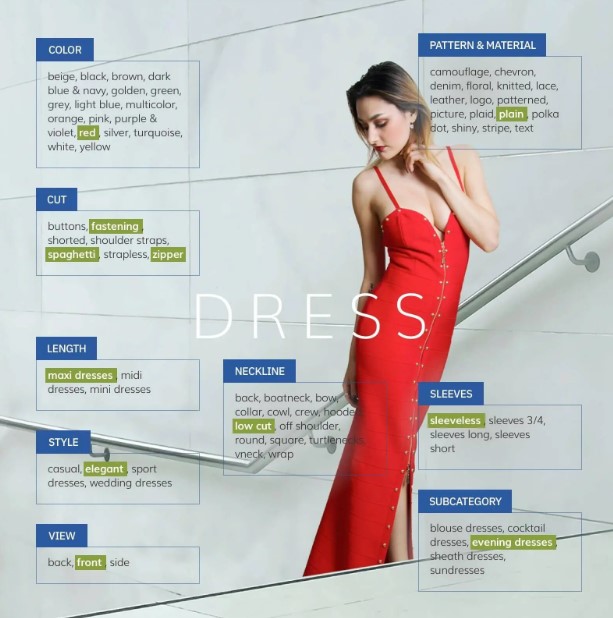
Visual search — “find me something like this picture” — is one of the cleanest applied-AI wins in fashion. Pinterest Lens popularised the consumer surface; behind it sits a tagging pipeline that retailers run on their own catalogues to make them searchable in ways manual taxonomy never could.
The pipeline:
- Image recognition with computer vision. Garment-type detection (dress, shoe, jacket) plus attribute extraction (sleeve length, neckline, colour, pattern) runs across the catalogue.
- NLP on accompanying text. Captions, product descriptions, and user-generated comments are mined for additional attributes the image alone cannot reveal (fabric composition, care instructions, brand collaborations).
- Metadata generation. The combined vision-and-text output produces a richer tag set than either source alone — and one that is consistent across thousands of products.
- Search and discovery. The tags become the substrate for visual search, “similar items” carousels, and personalised feeds.
- Feedback loops. Click-through and dwell-time signals refine the tagging models over time, so the catalogue gets better at describing itself.
The failure mode here is over-tagging. A garment with forty attributes attached is harder to retrieve well than one with twelve carefully chosen ones. We pay close attention to attribute pruning when we build these pipelines — more tags is not more signal.
Where AI in Fashion Genuinely Struggles
Five integration challenges show up across nearly every fashion and beauty AI engagement:
- Data privacy and regulatory compliance. Face images, body measurements, and purchase history are all sensitive under GDPR and equivalent frameworks. The architecture decisions (on-device vs. cloud, retention windows, consent flows) matter more than the model architecture.
- Integration with legacy systems. Most fashion retailers run on a patchwork of PIM, OMS, and e-commerce platforms that were not designed with model-serving in mind. The integration work usually dwarfs the model work.
- Skills gap and workforce readiness. Designers and merchandisers do not need to become ML engineers, but they do need enough literacy to interrogate model output rather than rubber-stamp it.
- Per-use-case quality bars. “Good enough” for trend forecasting is very different from “good enough” for a virtual try-on shown to a paying customer. Each use case needs its own quality gate, and shared infrastructure does not mean shared acceptance criteria.
- Cost of inference at scale. GPU-accelerated rendering and generative inference are not free. The retailers who run these systems sustainably have explicit unit-economics dashboards tied to model usage.
How Does TechnoLynx Approach Fashion and Beauty AI?
Our work with retailers and brands centres on stack components that demand custom engineering: virtual try-on pipelines, computer-vision-based measurement, image-tagging infrastructure, and the GPU-acceleration plumbing underneath. Our R&D engagements with outcome ownership pair our team with the client’s existing platform and design organisation, so the AI work lands inside the workflows people already use.
Concretely, that tends to mean: scoping the use case against measurable outcomes (conversion lift, return-rate reduction, time-to-first-design), designing for the privacy and latency constraints up front, and instrumenting the system so model drift is visible before it affects customers.
Frequently Asked Questions
How is AI used in the fashion industry?
Virtual try-ons, personalised product recommendations, trend forecasting, custom tailoring, and image recognition for visual search and catalogue tagging now define fashion’s digital transformation. The common thread is computer vision plus generative models, accelerated by GPUs and — increasingly — pushed to edge devices for latency and privacy reasons.
Does AI actually reduce returns in online fashion and beauty?
Yes, in well-scoped deployments. Sephora reports a 35% increase in online make-up sales tied to its virtual try-on experience as reported in a single-vendor case study, not a category benchmark. Fit-driven returns in apparel are harder to move with AI alone — they need the measurement and tailoring layer working together, not just a recommendation engine.
Is AI replacing fashion designers?
No. Generative AI proposes variations and aggregates signals; it does not replace the editorial judgement that gives a collection coherence. The pattern we see is augmentation: a designer iterates through more variants per day with AI support than without it, but the curation and brand-fit calls remain human.
What are the main risks of deploying AI in fashion and beauty?
Three stand out: data privacy (face and body data are highly sensitive under GDPR), integration cost into legacy retail systems, and over-confidence in generative output that has not been validated against real user behaviour. Each of these is an engineering and governance question, not a model-architecture question.
References
- Deloitte (2019). The Deloitte Consumer Review — Made-to-order: The rise of mass personalisation.
- IBM Newsroom. Data Suggests Growth in Enterprise Adoption of AI is Due to Widespread Deployment by Early Adopters.
- PwC (2018). Global Artificial Intelligence Study: Sizing the prize.
- Salesforce. It’s Personal, and It’s Business: Using Retail Personalization to Connect with Customers.
- The Glimpse Group. Sephora Increases Online Make-up Sales by 35% with Virtual Try-on Experience (case study) — as reported in vendor case study.
- Statista. Artificial intelligence in the global fashion market value 2027.