Introduction
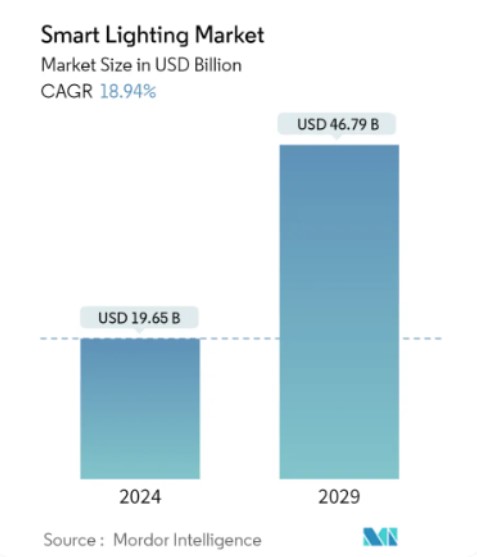
Few recognize that lighting infrastructure has evolved into a high‑resolution sensing substrate throughout commercial buildings. What used to be a wall switch is now a presence-aware control loop — one that decides brightness, colour temperature, and timing from occupancy data, ambient light, and user preference. Industry trackers (Mordor Intelligence, 2023) project the global smart lighting market to reach roughly $46.79 billion by 2029 at a CAGR near 19% from 2024–2029, a market-direction figure that frames demand but is not an operational benchmark.
The interesting shift is not the LED itself — it is what sits behind it. AI models adjust light levels, colours, and switching patterns in response to behaviour and environment, and they do so in real time. Across our engagements we see the same recurring architecture: a computer-vision or sensor layer for perception, an edge inference layer for low-latency response, and a thin cloud layer for fleet management. This article walks through the AI techniques that make that architecture work, where it pays off, and where it breaks.
How Does Computer Vision Drive Smart Lighting?
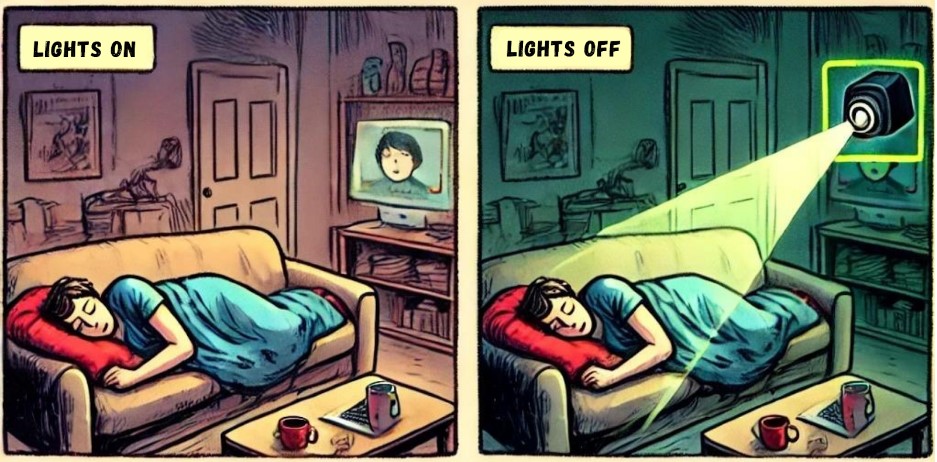
Motion sensors tell you something moved. Computer vision tells you what is happening. That distinction is what separates a hallway PIR from a system that knows the difference between someone walking through a room and someone settling on a sofa to watch a film.
In residential and hospitality settings, vision-driven lighting can lower brightness when a person reclines, hold a colour temperature steady during reading, and shift to a warmer band as the evening progresses. In retail and entertainment, the same perception stack drives interactive displays that respond to movement. None of this requires exotic hardware — a modest embedded camera plus an on-device classifier is enough for the common cases.
The industrial use is less glamorous but more measurable. In automated warehouses, vision systems adjust both lighting and focus to read package labels on moving conveyors. Sorting accuracy depends directly on illumination quality, and a closed loop between the camera and the lighting controller eliminates the worst failure mode: an underexposed frame that defeats the OCR or classifier downstream. This is an observed pattern across the vision deployments we have worked on — the gains come from removing variance, not from raising peak brightness.
Generative AI in Cinematography and Post-Production
Low-light cinematography is one of the harder problems in image processing. Footage shot in dim conditions tends to be noisy, low-contrast, and starved of detail in shadow regions. Generative AI is increasingly part of the post-production toolchain that recovers usable footage from those takes.
The models in this space — diffusion-based denoisers, transformer-driven inpainters, learned tone mappers — are trained on large, varied video corpora and learn the statistical shape of natural lighting. Applied to a graded scene, they can lift shadow detail, suppress sensor noise, and reconstruct texture without the plasticky look that older sharpeners produced. The practical benefit is fewer reshoots and a tighter editing loop, particularly on productions where the schedule does not permit returning to the location.
The caveat matters: these are generative edits, and they introduce content that was not in the original frame. Used carefully — as a recovery tool rather than a creative shortcut — they preserve the cinematographer’s intent. Used carelessly, they invent texture and erode the truthfulness of the footage. Treating the output as a draft that a colourist reviews, rather than as a finished pass, is the discipline that keeps the workflow honest.
Why GPU Acceleration Matters for Real-Time Lighting
Smart lighting at scale is a streaming-data problem. A single venue can carry hundreds of cameras and thousands of fixtures, each producing or consuming control signals at video frame rates. GPU acceleration is what keeps that loop tight enough to feel instantaneous. Frameworks such as CUDA, TensorRT, and ONNX Runtime — running on NVIDIA Jetson-class edge devices or rack-mounted accelerators — handle the inference workloads that CPUs cannot serve in time.
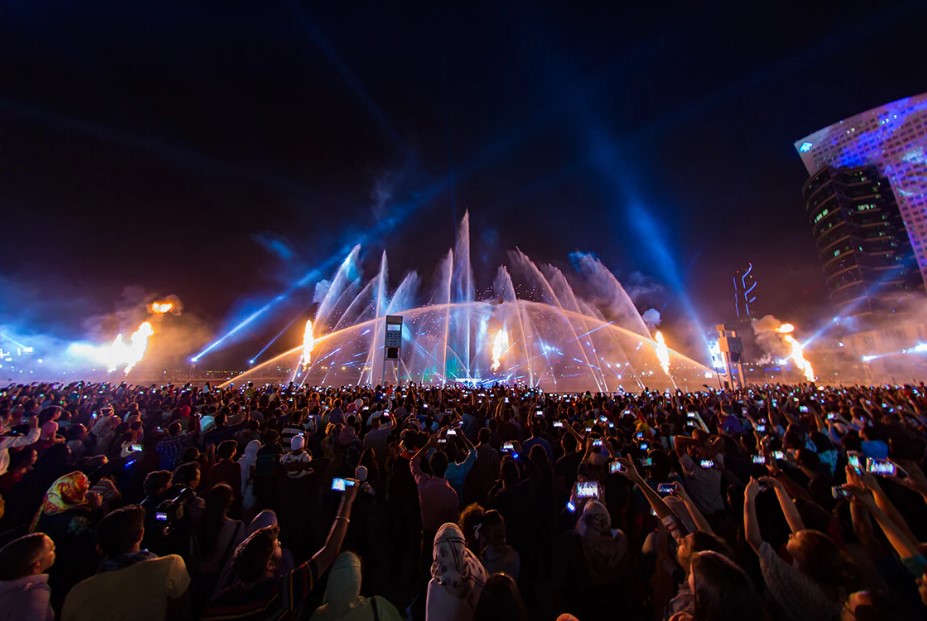
Large-scale light shows are the visible end of this. The IMAGINE installation at Dubai Festival City coordinates lasers, projection, and synchronised lighting across a façade, and the choreography is computed and re-rendered continuously. The same kind of pipeline drives the visual displays we have worked on for events and architectural installations.
The less visible end is where most of the value sits. In commercial buildings and factories, GPU-accelerated inference handles security camera analytics, product-quality inspection, and equipment monitoring on the same compute fabric that drives the lighting controller. Consolidating these workloads onto shared accelerators — rather than scattering them across embedded boards — reduces both latency and operational overhead.
Smart Lighting at the Edge: IoT Edge Computing
Lighting telemetry is bulky and sensitive. Sending occupancy footage, brightness readings, and user-preference data to the cloud for every adjustment is wasteful on bandwidth and uncomfortable on privacy. IoT edge computing addresses both problems by running the analytics on the fixture or on a nearby gateway.
A typical edge-driven setup looks like this:
| Layer | What it does | Where it runs |
|---|---|---|
| Sensing | Occupancy, ambient lux, user input | Embedded sensor in fixture |
| Inference | Presence classification, preference matching | Edge gateway or Jetson-class device |
| Actuation | Dim, switch, colour-shift commands | Lighting controller (DALI / Zigbee / Matter) |
| Fleet management | Firmware, telemetry roll-up, alerting | Cloud |
The split matters: identity-sensitive features (who is in the room, what they are doing) stay local; only aggregate telemetry leaves the building. Vendor case studies (Qualcomm / Juganu, 2021) report energy reductions on the order of 60% for retrofit projects — a published-survey figure tied to specific deployments rather than a universal guarantee.
In Mexico City, edge-driven smart lighting in parks and transit corridors has been linked to improved perceived safety and lower energy spend. The same architecture also gives facility managers remote diagnostics — a failing ballast or drifting colour temperature can be flagged before it becomes a maintenance call.
Voice-Activated Smart Lighting Systems
Natural Language Processing (NLP) — a part of the same family of techniques that powers generative AI assistants — is what makes lights respond to spoken commands. Modern voice front-ends handle wake-word detection on-device, then route the parsed intent to a lighting controller through standard smart-home protocols.
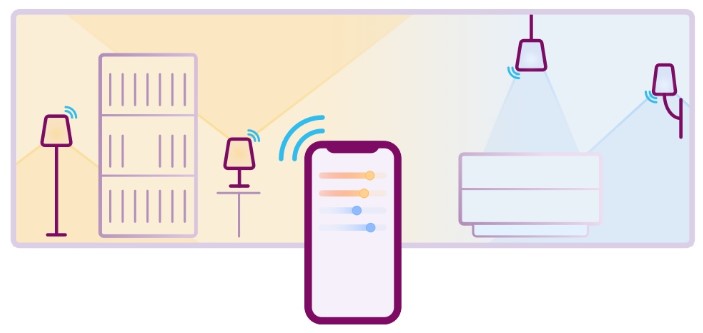
Amazon Alexa, Google Assistant, and Apple HomeKit all expose stable interfaces for lighting control, and most contemporary fixtures speak at least one of them. The interaction is more useful than the demo videos suggest: hands-free control is genuinely valuable for accessibility, for kitchens where hands are occupied, and for spaces where wall switches are inconvenient. The integration is also where the architecture gets messy — voice latency, network reliability, and the failure modes of cloud-tethered assistants all show up in user experience, and a well-designed system degrades gracefully when the cloud link drops.
Immersive Lighting Experiences with AR/VR
Lighting is the single biggest contributor to perceived realism in virtual scenes. Real-time ray tracing, neural radiance fields, and learned global-illumination approximations are what make the current generation of AR/VR experiences feel grounded rather than synthetic.
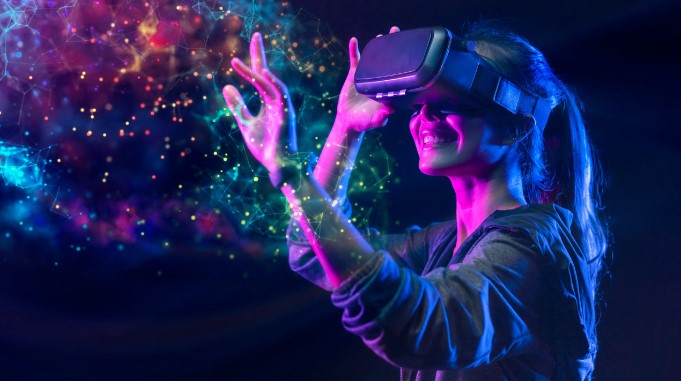
In gaming and entertainment, the payoff is immersion — light behaves the way the eye expects, and the suspension of disbelief holds. In industrial training, the payoff is transfer: a simulation that reproduces the lighting of an actual control room or warehouse trains operators for the real environment rather than for an idealised one. We see this matter most in safety-critical training, where readability of warning indicators under realistic lighting conditions is part of the skill being practised.
Benefits of AI-Powered Smart Lighting
Four benefit categories show up consistently across the deployments we have seen:
- Energy efficiency. Brightness and switching track occupancy and ambient light rather than a fixed schedule. Reported reductions vary widely by site (15–60% range, published-survey class), and the realistic operational pattern is closer to the lower end once you account for retrofit constraints.
- Workplace health. Lighting affects fatigue, headache frequency, and screen-reading comfort. UK NHS-linked figures cite roughly 86 million workdays lost annually to migraine — a published-survey statistic that frames the cost rather than measures a lighting intervention directly.
- Sustainability. LED hardware combined with adaptive control reduces both energy draw and lamp replacement cycles. The carbon impact is real but project-specific.
- Personalisation. Per-user colour temperature, scene presets, and circadian-aligned schedules are now table-stakes in higher-end installations.
Demonstration of a personalised smart light system with a colour-changing bulb | Source: Pinterest
The pattern across these benefits is consistent: the gains come from removing waste rather than from adding capability. A fixture that turns off correctly is worth more than one that produces an extra colour.
What Are the Challenges of AI-Powered Lighting?
The harder problems are not technical capability — they are integration, privacy, and operational discipline.
- Privacy. Camera-based occupancy detection raises legitimate concerns. Edge processing helps, but the policy and disclosure work has to be done explicitly, not assumed.
- Installation cost and retrofit constraints. New construction is straightforward. Retrofits into existing wiring, control protocols (DALI, KNX, 0–10V), and building management systems are where projects stall.
- Hardware compatibility. The smart-home ecosystem has fragmented across protocols; Matter is consolidating it, but slowly. Specifying a system that survives a five-year refresh cycle requires conservative choices.
- Model bias and drift. A vision model trained on one demographic of users, or on one lighting condition, will misclassify in others. We pay close attention to this in our deployments — bias is rarely visible in the lab and almost always visible in the field.
What We Can Offer as TechnoLynx
At TechnoLynx we build production AI systems across computer vision, generative AI, GPU acceleration, IoT edge computing, NLP, and AR/VR. Smart lighting sits at the intersection of several of these, which is why we treat it as a systems problem rather than a feature problem. Our engagements typically cover the perception layer, the edge inference stack, the integration into existing building or venue infrastructure, and the operational tooling that keeps the system reliable after handover.
We do not sell off-the-shelf lighting products. We work with teams that have a specific operational problem — a retail environment that needs adaptive illumination, a warehouse that needs vision-driven sorting, a venue that needs synchronised effects — and we build the inference and integration layer that makes it run. If that matches what you are looking at, let’s talk.
Conclusion
AI-powered smart lighting is less a single product category than a stack of techniques — vision for perception, edge inference for latency, generative models for content, NLP for interaction — assembled into a control loop that responds to its environment. The hard parts are integration, privacy, and the discipline to specify systems that survive a refresh cycle. The easy part, finally, is the lighting itself.
Frequently Asked Questions
How does AI improve smart lighting compared to motion-sensor systems?
Motion sensors detect change; AI-driven systems classify context. A vision model can distinguish reading from sleeping, or an occupied workspace from an empty one, and adjust brightness, colour temperature, and switching accordingly. The practical gain is fewer false triggers and better alignment with what the occupant actually wants.
Where does the AI computation actually run in a smart lighting system?
Most production deployments split the workload: lightweight perception runs on the fixture or a nearby edge gateway (Jetson-class devices, embedded NPUs), and fleet-management telemetry rolls up to the cloud. Keeping inference local cuts latency to under ~100 ms (a rule of thumb for on-device inference) and limits how much sensitive data leaves the building.
Is camera-based smart lighting a privacy risk?
It can be, and the answer depends on architecture. Systems that send video to the cloud are a meaningful risk. Systems that run the vision model on-device and emit only abstracted signals (occupancy count, activity class) are substantially safer. The policy and disclosure work has to be done explicitly — privacy by architecture, not by promise.
What protocols and standards should a smart lighting deployment standardise on?
For new construction, Matter over Thread or Wi-Fi is the consolidating standard and the safest bet for a five-year horizon. For commercial retrofits, DALI-2 remains the workhorse for fixture-level control, with KNX or BACnet for building-management integration. Specifying a hybrid that exposes a clean API surface to the inference layer is the durable choice.
Sources for the images
- Adatis (2023) Virtual Reality
- Dubai Festival City Mall (n.d.) Laser Show in Dubai
- Mordor Intelligence (2023) Smart Lighting Market.
- Philips (n.d.) Voice Controlled Smart Lights.
- Pinterest (n.d.) The Best Smart LED Light Bulbs
- Qualcomm (2021) Smart Lighting in Mexico City
Sources Consulted
- Kinney, S. (2021) Intelligent Lighting Brings Machine Vision to New Heights. Photonics Spectra
- Kriaras, N. (2022) Smart Lighting Set to be Revolutionised by AI Technology. EGG Lighting.
- Ma, W. (2021) How Juganu’s Smart Lighting Paves the Way for the Smart Cities of Tomorrow. Qualcomm Developer Blog
- Mordor Intelligence (n.d.) Smart Lighting Market.
- Natephra, W., Motamedi, A., Fukuda, T. et al. (2017) ‘Integrating building information modeling and virtual reality development engines for building indoor lighting design’, Visualization in Engineering, 5(19).
- Nnoli, I. (2024) ‘Generative AI for Digital Humans and New AI-powered NVIDIA RTX Lighting’, NVIDIA Developer Blog
- Philips Lighting (n.d.) Philips Smart Light.