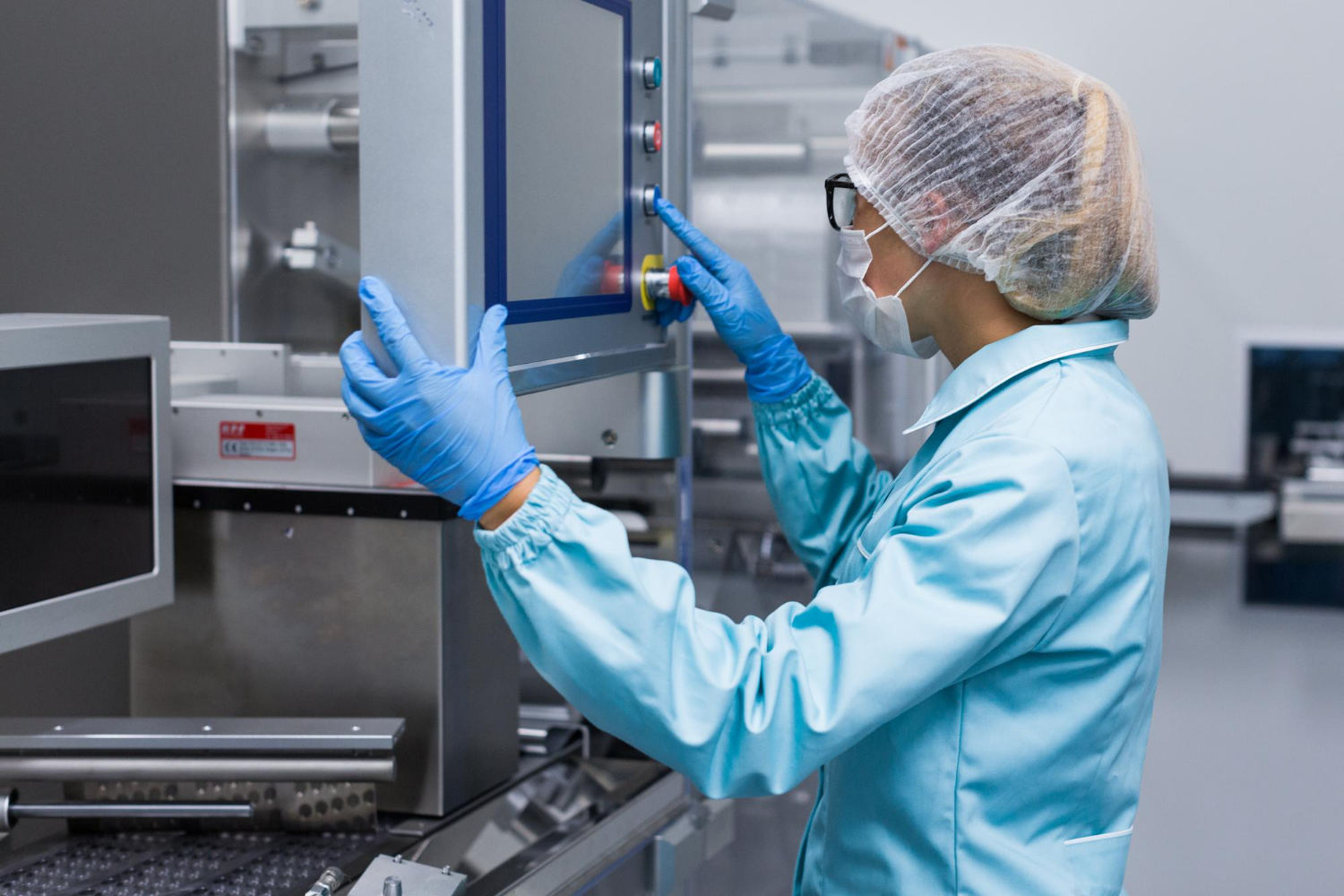
Manual visual inspection is still the default for pharmaceutical packaging, labelling, and injectable product QC — and it is the largest controllable source of variability in a GMP environment. Human inspectors fatigue across a shift, miss particulates at production line speed, and disagree with each other on borderline defects. Replacing that workflow with computer vision is no longer experimental. The honest question is narrower: which defect classes does CV reliably catch today, when does an AI-based approach beat deterministic machine vision, and how do you validate the resulting system under GMP without inheriting the failure modes the regulator already knows about?
This article sits at the bridge between our production computer vision practice and pharmaceutical quality control. It is written for engineering and quality leads who already know what an inspection booth looks like and want a clearer picture of where AI vision belongs in their line — and where it does not.
Why manual inspection is the wrong baseline to defend
Human inspectors performing 100% visual checks (as a methodological standard) on parenteral lines reliably catch cracked vials, gross particulates, missing stoppers, and badly skewed labels.
In our experience across pharma CV engagements, the operationally relevant measure is not peak detection rate on a controlled sample but sustained detection rate across a full shift on the actual production line. That is also the measure regulators care about. Manual inspection variability — inspector-to-inspector and shift-to-shift — is exactly the kind of process noise GMP is designed to eliminate. A CV system that hits a lower peak accuracy than a fresh human but holds it flat for 24 hours is, in practice, the better instrument.
Which defect classes CV reliably detects today
Some defect classes remain unsolved even with advanced CV. The honest map looks roughly like this.
| Defect class | CV maturity | Notes |
|---|---|---|
| Cracks, chips on vials and ampoules | High | Deterministic vision + structured lighting solves most cases; AI helps on reflective or coloured glass |
| Particulates in clear liquids | High | Standard for parenterals; well-validated workflows exist |
| Fill level deviations | High | Deterministic measurement, no AI needed in most setups |
| Label presence, orientation, print quality | High | Mature OCR + template matching; AI adds robustness to print variation |
| Particulates in suspensions and opaque vials | Medium | AI vision genuinely helps here; humans also struggle, so the baseline is weaker |
| Lyophilised cake defects (collapse, meltback, cracks) | Medium | AI-driven; requires careful dataset curation per product |
| Stopper seating, crimp integrity | Medium-High | Mixed deterministic + AI depending on geometry |
| Sub-visible particulates | Low (visual) | Outside the visible-inspection scope; handled by HIAC or MFI, not cameras |
The pattern is consistent: where the defect is geometric and the imaging is controlled, deterministic machine vision is often the correct answer and AI adds little. Where the defect is contextual — meaning its appearance depends on the product, the lighting, and the surrounding features — deep-learning models earn their place. The mistake we see most often is teams reaching for a neural network when a calibrated structured-light setup would have solved the problem with less validation burden. Avoiding that mismatch is a recurring theme across the rest of our life-sciences AI practice.
How does CV-based inspection get validated under GMP?
Most pilots fail at exactly this stage. A working model in a lab is not a validated inspection system on a GMP line. The validation path has four components that have to be in place before performance qualification is meaningful.
First, a golden dataset — a curated, frozen set of images covering every defect class the system is claimed to detect, with consensus labels from qualified inspectors. This dataset is the regulatory artefact. It is versioned, archived, and used to re-qualify the system after any change.
Second, a performance qualification protocol that defines the acceptance criteria: minimum detection rate per defect class, maximum false-reject rate, behaviour at the boundary cases. These thresholds are negotiated with the quality function before training, not after.
Third, change control over the model. Every retrain is a change. The system must be able to demonstrate, against the frozen golden dataset, that a new model version performs no worse than the qualified version on every claimed defect class. This is the discipline that distinguishes a production CV system from a research model.
Fourth, ongoing monitoring — drift detection on incoming image distributions, periodic re-qualification, and a defined path for handling false rejects that turn out to be true defects (or true accepts that turn out to be misses). For deeper treatment of the GxP scope, see our work on GxP compliance for AI software in pharmaceutical manufacturing.
The TK2-side production hardening rules apply directly here. The general production failure modes are covered in our piece on why off-the-shelf computer vision models fail in production; the pharma context tightens those rules rather than relaxing them.
When AI vision beats deterministic machine vision — and when it does not
A useful decision rubric, written down once so it stops being relitigated per project:
- Use deterministic vision when the defect is a measurable geometric or photometric property (dimension, contrast threshold, edge integrity) under controlled illumination. The validation burden is lower, the failure modes are bounded, and the system is easier to defend in audit.
- Use AI vision when the defect’s visual signature is contextual — particulates against an inhomogeneous background, cake defects in lyophilised product, label print quality across substrate variation, contamination on textured surfaces. These are the cases where rule-based thresholds either miss real defects or generate unacceptable false-reject rates.
- Use a hybrid pipeline for most real lines. Deterministic checks handle the geometric layer (presence, position, dimension); a downstream learned classifier handles the contextual layer (defect type, severity grading). The two layers are validated independently.
The economic argument is straightforward. A deterministic system costs less to build and validate but cannot reach the contextual defect classes. An AI-only system can reach them but inherits a heavier validation tail. The hybrid recovers most of the AI’s reach at a fraction of the validation cost.
Integration with the manufacturing execution layer
Isolate a CV inspection system, and it becomes a black box that outputs images and reject signals without context. A CV inspection system integrated with the MES produces traceable batch records — every inspected unit linked to its batch, its inspection result, its image (retained per retention policy), and the model version that made the call. That linkage is what makes the system useful for deviation investigations and trend analysis.
We design the integration so that the inspection result is the system of record for visual quality, and the underlying images are retrievable for any unit a deviation references. Operators see clear dashboards; quality sees auditable logs; engineering sees drift metrics. Each audience gets the surface it needs without exposing the others to noise.
Difficult-to-inspect products: where the honest answer is “harder”
CV vendors routinely over-promise on suspensions, opaque vials, and lyophilised products. The truth is that humans also struggle with these products — which means the manual baseline is weaker, and a CV system can match or beat it without being remarkable. We work these problems with controlled imaging environments (multi-angle illumination, optimised exposure for the product’s optical properties) and product-specific training data. The result is usually a system that catches more than a tired human but still has named blind spots. Naming the blind spots in the validation package is part of the discipline; pretending they do not exist is how pilots fail their audit.
For broader context on the scale and throughput side of pharma image analysis, our companion piece on high-throughput image analysis in biotechnology covers the infrastructure layer this kind of inspection assumes.
FAQ
How does computer vision replace manual visual inspection in pharma QC without losing defect sensitivity?
By matching the imaging setup to the defect class. Controlled illumination, fixed camera geometry, and a curated training set let a CV system hold a defined detection rate across a full shift — which is the relevant comparison, not peak performance versus a fresh inspector. Validation against a frozen golden dataset is what makes the sensitivity defensible.
Which defect classes can automated visual inspection reliably detect today?
Cracks and chips on glass, particulates in clear liquids, fill levels, label presence and orientation, and print quality are mature. Particulates in suspensions, lyophilised cake defects, and contamination on textured surfaces are increasingly reliable with AI-driven approaches but require product-specific training data and explicit acknowledgement of residual blind spots.
What does an automated visual inspection deployment cost compared with manual inspection at the same throughput?
This is an observed-pattern answer, not a benchmark: the comparison only makes sense per line and per product. The relevant inputs are reject rates (real and false), inspector headcount across shifts, batch value, and the cost of recalls or deviations that manual inspection lets through. We work that comparison up explicitly per engagement; quoting an industry-average payback period would be misleading.
How is a CV-based inspection system validated under GMP?
Through a golden dataset, a performance qualification protocol with pre-agreed acceptance criteria, formal change control over model versions (every retrain re-qualified against the frozen dataset), and ongoing drift monitoring with defined paths for false-reject and missed-defect handling.
When does AI-based inspection outperform deterministic machine vision, and when is the simpler approach correct?
Deterministic vision wins on geometric and photometric defects under controlled illumination — lower validation burden, bounded failure modes. AI wins on contextual defects where the visual signature depends on background or product variation. Most production lines benefit from a hybrid pipeline that validates the two layers independently.
How do CV systems handle difficult-to-inspect products where humans also struggle?
With product-specific imaging setups, product-specific training data, and an explicit list of residual blind spots in the validation package. The honest framing is that the system matches or beats a weaker human baseline rather than achieving perfect detection.
Why vision systems fail in pharma—and how to prevent it
Vision deployments fail most often because teams deploy models without establishing annotation governance first. Revisit it when your workload shifts.