
Every day, construction workers face risks on the job, and companies grapple with safety hazards and cost overruns. OSHA still ranks construction among the most dangerous industries in the United States, and the Bureau of Labor Statistics recorded 1,102 construction fatalities in 2020 alone. Cost overruns hit the same projects on the financial side. AI is not a cure for either problem, but it has become a practical tool for shrinking both — when it is grounded in real site data rather than vendor demos.
We work with construction and real-estate teams on exactly this gap: the distance between a slide claiming “AI improves safety” and a system that actually flags a worker entering an exclusion zone in time to matter. The honest picture is mixed. Some classes of problem — defect detection, equipment monitoring, document parsing — respond well to current models. Others, like full-project cost prediction, remain stubborn. This article walks through where AI earns its place on a construction site today, and where the claims outrun the evidence.

What does AI actually do on a construction site?
Most deployments we encounter fall into five capability clusters. Each maps to a distinct data source and a distinct failure mode.
| Capability | Primary data source | Operational use | Typical failure mode |
|---|---|---|---|
| Computer vision monitoring | Site cameras, drone footage | PPE detection, exclusion-zone alerts, defect scanning | False positives in low light, occluded workers |
| Generative design | CAD models, material property libraries | Topology optimisation, material exploration | Manufacturable-but-unbuildable geometries |
| Edge analytics | IoT sensors on equipment | Predictive maintenance, real-time fault detection | Sensor drift, intermittent connectivity |
| XR visualisation | BIM models, site geometry | Pre-build walkthroughs, training, virtual inspection | Tracking loss in dusty or reflective environments |
| NLP on project docs | RFIs, contracts, daily reports | Risk extraction, schedule parsing, compliance checks | Misclassified clauses, hallucinated entities |
The pattern that holds across all five: AI works best where the data is already digital, structured, and continuously generated. It struggles where it depends on workers changing behaviour to feed it inputs.
Generative AI for design and material innovation
Generative AI has transitioned from experimental curiosity to production tool in design workflows. Engineers can explore design spaces — geometries, lattice structures, load paths — that would be impractical to draw by hand. The bio-textiles and advanced-composites space is one example: combining natural and synthetic fibres for stronger, more flexible building skins. MarketsandMarkets projects bio-based textiles to reach roughly USD 19.8 billion by 2025, with AI-assisted design among the drivers.
For concrete, steel and composite materials, AI is being used to model and optimise molecular structure. Research published in PMC describes algorithms that propose candidate formulations with improved strength and thermal performance, which lab teams then narrow down through real-world testing. The Autodesk MX3D bridge in Amsterdam is the often-cited demonstrator: a 3D-printed steel pedestrian bridge whose geometry came out of generative design rather than conventional drafting.
The caution we add to clients exploring this: generative tools produce many candidates, and most of them are not buildable with current methods. The value is in the curation pipeline that filters thousands of candidates down to a handful worth a manufacturability review.

Computer vision for quality control and safety
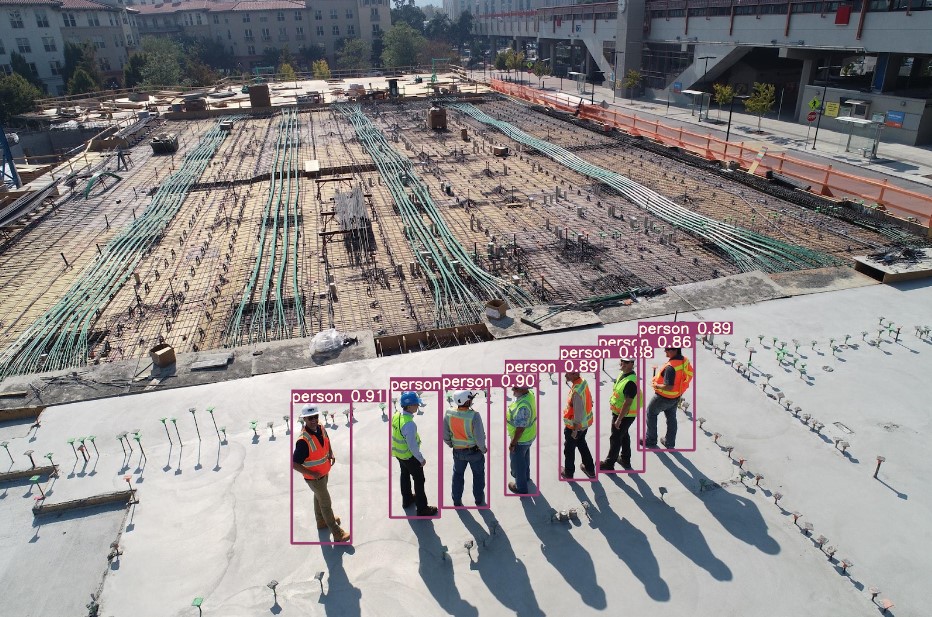
Computer vision proves its value most directly in real-time inspection tasks. Site cameras feeding a vision model can flag missing PPE, workers in exclusion zones, and structural defects in poured concrete or finished surfaces — at frame rate, without depending on a supervisor walking past at the right moment. Grand View Research projects the construction-technology market at around $3.7 billion by 2027, with quality control and productivity as the main demand drivers.
Vendor case studies report safety-incident reductions of around 25%, productivity gains near 15%, and rework reductions of around 20% on large projects equipped with vision-based inspection. These numbers come from vendor-reported deployments, not independent benchmarks, so we read them as directional rather than guaranteed outcomes for any specific project. What is robust across the studies we have seen is the direction: continuous, automated inspection catches defect patterns that intermittent human inspection misses.
The practical engineering challenge is unglamorous: model drift on changing site conditions. A defect classifier trained on summer footage performs differently in winter mud and rain. We tend to recommend a retraining cadence tied to seasonal changes, not a one-shot deployment.
AR, VR and XR for visualisation and inspection
AR, VR, and XR hardware addresses a distinct challenge: reconciling BIM geometry with as-built conditions on site. AR overlays digital plans onto the physical worksite, so an installer can see where a duct or rebar mat is supposed to sit before cutting or pouring. MarketsandMarkets estimates the global AR-in-construction market at around $1.4 billion by 2026.
VR is used most often pre-construction: walking stakeholders through a 1:1 model of the building before ground breaks. McKinsey & Company has reported VR simulations cutting project time by around 10% on the projects studied, primarily through earlier discovery of clashes and constructability issues. XR — the union of AR and VR — is increasingly used for training: workers can rehearse high-risk tasks (working at height, confined-space entry, crane signalling) without exposure to the real hazard. Studies suggest XR training improves task performance by around 20%, though the size of the effect varies heavily by task complexity.
A pattern worth noting: XR’s biggest return in our experience is not visualisation novelty but error prevention at the point of installation. A foreman who can hold a tablet up and see exactly where the next bolt belongs makes fewer rework-causing mistakes.

Edge computing for site operations
Data centres and construction sites operate under fundamentally incompatible assumptions. They are remote, dusty, intermittently connected, and full of equipment producing telemetry no one is reading. Edge computing addresses the connectivity problem by processing data locally — on a gateway box near the equipment — rather than shipping everything to the cloud and waiting for an answer.
For predictive maintenance, this matters because the relevant signals (vibration, temperature, hydraulic pressure) are high-frequency. Streaming them all to a cloud endpoint is impractical; processing them locally and sending only summaries or alerts is. MarketsandMarkets projects the construction-sector edge-computing market at around $2.8 billion by 2026. Reports in the Journal of Construction Engineering and Management cite equipment uptime improvements near 30% and maintenance cost reductions around 25% on projects with edge-based predictive maintenance deployed.
Supply-chain and resource management is the second high-value edge use case. Tracking material movement, equipment utilisation and crew location locally — and feeding only the aggregates upward — gives project managers a usable signal without saturating the connection. IBM has documented lead-time reductions around 15% in major construction projects using this pattern.
NLP for project documentation
Text proliferates across construction projects—RFIs, daily logs, change orders, contracts, safety briefings, inspection records—creating volumes that manual review cannot scale to meet. Most of it is never read after filing. NLP tools extract signal from this archive — flagging clauses with cost or schedule risk, surfacing recurring defect themes across daily reports, parsing inspection findings into structured logs.
The current generation of models handles construction-specific terminology reasonably well, especially after light fine-tuning on a project’s own vocabulary. Where they still struggle is on cross-document reasoning — connecting an RFI from week 4 to a defect report in week 18 — which remains a workflow problem more than a model problem. We use NLP most heavily in the closeout and dispute-avoidance phase, where the cost of missing a relevant clause is highest.
Where AI delivers and where it doesn’t
| Category | What the data supports | What we still consider unproven |
|---|---|---|
| Safety monitoring | Vision-based PPE and exclusion-zone detection reduces near-misses | End-to-end injury rate reduction at portfolio scale |
| Quality control | Automated defect detection on standardised elements | Subjective finish quality (aesthetics, alignment) |
| Predictive maintenance | Equipment-level fault prediction with weeks of warning | Cross-fleet predictions without project-specific training |
| Schedule and cost | NLP risk extraction from contracts and RFIs | Full-project cost forecasting beyond 6 months |
| Design exploration | Topology and material optimisation at component scale | Generative whole-building design without heavy human curation |
AI delivers construction value where tasks repeat, data flows continuously, and failures surface quickly enough to correct. It is least valuable where outcomes depend on contractual relationships, weather, or workforce decisions that no model has visibility into.
Adoption challenges
Data integration
BIM geometry, project schedules, financial ledgers, and daily site reports rarely share a common platform or schema. Dodge Data & Analytics reports that around 64% of construction firms cite data integration as a primary barrier to automation. Most AI projects we see succeed or fail on this layer before the model ever runs.
Workforce training
The AGC of America found around 70% of construction firms struggle to train workers in the digital skills new tools demand. The right pattern, in our experience, is to deploy AI tools that augment existing workflows rather than replace them — workers adopt what makes their day easier, not what threatens it.
Ethical and legal questions
Royal Institution of Chartered Surveyors research notes around 56% of construction professionals have ethical concerns about AI use, particularly around liability when AI-informed decisions go wrong. Marsh & McLennan’s AI governance work catalogues the open questions on responsibility, privacy and IP. These do not block deployment, but they shape how decisions are logged and who is named on the audit trail.
Cost and ROI
McKinsey research finds around 60% of construction executives view upfront cost as the main adoption barrier. KPMG’s survey work on generative AI specifically highlights ROI uncertainty as a parallel concern. Pilots scoped to one site and one capability tend to give a cleaner read on payback than enterprise-wide rollouts.
Regulatory compliance
Regulatory frameworks for AI in safety-critical industries are still maturing. World Economic Forum data suggests around 45% of construction professionals find compliance with emerging AI rules challenging. Anything touching safety monitoring or autonomous equipment falls under multiple jurisdictions at once.
How we work with construction teams
TechnoLynx designs AI interventions for the specific constraint limiting a project—rejecting one-size-fits-all platform thinking. The recurring patterns are: computer vision for site safety and quality, edge analytics for equipment and supply-chain telemetry, and NLP for documentation-heavy phases (procurement, closeout, dispute prep).
The engagement model is engineering-first: we work directly with your site systems and project data, scope each component to a measurable outcome, and own the result rather than handing over a model and walking away. If you have a specific bottleneck — safety incidents on a particular project type, defect rates on a specific assembly, equipment downtime that keeps blowing the schedule — contact TechnoLynx and we’ll talk through whether AI is the right tool for it.
Frequently asked questions
Is AI in construction mature enough to deploy on real projects today?
For specific use cases — vision-based safety monitoring, predictive maintenance on instrumented equipment, NLP on project documentation — yes. For others, including full-project cost forecasting and end-to-end generative building design, it remains exploratory. The right question is not “is AI ready” but “is AI ready for the specific bottleneck I’m trying to solve.”
What’s the realistic safety improvement from AI on a construction site?
Vendor-reported studies show roughly 25% reductions in safety incidents on sites equipped with computer vision monitoring, and around 50% reductions in some categories of injury when AI-based safety systems are paired with workflow changes. These are observed patterns from individual deployments rather than industry-wide benchmarks, so the realistic expectation for any specific project will depend on baseline safety culture and the classes of incident being targeted.
How does AI handle the data integration problem in construction?
It mostly doesn’t — the integration work is upstream of the AI. The reason 64% of firms cite data integration as a barrier, as reported in the cited survey, is that AI models depend on clean, structured, continuously updated inputs, and most construction data is none of those. Practical AI deployments start with the data pipeline (sensors, BIM exports, document ingestion) and add the model only when that layer is reliable.
What’s the difference between AR, VR and XR in a construction context?
AR overlays digital information on the physical site — useful at the point of installation. VR places stakeholders inside a fully virtual model — useful pre-build for clash detection and walkthroughs. XR is the union, including mixed-reality training environments where physical actions interact with virtual hazards. Most production deployments today are AR on tablets and VR in pre-construction; XR training is growing but remains specialised.
Where does edge computing fit alongside cloud AI in construction?
Edge handles the high-frequency, latency-sensitive workloads — equipment telemetry, on-site vision inference, alerts that need to fire in seconds. The cloud handles aggregation, longer-horizon analytics, and retraining. The split is dictated by physics (bandwidth, latency) more than preference: streaming raw sensor data from a remote site to a cloud endpoint is rarely practical.
References
- Abioye, S.O., Oyedele, L.O., Akanbi, L., Ajayi, A., Davila Delgado, J.M., Bilal, M., Akinade, O.O., & Ahmed, A. (2021). Artificial Intelligence in the Construction industry: a Review of Present status, Opportunities and Future Challenges. Journal of Building Engineering, 44(1), 103299.
- Autodesk University (2021). Amsterdam’s 3D-Printed MX3D Bridge and the Future of Smart Infrastructure.
- Badini, S., Regondi, S., & Pugliese, R. (2023). Unleashing the Power of Artificial Intelligence in Materials Design. Materials, 16(17), 5927.
- Fisher, E., Flynn, M.A., Pratap, P., & Vietas, J.A. (2023). Occupational Safety and Health Equity Impacts of Artificial Intelligence: A Scoping Review. International Journal of Environmental Research and Public Health, 20(13), 6221.
- Hoster, B., Riddell, G., & Smith-Bingham, R. Governing Artificial Intelligence. Marsh & McLennan Companies.
- IBM. IBM Supply Chain.
- Khan, N., Syed, Yang, J., Park, C.-S., & Lee, D. (2023). Construction Work-Stage-Based Rule Compliance Monitoring Framework Using Computer Vision (CV) Technology. Buildings, 13(8), 2093.
- Li, S., Wang, Q.-C., Wei, H.-H., & Chen, J.-H. (2024). Extended Reality (XR) Training in the Construction Industry: A Content Review. Buildings, 14(2), 414.
- Roepke, A. (2023). New Study Shows Greater Automation of Project Management Processes Improves General Contractors’ Projects and Bottom Lines. Dodge Construction Network.
Cover image: Freepik