Introduction
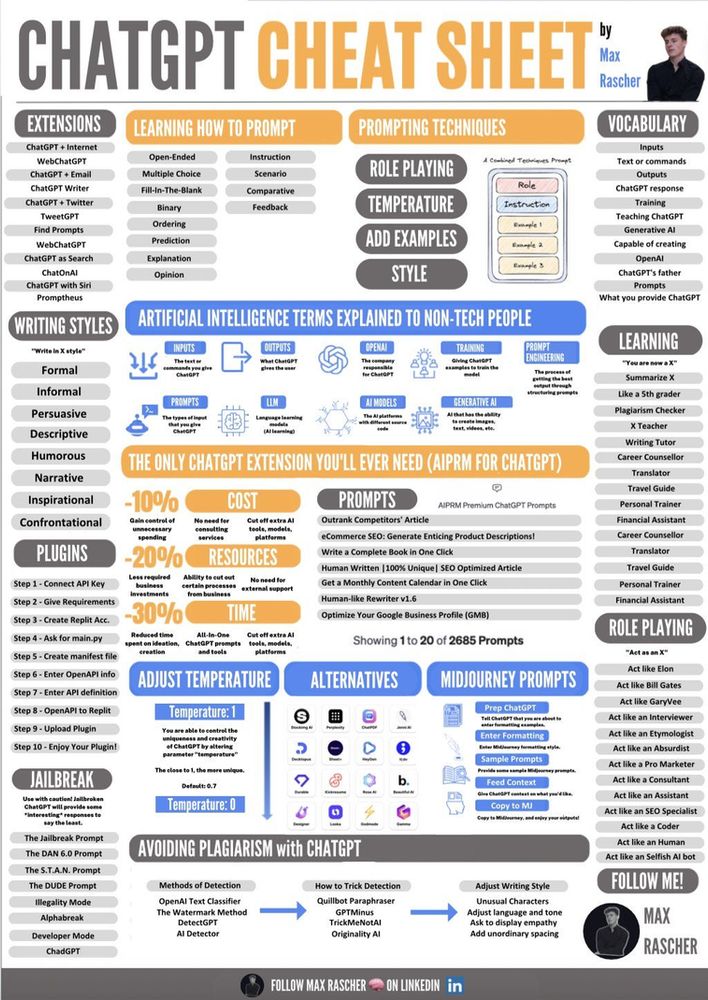
ChatGPT cheat sheets proliferated after November 2022, the majority clustering around monetization tactics and surface-level workflow hacks. The version that matters for engineering teams in 2026 is different: which prompts actually accelerate the work, which prompt patterns hold up against reasoning models versus the older instruction-tuned models, where AI chatbots measurably improve productivity, what should not be asked of ChatGPT in a production engineering context, and how a cheat sheet turns into a governed prompt library. See generative AI for the broader landing this article serves.
The expert read is that the engineering-grade cheat sheet is not about clever prompts; it is about repeatable patterns that produce measurable productivity rather than impressive-looking output.
What this means in practice
- Prompts that ship: specific context, structured output, verification step.
- Reasoning models in 2026 changed which patterns work and which became unnecessary.
- Productivity gains concentrate in software, ops, and structured customer roles.
- A versioned prompt library is engineering infrastructure, not a wiki page.
Which ChatGPT prompts actually accelerate an engineering team, and which only look productive in a demo?
Focus on prompts that compress real work into fewer iterations. Specification refinement: paste a draft requirement, ask for missing edge cases and ambiguities, review and integrate. The output requires expert review but surfaces issues faster than blank-page review. Code translation between languages or frameworks: provide source code and target framework with context about conventions, get a translation, run tests, fix gaps. Useful for one-off migration work; not a substitute for engineers who understand both sides. Test-case generation: provide function signature and behaviour description, request edge-case test set, review for completeness, add tests the model missed. Documentation drafting: provide code or behaviour, request first-draft documentation, edit for accuracy and voice. Faster than writing from scratch; not publishable without review. Refactoring suggestions: provide code and refactoring goal (extract function, reduce complexity, improve naming), evaluate suggestions, apply the ones that fit. Useful for unfamiliar code; not a substitute for ownership.
Prompts that demo well but rarely accelerate. “Write me a complete X” prompts (complete app, complete article, complete spec). Output is plausible but rarely correct in detail; effort to repair exceeds effort to write from a good outline. “Explain this code” on code the asker already understands. Performative; no productivity gain. “Generate test data” without behavioural constraints. Output is syntactically valid but rarely representative of real distributions; misleading for validation. The pattern across what accelerates: small focused tasks with expert-reviewable output. The pattern across what does not: large unfocused tasks with output the asker cannot or does not review.
What is the production-engineering version of a ChatGPT cheat sheet (versus the make-money variants)?
Developer-oriented collections prioritize structure, error handling, and integration—domains the productivity listicles skip entirely. Code-review prompts that ask the model to look for specific issue classes (security, performance, race conditions, error handling). Useful first-pass before human review. Diagnostic prompts that translate error messages, stack traces, or log excerpts into hypotheses. Useful as triage; the hypotheses need verification before action. Architecture prompts that take a problem statement and produce candidate architectures with trade-offs. Useful for exploration; not a substitute for architectural judgement. Operations prompts that translate observability data into incident summaries or remediation suggestions. Useful for on-call; the suggestions need verification before applying. Documentation prompts that take code or specification and produce reference documentation. Useful for closing documentation gaps; output requires editing.
The make-money variants typically focus on content marketing, social media drafting, email templates, productivity affirmations, and similar consumer-grade tasks. They are not wrong; they are not engineering. The engineering cheat sheet is organised by engineering activity (specification, code, review, ops, documentation) and by the verification step each prompt requires. The pattern that ships: prompt + expert review with the verification step explicit, not implicit.
How do prompt-engineering patterns from 2023-2024 hold up in 2026 with reasoning models?
Reasoning models reduced reliance on several prompt patterns that previously required explicit instruction. Chain-of-thought prompting (“think step by step”) — reasoning models do this internally; explicit chain-of-thought adds marginal benefit on most tasks. Few-shot example prompting for simple tasks — reasoning models often perform well zero-shot on tasks that needed few-shot in 2023. Self-consistency / sampling-and-voting — reasoning models internally consider alternatives, reducing the need.
Patterns that remain necessary or became more important. Specific-context prompting — providing relevant context (code, document, situation) still matters; the model cannot reason about what it does not see. Structured output requests — explicit output format (JSON schema, structured sections) remains valuable for downstream parsing. Tool-use prompting — explicit instructions for tool invocation, parameter format, expected behaviour. Reasoning models use tools more capably but still benefit from clear instructions. Constraint specification — explicit constraints (do not invent facts, cite sources, defer if uncertain) remain critical for accuracy.
Patterns that emerged in 2026. Reasoning-effort guidance — for models that expose reasoning-effort parameters, explicit guidance on how much reasoning to apply. Multi-step decomposition with checkpoints — for complex tasks, decomposing into stages with verification between rather than one large prompt. Tool-use planning — asking the model to plan tool use before executing, especially for multi-step tasks. The shift from 2023 to 2026: from clever prompt phrasing to disciplined context and verification engineering.
Where do AI chatbots measurably boost productivity in software, ops, and customer-facing roles?
Engineering applications demand precision that general-purpose templates cannot supply. Productivity gains in 2024-2026 studies, as reported in cited empirical literature, range from 10% to 55% depending on task and seniority; gains concentrate in routine implementation (boilerplate, test generation, documentation, code translation) and are smaller or negative on complex architecture and debugging. The pattern: AI accelerates the high-volume low-complexity work; complex work remains expert-driven with AI as occasional reference. Pair-programming style integration (Copilot, Cursor) measurable benefit; chat-only interaction measurable benefit but smaller.
Operations and SRE. Measured benefit on incident triage (suggesting hypotheses, summarising long log/trace data), on documentation of runbooks (drafting from incident notes), on first-draft post-mortems (structuring observations). Critical: AI output must be verified before acting; AI-suggested remediation that is applied without verification has caused outages. Best practice: AI as suggestion, human as execution.
Customer-facing roles. Measured benefit on first-line support (categorisation, response drafting, knowledge-base search), on technical writing (documentation, FAQ, knowledge-base entries), on customer success (call summarisation, follow-up drafting). Benefit smaller on roles requiring deep relationship judgement (account management, escalation handling) where AI assists but does not replace.
Where benefit is smaller or negative. Roles requiring deep domain expertise the model lacks; roles requiring physical presence or judgement under unclear constraints; roles where AI output requires more verification than the output saves (high-stakes regulated decisions). The honest aggregate picture: AI chatbots produce measurable productivity gains across most knowledge work, but the magnitude is task-specific and smaller than the marketing line. Engineering teams that measure their own productivity with and without AI assistance build evidence for their own context rather than relying on industry-wide averages.
What should not be asked of ChatGPT in a production engineering context, and why?
Never embed production credentials, API keys, or secrets in prompt text. Even if the model knows examples from training data, those are not your credentials, and asking for them creates the bad habit of expecting the model to provide secrets. Do not paste production data, customer data, or proprietary information unless using a contract-enforced enterprise deployment. Consumer ChatGPT terms allow training on submitted data unless explicitly opted out; enterprise deployments have different terms; know which you are using.
Do not ask for production-deployable code without verification. The output is plausible but may contain subtle bugs, security issues, or licensing problems. Use the output as a starting point; verify before committing. Do not ask for legal advice, medical advice, or financial advice you will act on. Use a human professional. The model can summarise general principles but not advise on your specific situation with the rigour those domains require. Do not ask for citations or fact claims you will not verify. The model can produce plausible citations that do not exist; treat citations as hypotheses to verify rather than facts.
Do not use ChatGPT for cryptographically sensitive work (generating secrets, validating cryptographic implementations). The output may be insecure in ways that are not obvious. Use established cryptographic libraries and review with cryptographic expertise. The pattern: the model’s strength is plausible-language generation; its weakness is factual precision and security guarantees. Use it where plausibility helps and verification is feasible; do not use it where verification is impossible or the cost of error is high.
How does an engineering team translate a cheat sheet into a versioned, governed prompt library?
Scaling from solo experimentation to shared repositories requires versioning, access control, and audit trails. Source the prompts that team members are using individually (Slack history, personal notes, demonstrated patterns). Categorise by activity (code-review, architecture, ops, docs) and by verification requirement. Version-control the prompts in a repo; treat them as code. Document inputs (what context the prompt expects), outputs (what format and what verification), and known limitations (what the prompt does not handle well). Test the prompts on representative inputs; record expected output characteristics; flag regressions when model versions change. Govern access: production prompts may need approval; experimental prompts can be more permissive.
Integration with development workflow. CLI or IDE extension to invoke prompts with context; chat-bot integration in team chat for ad-hoc invocation; CI integration for prompt-driven checks. Cost and rate-limit governance: track per-team and per-prompt usage; alert on anomalies. Audit log for prompts run on production data or production decisions.
The maturity progression. Level 1: individuals use ChatGPT ad-hoc. Level 2: team shares prompts in wiki or chat. Level 3: team versions prompts in repo with documentation and tests. Level 4: prompt library is engineering infrastructure with monitoring, governance, and integration. Most engineering teams in 2026 are at Level 1-2; the productivity benefit increases substantially at Level 3-4 because reuse and verification become systematic. The cheat-sheet-to-library transition is engineering investment, not a knowledge-management exercise.
Limitations that remained
Hallucination remains the central risk; every ChatGPT output must pass through a verification gate before use. Model versions change behaviour; what worked last month may behave differently this month. Cost at scale can be substantial; teams that adopt without cost monitoring discover surprise bills. Enterprise vs consumer deployment terms differ; using consumer ChatGPT for proprietary data exposes the team to terms-of-service issues. The productivity gain is task-specific; aggregate productivity claims do not translate to specific teams without measurement. The honest picture is that the engineering cheat sheet is a starting point and the production discipline is what determines whether AI chatbot use is net productive or net negative.
Why This Reference Matters
Efficiency with ChatGPT scales with the size and quality of your reusable prompt inventory. If your engineering organisation is adopting GenAI tools and wants the integration discipline that produces measurable gains, contact us.
Image credits: Freepik