Apple’s June 2024 keynote was, on the surface, a product launch. Read more carefully, it was a public worked example of how a mature engineering organisation segments a generative AI roadmap: which capabilities ship as features now, which sit behind a partnership, and which stay in the lab. For anyone deciding whether to commit budget to a GenAI use case inside their own business, the announcements are a useful mirror — not because Apple’s choices generalise, but because the shape of the decision does.
We look at the Apple Intelligence release through the lens that matters for buyers: per-use-case technical feasibility. Some of what Apple announced is squarely automatable with current models. Some of it is speculative and depends on capability that does not yet exist at the required quality bar. The line between the two is the line every GenAI investment decision sits on.
What Apple actually announced
At the Worldwide Developers Conference in Cupertino on 10 June 2024, Apple unveiled “Apple Intelligence,” a system-level integration of generative AI across iOS 18, iPadOS 18 and macOS Sequoia. The headline elements:
- On-device generative models for writing assistance, summarisation, image generation (Image Playground), and personalised emoji (Genmoji).
- Private Cloud Compute — a server tier for prompts too large for the device, running Apple-designed silicon under a verifiable privacy contract.
- A Siri overhaul with screen-aware context, app intents, and personal-context understanding (mail, calendar, messages).
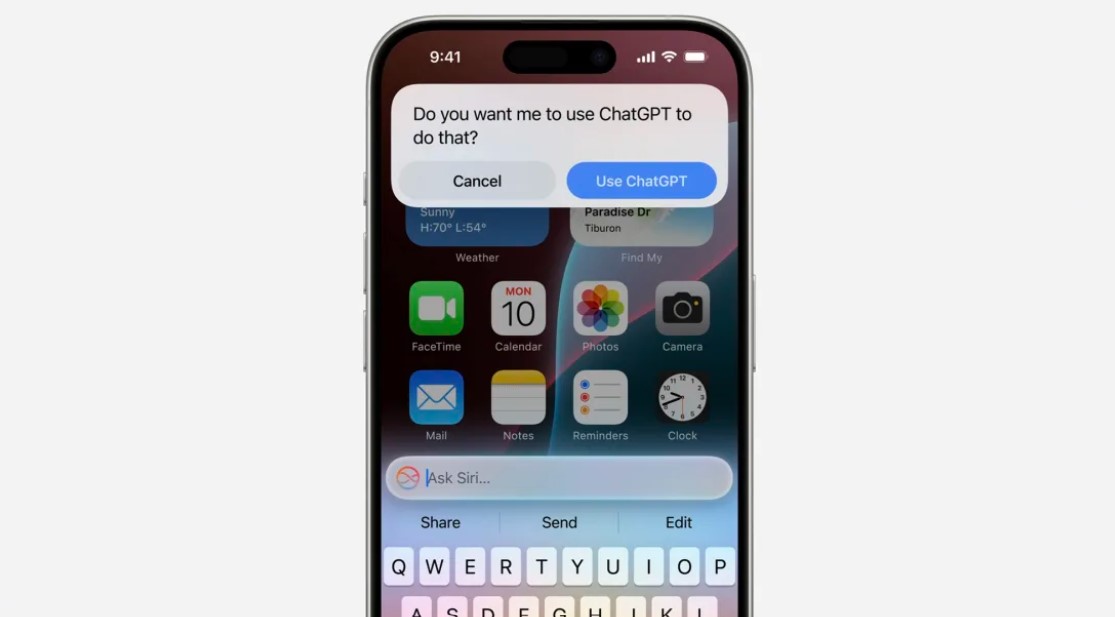
- An OpenAI partnership routing select queries to ChatGPT when the user opts in.
- visionOS 2 updates for Vision Pro, including larger workstation displays and depth-from-2D-photo machine learning.
- iOS 18 communication features: satellite texting, scheduled iMessages, call recording with on-device transcription.
The technical substrate matters. Most of these features rely on on-device transformer inference accelerated by Apple Silicon’s Neural Engine, with selective offload to Private Cloud Compute when context windows exceed what the device can hold. The architecture is a deliberate engineering decision, not a marketing line.
A feasibility frame for reading the announcements
When we assess a GenAI use case for a client, we classify each candidate into one of three buckets:
| Class | Definition | What it justifies |
|---|---|---|
| Automatable | Current models meet the quality bar; the work is integration, evaluation, and operations. | Direct build with measurable ROI targets. |
| Speculative | Requires capability beyond reliable current performance — accuracy, latency, or grounding. | A bounded research phase before any commitment to ship. |
| Research | The question itself is unresolved — no published benchmark or operational measurement establishes feasibility. | An investigation phase with explicit go/no-go criteria. |
This is an observed pattern across our R&D engagements: roughly two-thirds of GenAI candidates a buyer brings to us at first contact sit in the speculative bucket, not the automatable one, yet they enter the conversation labelled as “ready to build.” The classification is not a benchmarked rate — it is a planning heuristic from how engagements actually unfold. The feasibility assessment is what separates the buckets cleanly enough to make a defensible decision.
Apple’s roadmap, read this way, is unusually disciplined. Apple shipped the automatable features, partnered for the speculative ones, and stayed quiet on the research questions.
Automatable: the bulk of Apple Intelligence
Writing assistance — proofreading, rewriting in different tones, summarisation of long threads — is genuinely automatable today. The model quality required to summarise a notifications stack or rewrite a paragraph in a friendlier tone is well within the operational range of small on-device models. Genmoji and Image Playground sit in the same bucket: the failure modes of an image generator are tolerable when the output is decorative, optional, and never load-bearing.
Notification prioritisation, photo search by natural-language description, and reply suggestions — all of these are pattern-recognition problems where current generative models perform reliably enough to ship at consumer scale. The engineering challenge is integration, latency, and battery, not capability.
Speculative: the Siri rebuild
The Siri overhaul is more interesting. A genuinely context-aware assistant that can reason across your mail, calendar, photos and third-party apps using app intents is at the edge of what current models do reliably. Apple’s choice here is telling: they announced the capability but staged the rollout, with the personal-context features arriving later than the writing tools. That is the behaviour of a team that knows the quality bar is higher and the failure modes more costly.
This is also why the OpenAI partnership exists. Routing harder prompts to ChatGPT is an admission that some queries exceed what a tightly bounded on-device model can answer. It is a feasibility hedge: ship the part you control, partner for the part where the capability question is still open.
Research: what Apple did not announce
Notice what was absent. No agentic Siri that books your flights end-to-end. No autonomous email triage that sends replies without confirmation. No medical-grade health interpretation. These are the obvious adjacencies, and they are the questions where current models do not yet meet the reliability bar required by Apple’s brand. Apple’s silence on them is the most informative part of the announcement.
How to apply the same lens to your own use cases
If you are sitting on a GenAI budget and a list of candidate use cases, the questions are:
- What is the cost of a wrong output? If a wrong output is reversible and visible to the user (rewriting an email), the use case is closer to automatable. If a wrong output is silent or downstream of an automated action (sending the email, paying the invoice, scheduling the appointment), the bar is much higher.
- What is the data readiness? GenAI features that need personal context — mail, calendar, files — only work if the data is structured, accessible, and clean enough for the model to ground on. Apple has the home-field advantage here: it controls the data layer. Most enterprises do not.
- What is the measurable outcome? If you cannot state, before development starts, what success looks like in numbers a stakeholder will accept, the use case is research, not engineering. The artifact that protects the spend is a documented set of go/no-go criteria written before the build.
- Where does the capability gap sit? Is the gap in model quality, in retrieval, in latency, or in evaluation? Each has a different cost profile and a different mitigation. Conflating them is how budgets get burned.
A structured GenAI feasibility assessment answers these questions per use case, classifies each one, and names the conditions under which a speculative candidate could move into the automatable bucket. The assessment is a defensible artifact: if the project proceeds, it justifies the spend; if it doesn’t, it prevents the waste.
The privacy architecture as a feasibility constraint
Private Cloud Compute deserves closer examination: it demonstrates how a non-functional requirement can determine which use cases are feasible at all. By committing to on-device inference plus a verifiable server tier, Apple constrained the model sizes it can use, the latency budget it has, and the context window available per prompt. This narrows what is possible — but it also makes the privacy claim defensible in a way that pure cloud inference is not.
Most enterprises face an analogous constraint. Regulatory scrutiny in healthcare, finance, and the public sector is not a marketing concern; it is a hard boundary on which models and which deployment topologies are available. The feasibility question is therefore not “can the model do this?” but “can the model do this under the constraints the use case actually carries?” A use case that is automatable in a research notebook can be speculative in production once data residency, audit trails, and explainability are added.
This is the same boundary we use when we discuss whether a proof of concept actually proves the right thing: the constraints, not the capability, determine whether a PoC result generalises.
Where this leaves the buyer
Apple’s WWDC announcement offers a case study in honest roadmap segmentation. The shape of the decision — not the technology stack — is what generalises.
For a buyer staring at a GenAI budget, the structural lesson is that not every plausible use case is a build candidate. Some are partnership candidates. Some are research candidates. Some are not yet candidates at all. A GenAI feasibility assessment is how you tell them apart before you have committed the money to find out the hard way. Running that assessment is the first deliverable of our Generative & Agentic AI R&D practice, and it applies whether the roadmap in question is Apple’s or a client’s own.
FAQ
Original announcement coverage: Samantha Murphy Kelly, CNN.