
Introduction
A working smart city is not measured by how much technology it deploys but by how easily its residents move. Affordable, sustainable, and efficient transit — public and private — is the load-bearing layer beneath every other smart-city ambition. Artificial intelligence has become one of the more practical levers for getting there. The worldwide market for AI in transportation is projected to reach roughly USD 23.11 billion by 2032 (published-survey, Precedence Research 2023), a directional industry-scale figure that reflects accelerating commitment rather than a guaranteed operational outcome.
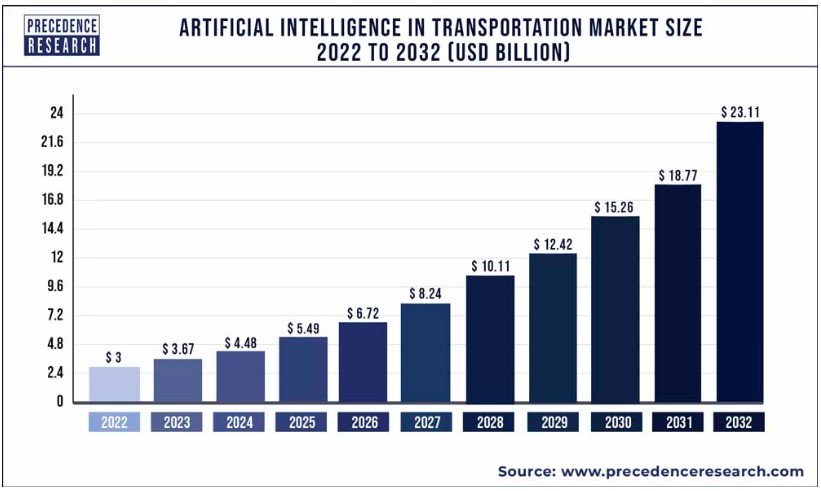
Transportation splits cleanly into public systems (buses, metros, trams) and private vehicles. On the public side, AI tends to optimise route planning, scheduling, and crowd flow. On the private side, it shows up in autonomous driving, navigation, traffic management, and parking. Across both, four technology families do most of the work: computer vision, GPU acceleration, generative AI for simulation, and IoT edge computing. This article walks through where each one actually changes the system, the failure modes engineers run into when deploying them, and what we at TechnoLynx pay attention to in our own engagements.
How does AI analyse real-world traffic?
IoT edge computing is the workhorse for real-time traffic analysis. Rather than streaming every frame back to a central data centre, edge devices — cameras, lidar, inductive-loop controllers — process data where it is generated. That changes the latency budget from seconds to tens of milliseconds, which is what closed-loop signal control needs to function. The 2012 National Traffic Signal Report Card attributed roughly 295 million vehicle-hours of annual delay in the United States to inefficient signal timing (published-survey, National Transportation Operations Coalition 2012), which framed the case for adaptive control long before edge inference was practical.
A typical deployment puts sensor-equipped edge devices at intersections, highway gantries, and dense urban centres. They collect vehicle count, speed, queue length, and turning-movement data continuously.
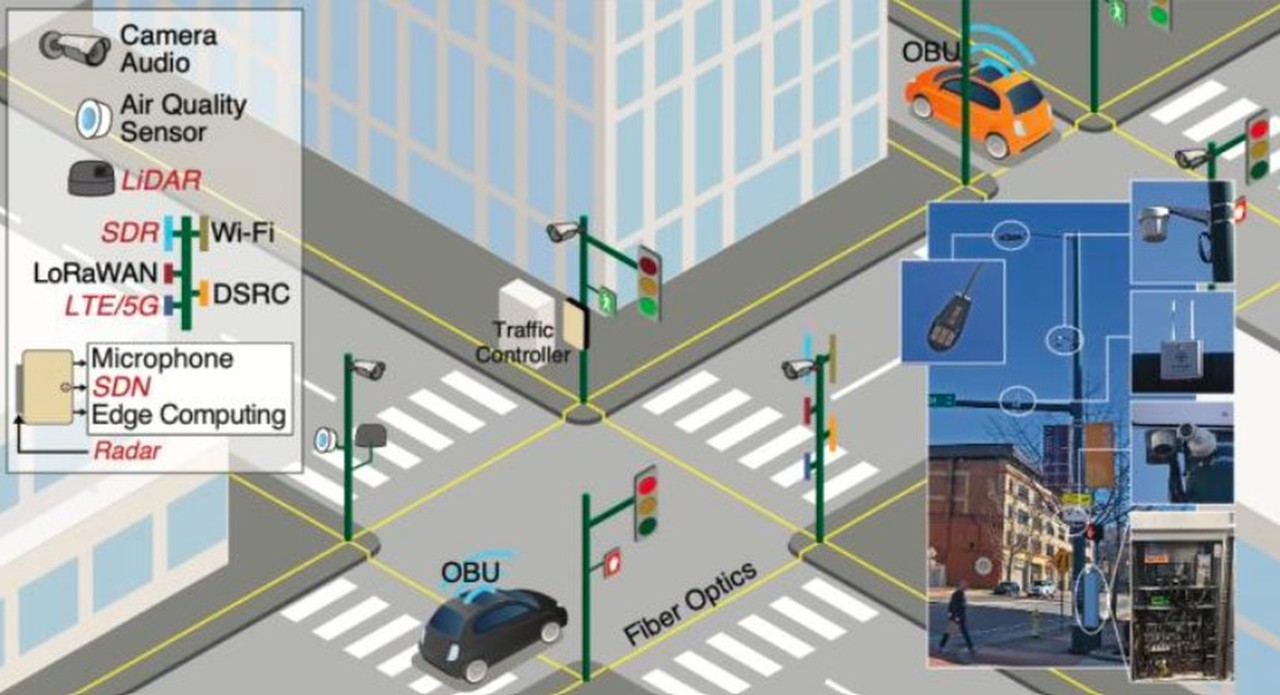
What the data is actually used for matters more than how much of it gets collected. In practice, the operationally relevant outputs are:
- Identifying congestion hotspots and recurring patterns by time-of-day.
- Faster decision-making for traffic management centres during incidents.
- Adaptive signal-timing adjustments that smooth platoons rather than freeze them.
- Real-time feeds into navigation apps so commuters can reroute before they are stuck.
- Lower mean travel times across a corridor, not just at a single intersection.
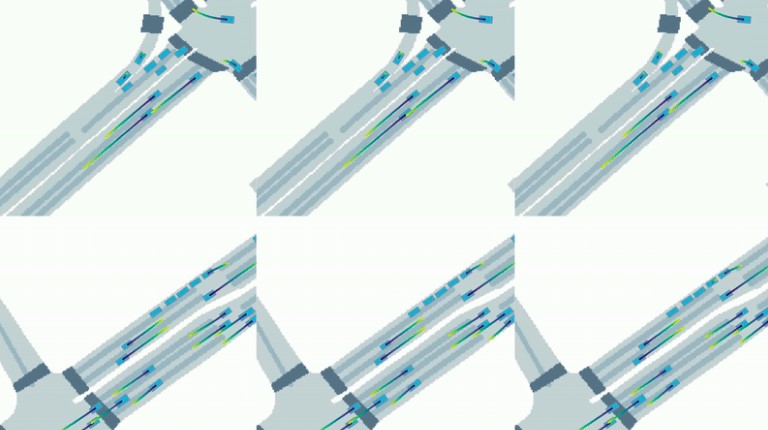
Generative AI complements this with simulation. With generative models trained on real driving traces, planners can stress-test signal-timing changes, lane reconfigurations, or new junction layouts before pouring concrete. Historical data drives predictive models that anticipate demand peaks, which is closer to a planning heuristic than a benchmark in our experience.
One concrete example: NVIDIA Research’s Bi-Level Imitation for Traffic Simulation (BITS) (observed-pattern, NVIDIA Developer Blog 2023) decomposes traffic-agent behaviour into a high-level prediction component and a low-level control component. The hierarchical split lets BITS replicate complex intersection behaviour and generate targeted scenarios — an unprotected left turn under congestion, a pedestrian incursion at peak — with more fidelity than monolithic imitation-learning baselines.
GPU-Accelerated Passenger Flow Analysis for Metro Efficiency
Metros carry a disproportionate share of urban commute trips, and crowd dynamics inside stations are where service quality is won or lost. GPU-accelerated video analytics has matured enough that real-time passenger-flow analysis is now a deployable capability rather than a research demo. Metro authorities use it to reallocate staff, adjust train headways, and intervene in platform crowding before it cascades.
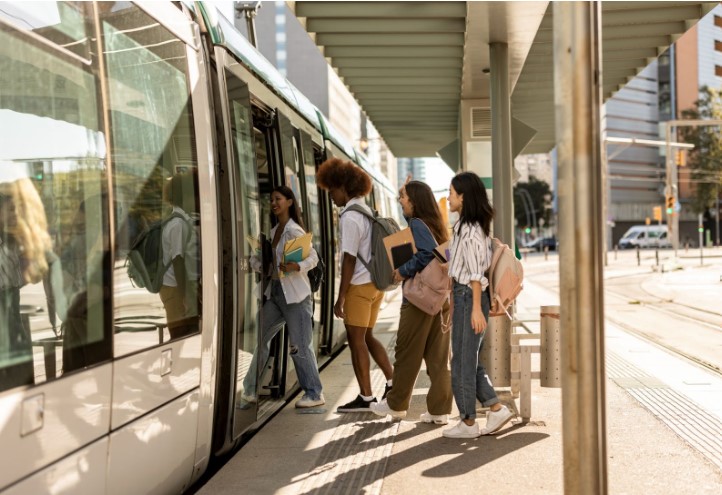
The mechanism is straightforward. CCTV feeds from concourses, escalators, and platform edges are decoded and run through computer-vision pipelines on GPUs — typically TensorRT-optimised detection models on top of CUDA, with NVDEC handling the video decode so the GPU is not bottlenecked on H.264 unpacking. Detection and multi-object tracking run frame-by-frame, surfacing metrics that operations actually use:
- Passenger density per square metre on platform sections.
- Flow direction and turning-movement counts at junctions inside the station.
- Queue formation at gate lines and ticket machines.
- Dwell-time anomalies that often precede incidents.
The output is a continuous operational signal, not a one-off study. Benefits we see referenced repeatedly across deployment write-ups:
- Better commuter safety and platform throughput.
- Train scheduling that responds to actual rather than forecast demand.
- Platform staff dispatched against measured congestion, not gut feel.
- Crowd control during peak hours informed by predicted, not reactive, density.
- Proactive intervention before congestion compounds.
This is where GPU acceleration earns its keep. Running modern detection-and-tracking pipelines on dozens of concurrent 1080p streams at low latency is not feasible on general-purpose CPUs once you require sub-second response.
Why does AI detect road violations more reliably than manual enforcement?
Computer-vision-based public safety in transportation has moved well beyond static speed cameras. The WHO’s Global Status Report on Road Safety 2023 records approximately 1.19 million road traffic fatalities annually (published-survey, WHO 2023), and a sizeable share is attributable to behaviours — red-light running, illegal lane changes, distracted driving — that are detectable from existing camera infrastructure if the inference layer is good enough.
AI-driven enforcement systems use detection and tracking models on roadside cameras to flag speeding, lane violations, illegal turns, and red-light running. The output is not just an alert; it is an evidentiary chain — frame timestamps, plate read, vehicle trajectory — that downstream enforcement processes can use.
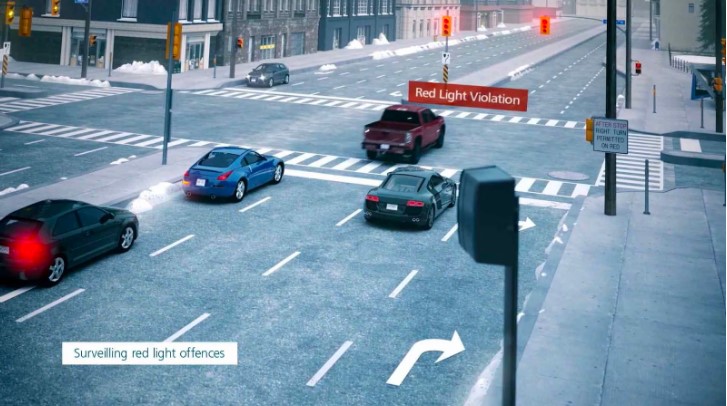
The case against manual enforcement is structural rather than rhetorical. Human operators introduce two unavoidable variances: limited coverage windows and subjective judgement. AI systems do not get tired, do not have shift changes, and apply the same threshold to every vehicle. That produces more consistent enforcement, which — when paired with transparent thresholds and review workflows — tends to be more defensible legally than manual stops.
Optimising Parking Management with AI
Urban vehicle growth has outpaced parking infrastructure in nearly every dense city. The result is a recurring failure mode: drivers circling for a free spot, generating congestion, emissions, and frustration entirely disproportionate to the trip purpose. Computer-vision-based parking management is one of the cleaner applications of AI in the transport stack because the problem is well-bounded and the ROI is measurable.
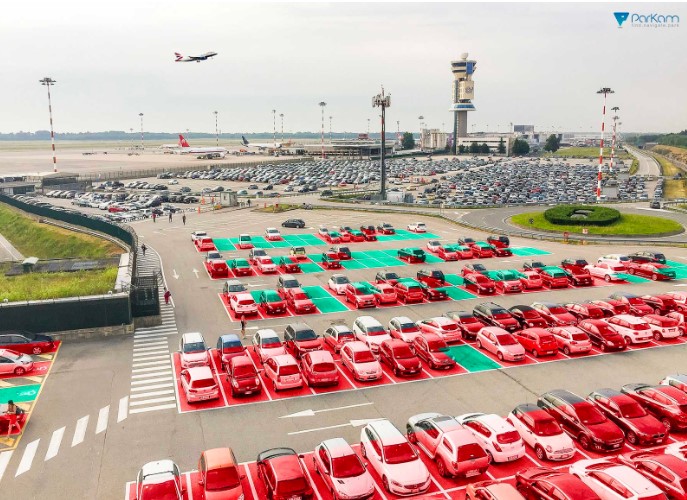
The pipeline has four stages:
- Step 1. Cameras are deployed across the parking facility — overhead for outdoor lots, ceiling-mounted for indoor garages. Each camera supervises a fixed set of bays.
- Step 2. A computer-vision model classifies each bay as occupied or vacant frame-by-frame. Modern deployments use small fine-tuned detectors rather than full object-detection networks, because the geometry is fixed and the model only needs to discriminate two states per bay.
- Step 3. Per-bay state changes flow into a backend that updates a real-time occupancy map.
- Step 4. Drivers see availability through an app or wayfinding display and route directly to a free bay.
Number-plate recognition extends the same camera infrastructure into touchless payment, removing the ticket-and-barrier friction that creates queues at exits. The same pipeline can also flag suspicious activity — loitering, attempted forced entry, vehicle break-ins — as an after-hours security layer. Engagements we see in this space typically combine all three (occupancy, payment, security) because the marginal cost of adding capabilities on top of an existing camera network is low.
AI Innovations to Make Public Transportation More Accessible
Accessibility is one of the places AI in transportation has the most leverage and gets the least attention. Machine-learning-powered apps can deliver turn-by-turn voice navigation inside stations for users with visual impairments. Natural-language processing translates signage and announcements between languages in real time. Predictive analytics surfaces the availability of accessibility vehicles before a passenger commits to a journey.
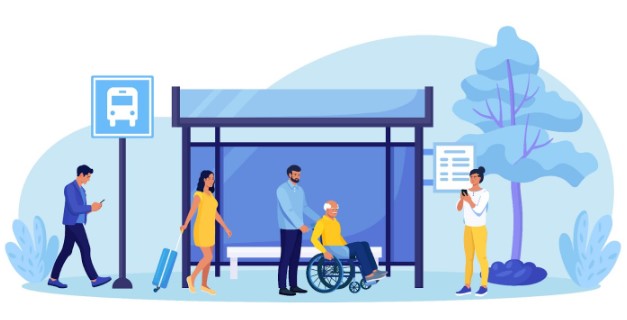
IoT sensors layered into infrastructure — lift status, escalator operation, ramp deployment — feed live accessibility information into journey planners. That changes the experience from “hope it works when I get there” to “I can see the lift is out of service before I leave”. Voice-guided NLP apps, predictive analytics for service planning, and IoT-based infrastructure monitoring are not a single product; they are a stack that turns an indifferent transit network into an inclusive one.
Future Trends in AI and Transportation
The horizon is dominated by two adjacent threads: autonomous vehicles and green-energy integration. Autonomous systems — even at SAE Level 2 and 3 — push toward smoother traffic flow because they react faster and more predictably than human drivers. V2X communication, where vehicles exchange state with each other and with the signal system, is the connective tissue that makes coordinated optimisation possible.
In parallel, electric and hybrid vehicles equipped with onboard AI optimise energy use against real-time conditions — terrain, traffic, regen opportunity. That cuts power draw and emissions without asking the driver to do anything different. The combined trajectory is faster, safer, and lower-carbon mobility, though the timeline for full integration depends heavily on infrastructure investment cycles rather than the AI itself.
Implementation Challenges
Deploying AI into a working transportation network is not a software project. The hardest problems are integration problems: matching new inference systems to legacy controllers, retrofitting cameras and edge devices into infrastructure that was not designed for them, and coordinating across agencies that own different parts of the corridor. Across our engagements with municipal and operator clients (observed-pattern, not a benchmarked rate), the largest delays tend to come from procurement and integration, not model accuracy.
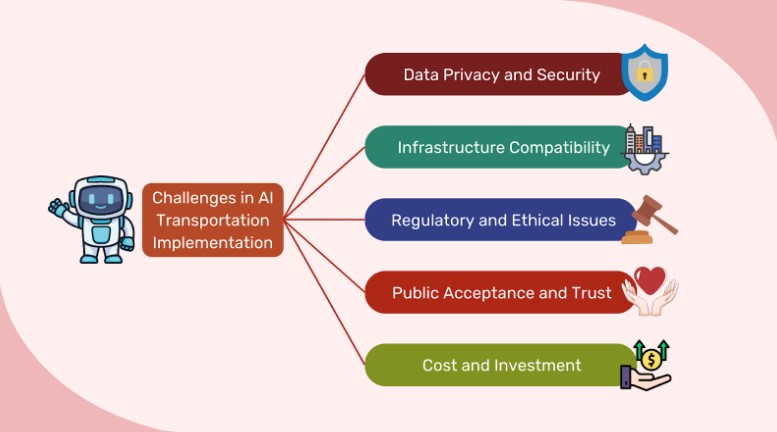
Beyond integration, four concerns surface in every project: data privacy (especially around plate and facial data), ethical handling of enforcement automation, public acceptance of opaque systems, and cost. None of these are solved by a better model. They are solved by careful scoping, clear governance, and a deployment plan that does not over-promise.
What We Can Offer as TechnoLynx
TechnoLynx works at the intersection of computer vision, GPU acceleration, generative AI, and IoT edge computing. Our engagements are scoped to your problem — we take outcome ownership rather than handing over a model and walking away. That matters in transportation, where deployment realities (camera angles, lighting, weather, network topology) decide whether a working prototype becomes a working system.
| Domain | Where we add the most value |
|---|---|
| Traffic analytics | Edge inference pipelines, model tuning for site-specific conditions |
| Metro and rail | GPU-accelerated multi-stream video analytics, density and dwell-time metrics |
| Enforcement | Detection plus evidentiary chain, plate-read fidelity at scale |
| Parking | End-to-end occupancy, plate recognition, and integration with payment |
| Accessibility | NLP, predictive availability, IoT-driven journey assistance |
We are a software R&D consulting firm. The work is the work — instrumented, measurable, and tied to the operational metrics that matter to your network.
Conclusion
AI in traffic, transit, and parking is not a single technology; it is a small number of well-understood techniques applied carefully to specific operational problems. Real-time edge analytics smooths signal timing. GPU-accelerated video analytics keeps metros moving. Computer-vision enforcement is more consistent than manual patrol. Parking optimisation removes one of the most visible sources of urban congestion. None of these are speculative — they are deployed, today, in cities that have done the integration work.
The harder question is not whether AI helps, but where the integration boundary sits and who owns the outcome when the system needs to perform. That is the part we treat as the actual project.
Frequently Asked Questions
How does AI improve real-time traffic management?
AI improves traffic management by pushing inference to the edge — onto cameras and roadside controllers — so signal timing and incident response can adapt within seconds rather than minutes. Edge processing reduces latency, removes dependence on central data-centre connectivity, and lets adaptive control respond to actual platoons rather than fixed schedules.
What role does GPU acceleration play in transport AI?
GPU acceleration is what makes large-scale, multi-stream video analytics tractable. A modern metro deployment may run dozens of concurrent 1080p feeds through detection and tracking models in real time, which CPUs cannot do at the required latency. GPUs handle video decode (NVDEC), inference (TensorRT or PyTorch on CUDA), and post-processing in a single pipeline.
Where does generative AI fit into traffic and transportation?
Generative AI is most useful for simulation. Models like NVIDIA’s BITS generate realistic traffic-agent behaviour, letting planners test signal-timing changes, lane reconfigurations, or autonomous-vehicle policies in simulation before deploying them. It is a planning and validation tool, not a real-time control mechanism.
What are the main challenges of deploying AI in transport systems?
The integration challenges dominate: matching new inference systems to legacy signal controllers, retrofitting sensors into infrastructure, and coordinating across agencies. Beyond that, data privacy (plate and facial data), enforcement ethics, public acceptance, and cost constraints all need explicit governance. None of these are solved by a better model.
Sources for the images
- BSW (n.d.) ParKam – Improved site is now up and running.
- Envato Elements (n.d.) Group of diverse friends in public transport.
- Envato Elements (n.d.) Passengers waiting public transport at bus stop.
- Ivanovic, B., Pavone, M., & Zadok, I. (2023). Simulating Realistic Traffic Behavior with a Bi-Level Imitation Learning AI Model.
- Jenoptik (n.d.) Innovative red light camera systems for combined speed and red light enforcement.
- Precedence Research (2023) Artificial Intelligence in Transportation Market Size, Report 2032.
References
Implementation separates theory from operational gain in AI-driven traffic systems. Imitation Learning for Real World Autonomous Driving Research.
- Cities Today, n.d. Chattanooga to trial energy-saving adaptive traffic control systems.
- NVIDIA Developer Blog, n.d. Simulating Realistic Traffic Behavior with a Bi-level Imitation Learning AI Model.
- Precedence Research, n.d. Artificial Intelligence in Transportation Market Size, Share & Trends Analysis Report by Mode of Transportation.
- World Health Organization, 2023. Global status report on road safety 2023.