
AI in music production is no longer a curiosity at the edge of the studio. It has moved into the daily workflow of composers and songwriters as a working tool — generating motifs, suggesting chord progressions, drafting lyric scaffolds, and accelerating the iterative loop between idea and audible output. The interesting question is no longer whether AI participates in composition. It is where it participates well, and where human judgement still does the load-bearing work.
The market signal is real. According to a GlobeNewswire industry report, generative AI for music is projected to grow at a 28.6% CAGR through 2032, reaching roughly USD 2.6 billion. That is a market-direction estimate, not an operational benchmark, but it tells us something useful: tooling investment is concentrated, and the workflow patterns being built now will shape what “AI-assisted composition” means for the next decade.
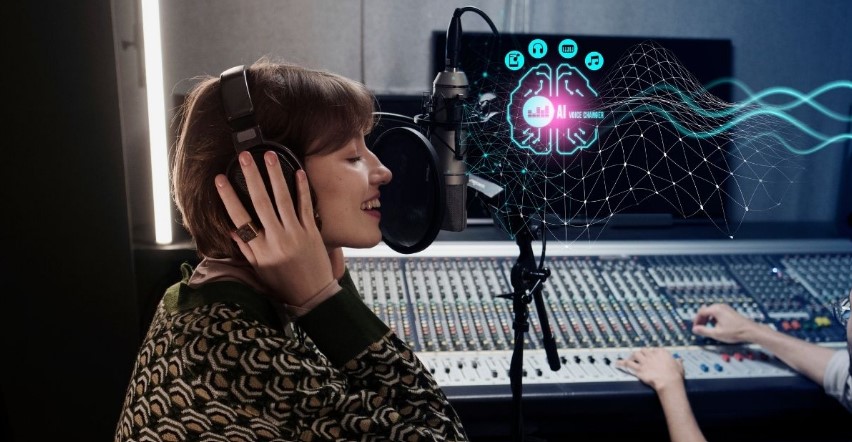
What does AI actually do in music composition?
Marketing claims outpace what these systems actually deliver. AI systems do not “compose music” in the sense a trained musician would. They generate candidate material — motifs, progressions, rhythmic patterns, lyric fragments — conditioned on training data and user input. The composer’s role shifts from generating raw ideas to evaluating, selecting, and shaping a flood of plausible-sounding output. The bottleneck moves from creation to curation.
In practice this means three distinct categories of tooling matter:
| Tool category | What it generates | Where the human still owns the decision |
|---|---|---|
| Motif and progression generators | Short melodic ideas, chord sequences, drum patterns | Which to keep, how to develop, where to break the pattern |
| Lyric drafting models | Verses, hooks, rhyme structures around a prompt | Emotional truth, narrative arc, voice consistency |
| Real-time accompaniment systems | Harmonisation, fills, variations during playback | Arrangement, mix decisions, performance intent |
Each category has different latency requirements, different acceptable error modes, and different points where a human edit becomes mandatory rather than optional. Conflating them is the most common source of overblown claims about AI replacing musicians.
AI-generated musical motifs
Motif generation is the most mature category. Systems like Google’s Magenta are trained on large corpora of musical compositions and produce short sequences conditioned on genre, key, or a seed phrase. The output is usable as a starting point for film scoring, advertising beds, and library music — settings where the brief is well-defined and the cost of an unremarkable result is low.
What these systems do not do is decide which motif belongs in this song. That judgement depends on context the model never sees: what the previous track on the album sounded like, what the artist is trying to say, what the audience expects this artist to not do. We see this pattern regularly in audio AI work — the generative step is fast, the curation step is where the time and craft actually goes.
NLP for interpreting musical intentions
A second strand of tooling lets composers describe what they want in natural language. OpenAI’s MuseNet and successor systems accept prompts like “a melancholic piano piece in the style of Debussy with a slow build” and produce candidate compositions. The translation from language to music is where it gets interesting — and where it breaks down.
Language describes music at a high level (mood, genre, instrumentation). Music exists at a low level (specific notes, specific timing, specific timbre). The mapping between the two is lossy in both directions. NLP-driven composition tools work best when the prompt is a constraint the composer can then push against, not a specification the system is expected to fulfil precisely.
GPU acceleration for real-time assistance
The third strand is real-time. GPU acceleration makes the difference between a generative system that runs as a background batch job and one that can suggest the next bar while the composer is still playing. Real-time changes the interaction model completely — the composer is no longer prompting and waiting, but improvising with an AI partner that responds within tens of milliseconds.
Google’s Magenta Studio and similar tools use GPU-accelerated inference to deliver this kind of latency. The engineering challenge is not just raw speed; it is bounded, predictable latency, because musicians notice jitter that other users would not.
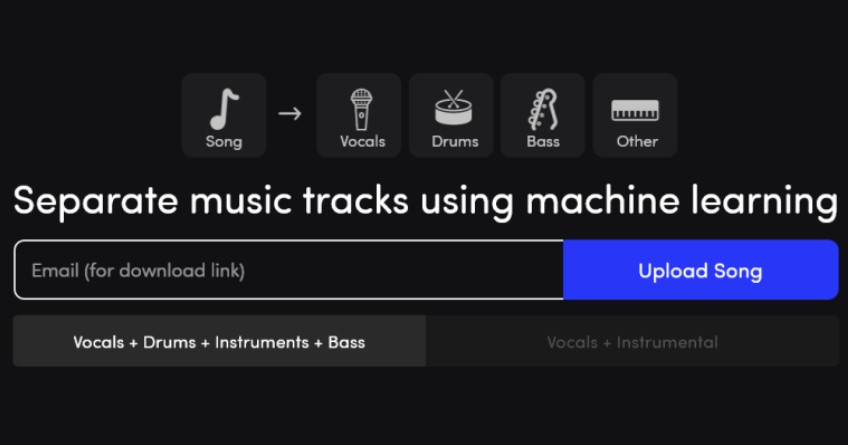
Collaborative composition: where AI sits in a multi-musician workflow
Rarely does a single individual shoulder the entire creative burden. Producers, session players, mixing engineers, and the artist all shape the final track. AI tooling has to slot into that workflow, not replace it.
Platforms like Splice let geographically separated collaborators exchange stems, MIDI, and project files. AI-assisted tools layer on top of this: a producer in one city can drop in an AI-generated drum pattern, a vocalist in another city can request lyric variations from a generative model, and the two can converge on a track without ever being in the same room. The IoT and edge-computing infrastructure underneath this is mundane but essential — synchronised playback across devices depends on tight clock discipline and low-latency networking.
Gesture-based composition using computer vision
A less obvious strand is gesture-controlled composition. Computer vision systems track hand and body movement and map it to musical parameters — pitch, velocity, filter cutoff, modulation depth. The Leap Motion Controller and similar devices, paired with software like GECO MIDI, let a composer shape sound by moving rather than by clicking. This matters less as a replacement for the keyboard and more as an additional axis of expression — particularly for performers whose musical instinct is physical rather than notational.
AI in songwriting: lyrics, mood, and the limits of generation
Melodic fragments emerge more easily from algorithms than do coherent verses. A motif can be tonally correct without meaning anything. A lyric that is grammatically correct but emotionally false fails on contact with a listener. The bar for human-feeling output is higher.
NLP for semantic understanding
The strongest current models — GPT-class systems and music-specific descendants — can produce lyrics that scan, rhyme, and stay on theme. What they cannot reliably do is sustain a single emotional voice across a song. The verses drift. The hook contradicts the bridge. A listener notices this within seconds, even if they cannot articulate why.
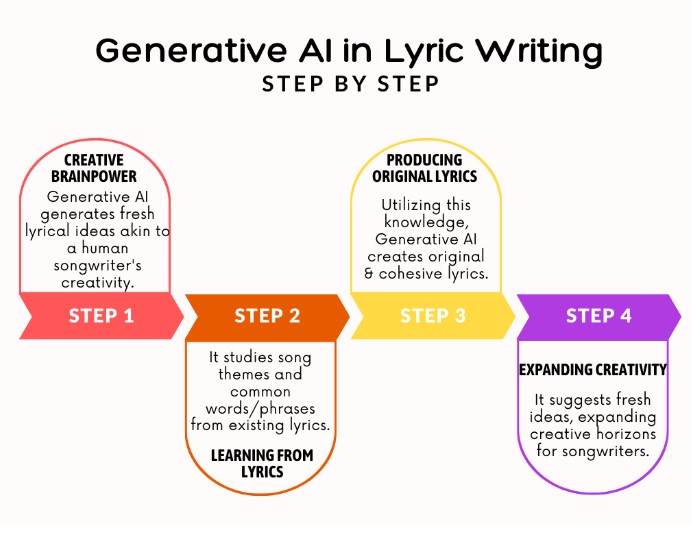
This is why the realistic use of lyric AI is drafting, not writing. The model produces a scaffold; the songwriter rewrites the lines that ring false. The ratio of human edits to retained AI output varies enormously by genre — a pop hook tolerates more synthetic phrasing than a singer-songwriter ballad does.
How does generative AI handle expressive lyrics?
Generative AI for lyrics works best on structured forms with strong conventions: verse-chorus-verse pop, advertising jingles, hook-driven dance tracks. It works worst on forms that depend on a specific authorial voice — confessional songwriting, hip-hop where the lyric is the artist, narrative folk where the story has to land.
A useful historical reference is Taryn Southern’s 2018 album I AM AI, which was co-written with Amper Music. Southern’s own interview with NPR about the project made the workflow explicit: AI generated raw musical and lyrical material, and the human work was the editing pass that made any of it usable. That ratio has not fundamentally changed in the years since, even as the underlying models have improved.
Mood and theme analysis
A quieter but useful application is mood and theme analysis — using AI to characterise existing tracks rather than generate new ones. Computer vision models analyse album artwork, music videos, and artist imagery; audio models extract tempo, key, timbral signatures, and energy curves. The output feeds recommendation systems, sync licensing search, and the kind of catalogue indexing that makes “find me something that feels like this but at 110 BPM” a tractable query.
Recognition systems like Shazam operate at the same layer, combining audio fingerprinting with visual cues to identify tracks at scale. The interesting engineering problem here is not the AI itself but the throughput — making the system work across millions of queries per day with low latency and high precision.
What this means for music technology teams
AI functions best as a sketch pad—generating raw material that human judgment then shapes into a finished piece. Teams building music AI products that ignore this — that pitch the AI as the artist — tend to ship demos that impress on first listen and disappoint on the tenth.
For our work at TechnoLynx on audio and generative AI systems, the design principles that have held up are:
- Latency budgets are tight. Musicians notice 20 ms of jitter (a representative threshold from perceptual studies, as reported in the psychoacoustic literature). Real-time assistance has to be engineered to bounded worst-case latency, not average-case.
- Curation surface matters more than generation quality. A model that produces 100 candidates the user can browse beats a model that produces one “perfect” candidate they cannot edit.
- Human-in-the-loop is the product, not a fallback. Lyric and melody generation are drafting tools. The UI has to make the editing pass fast, not the generation pass impressive.
- Domain-specific evaluation beats generic benchmarks. A model that scores well on perplexity may still produce lyrics that no human songwriter would keep.
These are observed patterns from generative AI engagements, not universal laws. The specifics shift with the form, the artist, and the production context. But the shape — AI drafts, human shapes, AI iterates — has been stable enough to design around.
Final thoughts
Asking whether machines will displace human creators misses the real transformation underway. The right question is what the division of labour looks like when generation is cheap and curation is the bottleneck. That division is already being drawn, in studios and in the tools shipping every quarter. The musicians and teams who treat AI as a drafting partner — and who invest in the editing surface that makes that partnership fast — are the ones building things that listeners actually want to hear.
Frequently Asked Questions
Does AI actually compose music, or just generate raw material?
AI systems generate candidate material — motifs, progressions, lyric fragments — conditioned on training data and prompts. The compositional decisions about which material to keep, how to develop it, and what the song is about still sit with a human. The bottleneck has moved from generation to curation.
Which AI tools are most used in music composition today?
Magenta and its derivatives for motif and pattern generation, MuseNet and successor systems for prompt-driven composition, GPT-class models for lyric drafting, and platforms like Amper and Splice that wrap these capabilities into a producer workflow. The category is fragmented and moves quickly.
Can AI write lyrics that feel emotionally real?
AI can draft lyrics that scan and rhyme on theme. Sustaining a single emotional voice across a full song is where current models struggle. In practice, lyric AI is used as a drafting layer that a human songwriter then rewrites — often heavily.
Why does GPU acceleration matter for music AI?
Real-time composition assistance requires bounded, predictable latency — musicians notice tens of milliseconds of jitter that other users would not. GPU acceleration is what makes generative systems usable as live collaborators rather than background batch jobs.
Why AI-composed music still needs human judgment
Pattern matching comes naturally to neural networks, yet they falter when a song demands catharsis or an unexpected key change.