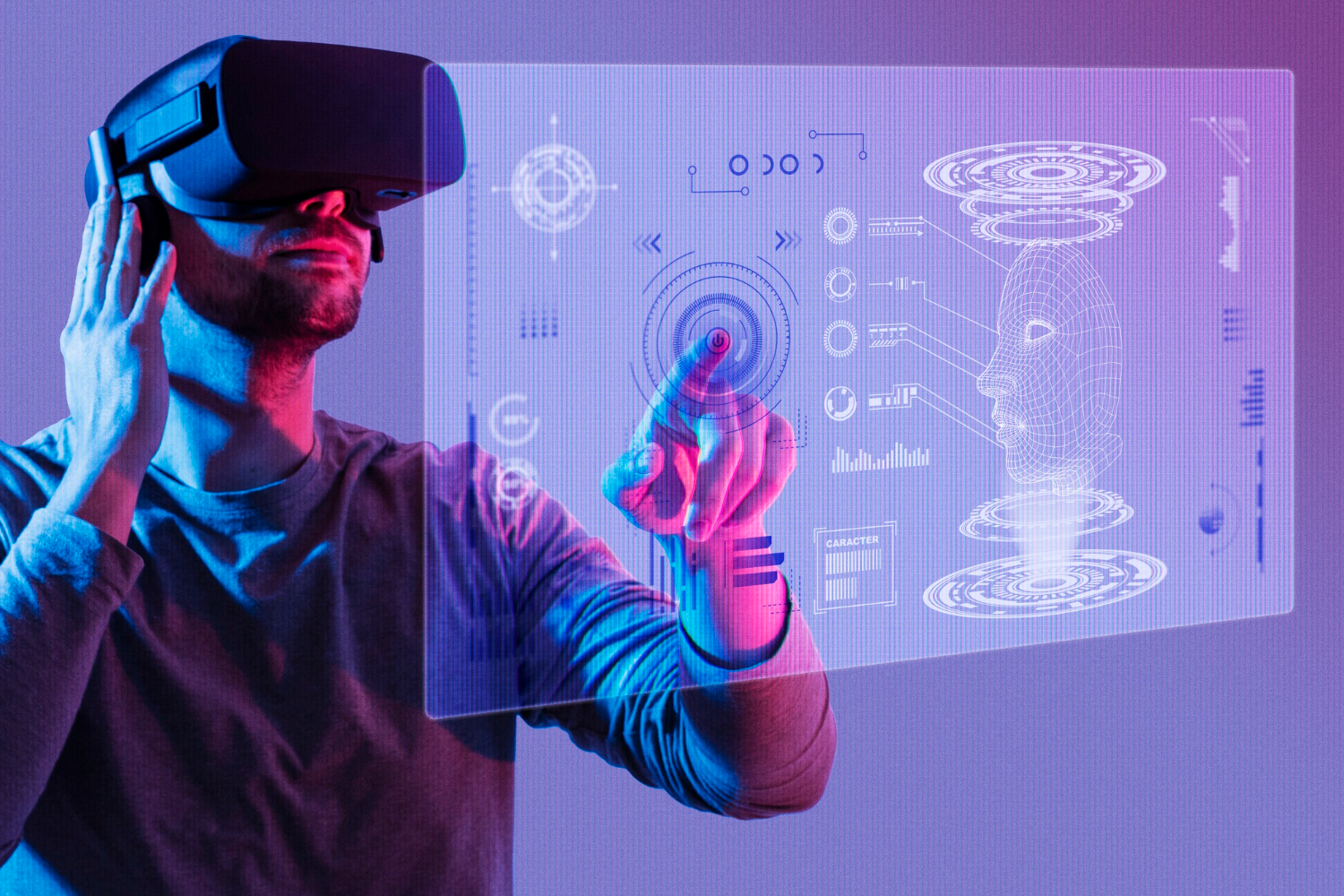

Futuristic AR and VR Technology: Immersive Future

Discover how futuristic AR and VR technology is shaping the future of immersive experiences, virtual environments, and real-time interactions.

Futuristic AR and VR Technology: Immersive  Future
Written by TechnoLynx Published on 24 Sep 2024

Futuristic AR and VR Technology Ahead

Augmented Reality (AR) and Virtual Reality (VR) have come a long way. What once seemed like science fiction is now a daily reality for millions of people. Futuristic AR and VR technology are pushing the boundaries of immersive experiences, creating worlds that feel just as real as our own.

These technologies aren’t just for video games anymore. They’re being used in education, healthcare, business, and beyond. As we look ahead, it’s clear that AR and VR will play a major role in shaping our future.

The Virtual World and Real-Time Interactions

At the heart of virtual reality is the creation of a virtual world. This is a fully computer-generated environment that you can interact with using VR headsets and other input devices.

Whether you’re walking through a forest, standing on a beach, or exploring a futuristic city, the experience feels incredibly lifelike. Real-time interaction is what makes VR so immersive. As you move, the world responds. You can look around, pick up objects, and interact with your surroundings.

In the near future, virtual reality headsets will become more advanced, offering even more realistic VR experiences. The use of haptic feedback (which lets you “feel” the virtual environment) and eye-tracking technology will take these experiences to a whole new level. Imagine being able to pick up a virtual cup and feel its weight, or walk through a virtual environment where every glance and movement is tracked and responded to in real-time.

Ivan Sutherland: The Pioneer of AR and VR

To understand where AR and VR are headed, it’s worth taking a look back at where it all began. Ivan Sutherland, a computer scientist, is widely considered the father of virtual reality. Back in the 1960s, he developed the first head-mounted display system, which was a precursor to modern VR headsets. Although it was primitive by today’s standards, it laid the foundation for the development of virtual reality and augmented reality technologies.

Since then, both AR and VR have evolved tremendously. Today, we’re not limited to bulky headsets and simple graphics. The futuristic AR and VR technology we’re seeing now is lightyears ahead of what Ivan Sutherland could have imagined.

Augmented Reality (AR) in the Future

While virtual reality immerses you in a completely digital world, augmented reality overlays virtual objects onto the physical world around you. Unlike VR, AR doesn’t take you away from your surroundings.

Instead, it enhances your environment by adding computer-generated elements. Imagine looking at a building and seeing virtual labels appear in the air, telling you more about the architecture. Or sitting in a classroom where AR technology brings history to life with 3D models.

AR technology is already being used in a wide range of industries. In medicine, doctors can use AR to overlay important patient data during surgery. In retail, customers can use AR to try on clothes or see how furniture will look in their homes.

As we move forward, AR will only become more integrated into our daily lives. AR and VR combined will create more seamless experiences, blurring the lines between the digital and physical worlds.

How Augmented Reality is Transforming Beauty and Cosmetics

Mixed Reality: Blending the Best of Both Worlds

Mixed reality (MR) combines the best aspects of virtual reality and augmented reality. It allows you to interact with both digital objects and your physical environment simultaneously. For example, you might use MR to see a virtual 3D model of a building, walk around it, and manipulate it with your hands—all while standing in your office. Unlike VR, you’re not completely cut off from the physical world, but unlike AR, you’re also interacting with more complex virtual objects.

Mixed reality is especially promising for industries like architecture, engineering, and design. It allows professionals to visualise complex projects in real-time, giving them a better understanding of how their designs will look and function in the real world.

Mixed Reality - The Integration of VR, AR, and XR

VR Technology in Entertainment and Beyond

When most people think of virtual reality, they think of video games. And it’s true—VR has completely transformed the gaming industry. Today, players can immerse themselves in worlds that feel incredibly real. They can explore new landscapes, solve puzzles, and battle enemies, all while fully engaged in the experience.

But VR technology has applications beyond gaming. In education, immersive VR can transport students to historical events, letting them experience history first-hand. In healthcare, VR is being used to help doctors practice surgery in a safe, virtual environment.

The technology can also be used to treat conditions like PTSD, where patients are gradually exposed to triggering situations in a controlled setting. The potential for VR technology is truly limitless.

Level Up Your Gaming Experience with AI and AR/VR

The Future of VR Headsets and Motion Sickness

One of the main challenges with current VR headsets is motion sickness. This occurs when there’s a disconnect between what your eyes are seeing and what your body is feeling. For example, if you’re walking around in a virtual environment but sitting still in the real world, your brain can get confused, leading to nausea and discomfort.

In the future, VR headsets will become more advanced, reducing the likelihood of motion sickness. Improved frame rates, more realistic motion tracking, and advancements in display technology will make VR more comfortable for longer periods of use. These improvements will open up new possibilities for VR content, from longer VR experiences to more detailed virtual environments.

AR and VR in the Workplace

One of the most exciting areas for AR and VR development is the workplace. In the future, professionals will use futuristic AR to improve collaboration, streamline workflows, and enhance training. Imagine attending a meeting where virtual objects appear on the table in front of you, allowing you to interact with 3D models of products, designs, or data.

Virtual reality will also play a big role in training and development. Employees will be able to practice skills in virtual environments, allowing for hands-on learning without the need for physical resources. This is especially valuable in industries like construction, where workers can train in dangerous situations without any real-world risk.

TechnoLynx’s Role in Futuristic AR and VR Development

At TechnoLynx, we are at the forefront of futuristic AR and VR technology. We help businesses gain the potential of these technologies to improve efficiency, engagement, and innovation. Whether it’s building virtual environments for training or creating AR experiences for real-time collaboration, our team of experts ensures that businesses can take full advantage of these groundbreaking technologies.

We specialise in developing custom AR and VR solutions tailored to the unique needs of our clients. Whether you’re in healthcare, education, retail, or any other industry, TechnoLynx can help you integrate AR and VR into your operations. We offer complete end-to-end solutions, from concept design to implementation and support.

Our team is experienced in working with a wide range of VR headsets, from the HTC Vive to Oculus Rift and beyond. We also have expertise in mixed reality, ensuring seamless interaction between the physical world and virtual objects. As the future of AR and VR unfolds, TechnoLynx is committed to staying ahead of the curve, delivering innovative solutions that meet the needs of businesses around the world.

Conclusion

Futuristic AR and VR technology will shape how we interact with the world around us. From virtual worlds and real-time interactions to immersive experiences in video games and professional training, the possibilities are endless. As virtual reality and augmented reality technologies continue to evolve, they will become more integrated into our daily lives, transforming industries and opening new doors for innovation.

At TechnoLynx, we’re excited to be part of this technological revolution. We help businesses navigate the world of AR and VR, providing the tools and expertise they need to succeed in this rapidly changing landscape. With our experience in AR, VR, and mixed reality, we can help you stay ahead of the competition and unlock the full potential of these groundbreaking technologies.

Continue reading: The Future of Augmented Reality: Transforming Our World

Cost, Efficiency, and Value Are Not the Same Metric

Cost, Efficiency, and Value Are Not the Same Metric

17/04/2026

Performance per dollar. Tokens per watt. Cost per request. These sound like the same thing said differently, but they measure genuinely different dimensions of AI infrastructure economics. Conflating them leads to infrastructure decisions that optimize for the wrong objective.

Precision Is an Economic Lever in Inference Systems

Precision Is an Economic Lever in Inference Systems

17/04/2026

Precision isn't just a numerical setting — it's an economic one. Choosing FP8 over BF16, or INT8 over FP16, changes throughput, latency, memory footprint, and power draw simultaneously. For inference at scale, these changes compound into significant cost differences.

Precision Choices Are Constrained by Hardware Architecture

Precision Choices Are Constrained by Hardware Architecture

17/04/2026

You can't run FP8 inference on hardware that doesn't have FP8 tensor cores. Precision format decisions are conditional on the accelerator's architecture — its tensor core generation, native format support, and the efficiency penalties for unsupported formats.

Steady-State Performance, Cost, and Capacity Planning

Steady-State Performance, Cost, and Capacity Planning

17/04/2026

Capacity planning built on peak performance numbers over-provisions or under-delivers. Real infrastructure sizing requires steady-state throughput — the predictable, sustained output the system actually delivers over hours and days, not the number it hit in the first five minutes.

How Benchmark Context Gets Lost in Procurement

How Benchmark Context Gets Lost in Procurement

16/04/2026

A benchmark result starts with full context — workload, software stack, measurement conditions. By the time it reaches a procurement deck, all that context is gone. The failure mode is not wrong benchmarks but context loss during propagation.

Building an Audit Trail: Benchmarks as Evidence for Governance and Risk

Building an Audit Trail: Benchmarks as Evidence for Governance and Risk

16/04/2026

High-value AI hardware decisions need traceable evidence, not slide-deck bullet points. When benchmarks are documented with methodology, assumptions, and limitations, they become auditable institutional evidence — defensible under scrutiny and revisitable when conditions change.

The Comparability Protocol: Why Benchmark Methodology Defines What You Can Compare

The Comparability Protocol: Why Benchmark Methodology Defines What You Can Compare

16/04/2026

Two benchmark scores can only be compared if they share a declared methodology — the same workload, precision, measurement protocol, and reporting conditions. Without that contract, the comparison is arithmetic on numbers of unknown provenance.

A Decision Framework for Choosing AI Hardware

A Decision Framework for Choosing AI Hardware

16/04/2026

Hardware selection is a multivariate decision under uncertainty — not a score comparison. This framework walks through the steps: defining the decision, matching evaluation to deployment, measuring what predicts production, preserving tradeoffs, and building a repeatable process.

How Benchmarks Shape Organizations Before Anyone Reads the Score

How Benchmarks Shape Organizations Before Anyone Reads the Score

16/04/2026

Before a benchmark score informs a purchase, it has already shaped what gets optimized, what gets reported, and what the organization considers important. Benchmarks function as decision infrastructure — and that influence deserves more scrutiny than the number itself.

Accuracy Loss from Lower Precision Is Task‑Dependent

Accuracy Loss from Lower Precision Is Task‑Dependent

16/04/2026

Reduced precision does not produce a uniform accuracy penalty. Sensitivity depends on the task, the metric, and the evaluation setup — and accuracy impact cannot be assumed without measurement.

Precision Is a Design Parameter, Not a Quality Compromise

Precision Is a Design Parameter, Not a Quality Compromise

16/04/2026

Numerical precision is an explicit design parameter in AI systems, not a moral downgrade in quality. This article reframes precision as a representation choice with intentional trade-offs, not a concession made reluctantly.

Mixed Precision Works by Exploiting Numerical Tolerance

Mixed Precision Works by Exploiting Numerical Tolerance

16/04/2026

Not every multiplication deserves 32 bits. Mixed precision works because neural network computations have uneven numerical sensitivity — some operations tolerate aggressive precision reduction, others don't — and the performance gains come from telling them apart.

Throughput vs Latency: Choosing the Wrong Optimization Target

16/04/2026

Throughput and latency are different objectives that often compete for the same resources. This article explains the trade-off, why batch size reshapes behavior, and why percentiles matter more than averages in latency-sensitive systems.

Quantization Is Controlled Approximation, Not Model Damage

16/04/2026

When someone says 'quantize the model,' the instinct is to hear 'degrade the model.' That framing is wrong. Quantization is controlled numerical approximation — a deliberate engineering trade-off with bounded, measurable error characteristics — not an act of destruction.

GPU Utilization Is Not Performance

15/04/2026

The utilization percentage in nvidia-smi reports kernel scheduling activity, not efficiency or throughput. This article explains the metric's exact definition, why it routinely misleads in both directions, and what to pair it with for accurate performance reads.

FP8, FP16, and BF16 Represent Different Operating Regimes

15/04/2026

FP8 is not just 'half of FP16.' Each numerical format encodes a different set of assumptions about range, precision, and risk tolerance. Choosing between them means choosing operating regimes — different trade-offs between throughput, numerical stability, and what the hardware can actually accelerate.

Peak Performance vs Steady‑State Performance in AI

15/04/2026

AI systems rarely operate at peak. This article defines the peak vs. steady-state distinction, explains when each regime applies, and shows why evaluations that capture only peak conditions mischaracterize real-world throughput.

The Software Stack Is a First‑Class Performance Component

15/04/2026

Drivers, runtimes, frameworks, and libraries define the execution path that determines GPU throughput. This article traces how each software layer introduces real performance ceilings and why version-level detail must be explicit in any credible comparison.

The Mythology of 100% GPU Utilization

15/04/2026

Is 100% GPU utilization bad? Will it damage the hardware? Should you be worried? For datacenter AI workloads, sustained high utilization is normal — and the anxiety around it usually reflects gaming-era intuitions that don't apply.

Why Benchmarks Fail to Match Real AI Workloads

15/04/2026

The word 'realistic' gets attached to benchmarks freely, but real AI workloads have properties that synthetic benchmarks structurally omit: variable request patterns, queuing dynamics, mixed operations, and workload shapes that change the hardware's operating regime.

Why Identical GPUs Often Perform Differently

15/04/2026

'Same GPU' does not imply the same performance. This article explains why system configuration, software versions, and execution context routinely outweigh nominal hardware identity.

Training and Inference Are Fundamentally Different Workloads

15/04/2026

A GPU that excels at training may disappoint at inference, and vice versa. Training and inference stress different system components, follow different scaling rules, and demand different optimization strategies. Treating them as interchangeable is a design error.

Performance Ownership Spans Hardware and Software Teams

15/04/2026

When an AI workload underperforms, attribution is the first casualty. Hardware blames software. Software blames hardware. The actual problem lives in the gap between them — and no single team owns that gap.

Performance Emerges from the Hardware × Software Stack

15/04/2026

AI performance is an emergent property of hardware, software, and workload operating together. This article explains why outcomes cannot be attributed to hardware alone and why the stack is the true unit of performance.

Power, Thermals, and the Hidden Governors of Performance

14/04/2026

Every GPU has a physical ceiling that sits below its theoretical peak. Power limits, thermal throttling, and transient boost clocks mean that the performance you read on the spec sheet is not the performance the hardware sustains. The physics always wins.

Why AI Performance Changes Over Time

14/04/2026

That impressive throughput number from the first five minutes of a training run? It probably won't hold. AI workload performance shifts over time due to warmup effects, thermal dynamics, scheduling changes, and memory pressure. Understanding why is the first step toward trustworthy measurement.

CUDA, Frameworks, and Ecosystem Lock-In

14/04/2026

Why is it so hard to switch away from CUDA? Because the lock-in isn't in the API — it's in the ecosystem. Libraries, tooling, community knowledge, and years of optimization create switching costs that no hardware swap alone can overcome.

GPUs Are Part of a Larger System

14/04/2026

CPU overhead, memory bandwidth, PCIe topology, and host-side scheduling routinely limit what a GPU can deliver — even when the accelerator itself has headroom. This article maps the non-GPU bottlenecks that determine real AI throughput.

Why AI Performance Must Be Measured Under Representative Workloads

14/04/2026

Spec sheets, leaderboards, and vendor numbers cannot substitute for empirical measurement under your own workload and stack. Defensible performance conclusions require representative execution — not estimates, not extrapolations.

Low GPU Utilization: Where the Real Bottlenecks Hide

14/04/2026

When GPU utilization drops below expectations, the cause usually isn't the GPU itself. This article traces common bottleneck patterns — host-side stalls, memory-bandwidth limits, pipeline bubbles — that create the illusion of idle hardware.

Why GPU Performance Is Not a Single Number

14/04/2026

AI GPU performance is multi-dimensional and workload-dependent. This article explains why scalar rankings collapse incompatible objectives and why 'best GPU' questions are structurally underspecified.

What a GPU Benchmark Actually Measures

14/04/2026

A benchmark result is not a hardware measurement — it is an execution measurement. The GPU, the software stack, and the workload all contribute to the number. Reading it correctly requires knowing which parts of the system shaped the outcome.

Why Spec‑Sheet Benchmarking Fails for AI

14/04/2026

GPU spec sheets describe theoretical limits. This article explains why real AI performance is an execution property shaped by workload, software, and sustained system behavior.

Augmented Reality Entertainment: Real-Time Digital Fun

28/03/2025

See how augmented reality entertainment is changing film, gaming, and live events with digital elements, AR apps, and real-time interactive experiences.

Back See Blogs
arrow icon