How AI can Read our Psyche

The eyes are the window to the soul. Yeah, but there are easier ways to access it if you ask us. Want to find out how psychology and neurology can be enhanced using AI? Let’s go!

How AI can Read our Psyche
Written by TechnoLynx Published on 09 May 2024

Introduction

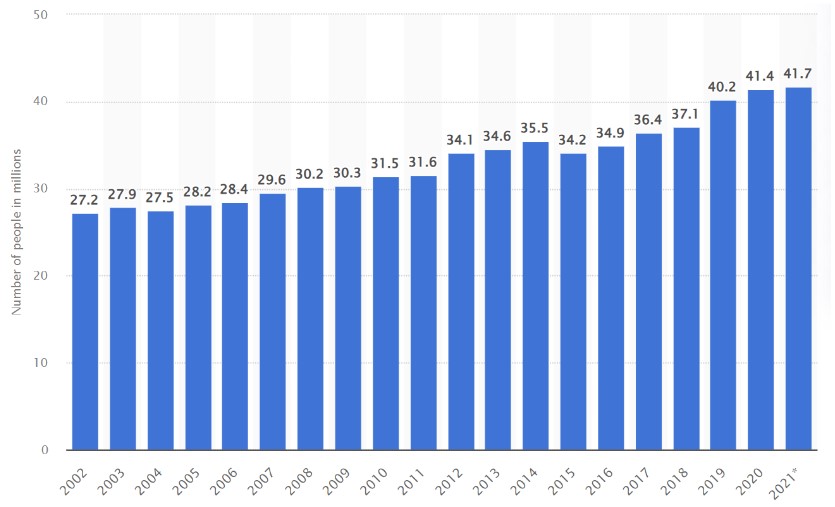
Psychology is a well-respected field of science and, dare we say, essential for the well-being of many people. Since 2002, the number of US citizens who received mental health treatment or counselling has increased by almost 50% (Mental health treatment or therapy among American adults 2002-2021). At the same time, 30% of people with depression do not seek any kind of treatment (30 Percent of Depressed People Do Not Receive Treatment, Psychology Today United Kingdom). A few decades ago, seeking treatment was perceived as being problematic. Although this is no longer the case, at least in modern countries, therapy can require many resources that people might not have access to. In any case, there are deterrent factors that prevent people from seeking help. However, this does not mean that a solution cannot be found. Let’s look at how AI can be added to our arsenal of medical solutions to heal the soul.

Figure 1 – Bar chart of the number of US adults in millions who received mental health treatment or counselling from 2002 to 2021 (Mental health treatment or therapy among American adults 2002-2021)

If you Get to Know me Better

Today, going to a therapist couldn’t be easier. Just book an appointment online and schedule your first session. At first, the therapist needs to learn about the patient to build his ‘profile’. Usually, the focus is on milestones in the patient’s life or points that had a serious impact on them. Although this is important, depending on how open the patient is for discussion, it can take weeks or even months until the patient’s profile is built!

Now you See me

Computer Vision (CV) has already been praised for its potential to benefit many fields and psychology is no exception. Face recognition algorithms can greatly assist in analysing an individual’s facial expressions. Human facial expressions are one of the most important non-verbal ways to communicate. Our faces have 43 different muscles, and it is estimated that we can make more than 10000 different expressions. Although humans may have difficulty sharing their emotions with others, this does not mean they can’t share them on a screen. Facial expressions can be essential to draw safe conclusions about some cognitive patterns, reading ‘behind the lines’ of what is said. Face expression recognition could be of great value to psychologists. Through Edge-Computing, localising the necessary hardware would allow for data processing at even higher speeds than those offered by cloud services, an excellent choice for large psychology centres that are visited by thousands of people each day.

Figure 2 – Concept of facial expression recognition using computer vision. The different points of interest are highlighted (Schepke, 2023)

Hear me Out

Words can lie, and facial expressions can deceive you. What other options does a therapist have? The voice! Natural Language Processing (NLP) algorithms are AI algorithms that can extract crucial information from one’s speech regarding one’s behaviour or psychological state. NLPs can not only draw conclusions about someone’s interests, but they can also indicate the words that were stressed and what the speaker’s feelings were, through voice tone recognition protocols. Similarly to CV, NLP technologies can be beneficial for large psychology centres. Centres, apart from edge computing, can also benefit from the Internet of Things (IoT) if they have more than one branch. The IoT can connect the databases of those centres for cross-data checking to improve the performance of the AI algorithms in use.

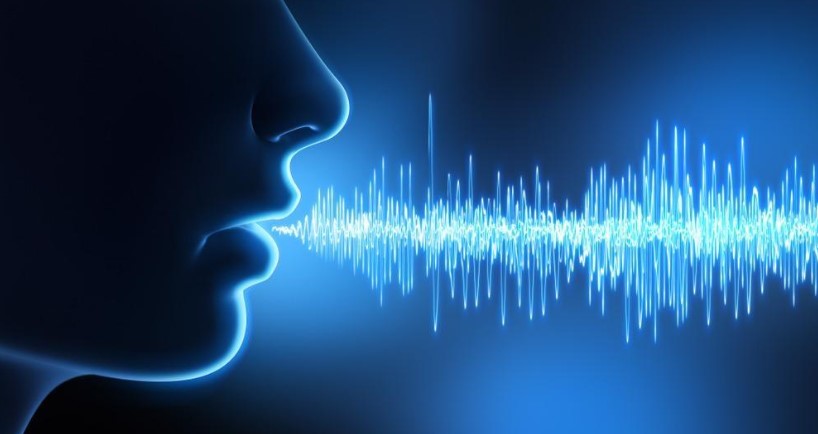
Figure 3 – Graphic illustration of the voice leaving a woman’s mouth in the form of a graphic equaliser (Moore, 2021)

A Friend in Need is a Friend in Deed

What would happen if we took a CV algorithm and combined its power with an NLP model? Our personal AI psychologist! Many people wish to express their true thoughts with people who are complete strangers to them, not to mention that most people feel safer or less exposed behind a computer screen. Chatbots have revolutionised the way we interact with some websites or solve some problems. Take this chatbot, make it smarter with Generative AI, and there you have it! Your private AI psychologist, capable of making true discussions, analysing your speech and facial expressions, and reaching safe conclusions that it can express and you can make use of!

Is that all?

Of course, what we have mentioned so far does not only concern therapists. Evaluation of the psychological state of an individual can be essential in other fields, such as criminology. Law enforcement agencies use what is called ‘Offender Profiling’ to identify possible suspects and link cases. This profiling is usually made manually, or through the help of some elementary algorithms that still need human input. We are no experts in law enforcement, but we bet the professionals would like to have a machine do this for them by combining all factors, even the tiny details. Guess what… AI offender profiling and forensics is already happening! Complex algorithms are already being developed and used by law enforcement to make the necessary connections between crime scenes and individuals, or to state areas as potentially in the risk of crime. Such algorithms use GPU acceleration to boost their efficiency, as, to achieve optimal results, the data can sometimes be overwhelming for a simple computer.

Another application of psychological assesment is medicine, but probably not as you think. Lifted spirits are a key factor in the treatment of many cases, such as different forms of cancer. In addition to that, feeling good and relaxed can be a game changer for patients preparing for surgery by increasing success odds and reducing postoperative recovery time. Talking about medicine… what if we told you that our psychology is determined by our body chemistry?

Figure 4 – Unknown man to be identified (Premium Photo | Anonymous man in a business shirt with a question mark on his face on a dark background)

Psyche vs Soma

How our body functions is a very delicate process determined by our genes, and it can have a direct impact on our soul. Proteins are the key to all our feelings. We fall in love, we get angry, we feel pain. Everything is a matter of protein synthesis. Proteins are essential for the growth, plasticity, and maintenance of neurones, a cell type responsible for sending messages throughout our body. Damage to neurons can bring terrible results to how we interact with our environment and close ones. However, this does not necessarily mean that the neurone itself is damaged. The release of proteins around neurons can have devastating effects on our perception. Maybe the term ‘Alzheimer’s disease’ will ring some bells.

Pick my Brain

This disease is characterised by deposits of certain proteins that cause changes in the brain, causing it to shrink and brain cells to eventually die. Being the most common cause of dementia, Alzheimer’s is characterised by a gradual decline in memory, thinking, behaviour, and social skills. Fortunately, this disease can be slowed if detected early, and technology is on our side! One solution is to perform brain scans and then have the doctor examine them or feed them into a CV image classification algorithm to detect the anomaly. Or… we can do it at home! Why bother going to the hospital and spending God knows how much time and money when we can be tested from the comfort of our couch? Speech-orientated tests can safely reach conclusions through cognitive pattern recognition about a patient having or not having Alzheimer’s through a conversation. Such tests ask memory-probing questions inspired by those used in outpatient consultations and conduct cognitive tests, such as picture descriptions and verbal fluency tests. Merge such tests with our AI psychologist, and there you have it! Guaranteed diagnosis without sweat!

Keep it Steady

Similarly to Alzheimer’s, Parkinson’s disease is a neurological condition that occurs in the brain, caused by a loss of nerve cells in the substantia nigra, leading to a reduction in dopamine, an essential substance for the regulation of body movement. A CV algorithm could potentially be beneficial for the early detection of Parkinson’s disease by analysing your body movements. When detected in the early stages, Parkinson’s can be slowed by taking countermeasures, the first being physical therapy and exercises that encourage balance and reciprocal patterns. Such exercises can be executed with or without an instructor. In any case, such exercises can be harsh on the joints. Thankfully, there are companies that can take care of joint pain with the help of technology.

Figure 5 – The MOVE+ Pro NIR enhanced light therapy device by the company KINEON (Red Light Therapy Science)

Kineon is a technology company that focusses on innovating light therapy devices and providing clinical-level treatments in the comfort of your home. In 2019 they conceived the idea of a safe, non-invasive, and enhanced light therapy device, named ‘MOVE+ Pro’. Early birds could purchase it in 2021; as of 2023, it has become available for the general public. The MOVE+ Pro uses Near Infrared (NIR) red light to reduce inflammation, boost healing and recovery, and even boost collagen production in your joints. It can be used by all ages, both as a treatment for joint pain and as a precaution after training for optimal recovery. The ’MOVE+ Pro’ has a small form factor and comes in a travel case to carry it wherever you need. It is equipped with 3 LED laser modules, 1 adjustable strap, and a charging cable. Click here to visit their store and get yours now. And please don’t rush to evaluate whether it suits your needs, as Kineon offers a 30-day trial. Last, no need to panic if you want it but live in a remote area. Kineon proudly ships their products worldwide!

Summing Up

Whoever said AI can only be technical couldn’t be more wrong. AI can be a powerful ally in the fields of psychology and neurology. Advanced AI models can read your facial expressions, understand what you mean despite the words you choose, and even make a diagnosis of neurological conditions. CV continues to improve daily, and medical applications are no exception in the fields in which it can be applied.

What We Offer

If you are looking for custom, innovative tech solutions tailored to your needs, we at TechnoLynx are the people you have been looking for. We understand better than anyone the benefits of integrating AI into existing systems to modernise them. Our expertise covers AI solutions that can be integrated to a plethora of fields and applications including psychology and neurology, or make an AI-driven system from scratch.

We are driven to provide innovative solutions that increase efficiency, accuracy, and productivity, while ensuring safety in human-machine interactions, managing and analysing extensive data sets, and addressing ethical considerations. Feel free to contact us. We will be more than happy to answer any questions!

List of references

  • 30 Percent of Depressed People Do Not Receive Treatment | Psychology Today United Kingdom (Accessed: 6 February 2024).

  • Mental health treatment or therapy among american adults 2002-2021 Statista (Accessed: 6 February 2024).

  • Moore, S. (2021) Voice Analysis in Forensics, AZoLifeSciences (Accessed: 7 February 2024).

  • Premium Photo | Anonymous man in a business shirt with question mark on his face on dark background Freepik (Accessed: 11 February 2024).

  • Red Light Therapy Science Kineon (Accessed: 25 January 2024).

  • Schepke, R. (2023) Decoding lies with AI? New machine learning model uses facial expressions and pulse rates to detect deception, PsyPost (Accessed: 7 February 2024).

Cost, Efficiency, and Value Are Not the Same Metric

Cost, Efficiency, and Value Are Not the Same Metric

17/04/2026

Performance per dollar. Tokens per watt. Cost per request. These sound like the same thing said differently, but they measure genuinely different dimensions of AI infrastructure economics. Conflating them leads to infrastructure decisions that optimize for the wrong objective.

Precision Is an Economic Lever in Inference Systems

Precision Is an Economic Lever in Inference Systems

17/04/2026

Precision isn't just a numerical setting — it's an economic one. Choosing FP8 over BF16, or INT8 over FP16, changes throughput, latency, memory footprint, and power draw simultaneously. For inference at scale, these changes compound into significant cost differences.

Precision Choices Are Constrained by Hardware Architecture

Precision Choices Are Constrained by Hardware Architecture

17/04/2026

You can't run FP8 inference on hardware that doesn't have FP8 tensor cores. Precision format decisions are conditional on the accelerator's architecture — its tensor core generation, native format support, and the efficiency penalties for unsupported formats.

Steady-State Performance, Cost, and Capacity Planning

Steady-State Performance, Cost, and Capacity Planning

17/04/2026

Capacity planning built on peak performance numbers over-provisions or under-delivers. Real infrastructure sizing requires steady-state throughput — the predictable, sustained output the system actually delivers over hours and days, not the number it hit in the first five minutes.

How Benchmark Context Gets Lost in Procurement

How Benchmark Context Gets Lost in Procurement

16/04/2026

A benchmark result starts with full context — workload, software stack, measurement conditions. By the time it reaches a procurement deck, all that context is gone. The failure mode is not wrong benchmarks but context loss during propagation.

Building an Audit Trail: Benchmarks as Evidence for Governance and Risk

Building an Audit Trail: Benchmarks as Evidence for Governance and Risk

16/04/2026

High-value AI hardware decisions need traceable evidence, not slide-deck bullet points. When benchmarks are documented with methodology, assumptions, and limitations, they become auditable institutional evidence — defensible under scrutiny and revisitable when conditions change.

The Comparability Protocol: Why Benchmark Methodology Defines What You Can Compare

The Comparability Protocol: Why Benchmark Methodology Defines What You Can Compare

16/04/2026

Two benchmark scores can only be compared if they share a declared methodology — the same workload, precision, measurement protocol, and reporting conditions. Without that contract, the comparison is arithmetic on numbers of unknown provenance.

A Decision Framework for Choosing AI Hardware

A Decision Framework for Choosing AI Hardware

16/04/2026

Hardware selection is a multivariate decision under uncertainty — not a score comparison. This framework walks through the steps: defining the decision, matching evaluation to deployment, measuring what predicts production, preserving tradeoffs, and building a repeatable process.

How Benchmarks Shape Organizations Before Anyone Reads the Score

How Benchmarks Shape Organizations Before Anyone Reads the Score

16/04/2026

Before a benchmark score informs a purchase, it has already shaped what gets optimized, what gets reported, and what the organization considers important. Benchmarks function as decision infrastructure — and that influence deserves more scrutiny than the number itself.

Accuracy Loss from Lower Precision Is Task‑Dependent

Accuracy Loss from Lower Precision Is Task‑Dependent

16/04/2026

Reduced precision does not produce a uniform accuracy penalty. Sensitivity depends on the task, the metric, and the evaluation setup — and accuracy impact cannot be assumed without measurement.

Precision Is a Design Parameter, Not a Quality Compromise

Precision Is a Design Parameter, Not a Quality Compromise

16/04/2026

Numerical precision is an explicit design parameter in AI systems, not a moral downgrade in quality. This article reframes precision as a representation choice with intentional trade-offs, not a concession made reluctantly.

Mixed Precision Works by Exploiting Numerical Tolerance

Mixed Precision Works by Exploiting Numerical Tolerance

16/04/2026

Not every multiplication deserves 32 bits. Mixed precision works because neural network computations have uneven numerical sensitivity — some operations tolerate aggressive precision reduction, others don't — and the performance gains come from telling them apart.

Throughput vs Latency: Choosing the Wrong Optimization Target

16/04/2026

Throughput and latency are different objectives that often compete for the same resources. This article explains the trade-off, why batch size reshapes behavior, and why percentiles matter more than averages in latency-sensitive systems.

Quantization Is Controlled Approximation, Not Model Damage

16/04/2026

When someone says 'quantize the model,' the instinct is to hear 'degrade the model.' That framing is wrong. Quantization is controlled numerical approximation — a deliberate engineering trade-off with bounded, measurable error characteristics — not an act of destruction.

GPU Utilization Is Not Performance

15/04/2026

The utilization percentage in nvidia-smi reports kernel scheduling activity, not efficiency or throughput. This article explains the metric's exact definition, why it routinely misleads in both directions, and what to pair it with for accurate performance reads.

FP8, FP16, and BF16 Represent Different Operating Regimes

15/04/2026

FP8 is not just 'half of FP16.' Each numerical format encodes a different set of assumptions about range, precision, and risk tolerance. Choosing between them means choosing operating regimes — different trade-offs between throughput, numerical stability, and what the hardware can actually accelerate.

Peak Performance vs Steady‑State Performance in AI

15/04/2026

AI systems rarely operate at peak. This article defines the peak vs. steady-state distinction, explains when each regime applies, and shows why evaluations that capture only peak conditions mischaracterize real-world throughput.

The Software Stack Is a First‑Class Performance Component

15/04/2026

Drivers, runtimes, frameworks, and libraries define the execution path that determines GPU throughput. This article traces how each software layer introduces real performance ceilings and why version-level detail must be explicit in any credible comparison.

The Mythology of 100% GPU Utilization

15/04/2026

Is 100% GPU utilization bad? Will it damage the hardware? Should you be worried? For datacenter AI workloads, sustained high utilization is normal — and the anxiety around it usually reflects gaming-era intuitions that don't apply.

Why Benchmarks Fail to Match Real AI Workloads

15/04/2026

The word 'realistic' gets attached to benchmarks freely, but real AI workloads have properties that synthetic benchmarks structurally omit: variable request patterns, queuing dynamics, mixed operations, and workload shapes that change the hardware's operating regime.

Why Identical GPUs Often Perform Differently

15/04/2026

'Same GPU' does not imply the same performance. This article explains why system configuration, software versions, and execution context routinely outweigh nominal hardware identity.

Training and Inference Are Fundamentally Different Workloads

15/04/2026

A GPU that excels at training may disappoint at inference, and vice versa. Training and inference stress different system components, follow different scaling rules, and demand different optimization strategies. Treating them as interchangeable is a design error.

Performance Ownership Spans Hardware and Software Teams

15/04/2026

When an AI workload underperforms, attribution is the first casualty. Hardware blames software. Software blames hardware. The actual problem lives in the gap between them — and no single team owns that gap.

Performance Emerges from the Hardware × Software Stack

15/04/2026

AI performance is an emergent property of hardware, software, and workload operating together. This article explains why outcomes cannot be attributed to hardware alone and why the stack is the true unit of performance.

Power, Thermals, and the Hidden Governors of Performance

14/04/2026

Every GPU has a physical ceiling that sits below its theoretical peak. Power limits, thermal throttling, and transient boost clocks mean that the performance you read on the spec sheet is not the performance the hardware sustains. The physics always wins.

Why AI Performance Changes Over Time

14/04/2026

That impressive throughput number from the first five minutes of a training run? It probably won't hold. AI workload performance shifts over time due to warmup effects, thermal dynamics, scheduling changes, and memory pressure. Understanding why is the first step toward trustworthy measurement.

CUDA, Frameworks, and Ecosystem Lock-In

14/04/2026

Why is it so hard to switch away from CUDA? Because the lock-in isn't in the API — it's in the ecosystem. Libraries, tooling, community knowledge, and years of optimization create switching costs that no hardware swap alone can overcome.

GPUs Are Part of a Larger System

14/04/2026

CPU overhead, memory bandwidth, PCIe topology, and host-side scheduling routinely limit what a GPU can deliver — even when the accelerator itself has headroom. This article maps the non-GPU bottlenecks that determine real AI throughput.

Why AI Performance Must Be Measured Under Representative Workloads

14/04/2026

Spec sheets, leaderboards, and vendor numbers cannot substitute for empirical measurement under your own workload and stack. Defensible performance conclusions require representative execution — not estimates, not extrapolations.

Low GPU Utilization: Where the Real Bottlenecks Hide

14/04/2026

When GPU utilization drops below expectations, the cause usually isn't the GPU itself. This article traces common bottleneck patterns — host-side stalls, memory-bandwidth limits, pipeline bubbles — that create the illusion of idle hardware.

Why GPU Performance Is Not a Single Number

14/04/2026

AI GPU performance is multi-dimensional and workload-dependent. This article explains why scalar rankings collapse incompatible objectives and why 'best GPU' questions are structurally underspecified.

What a GPU Benchmark Actually Measures

14/04/2026

A benchmark result is not a hardware measurement — it is an execution measurement. The GPU, the software stack, and the workload all contribute to the number. Reading it correctly requires knowing which parts of the system shaped the outcome.

Why Spec‑Sheet Benchmarking Fails for AI

14/04/2026

GPU spec sheets describe theoretical limits. This article explains why real AI performance is an execution property shaped by workload, software, and sustained system behavior.

Deep Learning Models for Accurate Object Size Classification

27/01/2026

A clear and practical guide to deep learning models for object size classification, covering feature extraction, model architectures, detection pipelines, and real‑world considerations.

Mimicking Human Vision: Rethinking Computer Vision Systems

10/11/2025

Why computer vision systems trained on benchmarks fail on real inputs, and how attention mechanisms, context modelling, and multi-scale features close the gap.

Visual analytic intelligence of neural networks

7/11/2025

Neural network visualisation: how activation maps, layer inspection, and feature attribution reveal what a model has learned and where it will fail.

Visual Computing in Life Sciences: Real-Time Insights

6/11/2025

Learn how visual computing transforms life sciences with real-time analysis, improving research, diagnostics, and decision-making for faster, accurate outcomes.

AI-Driven Aseptic Operations: Eliminating Contamination

21/10/2025

Learn how AI-driven aseptic operations help pharmaceutical manufacturers reduce contamination, improve risk assessment, and meet FDA standards for safe, sterile products.

AI Visual Quality Control: Assuring Safe Pharma Packaging

20/10/2025

See how AI-powered visual quality control ensures safe, compliant, and high-quality pharmaceutical packaging across a wide range of products.

AI for Reliable and Efficient Pharmaceutical Manufacturing

15/10/2025

See how AI and generative AI help pharmaceutical companies optimise manufacturing processes, improve product quality, and ensure safety and efficacy.

Barcodes in Pharma: From DSCSA to FMD in Practice

25/09/2025

What the 2‑D barcode and seal on your medicine mean, how pharmacists scan packs, and why these checks stop fake medicines reaching you.

Pharma’s EU AI Act Playbook: GxP‑Ready Steps

24/09/2025

A clear, GxP‑ready guide to the EU AI Act for pharma and medical devices: risk tiers, GPAI, codes of practice, governance, and audit‑ready execution.

Cell Painting: Fixing Batch Effects for Reliable HCS

23/09/2025

Reduce batch effects in Cell Painting. Standardise assays, adopt OME‑Zarr, and apply robust harmonisation to make high‑content screening reproducible.

Explainable Digital Pathology: QC that Scales

22/09/2025

Raise slide quality and trust in AI for digital pathology with robust WSI validation, automated QC, and explainable outputs that fit clinical workflows.

Validation‑Ready AI for GxP Operations in Pharma

19/09/2025

Make AI systems validation‑ready across GxP. GMP, GCP and GLP. Build secure, audit‑ready workflows for data integrity, manufacturing and clinical trials.

Edge Imaging for Reliable Cell and Gene Therapy

17/09/2025

Edge imaging transforms cell & gene therapy manufacturing with real‑time monitoring, risk‑based control and Annex 1 compliance for safer, faster production.

AI in Genetic Variant Interpretation: From Data to Meaning

15/09/2025

AI enhances genetic variant interpretation by analysing DNA sequences, de novo variants, and complex patterns in the human genome for clinical precision.

AI Visual Inspection for Sterile Injectables

11/09/2025

Improve quality and safety in sterile injectable manufacturing with AI‑driven visual inspection, real‑time control and cost‑effective compliance.

Back See Blogs
arrow icon