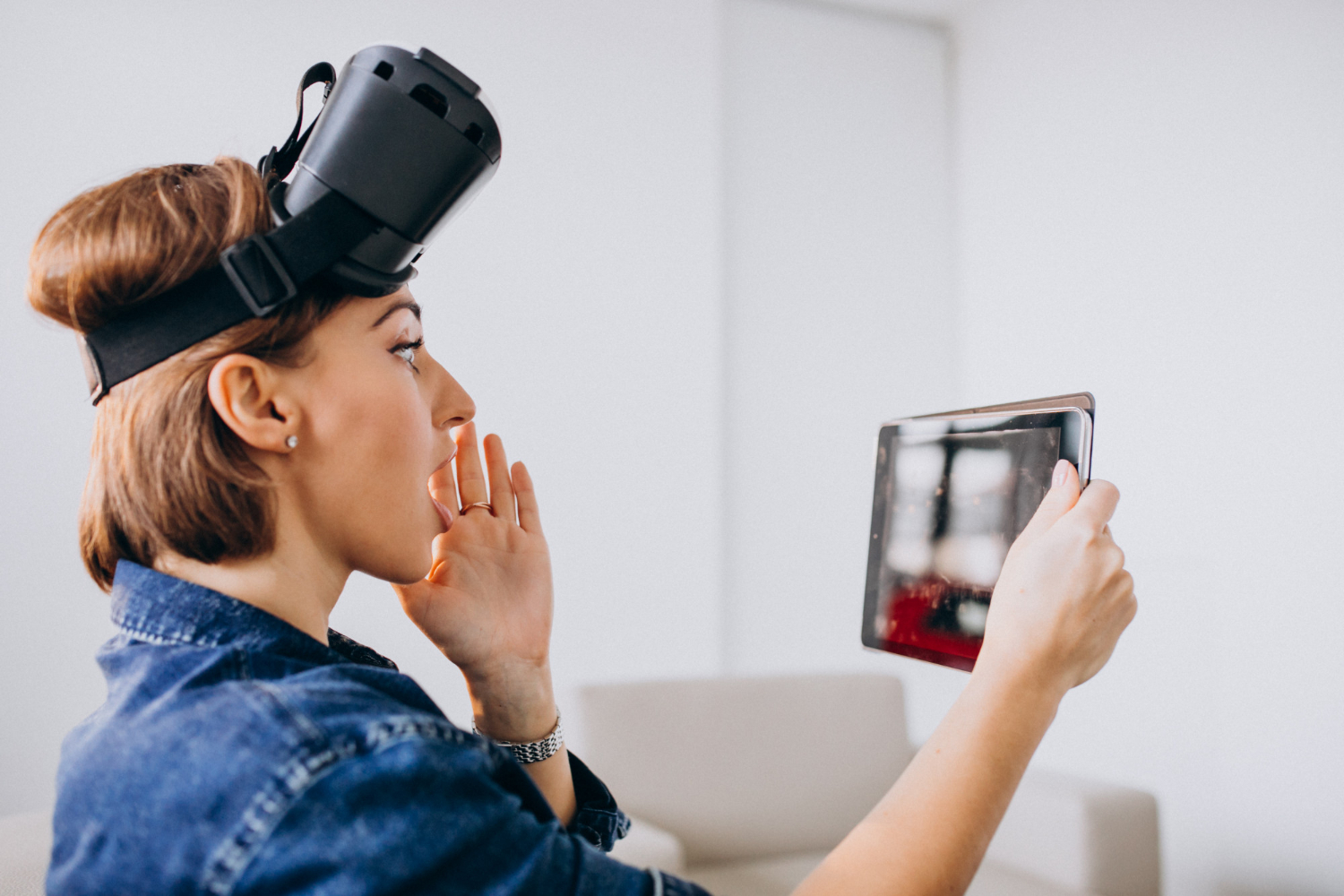
Augmented reality has crossed the line from novelty to infrastructure. Most people use it without realising — placing a sofa in a living room before buying it, trying on a pair of glasses through a phone camera, following an arrow painted onto the pavement by a navigation app. The interesting question in 2026 is no longer “what is AR?” but “where does AR actually pay off, and what does the device-and-software stack look like underneath?”
This guide walks through how AR systems work today, which devices and platforms matter, where the technology is genuinely deployed, and how a 2026 organisation should scope a first programme. The framing is decision-grade rather than encyclopaedic: we want you to leave with a clearer sense of when AR is the right paradigm — and when it isn’t.
What Augmented Reality Means Today
Live video feeds are augmented in real time as smartphone processors estimate depth and detect surfaces, all within a frame budget measured in milliseconds. Text labels, 3D models, audio cues, navigation arrows — any computer-generated element that sits in the room rather than in a separate window. The defining property is environmental coupling: the digital layer is registered to real-world geometry and persists in place as the viewer moves.
That coupling is what separates AR from a traditional animation or a heads-up overlay. It’s also what makes AR genuinely difficult. The system has to understand the scene fast enough that virtual content stays glued to the right point in space across head motion, lighting changes, and occlusion.
AR sits inside the broader mixed reality spectrum first sketched by Milgram and Kishino (1994). Pure VR replaces the world; pure AR augments it; mixed reality describes any point in between where digital and physical layers interact. In practice, most “AR” deployments today are partway along that spectrum — modern smartphone AR is closer to mixed reality than to the simple sticker overlays of a decade ago.
What Distinguishes AR from VR and MR?
The short version: AR keeps you in the real world and adds to it; VR replaces the world with a synthetic one; MR lets virtual objects react to the real environment (occlude behind a real chair, sit on a real table, respond to a real hand). For a deeper structural comparison, see how to distinguish AR and VR. The paradigm choice has real consequences for hardware, content authoring, and session length — which is why we treat it as a decision worth making early.
The 2026 AR Stack
Dissecting the stack—sensors, compute, rendering pipeline, display—reveals why certain AR promises remain out of reach while others ship today. Form factors vary — phone, tablet, smart glasses, dedicated headset — but the loop is broadly the same.
- Capture. Cameras (typically one or more colour, sometimes a depth sensor or LiDAR) and an IMU (gyroscope, accelerometer, magnetometer) feed the system raw sensor data at frame rate.
- Perception. On-device SLAM and scene-understanding stacks — ARKit on iOS, ARCore on Android, OpenXR-aligned runtimes on dedicated headsets — turn that stream into a continuously updated map: planes, anchors, depth, light estimation, and (where supported) semantic segmentation.
- Rendering. A graphics pipeline (Metal, Vulkan, DirectX, or a higher-level engine like Unity or Unreal sitting on top of them) draws the virtual content with the right pose, scale, lighting, and occlusion against that map.
- Compositing. The final view is shown on a phone screen (video-passthrough), the lenses of smart glasses (optical see-through), or a passthrough HMD (camera-mediated see-through). The full loop runs at 60 Hz or higher; below that, the registration breaks and immersion collapses.
Two structural points are worth pulling out. First, the perception loop is firmly on-device — round-tripping camera frames to the cloud would blow the latency budget. Cloud has a role in content delivery, multi-user anchor sharing, and heavier generative tasks (a large language model annotating a scene, for instance), but the tracking-and-render loop stays local. Second, the GPU and NPU budget is real. AR applications run computer-vision models and a rendering pipeline simultaneously, in real time, on a battery-constrained device. This is why the paradigm choice connects so directly to the GPU audit discipline — the rendering and tracking budget has to be sized against the device envelope before the project ships.
Which AR Devices Matter in 2026?
Hardware segments into three distinct classes, each suited to different cost structures and deployment contexts.
| Tier | Examples | Session length | Best fit |
|---|---|---|---|
| Smartphone / tablet AR | ARKit on iOS, ARCore on Android | Seconds to a few minutes | Consumer reach, try-on, navigation, marketing |
| Smart glasses | Meta Ray-Ban, Xreal, Android XR partners | Intermittent through the day | Notifications, AI-assistant overlays, light navigation |
| Dedicated MR / AR headsets | Apple Vision Pro, Meta Quest 3/3S, HoloLens 2, Magic Leap 2 | 20–60 minute focused sessions | Industrial training, clinical, design review, field service |
Smartphone AR is still the volume leader by a long way. Most production AR deployments in 2026 reach users through an app or a web page on a device they already own. Smart glasses have finally crossed into being a real consumer category — driven mostly by AI-assistant features rather than persistent visual overlays — but the heavy graphics work still belongs to the headset tier.
Headsets, in turn, have settled into a focused-session model: 20 to 60 minutes for a training module, a surgical rehearsal, a design walkthrough. The “wear it all day” promise has receded; in our experience working with deployment teams, the realistic envelope is hours-per-week per worker, not hours-per-day. That shapes the ROI case significantly.
Where AR Is Actually Deployed
Hype collapses when you stress-test a concept against unit economics and ask whether margin survives real-world friction. That filter cuts through most AR hype. This filter cuts through most AR overreach. Two clusters have shown durable adoption.
Consumer. Navigation overlays in Google Maps and Apple Maps; virtual try-on for eyewear, cosmetics, footwear, and apparel (with measurable impact on return rates for high-return SKUs); face filters across messaging and short-form video; location-based gaming; and the new generation of AI-assistant features on smart glasses. These workloads run on phones and glasses, are short-session, and tolerate occasional tracking failure because the cost of a glitch is low.
Enterprise and clinical. Remote assistance — an expert sees what a field engineer sees and annotates the live feed — has the clearest ROI story, because a single avoided truck roll often justifies the headset. Industrial training overlays cut the time to competence on manual tasks. Medical-imaging visualisation and surgical guidance use HoloLens 2 and Magic Leap 2 in clinical settings where sub-millimetre registration matters. Architecture and construction use AR for BIM walkthroughs on site. Retail uses it for planogram compliance and assisted selling.
The pattern that’s harder to see from the outside: enterprise AR ROI almost always comes from compressing an expert’s time or reducing physical-world cost (a truck roll, a redo, a return), not from adding a wow factor. Pilots that demo well but can’t point to that compression don’t survive the next budget cycle. For an industry-by-industry treatment see the benefits of AR across industries; for the AI-perception side of things, AI and AR applications and use cases goes deeper on the model pipeline.
How a 2026 Organisation Should Scope Its First AR Programme
Teams that begin with a device—”let’s build for Vision Pro”—rather than a validated user problem reliably encounter the scoping traps we’ve catalogued. The corrective is structural.
- Start from the journey, not the device. Map the customer or employee journey. Identify a specific point where AR could materially reduce friction, returns, or service cost. Be ruthless about specificity: “try-on for high-return SKUs in eyewear” beats “AR for retail”.
- Build smartphone-first. Integrate the AR experience into the existing app or web flow. Reach is already there; the AR layer becomes a feature, not a separate product. The content authoring cost is bounded — 3D assets can be commissioned per-SKU rather than per-category.
- Defer the headset decision. Treat dedicated headsets as a separate, later question, evaluated once the smartphone case is proved. The shift to a headset programme changes the procurement model, the support model, and the unit economics; it deserves its own business case.
- Size the perception budget early. Before committing to features, validate that the tracking and rendering load fits the device envelope at battery and thermal cost the user will accept. A pilot that runs hot for ten minutes and dies isn’t a pilot.
This is, at heart, a decision-framework problem. The choice between AR, MR, and VR — and within AR, between phone, glasses, and headset — should fall out of four variables: how much real-world context the user needs, how long the session runs, what input modalities the workflow demands, and the economics of authoring the content. Get those right, and the vendor selection becomes almost mechanical.
Frequently asked questions
What is the practical difference between AR, VR, MR, and XR when scoping a use case beyond the textbook definitions?
Unlike virtual reality, augmented reality overlays digital elements onto your physical surroundings via phone, tablet, or see-through headset without replacing your view of the real world. VR fully replaces the environment with a synthetic one through an opaque headset. MR is the band in between where digital content interacts with real geometry (occlusion, physics, real-surface anchoring). XR is the umbrella term covering all three. For scoping, the question that actually matters is environmental coupling: does the user need to see and act on the real world during the session? If yes, AR or MR. If no, VR.
Which paradigm fits which workflow — industrial training, retail try-on, remote collaboration, field service?
Industrial training typically uses MR headsets for hands-free, high-context skill rehearsal. Retail try-on is overwhelmingly smartphone AR — reach and zero friction matter more than fidelity. Remote collaboration splits: expert-to-field-engineer assistance runs on phones, tablets, or HoloLens-class headsets depending on the task; remote design review runs on dedicated MR headsets. Field service uses smartphone or tablet AR for the work-order overlay and reserves headsets for hands-busy tasks where the truck-roll savings cover the device cost.
What hardware constraints (FOV, weight, tethering, optics) drive the AR-glasses vs VR-headset choice in 2026?
VR headsets accept weight (450–600g), heat, and opaque optics in exchange for full immersion and wide FOV — they’re focused-session devices. AR glasses target all-day wear, which forces sub-100g designs, narrow FOV (often 30–50 degrees on consumer optical see-through), and aggressive power budgets that cap on-device compute. Passthrough MR headsets like Vision Pro and Quest 3 sit in the middle: headset weight class, but with high-quality video passthrough that lets the device serve AR-style use cases for limited sessions. The choice is rarely “AR or VR”; it’s “what session length and FOV does the workflow demand?”
How do enterprise VR examples (training, design review, remote ops) compare with consumer use cases for ROI?
Enterprise VR and MR programmes tend to show ROI through compressed expert time, reduced physical cost (avoided travel, fewer redos, lower return rates), and shorter time-to-competence on hard-to-teach tasks. The unit economics are favourable because a single trainer, surgeon, or design reviewer is high-cost. Consumer use cases optimise instead for scale and engagement — try-on conversion lift, reduced returns at category level, time-in-app. The headset tier dominates enterprise ROI stories in 2026; the smartphone tier dominates consumer reach.
What is the key feature of mixed reality that distinguishes it from layered AR, and when does that matter?
Mixed reality lets virtual objects react to real geometry: a digital ball rolls along the real floor, a virtual screen anchors behind a real plant, a hologram is occluded by a real hand. Layered AR places content on top without that interaction. The distinction matters whenever the user needs to perceive virtual objects as part of the room rather than over it — surgical guidance, BIM walkthroughs, training simulations involving physical tools. For text labels and try-on it’s overkill.
Where are AR/VR/XR adoption curves actually plateauing versus accelerating across industries?
Consumer VR has plateaued at the enthusiast tier; the breakout is now happening on the smart-glasses side, driven by AI assistants. Enterprise MR is accelerating in remote assistance, training, and clinical guidance, where the ROI story is concrete. Smartphone AR is in steady, broad growth — a feature folded into existing apps rather than a category of its own. Industries with high-cost expert time (clinical, industrial, field service) and industries with high-return product categories (eyewear, cosmetics, furniture) are pulling ahead; sectors waiting for “a killer headset app” are not.
Three AR Implementation Pitfalls to Avoid
Computer-vision pipelines, GPU optimization, and business-case validation converge in every AR engagement we undertake. We pay close attention to whether a proposed programme has chosen the right paradigm before it has chosen a vendor — because that’s where most pilots quietly go wrong. The perception loop has to fit the device; the device has to fit the session; the session has to fit the user journey; the user journey has to fit a measurable cost or revenue lever. When those four are aligned, AR ships. When they’re not, no amount of engineering rescues the project.
Whether launching your inaugural augmented reality pilot or salvaging an underperforming deployment, reach out to discuss how we tailor scoping frameworks to match your organization’s readiness and constraints. Get in touch and we’ll start from your user journey, not the hardware shelf.
References
- Craig, A.B. (2013) Understanding Augmented Reality: Concepts and Applications. Morgan Kaufmann.
- IEEE (2023) IEEE Standard for Virtual and Augmented Reality: Terminology and Standards Guidelines. IEEE Standards Association.
- Jerald, J. (2015) The VR Book: Human-Centered Design for Virtual Reality. ACM Books.
- Milgram, P. & Kishino, F. (1994) ‘A taxonomy of mixed reality visual displays’, IEICE Transactions on Information and Systems, E77-D(12), pp. 1321–1329.
- Schmalstieg, D. & Hollerer, T. (2016) Augmented Reality: Principles and Practice. Addison-Wesley.
- Zhang, Z. (2021) ‘Advances in camera tracking and sensor fusion for augmented reality’, IEEE Transactions on Visualization and Computer Graphics, 27(5), pp. 2535–2547.
Image credits: Freepik.