Introduction
Domestic environments now host devices capable of inference, not merely programmed response. Known as smart houses, these homes have infrastructure ranging from networked smart lighting systems to home surveillance drones designed to alert you to intruders. Many of these smart features are backed by AI technologies like computer vision, generative AI, IoT edge computing, and GPU acceleration.
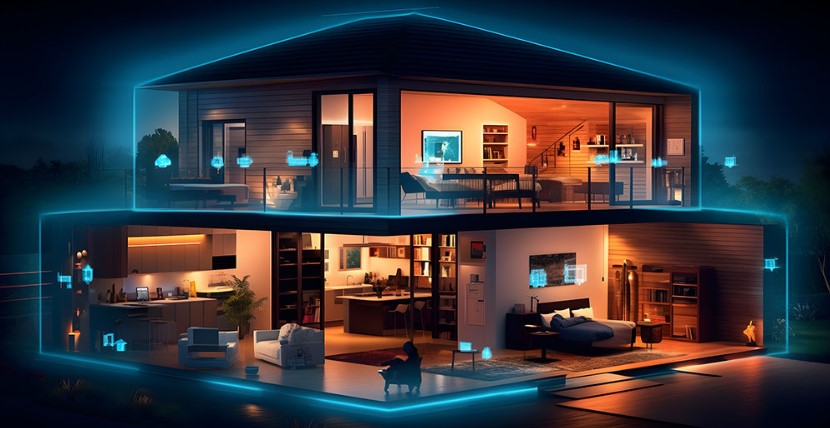
You might be thinking — we already have universal remotes that can control multiple home devices. So why do we need smart home features with AI? The difference is adaptation. A universal remote replays the same command on demand; an AI-driven home learns user preferences, detects presence, and adjusts to changing conditions without being asked. As the day shifts and a room dims, the lights come up because the system already knows you don’t prefer gloomy spaces. That is the practical line between automation and intelligence.
Many companies worldwide are experimenting with this concept, and the global smart home market is projected to reach $537.01 billion by 2030 according to Grand View Research’s published market forecast — a directional industry-scale figure, not an operational benchmark. The expansion involves technologies for connecting and managing various devices and appliances, including lighting, thermostats, security cameras, and entertainment systems. In our work with AI integrators we see four technology classes doing most of the real work: generative AI for natural-language interfaces, computer vision for awareness, IoT edge computing for latency-sensitive control, and GPU acceleration for real-time inference. The rest of this article walks through each in a home context.
What Counts as an AI-Powered Home, Really?
Intelligence emerges when hardware adapts behavior through learned representations of occupant patterns and environmental state. A motion-sensor light is not AI; a camera that distinguishes a returning resident from a delivery courier and behaves differently in each case is. That distinction matters because it changes what the system needs underneath: a model, an inference runtime, and enough compute to run it within human-perceivable latency.
The technology stack we see deployed in serious smart-home products is consistent:
| Layer | Role | Common tech |
|---|---|---|
| Sensing | Capture environment | Cameras, microphones, IoT sensors |
| Inference | Interpret what was sensed | Computer vision models, NLP, on-device LLMs |
| Compute | Run the inference fast enough | GPU acceleration, edge SoCs (Jetson, Coral) |
| Connectivity | Coordinate devices | Matter, Zigbee, Wi-Fi, MQTT |
| Action | Change the physical world | Smart switches, locks, thermostats, drones |
When any layer is weak, the whole system feels dumb — usually it is the inference or compute layer that fails first.
AI Assistants and the Shift to Conversational Control
Go-Globe’s 2021 survey reported 54% of users credit digital assistants with tangible convenience gains, and 31% consider them daily necessities—self-reported perception, not outcome telemetry.
Turning off lights, adjusting the thermostat, or arming a security system without lifting a finger is what AI assistants now do routinely. Under the hood, they use Natural Language Processing algorithms to parse voice commands, generative AI to handle multi-step or ambiguous requests, and IoT edge computing to keep response times tight by processing locally instead of round-tripping every utterance to a distant data centre.
The latency point is not cosmetic. When a voice command travels to a cloud endpoint, gets parsed, gets answered, and travels back, the round-trip dominates the user experience. In our experience working with edge-AI deployments, anything above 800 ms of perceived response time starts to feel broken — which is exactly why on-device or near-device inference has become the default architecture for premium assistants.
Josh.ai is one of the more advanced examples in market. As reported by ZDNet, it was the first GPT-powered smart home platform to ship, using generative AI to interpret layered commands and integrating with home systems through IoT to create a more adaptive automation experience than the single-intent assistants most households are used to.
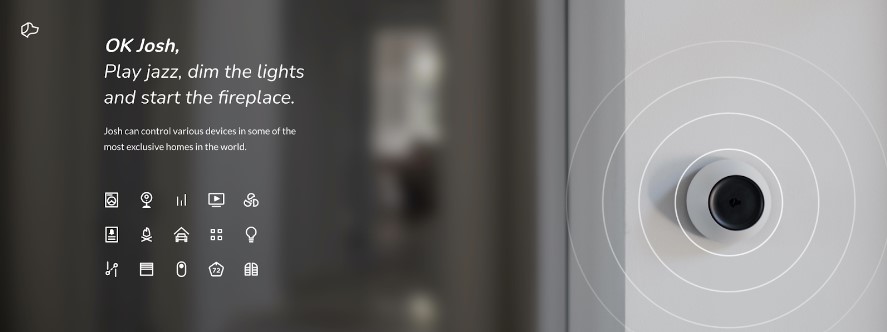
Here’s how it plays out in practice:
- When you say, “Ok, Josh, play jazz, dim the lights, and start the fireplace,” the assistant resolves the intent — you want a cosy atmosphere — rather than executing three disconnected commands.
- It then signals each device over IoT: music on, lights softened, fireplace ignited.
- After execution, it remembers the configuration. The next time the same intent comes up, the defaults are already tuned to your prior preferences.
The interesting engineering choice here is the move from command-matching to intent-resolution. That is the part generative models make practical.
Why Does a Smart Home Need Computer Vision at All?
Speech interfaces excel at explicit instruction but falter when context is ambiguous. It handles ambient state poorly. You do not narrate every time you walk into a room. Computer vision fills that gap — it lets the home perceive who is present and what they are doing without the resident having to announce it.
Cameras equipped with computer vision can determine whether a room is empty or occupied by identifying human shapes and movements, then signal the smart lighting system to adjust accordingly. It is convenient and it saves energy. Gartner’s 2015 published survey estimated that smart solid-state lighting has the potential to reduce energy costs by up to 90% when sensing, controls, and LED hardware are deployed together — a published analyst projection, not a measurement from any specific household installation.
Vision also unlocks gesture control. A wave of the hand can turn lights on or off, mute a TV, or step a thermostat up or down. The same model class — typically a lightweight CNN or a transformer-based pose model running on an edge GPU — can serve all of these.
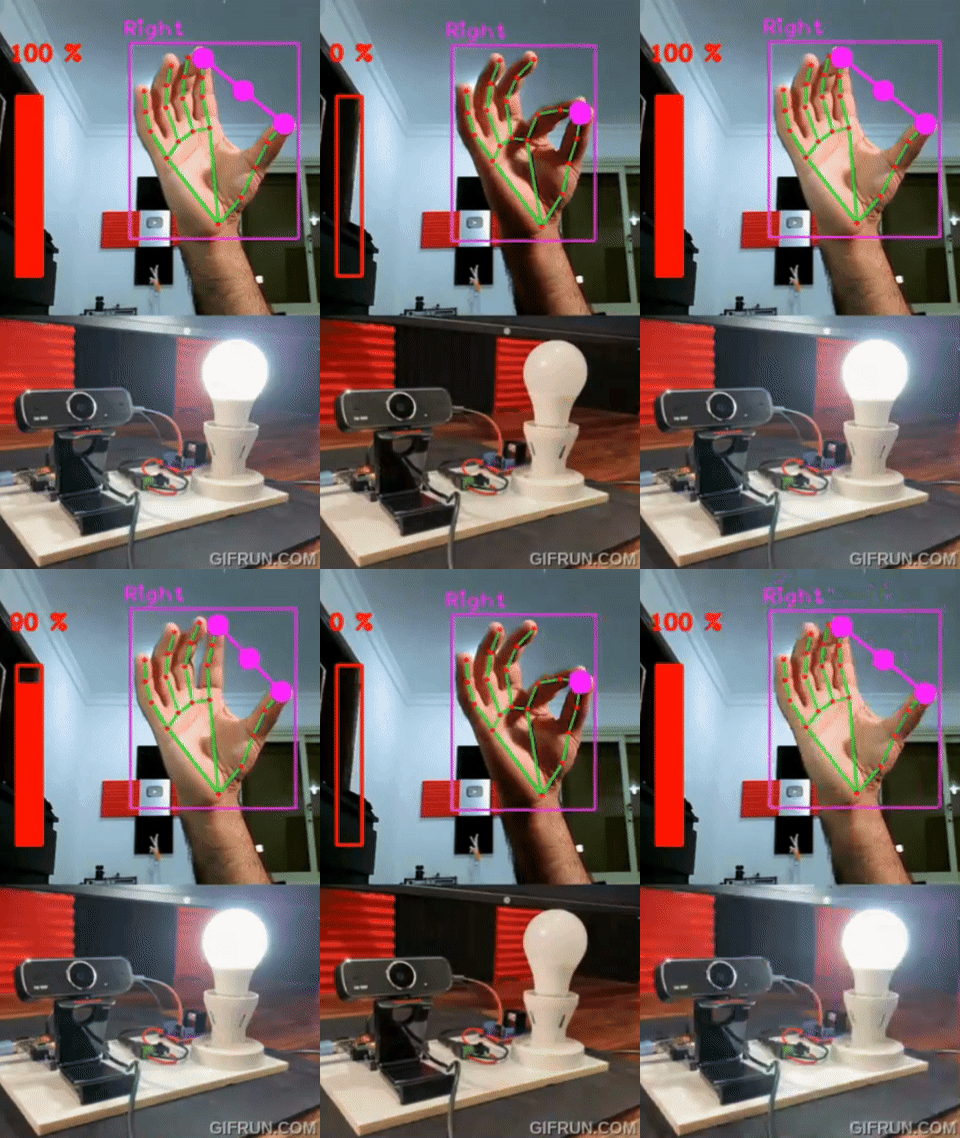
The deeper point: once the home can see, the input modality stops being a remote or a phone and becomes the resident themselves. That is what makes the interaction feel different from a programmable thermostat.
Keeping Homes Safe with AI Smart Cameras and Locks
Intrusion detection and anomaly classification have crossed from experimental to baseline consumer expectation in residential installations. AI-integrated surveillance systems, smart locks, and biometric access controls now share a common architecture: computer vision models running on GPU-accelerated edge hardware, coordinated over IoT.
These systems use face detection and recognition, retinal scans, and fingerprint authentication to restrict access. The shift from cloud-only to edge-accelerated inference matters for two reasons. First, it removes the dependency on continuous video storage — the system reasons about frames as they arrive rather than uploading everything to be reviewed later. Second, it cuts response latency from seconds to tens of milliseconds, which is the difference between a useful intruder alert and a forensic record of an event that already happened.
Sunflower Labs’ Beehive autonomous drone system is a sharp example. It combines computer vision, IoT edge computing, and GPU acceleration to provide an active rather than passive layer of perimeter security.
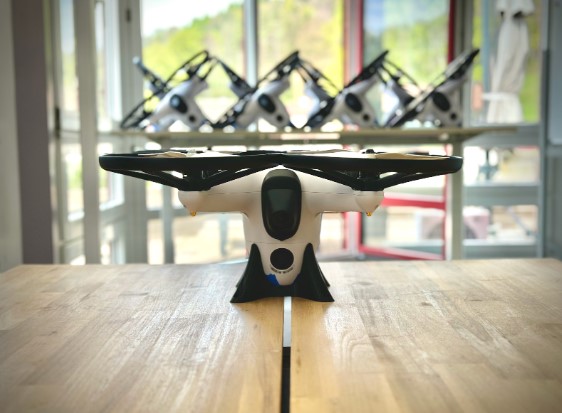
Key features include:
- 3D property mapping for accurate navigation.
- Geofencing to keep the drone within property lines.
- Real-time obstacle avoidance so the drone can fly safely without operator input.
- Proactive deterrence when something suspicious is detected.
- Object tracking and identification that distinguishes routine activity from genuine threats, reducing false alerts.
None of these capabilities are exotic in isolation. The interesting part is that they are integrated tightly enough to run in the field, on battery, without continuous cloud connectivity.
Using AI in the Kitchen
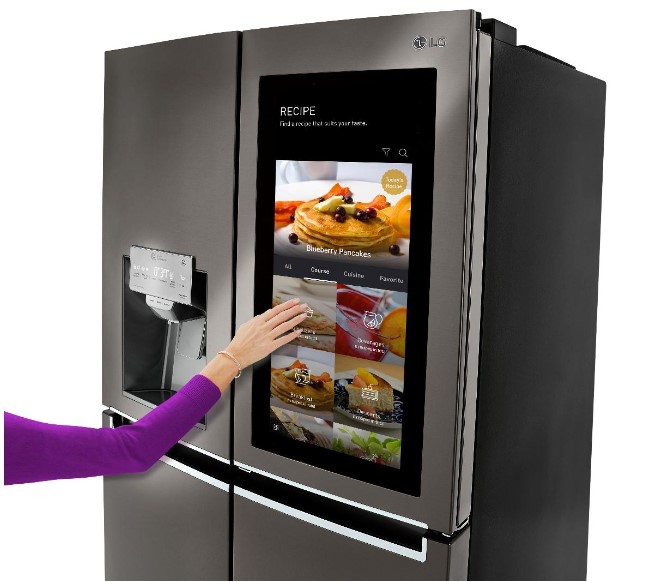
Connected appliances in food preparation exemplify ambient intelligence, with ovens leading commercial uptake. They adjust temperature and cooking time automatically based on what is being cooked — sometimes using internal cameras and computer vision models to identify the dish.
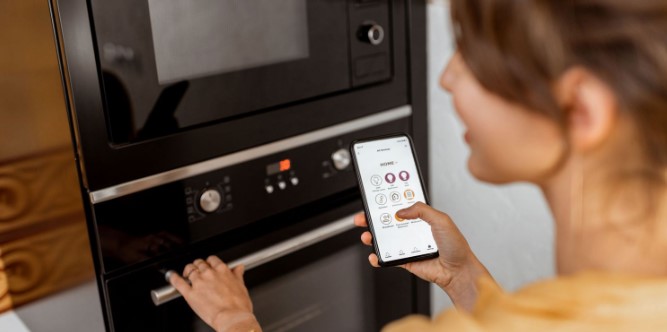
The same intelligence extends to inventory. AI can track what is in your fridge and pantry, flag items running low, and warn before food expires — a small but persistent reduction in waste and over-buying that compounds over a year.
The shift here is from appliance to participant. The oven is no longer a heating element with a dial; it is a node in a household decision system.
How Far Can This Realistically Go?
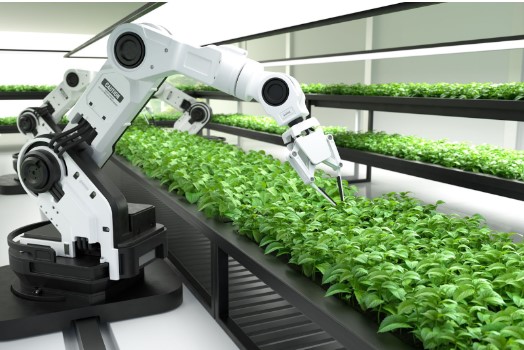
Deployment will expand, though not at the exponential pace forecasters sometimes claim. Beyond today’s implementations, but within more conservative industry projections. The pieces converging are a smart gardening layer that adjusts irrigation to soil moisture, sunlight, and temperature; household robotics like Google’s PaLM-SayCan robot that combine large language models with manipulation policies; and cross-device coordination via standards like Matter that finally make multi-vendor smart homes feasible without custom integration work.
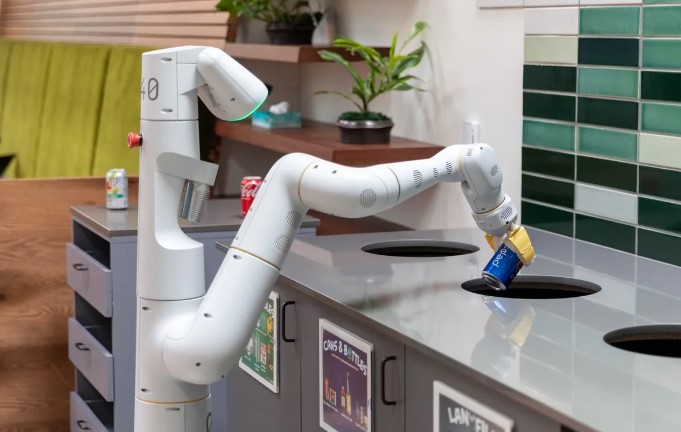
What this points toward is not a talking home but an attentive one — a household environment whose default state is responsive to the people in it. The interaction surface shrinks; the underlying intelligence expands.
Challenges with Respect to AI in Smart Homes
Engineering obstacles—interoperability standards, failure-mode transparency—now constrain adoption more than model performance. Security breaches, unauthorised access to camera feeds, and biased recognition models raise legitimate concerns about data privacy and fair treatment, and they require new security and privacy architectures rather than bolted-on patches.
Cost is a second barrier. Installing, maintaining, and updating smart home systems is non-trivial, particularly when devices come from multiple vendors with different update lifecycles. And improperly trained models can exhibit bias — face recognition that works less well for some demographics, voice assistants that mis-parse accents — which makes careful dataset curation and ongoing evaluation part of the deployment cost, not a one-time engineering line item.
Addressing these is complex, and it is where domain expertise tends to matter more than raw model quality.
What We Can Offer as TechnoLynx
TechnoLynx architects bespoke AI deployments where generative models, vision pipelines, edge inference, and accelerated compute must coexist in production residential or commercial IoT environments. Our R&D engagements with outcome ownership cover not just the model layer but also the privacy, data-handling, and ethical considerations that determine whether a smart-home or building-scale deployment is actually viable in production. We work with teams that already know what they want to build and need a partner who can take responsibility for the parts that are easy to underestimate.
Frequently Asked Questions
What is a smart home powered by AI?
A smart home powered by AI is one where at least one device makes decisions based on a learned model of the environment, rather than simply replaying preset commands. Typical capabilities include voice and gesture control, presence-aware lighting and climate, and vision-based security. The defining property is adaptation: the home changes its behaviour as it learns the residents’ preferences and context.
Which AI technologies matter most in a smart home?
Four technologies do most of the real work: generative AI for natural-language interfaces and intent resolution, computer vision for ambient awareness and security, IoT edge computing for low-latency control, and GPU acceleration for running inference fast enough to feel instant. Standards like Matter sit alongside these to coordinate devices across vendors.
Why is edge computing important for smart-home AI?
Edge computing keeps inference close to the device, which cuts response latency from seconds to tens of milliseconds and reduces reliance on continuous cloud connectivity. For voice assistants, security cameras, and gesture control, that latency difference is what separates a useful experience from a broken one. It also limits how much raw sensor data — particularly video — leaves the home, which improves privacy posture.
What are the main risks of putting AI into a home?
The main risks are privacy and security breaches involving camera or microphone data, biased models that work less well for some users, and the cost and complexity of keeping multi-vendor systems updated. Mitigating these requires deliberate architecture: on-device inference where feasible, careful dataset curation, vendor selection based on update lifecycle, and clear data-retention policies.
Conclusion
Residential automation now spans adaptive illumination, perimeter monitoring via autonomous drones, and anticipatory climate control. Bringing AI into your home is exciting, but it comes with integration, privacy, and reliability challenges that benefit from collaboration with a partner who has built and shipped this class of system before.
At TechnoLynx, we build AI solutions that meet the actual constraints of the environment they run in — including the household one — with privacy and reliability treated as first-class engineering concerns rather than afterthoughts.
Sources for images:
- CNET. 2020. See Google’s AI-Powered Robot at Work in a Kitchen.
- Lamp Control using Hand Gestures. 2021. YouTube.
- The Droning Company. 2023. Sunflower Labs — Security-Focused Drone-in-a-Box Solution.
- Which? 2023. Smart oven explainer: what they do and how they work.
References:
- CNET. See Google’s AI-powered robot at work in a kitchen.
- Gartner. 2015. Gartner Says Smart Lighting Has the Potential to Reduce Energy Costs by 90 Percent.
- Grand View Research. Smart Homes Market Size, Share & Trends Analysis Report.
- Sunflower Labs. Sunflower Labs Home Security System.
- ZDNet. The first GPT-powered smart home platform is here.