Introduction
Manufacturing lines now ask not whether to automate quality control with computer vision, but which approach to deploy and where constraints will bind. The deeper question is when a learned model earns its place over a deterministic rule-based system, and what it takes to keep false-reject rates low once the line goes live.
Manual inspection is slow, inconsistent, and expensive to scale. Even traditional rule-based machine-vision systems — the kind built around fixed-fixture cameras, structured lighting, and hand-tuned thresholds — struggle when defect classes are visually subtle or when product variation outpaces the rules. The shift toward AI-based computer vision is not about replacing those systems wholesale; it is about widening the envelope of defects you can catch without rebuilding the rig every quarter.
The market direction reflects that shift. The AI Quality Inspection Market report (GlobeNewswire, 2024) projects growth toward $70.7 billion by 2029 — a directional industry-scale macro estimate, not an operational benchmark. The Google Cloud Manufacturing Report 2021 (published-survey) places 64% of manufacturers on Industry 4.0 stacks, with vision among the top automation targets.
This article walks through what computer vision actually does inside a QC pipeline, which factors drive false-reject rates in production, and where the boundary still sits between learned and rule-based inspection.
What Does Computer Vision Do in a Quality Control Pipeline?
Vision-driven QC pipelines distribute work across multiple models, not a single monolithic system. It is a sequence of stages, each tuned to a specific class of decision. Misunderstanding the sequence is one of the more common reasons deployments underperform in operational measurement on the line.
The stages, in the order they typically execute:
- Image acquisition. Cameras (area-scan, line-scan, or 3D depth), lensing, and lighting are chosen to make the defect class visible. This is the most under-invested stage in failing deployments — no model recovers what the sensor never captured.
- Pre-processing. Contrast normalisation, white-balance correction, distortion compensation. Pre-processing turns variable input into a stable feed for the downstream model.
- Region selection. Object detection or segmentation isolates the part — or the relevant area of the part — from the conveyor, fixture, or background.
- Defect classification or segmentation. A learned model (CNN, vision transformer, or a foundation-model-derived feature extractor) decides whether the region contains a defect and, often, what type.
- Decision and trace. The result is fused with metadata (timestamp, line ID, lot, station), logged for audit, and routed to a reject mechanism or downstream rework cell.
At step 4, the model choice matters less than people expect once the upstream stages are solid. Convolutional Neural Networks (CNNs) — including detection-oriented variants like Faster R-CNN and YOLO — remain the workhorse for production defect detection. Vision transformers, including foundation models such as DINO, are gaining ground in feature-extraction roles where local-plus-global context helps; in our experience they pay back the higher compute when defect classes are subtle and varied, not when the task is “scratch on a metal panel”.
Why Do False-Reject Rates Stay High Even After Deployment?
Validation-set accuracy diverges from what production lines actually measure. The number that matters is the false-reject rate in production — how often the system rejects a part that was actually fine. False rejects waste material, slow throughput, and erode operator trust until the system gets bypassed. This is an observed pattern across our manufacturing engagements; planning heuristics, not a benchmarked rate.
Five factors do most of the damage:
- Lighting drift. A fluorescent tube ageing or a skylight changing the ambient at 3pm can shift the input distribution enough to spike rejects. Controlled, redundant lighting is cheaper than retraining.
- Fixture wear. Part presentation drifts as jigs wear. The model sees the same part at a slightly different angle and flags texture as a defect.
- Training-set coverage gaps. If the model never saw the legitimate cosmetic variation that comes from a new batch of raw material, it will reject the batch.
- Threshold calibration. Most defect classifiers output a score; the operational cutoff is a deployment choice. A cutoff set during commissioning rarely survives a season change without review.
- Class imbalance in production. Defects are rare. Even a small drop in specificity creates a disproportionate false-reject volume because the denominator (good parts) is enormous.
A pragmatic remedy is to instrument the line so the false-reject rate is visible in near real time, with sampling of rejected parts for human review. That feedback loop — not the original model accuracy — is what holds the system in spec over months.
Where Does Rule-Based Machine Vision Still Win?
Procurement hinges on this question more than any other metric. The honest answer is that traditional machine vision — Keyence-, Cognex-, or Basler-style rule-based systems — still wins in a defined set of conditions, and trying to displace it with a custom CNN is often the wrong call.
| Condition | Better fit |
|---|---|
| Defect is geometrically defined (size, presence, position, alignment) | Rule-based machine vision |
| Lighting is fully controlled and fixed | Rule-based machine vision |
| Throughput is high and latency budget is microseconds | Rule-based machine vision |
| Auditability per part is a regulatory requirement | Rule-based machine vision (deterministic) |
| Defect is visually subtle and varies across batches | Learned computer vision |
| Defect classes evolve as product evolves | Learned computer vision |
| Production environment has variable lighting or part presentation | Learned computer vision |
| Maintenance team has ML/CV competence in-house | Learned computer vision |
The decision is rarely a clean one-or-the-other. Many production deployments end up as hybrids: a rule-based front end handles the deterministic checks, and a learned model handles the cosmetic or batch-variant ones. For a deeper treatment of where each approach belongs, our Machine Vision vs Computer Vision decision framework walks through the trade-offs against production constraints.
Real-World Use Cases of AI in Quality Assurance
McKinsey’s Smartening Up with Artificial Intelligence survey reports defect-detection improvements reaching 90% in certain AI-enabled QC deployments—figures drawn from mixed industry samples, not guaranteed per-line outcomes. The shape of the gains is more informative than the headline number.
AI Defect Detection in Automotive Production Lines
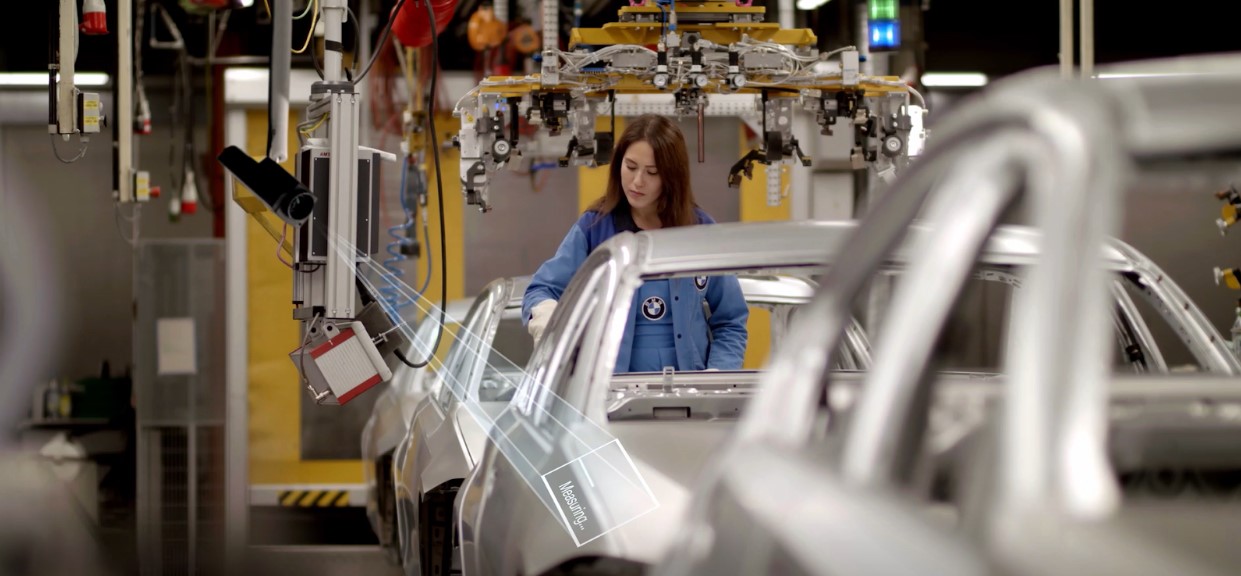
Surface inspection on car bodies is one of the cleaner wins for learned vision: large surface area, subtle defects (scratches, dents, paint inclusions), tight throughput. BMW Group reports that AI image analysis in body-shop QC has reduced manual inspection time by up to 50% as reported in BMW’s published case study. Audi has framed its own programme as defining new standards for AI image processing across vehicle production.
Generative AI for Failure Simulation and Predictive Maintenance
Generative AI has a different role here. It is rarely doing the inspection itself; it is generating synthetic failure data to harden the inspection model and feeding digital-twin simulations for predictive maintenance. The generative AI in manufacturing market is projected to reach $13.8 billion by 2034 (Precedence Research; market-direction). The operationally useful pattern is narrower: synthesise rare defect classes to balance training sets, and stress-test maintenance schedules against simulated wear profiles on a digital twin of the equipment.
A concrete example: a robotic arm on an assembly line is instrumented for temperature, vibration, and motor current. A generative model trained on its operating envelope can sample plausible failure trajectories — bearing wear, overheating under varying duty cycles — that engineers then validate on the twin. The signal is in the interaction between learned simulation and physical sensor data, not in either alone.
XR for Remote Quality Inspection
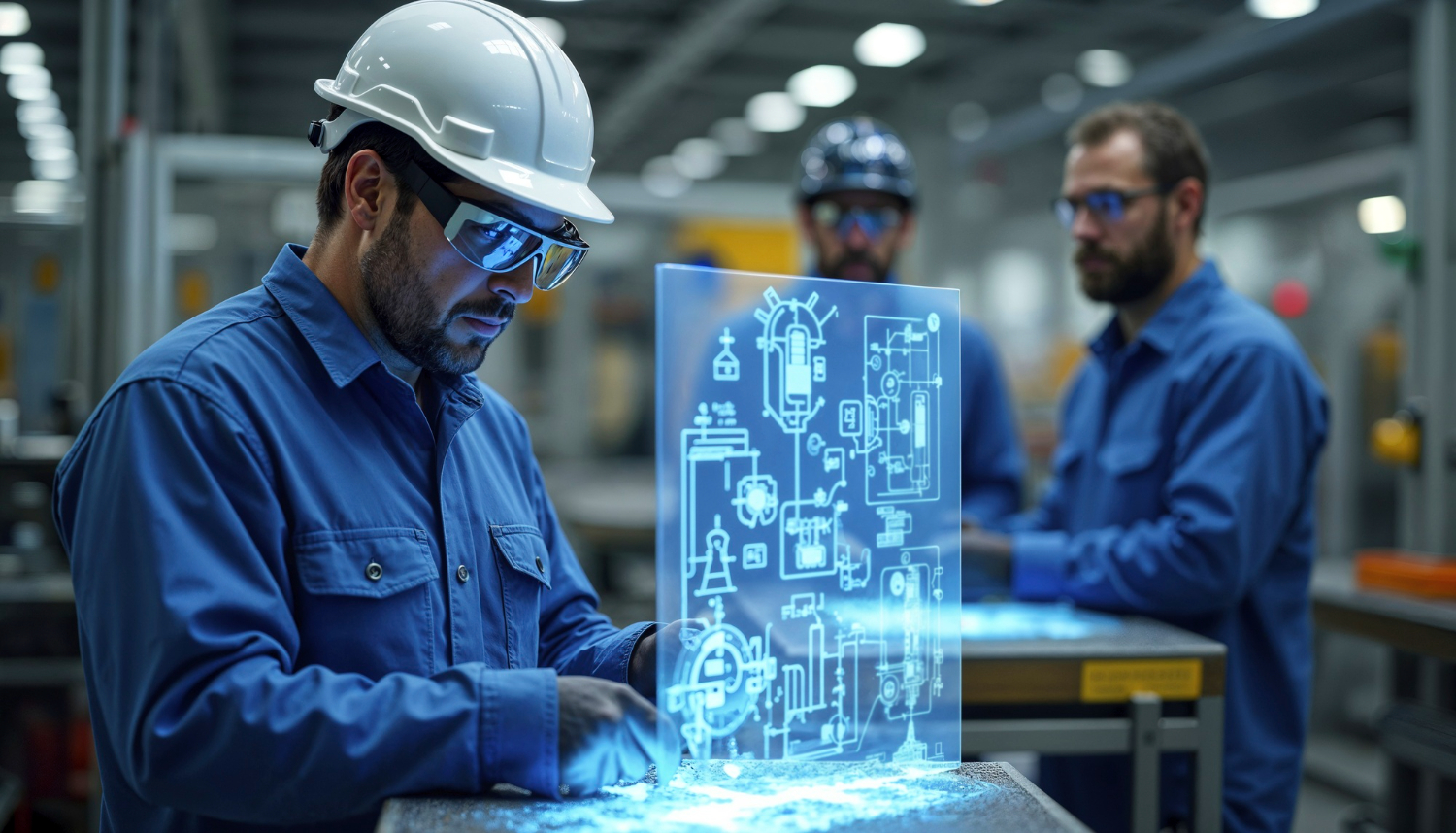
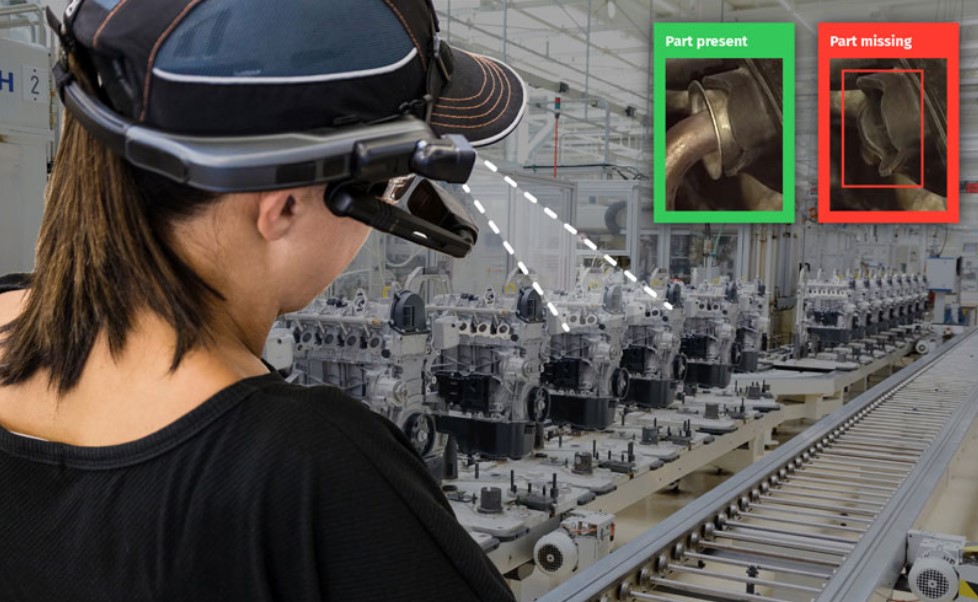
Extended reality overlays digital information onto a physical workspace, which is useful for two QC jobs: guiding an operator through an inspection sequence, and letting a remote expert see what the on-site inspector sees. The Capgemini augmented and virtual reality report documents Boeing’s AR-assisted aircraft maintenance, where technicians view digital schematics on aircraft components, with reported inspection-time reduction of around 40% (published-survey, vendor-reported).
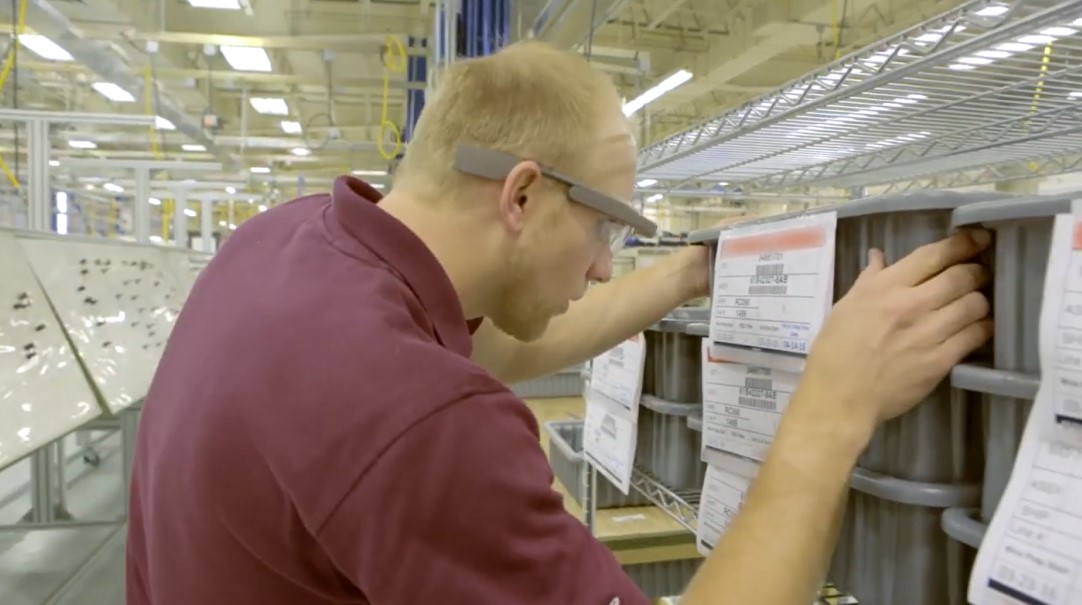
The combination that matters operationally is XR plus a learned vision model: the inspector’s gaze drives the camera, the model flags candidate defects in the overlay, and the inspector confirms or overrides. The handoff between automated detection and human judgement is where most of the practical gain is realised.
OCR for Label and Packaging Verification
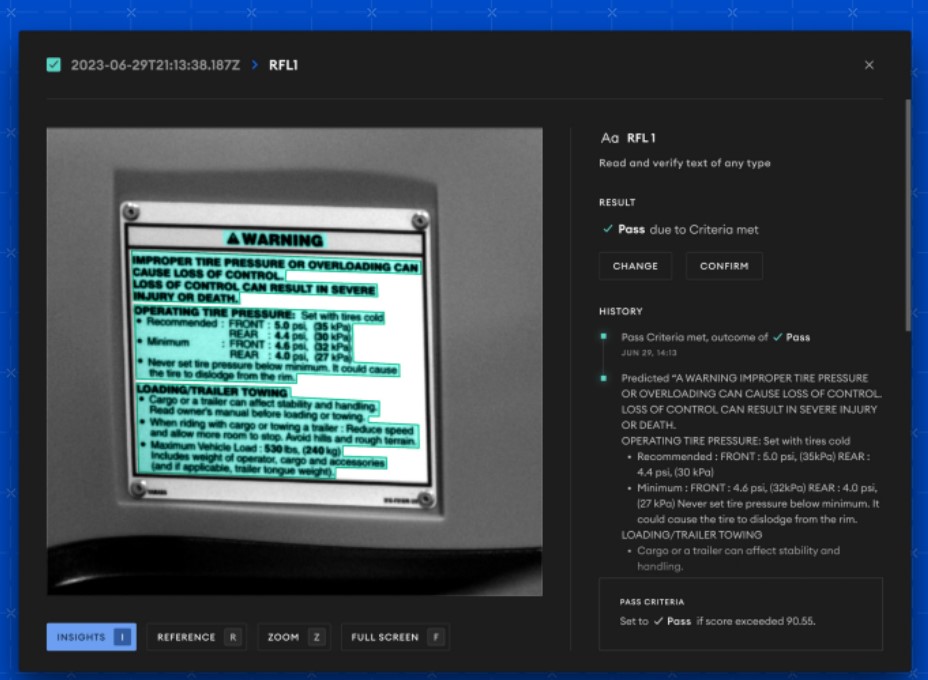
Vision QC discussions routinely overlook optical character recognition despite its operational importance. It is also one of the highest-ROI: misprinted labels, wrong lot codes, and incorrect language variants drive recalls in regulated industries. Deep-learning OCR handles diverse fonts, partial occlusion, and curved surfaces in ways the previous generation of template-based readers could not.
Yamaha Motors documented an AI-powered vision deployment for warning-label inspection on ATVs and recreational off-highway vehicles, replacing manual checks with automated verification of label placement and content (published-survey, vendor-reported). The structural lesson: OCR for QC is a hybrid task — detection (is the label there?), recognition (does the text match?), and layout (is it in the right place?) — and treating it as three sub-problems is more robust than asking one model to do all three.
Structural Inspections with Drones and Computer Vision
Onboard drone vision pushes QC inspection beyond factory boundaries. Infrastructure inspections — bridges, transmission towers, wind turbines — are dangerous, expensive, and visually rich. AI image classification and segmentation models can flag cracks, corrosion, and structural degradation from drone imagery, then route ambiguous cases to human review.
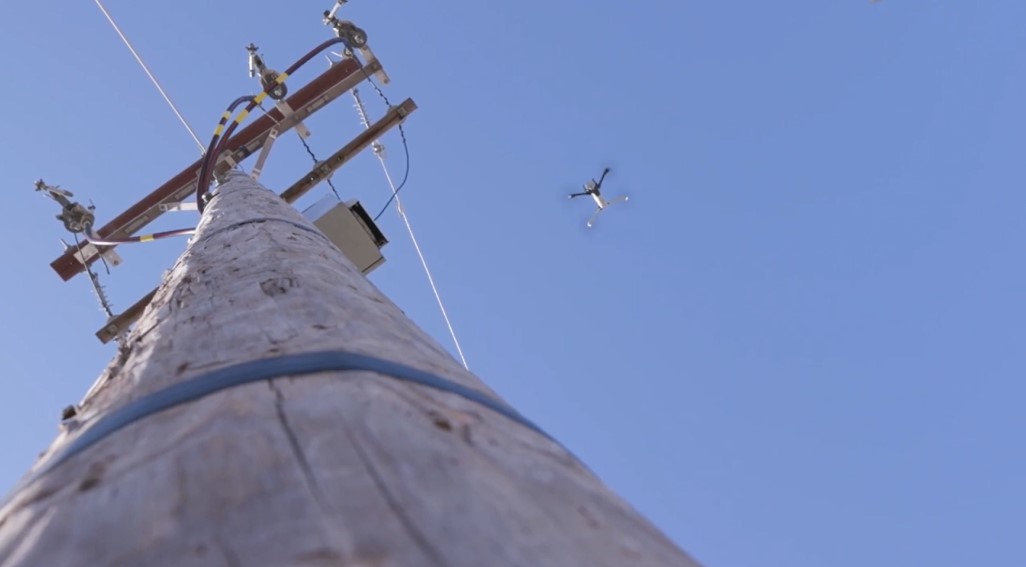
ComEd’s published case study describes AI drone power-line inspection with reported defect-identification accuracy over 95% on power-pole imagery (published-survey, vendor-reported). The gating constraint in our experience is rarely model accuracy in isolation — it is the chain from flight planning, through image quality, to defect localisation in the asset model. The model is one link.
Future Direction: IoT, Edge, and Continuous Learning
Two industrial trends are now converging. First, the camera itself is becoming a compute node — edge inference on smart cameras eliminates round-trip latency to a server and makes the inspection robust to network drops. Second, continuous learning pipelines are turning false-reject reviews into training-set updates, closing the loop between deployment and improvement. The Kaspersky 2024 survey puts 54% of companies on AI and 51% on IoT (published-survey).
The practical implication is architectural. A QC stack designed around a one-shot deployment ages badly. A stack designed around continuous data capture, periodic retraining, and versioned model deployment ages well — and that is where the engineering effort belongs from day one.
FAQ
What We Can Offer as TechnoLynx
TechnoLynx builds inspection systems where rule-based and learned vision methods are chosen deliberately per defect class, constrained by your production realities rather than vendor preferences. Our engagements scoped to your problem cover sensor selection, pipeline architecture, model development, edge deployment, and the continuous-learning loop that keeps false-reject rates stable in operation.
If you are evaluating a QC programme — or trying to recover one that drifted after commissioning — we are happy to talk it through. Reach out or browse our AI solutions.
Sources
- BMW Group Press, 2019. Fast, Efficient, Reliable: Artificial Intelligence in BMW Group Production.
- Automotive Manufacturing Solutions, 2025. Audi is Advancing Vehicle Production with AI-Powered Image Processing.
- Capgemini, 2018. Augmented and Virtual Reality in Operations.
- Elementary, 2023. AI-Powered OCR for Label Inspection at Yamaha Motors.
- GlobeNewswire, 2024. AI Quality Inspection Market Report 2024: Forecasts to 2029.
- Google Cloud, 2021. Google Cloud Manufacturing Report 2021.
- Kaspersky, 2024. More than Half of Companies Use AI and IoT in Their Business Processes.
- McKinsey & Company. Smartening Up with Artificial Intelligence.
- Optelos, 2024. ComEd Case Study: Drone Power Line Inspection and Computer Vision AI.
- Precedence Research, 2024. Generative AI in Manufacturing Market Size, Share, and Trends 2024-2034.