
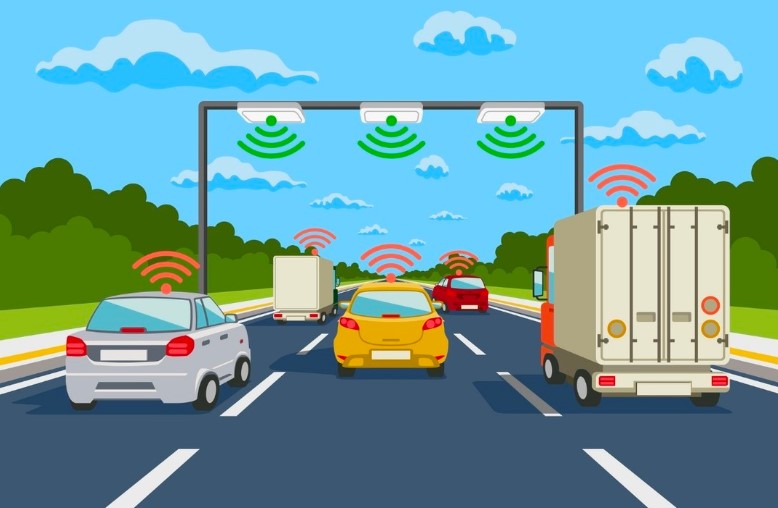
Where AI-driven pathfinding actually sits
Classical pathfinding — A*, Dijkstra, RRT — guarantees a shortest path on a fixed graph with a fixed heuristic. That guarantee dissolves the moment the cost function becomes dynamic, partially observable, or shaped by other agents’ likely behaviour. AI-driven pathfinding is the practical answer to that gap: a learned heuristic, a learned cost map, or in some cases an end-to-end policy network sitting alongside (not replacing) the classical search core.
The honest framing matters because the marketing story — “AI replaces A*” — is almost never what production systems actually do. In our experience across navigation, robotics, and routing engagements, the architectures that ship are hybrids. Classical search at the architectural core handles safety and explainability. Learned components handle adaptivity in the cost or heuristic layer. The split is not accidental; it is the only structure that survives a safety review.
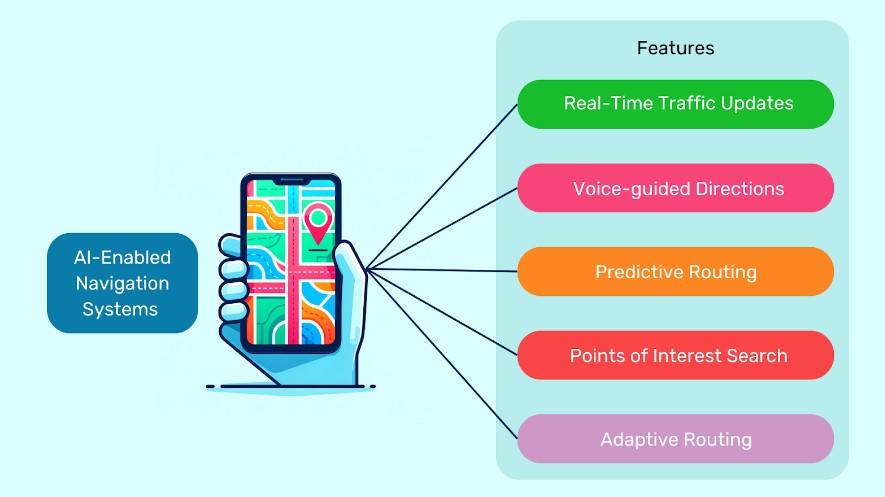
What classical search gives up, and what it keeps
An admissible heuristic ensures A* produces an optimal path. You can inspect the open list, audit the expansion order, and prove the property holds. That is an engineering artifact worth defending. Once you replace the heuristic with a neural network — a learned heuristic trained on historical routes — you trade the optimality proof for the ability to encode contextual signals that no hand-tuned formula can capture: typical congestion at a given hour, time-of-day delivery windows, neighbourhood-specific driver behaviour.
The decision is not “learned or classical”. It is which layer of the stack absorbs the learning, and what guarantees you keep at the layers above and below.
Decision surface — where learning belongs in a pathfinding stack
| Layer | Classical default | Learned alternative | When learning pays off |
|---|---|---|---|
| Graph / map representation | Hand-built road graph, occupancy grid | Learned scene graph from imagery | Environment changes faster than maps can be maintained |
| Cost function | Distance, travel time, hand-weighted penalties | Learned cost map (CNN on tile features) | Cost depends on context a human cannot enumerate |
| Heuristic | Euclidean / Manhattan / admissible domain heuristic | Learned heuristic network (regression head) | Search expansion is the bottleneck, not optimality |
| Policy | A* / Dijkstra / RRT search | End-to-end policy network (imitation or RL) | Search itself is too slow at deployment latency |
| Safety wrapper | Reachability check, collision predicate | (Keep classical — do not learn this) | Never |
Two operational observations from our deployment work — both observed-pattern across our engagements, not benchmarked rates — guide where the learned/classical boundary should land:
- The cost-map layer is where learning gives the largest practical lift with the smallest certification burden. The search core stays classical, so the audit story for the planner is unchanged.
- End-to-end policy networks pay off in a narrow set of cases — primarily latency-bound domains like video-game NPCs in large open worlds or fast-twitch drone flight — and rarely in safety-critical road or robotics contexts.
What is AI-driven pathfinding, concretely?
Learned components injected into the search pipeline define the family of AI-driven pathfinding methods. The three practical patterns we encounter in real engagements:
- Learned heuristic over a classical search core. A neural network predicts the cost-to-go from any state to the goal. A* uses this estimate to prioritise expansions. The search remains complete; only expansion order changes. This is the easiest pattern to ship and to defend in a safety review.
- Learned cost map. A computer-vision model — typically a convolutional network — consumes aerial imagery, satellite tiles, or onboard camera frames and emits a per-cell traversability cost. Classical search then plans over that learned cost field. Common in off-road autonomy and warehouse robotics where layouts shift faster than hand-built maps can be refreshed.
- End-to-end policy network. A network maps observations directly to actions. No explicit search at deployment. Trained via imitation learning on expert trajectories or via reinforcement learning against a simulator. Used where deployment latency forbids search and where the action space is small and well-bounded.
The three patterns answer different operational pressures. They are not interchangeable, and most production systems combine them — a learned cost map feeding a classical search core with a learned heuristic on top. We discuss the imaging-data infrastructure that sits underneath patterns (2) and (3) in where computer vision fits in adjacent applied pipelines — the biotech-pipeline framing there transfers cleanly to the navigation-imagery problem.
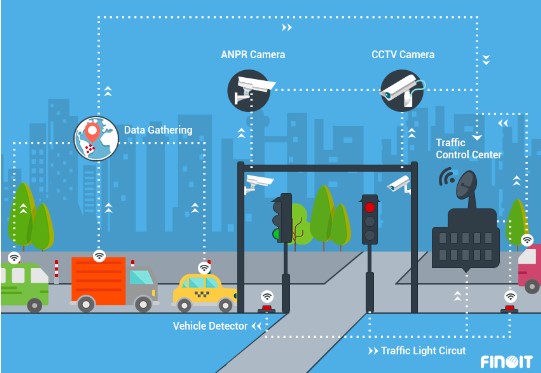
Where AI pathfinding is used in production today
Research systems transition to operational deployments when the cost surface proves too complex or too dynamic for hand-tuned heuristics. That shared feature shows up across otherwise unrelated industries.
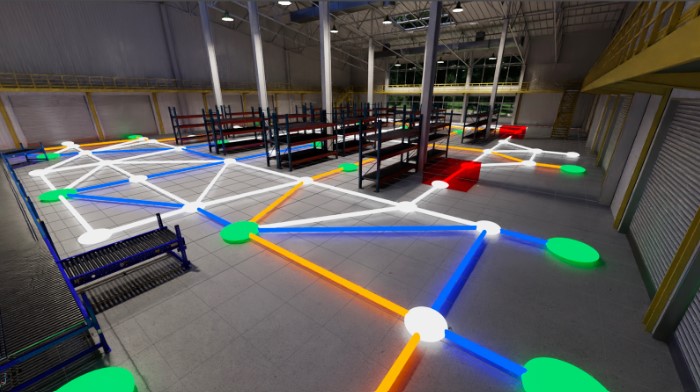
Warehouse robotics is the cleanest example. Multi-agent path planning under shifting layouts, with dozens of robots negotiating the same aisles, is a problem class where classical multi-agent search (CBS, ICTS) gets expensive fast. A learned cost map that anticipates congestion at intersections substantially reduces search depth. Last-mile delivery routing — under live traffic, weather, and time-windowed delivery commitments — is structurally similar: the cost of every road segment is a function of context that no static table can hold. Google Maps’ AI workflow is a public-facing example of this pattern; Google Maps’ AI-based features blend a learned routing layer on top of a classical search core.
Video-game NPC navigation in large open worlds is where end-to-end policies have made the most progress, precisely because the safety bar is low and the latency bar is high. Autonomous vehicle high-level path planning sits at the other extreme — almost universally classical at the planner level, with learned components confined to perception and prediction. Drone flight planning in cluttered environments and surgical robotics for instrument-path optimisation both fall in the middle, with learned cost maps and classical search at the planner core.
NVIDIA’s AI workflow for route optimisation and NVIDIA cuOpt for Isaac Sim illustrate the same architecture from the GPU-acceleration side: classical combinatorial optimisation cores accelerated on GPU, with learned components in the upstream cost-shaping stages.
How does AI pathfinding differ from A* or Dijkstra in practice?
Optimality guarantees represent the fundamental textbook distinction. The operational difference is which failure modes you inherit.
A* and Dijkstra fail predictably. If the graph is stale, the path is wrong in a way you can diagnose by inspecting the graph. If the heuristic is inadmissible, you lose optimality but the failure shows up in node expansions you can audit. The failure surface is small and instrumented.
A learned heuristic fails less predictably. The network may produce a confidently wrong cost-to-go estimate for an out-of-distribution input — a road type, weather pattern, or layout the training set did not represent. Search still terminates, but on a longer path than necessary, and the diagnosis requires looking inside the network rather than at the search trace. This is the certification gap that keeps end-to-end policies out of safety-critical roads: the inspection tools we built for classical search do not transfer.
The practical implication is that AI-driven pathfinding is not a drop-in replacement. It is an architectural choice with a different operational support cost — different monitoring, different retraining cadence, different failure-recovery procedures. Teams that treat it as a drop-in tend to be surprised when the first out-of-distribution day arrives.
What 4D path planning actually means
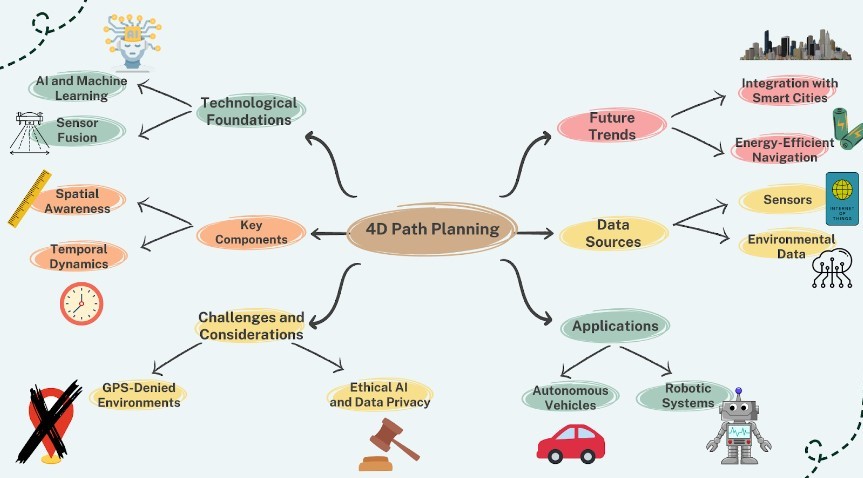
Marketing emphasizes 4D framing — three spatial dimensions plus time — yet the real substance lies in concrete engineering shifts. Static 3D planning treats the environment as fixed during the planning horizon. 4D planning makes time an explicit axis: cell (x, y, z) at time t can be free while cell (x, y, z) at time t+1 is occupied by a predicted moving obstacle.
This matters in two contexts. In drone flight through cluttered, moving environments, predicted obstacle trajectories shape the reachable set; planning that ignores time produces paths that are geometrically valid but temporally infeasible. In multi-agent robotics, time-indexed conflict resolution is what lets a fleet share a corridor without collisions.
The 4D pattern is also where learning has the clearest seat at the table. Predicting where moving obstacles will be in 200 ms or 2 s (as illustrative time horizons) is exactly the kind of pattern-fitting task neural networks do well, and exactly the kind of dynamics no hand-tuned cost function can encode.
What we focus on at TechnoLynx
Our focus targets the engineering layer: imaging-data infrastructure feeding learned cost maps, GPU performance engineering achieving deployment latency, and system architecture preserving classical safety properties as learning components evolve. We treat the boundary between learned and classical layers as the most important design decision in the system, not an implementation detail. Our Computer Vision R&D practice covers the perception side of this work; the planning side is treated as an integration problem rather than a single-model question.
When we engage on a pathfinding system, the first question is rarely “which model”. It is which layer of the stack the model belongs in, what the classical fallback is, and what the certification story looks like when the learned component is replaced or retrained. That ordering is what separates a system that ships from one that demos.
Frequently asked questions
Where does computer vision sit in the AI drug-discovery pipeline alongside molecular and clinical data?
In drug discovery, computer vision is the imaging-data infrastructure layer — it sits underneath molecular generation and clinical-data layers, not alongside them. CV’s structural role is at three pipeline stages: high-content imaging analysis for phenotypic screening, cryo-EM image processing for structural biology, and digital pathology for target validation. The same architectural pattern applies in navigation: CV is the perception layer that feeds learned cost maps; the planner sits above.
Which AI drug-discovery companies have shipped clinical-stage candidates versus remain platform-only?
The distinction between platforms with a clinical-stage candidate (companies whose AI-generated molecules have entered Phase I or beyond) and platform-only companies (no candidate past preclinical) is the cleanest filter on the field. We do not maintain a public scorecard here, but the same pattern appears in navigation: many AI-pathfinding platforms demo well in simulation; far fewer have shipped into a safety-critical production deployment. Cross-checking the deployment claim against an operational reference is the only reliable filter.
How do CV-driven imaging assays integrate with high-throughput screening workflows?
CV-driven imaging assays integrate as the analysis layer downstream of automated microscopy: plate readers produce imagery, CV models produce per-well phenotypic descriptors, and the descriptors feed the hit-calling pipeline. The structural lesson — that learned models are most useful as the layer that converts raw signal into structured features for a classical downstream pipeline — is the same lesson we apply to pathfinding cost maps.
What is the realistic state of AI-driven navigation, planning, and decision-making in a discovery pipeline?
The realistic state in 2026 is that AI-driven planning is dominant in the upstream cost-shaping and perception stages, and largely absent from the safety-critical planning and decision-making cores. In a discovery pipeline this means CV and generative models drive screening and lead generation, but go/no-go decisions remain human-led with classical statistics. In navigation, learned components shape costs and predictions, but the planner itself stays classical for safety reasons. The pattern is structural, not domain-specific.
Where do AI drug-discovery platforms break down — data quality, model generalisation, IP, regulation?
The breakdown points, in order of frequency in our experience: data quality (imaging assays with inconsistent acquisition protocols across sites), model generalisation (a phenotypic model trained on one cell line failing on another), and regulation (the certification path for an AI-derived candidate is longer than the marketing implies). IP shows up less often as a hard failure and more often as a slowdown. The navigation parallel is exact: data quality (sensor calibration drift), generalisation (a cost map trained in one city failing in another), and certification (the safety story for a learned heuristic).
How does an AI drug-discovery proof of concept scale from one target to a portfolio?
The honest answer is that most do not, without a substantial re-engineering pass between target one and target two. The PoC tends to optimise for the first target’s specific assay; portfolio scaling requires generalising the imaging-data infrastructure underneath, not the molecular generation layer on top. The same is true of navigation: the first deployment optimises for one city or one warehouse; the second requires generalising the cost-map layer, which is where the engineering effort actually concentrates.
Sources for the images
- Arejola, P., Burkacky, O., Deichmann, J., Ganguly, G., Khan, A., & Wrulich, M. (2022). The future of automotive computing: Cloud and edge. McKinsey & Company.
- NVIDIA (n.d). NVIDIA route optimisation AI workflow.
- Rapacki, E. (2023). Optimizing Robot Route Planning with NVIDIA cuOpt for Isaac Sim. NVIDIA.