
In a world where innovation is the heartbeat of progress, one force has emerged as the catalyst for transforming the very DNA of marketing: Artificial Intelligence (AI). This dynamic synergy reshapes how businesses engage with their audience and operations, and drives revenue growth. Industry reports also indicate increased AI usage in marketing investments across advertising, predictive analytics and building strong customer relationships.
The market size of AI in marketing was projected to grow from £6.5 billion in 2018 to £40.1 billion by 2025, at a CAGR of 29.79% during the forecast period, according to a report by MarketsandMarkets. In this article, we explore the current AI trends in marketing and the impact of AI on marketing, focusing on key use cases, benefits, challenges and solutions offered by TechnoLynx.
Use Cases
Integrating AI technologies accelerates the entire market studies lifecycle, from data collection to analysis and insights extraction. This not only saves time but also encourages marketers to make informed choices that resonate with their target audience, ultimately enhancing campaign effectiveness and ROI.
What is AI’s role in market research automation?
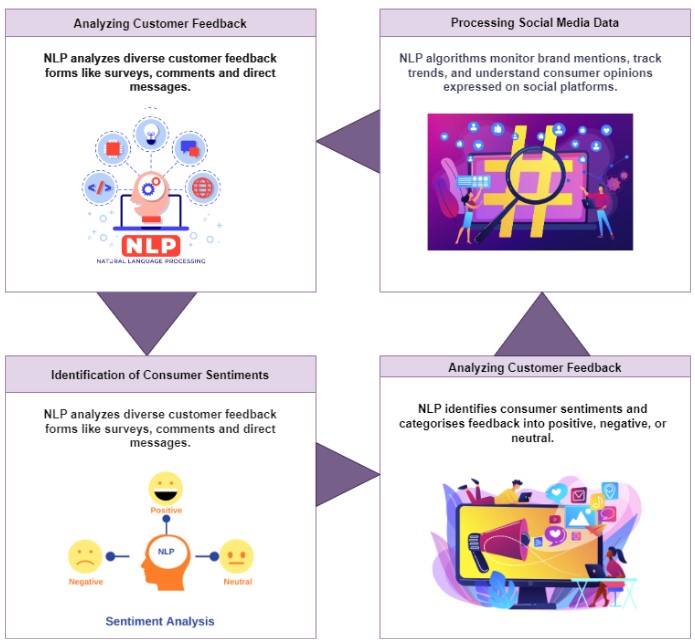
AI automates the entire lifecycle of market research with the help of its fundamental technology — Natural Language Processing (NLP). It enables machines to comprehend and interpret human language, extracting valuable insights from customer feedback, social media data, and online reviews. Recent advancements include:
- Analysing customer feedback. NLP analyses diverse customer feedback forms like surveys, comments, and direct messages. It also helps understand customer sentiments, preferences, and areas of improvement. For example, MonkeyLearn’s sentiment analysis tool processes customer feedback, enabling precise sentiment categorisation.
- Processing social media data. Social media serves as a rich source of unstructured data, and NLP algorithms help monitor brand mentions, track trends, and understand consumer opinions expressed on social platforms. For instance, Brandwatch utilises NLP to perform sentiment analysis on social media, providing actionable insights.
- Extraction of insights from online reviews. Online reviews provide a wealth of information, and NLP is employed to extract key insights from these textual sources. By applying NLP algorithms, marketers can identify common themes, sentiments, and factors influencing customer perceptions. Solutions like Reputation.com leverage NLP to filter valuable data from the vast repository of online reviews.
- Identification of consumer sentiments. NLP becomes a powerful tool for identifying consumer sentiments and categorising feedback into positive, negative, or neutral. Lexalytics leverages NLP to gauge the emotional tone of customer communications and customise business strategies accordingly.
AI’s unleashed power in ads generation — crafting text and visuals
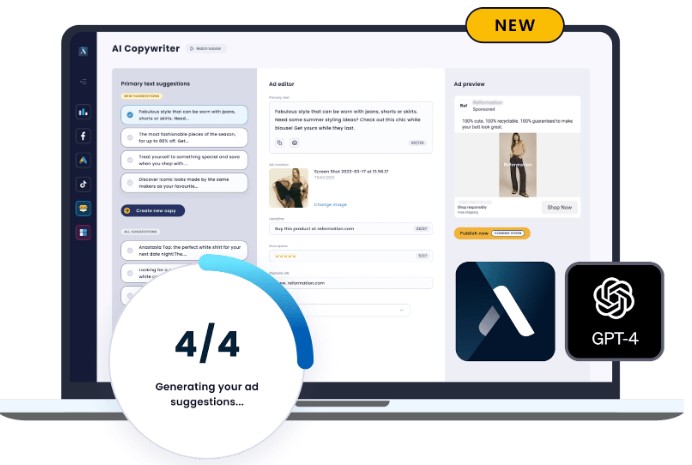
Machine learning algorithms are transforming the ads generation landscape, introducing unparalleled targeting precision. A prime example of this innovation is evident in platforms like Google Ads, where sophisticated algorithms leverage historical data to customise ad content — both text and visuals — resulting in optimised campaigns that resonate with the intended audience.
1. Optimising targeting precision
Before AI, advertising targeting relied heavily on broad demographics and basic segmentation. With machine learning algorithms at the forefront, they process vast data for targeting users based on their behaviours, preferences, and intent. For example, Google Ads has reported an increase of up to 15% in clicks with the help of machine learning-driven responsive search ads.
2. Text and visual targeting
Tailoring ad content was a time-consuming and manual process, limiting the ability to address diverse audiences before the advent of AI. Machine learning now allows dynamic ad content generation, crafting real-time text and visuals based on user preferences. Dynamic web ads, for instance, have demonstrated meaningfully higher click-through rates than static placements in advertiser case studies.
3. Maximum impact at the right time
Before the integration of AI, ad placements worked on general scheduling, lacking on most suitable times for personal engagement with users. With AI, machine learning uses predictive analytics to analyse historical data and optimise ad delivery. This ensures that the right message is presented to the right audience precisely when they are most likely to interact.
4. Continuous learning and adaptation
Before AI, campaign adjustments were typically made based on periodic reviews and manual interventions. With AI, machine learning continuously learns from ongoing campaigns. The algorithms adapt to changing user behaviour and market trends, refining targeting strategies and ad content in real time.
Retail revolution: AI’s dynamic influence on in-store ads
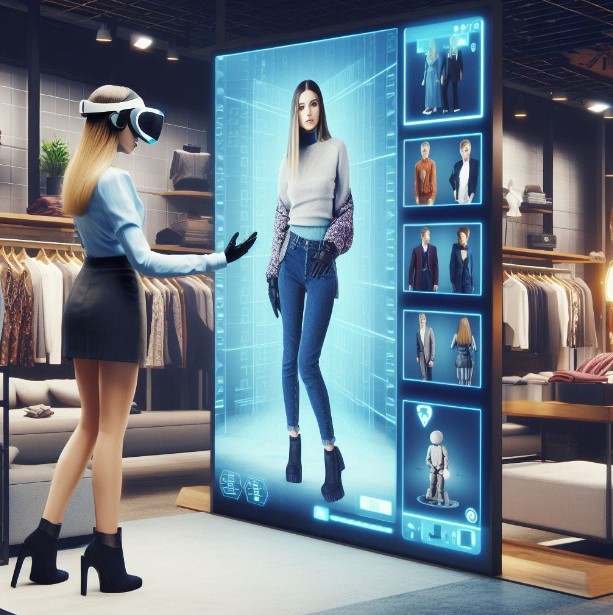
Computer vision enables in-store advertising by understanding visual content. For example, visual analysis and facial recognition tools allow retailers to identify customer reactions, optimising in-store layouts for enhanced shopping experience. In our experience working with retail and brand clients, the value lies less in any one model and more in stitching detection, tracking, and re-identification into a pipeline that survives messy real-world lighting and crowd density.
Visual content analysis
These algorithms analyse images and videos across various platforms, such as social media and e-commerce sites. Marketers can track the presence of their products in the visual landscape, identify trends, and assess consumer sentiment towards their brand.
Emotion analysis in advertising
Facial recognition algorithms within computer vision are applied to analyse consumer emotions in response to video advertisements. Marketers can gain insights into how different elements of an ad evoke emotional responses.
In-store behaviour analysis
Computer vision tracks customer behaviour within physical retail spaces, enabling retailers to create personalised shopping experiences.
Virtual try-on experiences
Computer vision offers augmented reality technology for virtual try-on experiences in the fashion and beauty section. Consumers can visualise how clothing items or makeup products will look on them before making a purchase.
Surveillance and monitoring
Computer vision surveys physical spaces for monitoring customer interactions and compliance with safety protocols, enhancing real-time safety in the retail environment.
Beyond boundaries: AI’s impact on out-of-store ad campaigns

Out-of-store ads benefit from the synergy of IoT and edge computing. Location-based push notifications use IoT-enabled mobile devices to send targeted messages to customers based on their location. Retailers can attract customers near a store with personalised promotions, increasing foot traffic and engagement.
In-store customer tracking
IoT beacons and sensors track customer movements within physical retail spaces. A clothing retailer can use IoT to analyse how customers navigate through the store. Edge computing then processes this data in real time, providing insights into popular sections and optimising product placements for increased visibility.
Smart shelf technology
RFID tags and IoT sensors on shelves provide real-time inventory data and customer interaction information. A grocery store employs smart shelves with RFID tags and sensors. IoT devices communicate this data to edge computing systems when a product is picked up or placed back on the shelf, enabling instant inventory updates and triggering automated restocking processes.
Location-based push notifications
IoT-enabled mobile devices and beacons send push notifications to nearby customers based on location. A coffee shop uses IoT beacons to detect customers in close proximity. Edge computing analyses this data and triggers personalised push notifications, offering discounts or promotions to entice customers to enter the shop.
Foot traffic analysis for events
IoT sensors at event venues track attendee movements and interactions. At a trade show, sensors capture data on visitor traffic, popular booth locations, and time spent at each exhibit. Edge computing then processes this information, helping event organisers optimise floor layouts for future events.
Precision personified: AI’s prowess in personalised ad campaigns

Ad personalisation was once limited to basic demographics. With the help of ML algorithms, personalised commercials have evolved by using extensive personal information from search history, geo-location and online activities. Using its recommendation engine powered by AI, Amazon has reported sales uplifts in the range of 29% as reported in the cited source, attributable to personalised product recommendations based on user behaviour.
AI algorithms analyse past purchases, browsing history, and user interactions to offer personalised product recommendations. Personalised ads foster deeper engagement and encourage repeat purchases. Using AI to curate personalised playlists, Spotify has observed increased user engagement and longer subscription periods.
AI’s influence on evolving consumer intelligence platforms
These platforms leverage NLP to enhance customer experiences. Zendesk, for instance, applies NLP for sentiment analysis, tailoring responses for enhanced customer experiences. By understanding customer sentiments, brands can tailor responses, resolve issues promptly, and create a more positive and personalised customer experience.
Benefits
Deployment evidence demonstrates AI’s transformation of traditional marketing workflows into data-driven operations.
Optimised ROI
Implementing AI in marketing campaigns significantly boosts return on investment. According to McKinsey, commercial leaders who invest in AI are seeing a revenue uplift in the 3% to 15% range and a sales ROI boost of 10% to 20%. AI-driven campaigns consistently outperform traditional approaches by precisely targeting high-value customer segments and optimising ad spending.
Personalised marketing content
AI marketing tools deliver personalised and dynamic content across channels like social media or websites. Clinique — a skincare brand — employs personalised AI marketing through an online skincare consultation tool where customers answer a series of questions about their skin preferences and issues, and the AI tool generates tailored content for their skincare routine and product suggestions.
Hyper-personalised experiences
With predictive analytics, brands can anticipate customer requirements and offer product recommendations, pricing and promotions accordingly. Amazon analyses customers’ browsing history, demographic data, and product pricing with AI algorithms, providing highly personalised suggestions.
Why does AI marketing still fail in practice?
Despite its transformative potential, AI in marketing faces real-world limitations. AI algorithms may struggle to capture subtle human emotions, resulting in personalisation inaccuracies. Bridging the gap between AI outputs and human behaviour context remains a continuous challenge.
- Data privacy concerns. In 2020, IBM’s report estimated the average global cost of a data breach at $3.86 million. AI campaigns rely on diverse datasets, making them attractive targets for attackers.
- Data quality issues. Biased or incomplete data can hamper the accuracy of AI models, leading to suboptimal outcomes in marketing strategies.
- Implementation challenges. Marketers may struggle to integrate AI into their existing platforms, which requires substantial investments in technology and staff training.
- Talent and expertise gap. A shortage of skilled professionals proficient in both marketing and AI hampers effective implementation. Addressing this gap requires upskilling in technical skills like machine learning and data analysis.
Quick-answer: where does AI fit across the marketing stack?
| Stage | AI capability | Representative technology |
|---|---|---|
| Market research | Sentiment + theme extraction | NLP, transformer-based classifiers |
| Ad creative | Dynamic text + image generation | Generative models, diffusion |
| Targeting & bidding | Behaviour-based prediction | ML on first-party signals |
| In-store ads | Behaviour + emotion analysis | Computer vision, OpenCV pipelines |
| Out-of-store ads | Location-aware triggering | IoT beacons + edge inference |
| Personalisation | Recommendation + ranking | Collaborative filtering, learned embeddings |
TechnoLynx’s innovative solutions and AI integration services
Major CPG brands reduced ad spend waste by 34% after implementing programmatic buying algorithms, as reported in cited case studies.ail, predictive analytics over historical campaign data, or generative models for creative production. Our work spans PyTorch and TensorRT for model inference, OpenCV for vision pipelines, and Kubernetes + Docker for the deployment substrate, so the production system survives contact with real traffic and not just a benchmark.
Final thoughts
AI’s integration into marketing strategies amplifies precision, personalisation, and performance. As marketers navigate a dynamic market, taking advantage of AI-driven innovations supports sustainable growth, deeper engagement, and stronger connections with audiences. The benefits are real, but so are the challenges around data privacy, data quality, and integration into existing tooling.
As a software engineering company, we at TechnoLynx address these challenges directly through custom AI integration services. Our role is less to “supply AI” and more to design the system that makes AI useful inside an existing marketing organisation — where the constraints of data governance, latency, and measurement actually live.
Frequently Asked Questions
How is AI used in marketing today?
Across the marketing stack, NLP powers market research and sentiment analysis, machine learning optimizes ad targeting and bidding, generative models produce creative assets, computer vision tracks in-store behaviour, IoT plus edge computing enable location-based campaigns, and recommendation systems drive personalisation. The common thread is using behavioural and contextual signals to decide what content to show, to whom, and when.
What are the main benefits of AI in marketing?
The most consistent benefits are sharper targeting, dynamic personalisation across channels, and better measurement of campaign performance. McKinsey reports AI-investing commercial leaders seeing revenue uplifts in the 3–15% range and sales ROI improvements of 10–20%, alongside operational gains from automating market research and creative iteration.
What are the challenges of using AI in marketing?
Four challenges show up repeatedly: data privacy and breach risk, data quality and bias, integration cost into existing martech platforms, and a shortage of staff fluent in both marketing and machine learning. None of these are solved by buying a tool — they require deliberate engineering and governance work alongside the AI itself.
How does computer vision change in-store advertising?
Computer vision lets retailers analyse customer behaviour, dwell time, and emotional response inside physical stores, and it powers virtual try-on experiences in fashion and beauty. The practical value comes from pipelines that combine detection, tracking, and re-identification reliably under real-world lighting and crowd conditions — not from any single model in isolation.
How does TechnoLynx help with AI marketing integration?
We design and build AI marketing systems end to end — from data pipelines and model selection through deployment on the appropriate infrastructure (cloud GPUs, on-prem servers, or edge devices). Our focus is the integration layer: making the AI usable inside the client’s existing marketing operation, with the data governance, latency, and measurement constraints accounted for from day one.
References
- Pang, G., & Pang, G., 2022. The AI Chip Race. IEEE Intelligent Systems, 37, pp. 111-112.
- Johnson, G., Lewis, R., & Nubbemeyer, E., 2016. The Online Display Ad Effectiveness Funnel & Carryover: A Meta-study of Predicted Ghost Ad Experiments.
- Kireyev, P., Pauwels, K., & Gupta, S., 2016. Do display ads influence search? Attribution and dynamics in online advertising. International Journal of Research in Marketing, 33, pp. 475-490.
- Linden, G., Smith, B., & York, J., 2003. Amazon.com Recommendations: Item-to-Item Collaborative Filtering. IEEE Internet Comput., 7, pp. 76-80.
- Parihar, A., & B., 2018. A Study on Sentiment Analysis of Product Reviews. 2018 International Conference on Soft-computing and Network Security (ICSNS), pp. 1-5.