Why computer vision matters in healthcare
Images form the operational core of modern medicine. Every day, hospitals produce millions of digital images — CT scans, MRIs, chest X-rays, and pathology slides. These pictures hold critical clues about disease, recovery, and risk. The volume now outpaces what radiology rosters can read inside a clinically useful window, and the gap is widening every quarter.
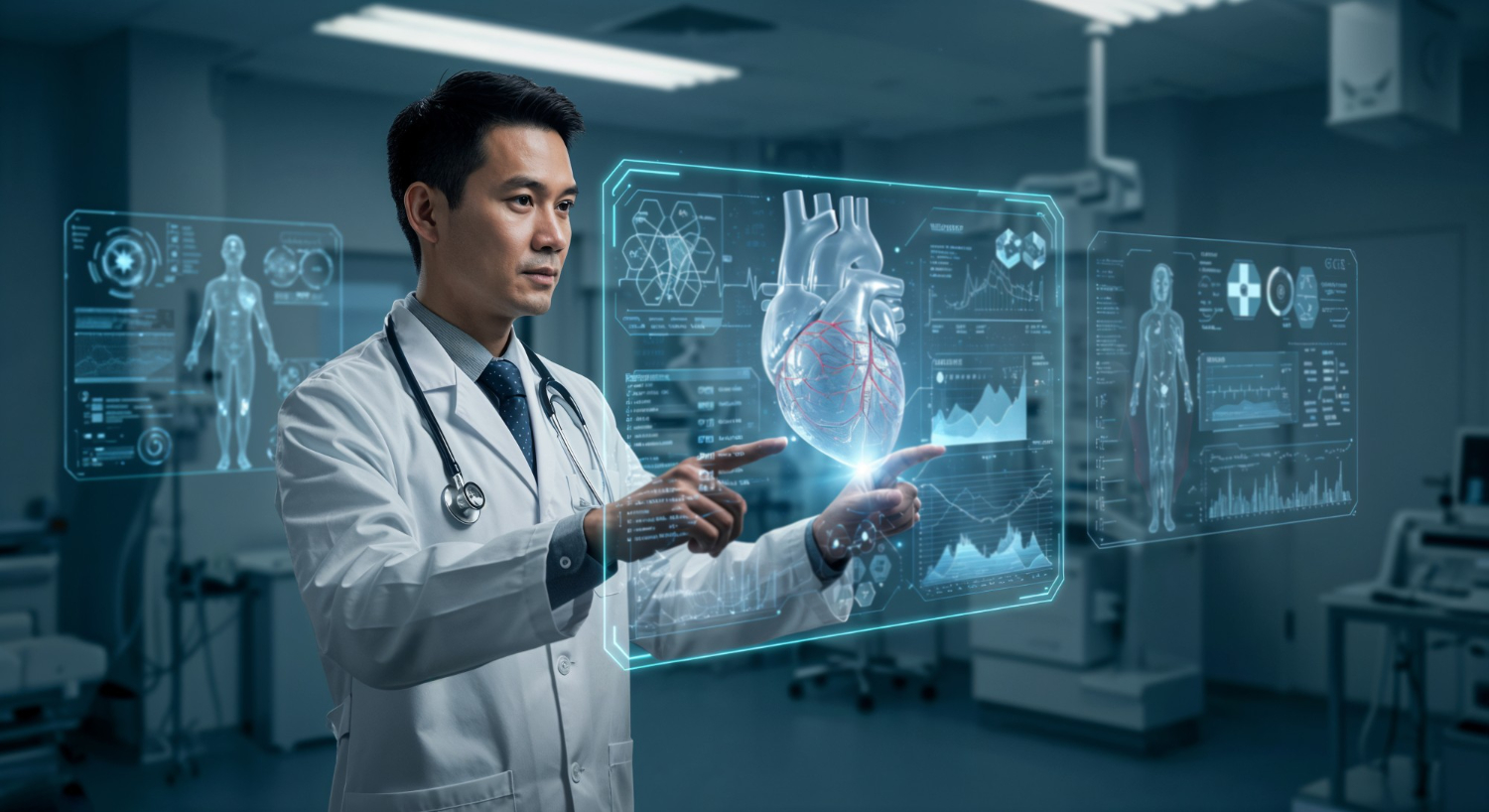
Computer vision systems are how that gap gets closed in practice. They apply deep learning to medical imaging tasks — classification, detection, segmentation — to support triage, early detection, intensive-care monitoring, and pathology review. The question we keep working on with hospital teams is not whether the models work in a notebook. It is what changes when those same models have to live inside a regulated clinical workflow, with PACS integration, audit logs, and a validated lock between the version that was cleared and the version that runs at 3 a.m. on a Tuesday.
That regulatory frame is the part most generic articles skip. We focus on it here because, in our experience, it determines whether a promising prototype ever reaches a patient.
What does FDA-cleared computer vision actually look like in production?
By 2024 the FDA had cleared more than 950 AI/ML-enabled medical devices, and the published list (an observed-pattern from the FDA’s own device database, not a benchmark on our infrastructure) is dominated by radiology — chest imaging, mammography, brain CT, retinal screening. The recurring engineering pattern is the same across all of them: a locked model version, a defined intended-use statement, and a post-market surveillance plan that triggers a re-submission whenever the weights change in a way that affects clinical performance.
That single constraint — every model change is a regulatory event — reshapes the whole pipeline. You cannot retrain weekly. You cannot silently swap a backbone. You design for traceability from day one.
The scale of the imaging challenge
Relentless growth in imaging demand confronts every hospital. Chest X-ray studies alone number in the millions each year in a mid-sized national system. Add CT, MRI, and ultrasound, and the load becomes staggering. Radiology departments hold large datasets that require fast, accurate interpretation, and manual review cannot keep pace.
Errors in interpretation carry heavy costs. A missed lesion can delay treatment by months. A false positive can trigger a cascade of unnecessary tests, radiation exposure, and patient anxiety. Both outcomes harm patients and strain budgets. Computer vision systems reduce these risks by automating routine triage and surfacing critical findings for human review — they do not replace the radiologist, they reorder the worklist.
From pixels to insight: the pipeline that holds up under audit
Tightly scoped paths define production-grade medical CV. Each step has to be traceable because each step will, eventually, appear in a regulatory submission or a post-market incident report.
| Stage | What happens | Why it matters for clearance |
|---|---|---|
| Image processing | Noise reduction, contrast normalisation, modality-specific pre-processing (DICOM windowing, MRI bias-field correction) | Locked pre-processing is part of the cleared device — drift here counts as a model change |
| Feature extraction | Convolutional backbones (often ResNet, EfficientNet, or 3D U-Net variants) learn task-specific representations | Architecture is declared in the 510(k) summary |
| Classification or detection | Output is a label, a bounding box, or a per-pixel segmentation mask | Performance is reported against a fixed test set drawn from declared populations |
| Decision support | Overlays, confidence scores, structured reports written back to PACS or EHR | The integration surface is part of the intended use — it cannot be silently changed |
This pipeline repeats across modalities, from radiology to digital pathology. What changes is the head, the labelling protocol, and the clinical pathway behind the output.
Early detection: time as a clinical asset
CV contributes to early detection through mechanisms narrower than marketing suggests, even as early detection itself saves lives. The model does not “find cancer.” It reorders the reading queue.
Lung cancer screening illustrates the point. A small nodule on a chest X-ray may signal early disease. If overlooked on a 200-study list at the end of a shift, it can progress before treatment begins. Computer vision systems rank studies by risk and push likely positives to the top of the queue. Radiologists read these first, and patients move to follow-up CT sooner. The cleared CADt (computer-aided triage) products do exactly this — they do not diagnose; they re-prioritise.
Screening programmes also benefit. AI models compare current and prior scans, spotting subtle growth or density changes that a human reader, looking at one study in isolation, may miss. These alerts prompt timely follow-up. Clinicians remain in control; the machine ensures nothing falls off the bottom of the list.
How does CV translate cancer detection beyond radiology?
Pathology labs scan slides at 40× resolution (the standard magnification for whole-slide imaging, as reported in the clinical literature), producing gigapixel images.
The Swedish MASAI trial reported a 20% increase in cancer detection rate (as reported in that trial) when AI was used as a second reader, with no increase in false positives.
Monitoring patients in intensive care
Non-imaging CV—passive video analysis complementing the existing bedside sensor stack—is increasingly deployed in intensive care units, where constant vigilance is non-negotiable. Cameras track posture, detect line disconnections, and monitor respiratory effort. AI models analyse the feeds in real time. When risk appears — a blocked ventilator tube, a patient attempting to self-extubate — the system raises an alert.
The engineering constraints here are different from radiology. There is no DICOM, no PACS, no offline batch processing. Latency budgets are measured in seconds, not minutes. Privacy obligations are sharper because the cameras see faces, visitors, and clinical staff. Hospitals enforce strict consent flows and encryption at every hop. Video complements sensors; it does not replace clinical judgement. We treat it as an additional channel into the early-warning score, not as a standalone alarm.
How AI models learn to see medical images
Convolutional neural networks built on PyTorch or TensorFlow, often exported through ONNX and served via TensorRT on hospital-grade GPUs, dominate medical imaging. These architectures learn hierarchical features: edges in early layers, complex shapes in deeper layers. Transformer-based vision backbones (ViT, Swin) are now appearing in cleared devices, particularly for whole-slide pathology where global context matters.
Training requires large, well-labelled datasets. Models ingest tens of thousands of labelled images — chest X-rays, CT slices, pathology slides — and learn patterns linked to disease. Validation uses held-out sets drawn from declared populations and scanners, because the regulator will ask exactly which scanners and which patient demographics were represented. Robust pipelines include bias checks across age, sex, and ethnicity, and calibration to maintain reliability across sites.
Generalisation is the perennial weak point. A model trained on one scanner vendor often degrades on another. Across our medical-imaging engagements we have seen 5–15 percentage point drops in detection sensitivity when a model trained on GE scanners is deployed against Siemens or Canon data without site-specific calibration — that is an observed-pattern across a small number of projects, not a benchmarked rate, and the magnitude depends heavily on modality and task.
Classification and segmentation in clinical use
A global label—normal, pneumonia, fracture, intracranial haemorrhage—is assigned by image classification. Segmentation goes further, outlining regions such as tumours, organs, or vessels at pixel level. Both tasks matter. Classification speeds triage. Segmentation supports planning for surgery, radiotherapy contouring, or quantitative follow-up — measuring how a tumour has changed between two scans.
Computer vision techniques combine these outputs with structured reports. Clinicians receive clear visuals and concise summaries, written back into the radiology information system in the same template as the human-authored reports. They act faster and with greater confidence because the AI output sits inside, not alongside, their existing workflow.
Managing large datasets without losing governance
Terabytes per site per year are generated by medical imaging. Hospitals need systems that store, retrieve, and process these files efficiently. Cloud platforms and distributed computing enable parallel analysis of thousands of studies. Compression and caching reduce costs without losing diagnostic detail — though lossy compression is rarely acceptable for primary diagnostic use.
Governance matters as much as throughput. Teams enforce de-identification at the DICOM-tag level, role-based access controls, and immutable audit trails. These steps protect patient privacy under HIPAA in the United States and GDPR in Europe, and they are non-negotiable for any system that touches identifiable patient data.
Building trust through interpretability
Transparency is demanded by healthcare professionals. AI models must explain their reasoning, or at least localise it. Cleared devices typically provide heatmaps, confidence scores, and full input/output logs. A chest X-ray flagged for a pulmonary nodule shows the region that triggered the alert. A pathology slide marked “high risk” includes visual cues that point the pathologist at specific tiles.
Interpretability also supports compliance. Regulators expect documented evidence for each automated decision pathway. Hospitals meet that bar with explainable-AI dashboards, version-pinned model registries, and clear audit trails that link a given output to a specific model version, a specific input, and a specific timestamp.
Applications across clinical domains
- Radiology benefits from automated triage, detection of bleeds and large-vessel occlusions, and quantitative follow-up across chest X-rays, CT, and MRI.
- Pathology — digital slides analysed for tumour grading, mitotic counts, and biomarker estimation.
- Ophthalmology — retinal images screened for diabetic retinopathy and age-related macular degeneration; this is where the FDA cleared its first autonomous AI diagnostic (IDx-DR) in 2018.
- Dermatology — lesion photos classified for urgent referral, typically as a triage tool rather than a diagnosis.
Each domain uses tailored CV techniques but shares the same engineering goal: faster, safer patient care, validated against the population that will actually see the tool.
Challenges that still stand
Dataset drift, bias, and noise remain real risks. Models trained on one scanner generation may falter on the next. Rare conditions can escape detection because they were under-represented in training. Hospitals counter these issues with continuous monitoring, scheduled re-validation, and — when material — formal re-submission to the regulator.
Ethical review demands its own attention. Teams check fairness across age, sex, ethnicity, and socioeconomic strata. They document the mitigations and publish performance metrics by subgroup. Patients deserve tools that work for the whole population, not just the majority slice of the training set.
Making medical vision deliver in clinics
More than a good demo is needed by hospitals. They need tools that improve patient care every working day, inside the existing IT estate, without surprise downtime.
Start with one service line and one outcome metric. Pick a clear goal — faster CT-head turnaround for suspected stroke, fewer missed central lines on ICU chest X-rays, shorter time-to-MDT-slot for screen-detected lung nodules. Define the baseline. Run a short, scoped pilot. Measure the change. Share the results with both the readers and the clinicians who act on the output.
Build the workflow around real cases. Capture digital images under stable acquisition protocols. Apply image processing that fixes noise and contrast before any model sees a pixel. Use CV techniques that match the task: classification for binary triage gates, detection for objects with location and size, segmentation when quantitative measurement matters.
Treat data flow as part of care, not as an IT side note. Large datasets grow every shift, so storage plans cannot slow the worklist. Cache priors that matter for change detection. Keep logs that explain why the system moved a study up the queue. Trust is earned step by step.
Tighten the feedback loop. Radiologists confirm or reject each prompt. Pathologists mark regions the tool missed. ICU nurses tag false alarms with a single tap. These labels feed monitoring — not silent retraining. Retraining is a regulatory event. Monitoring is what tells you a regulatory event is coming.
Avoid silent breaks between teams. Bring clinical leads, informatics, quality, and information governance into the same room. Agree definitions of success that reflect the clinical pathway, not just model AUC. For cancer detection, set targets tied to risk and pathway capacity. For ward safety, track true alerts per bed-day. Numbers only matter when the ward feels the change.
Plan for scale after the first win. Add one adjacent use case at a time — chest X-ray triage to CT triage, line checks to fall-risk monitoring. Reuse the core pipeline and extend heads and rules. Familiar interfaces reduce training overhead for staff.
Protect patients while you grow. Keep consent flows clear. Mask faces when identity is not clinically relevant. Encrypt camera streams and store only event-triggered frames. Publish audit trails that show who viewed what and when. People accept CV systems when they see care and respect in every step.
Budget for uptime. Clinical tools fail if they stall during peak hours. Run active monitoring of latency, throughput, and error rates. Set safe fallbacks that route images to manual review when a threshold is breached. Reliability beats novelty on busy lists.
Teach the reasoning, not just the buttons. Show heatmaps and confidence bands next to each prompt. Explain why a case was promoted on the worklist. Share simple one-page guides for common miss patterns. When a reader understands why a nodule alert fired, the reader engages — and engagement lifts real-world accuracy far more than slogans about AI ever will.
Future directions in medical vision
Multimodal AI—linking images with structured EHR data, clinical notes, and lab results—is where research is moving for richer context. Self-supervised pre-training on unlabelled medical images reduces dependence on heavy expert labelling. Edge computing brings inference closer to scanners, cutting latency for time-critical tasks like stroke triage. Generative models are being explored to balance datasets for rare diseases, under careful governance to prevent training-on-synthetic-data collapse.
Adoption will depend, as always, on safety, clarity, and measurable value — not on the headline architecture.
FAQ
How many AI-enabled medical devices has the FDA cleared, and which CV patterns recur across them?
Diagnostic accuracy has improved dramatically as deep learning models analyze medical images for pathologies once visible only to trained specialists. In Impact Computer Vision Medical, the short answer is as follows. Impact Computer Vision Medical behaves predictably once you see the mechanism. In Impact Computer Vision Medical, the short answer is as follows. By 2024 the FDA’s published list of AI/ML-enabled devices exceeded 950 entries, and the large majority sit in radiology — chest imaging, mammography, brain CT, retinal screening — with growing presence in digital pathology and cardiology. The recurring CV patterns are computer-aided triage (worklist reordering), computer-aided detection (CADe, marking regions of interest), and computer-aided diagnosis (CADx, providing a likelihood assessment). All three operate under locked-model rules, a fixed intended-use statement, and a post-market surveillance plan.
What are the production patterns behind FDA-cleared CV diagnostics?
CADe surfaces candidate findings — nodules, microcalcifications, fractures — without claiming a diagnosis. CADx assigns a probability or risk score, which is regulated more strictly because it more directly influences a clinical decision. Radiomics pipelines extract quantitative features from images and feed them into downstream models. All three patterns share the same engineering disciplines: locked pre-processing, declared training population, fixed validation cohort, and an audit log that ties every output to a specific model version.
How does deep learning in medical CV translate into regulatory artefacts?
Classification, segmentation, and detection each map onto specific submission evidence. Classification needs a confusion matrix on a declared test set drawn from the intended-use population. Segmentation needs Dice or IoU against expert ground truth, often with inter-reader variability reported alongside. Detection needs free-response operating characteristic curves. All three need subgroup performance — age, sex, ethnicity, scanner vendor — and a documented monitoring plan.
Where do AI medical-device pipelines need to handle generalisability, drift, and population shift?
Scanner heterogeneity, protocol drift, and population shift are the three big failure modes. The mitigations are site-specific calibration before go-live, continuous monitoring of input-distribution statistics and output-rate stability, and a clear escalation path when monitored metrics breach pre-defined thresholds. A breach is not a silent retrain — it is a clinical-safety event that may require a regulatory re-submission.
What integration patterns connect CV inference to PACS, EHR, and clinical workflow?
The dominant integration pattern is DICOM in, DICOM-SR or DICOM-GSPS out, so that AI findings travel through the same plumbing as human reads. For triage tools, the integration extends to the worklist manager, where the model output drives study priority. For ward-side applications, integration is via HL7 or FHIR into the EHR, with alerts routed through the existing nurse-call or early-warning-score channels.
Which AI-enabled medical-device companies and products define the current state of practice in 2026?
The 2026 state of practice is shaped by a mix of specialist vendors and platform players. Recurring names across radiology, pathology, and ophthalmology include vendors clearing CADt for stroke and pulmonary embolism, CADe and CADx for chest and breast imaging, autonomous diagnostic AI for diabetic retinopathy, and whole-slide pathology AI for prostate and breast. Hospital systems increasingly evaluate these as components inside a broader CV platform rather than as standalone point solutions — which is the architectural shift driving most of our current engagements.
TechnoLynx: practical computer vision for patient care
Clinical reality, not lab benchmarks, defines the CV systems we build. Our work covers image processing, classification, detection, and segmentation pipelines, validated against the populations and scanners that will actually see the tool. We integrate with PACS and EHR estates without surprising the IT team, and we design for the lock-and-key model governance that medical-device CV requires.
Where the goal is a cleared device, we design for the regulatory submission from day one — declared intended use, locked pre-processing, fixed validation cohort, post-market monitoring plan. Where the goal is a research or quality-improvement deployment, we build the same discipline at a lighter weight, so the path to clearance stays open if the project matures.
Let’s collaborate and turn medical imaging challenges into reliable, patient-centred systems.
Engineering note: the recurring failure class in early-stage medical CV is scanner-vendor drift surfacing as a quiet drop in detection sensitivity months after go-live; the artefact that prevents it is a site-specific calibration set captured before clinical use and re-checked on a defined cadence.
Image credits: Freepik