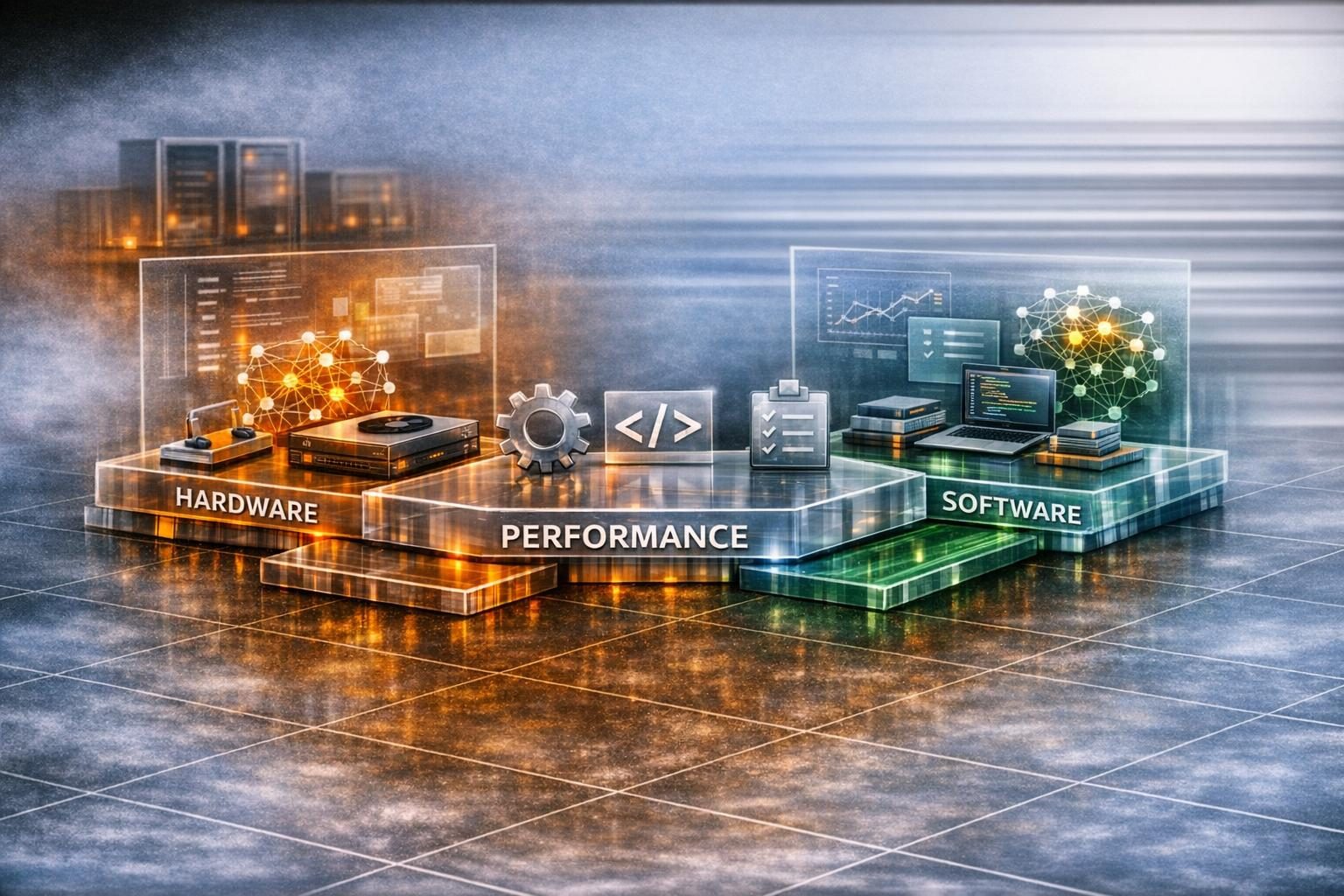

A PyTorch version bump changed which attention kernel was selected. Throughput moved by 30%.
Every parameter held constant—model, hardware, configuration, dataset. The framework updated, the kernel dispatch logic chose a different code path, and the measured throughput shifted by nearly a third. If you didn’t know about the version change, you’d think the hardware regressed.
This kind of event is not rare. It’s the normal texture of running AI workloads on real software stacks, and it illustrates something that many performance discussions still treat as a footnote: the software stack is not plumbing. It’s a first-class performance component — one that routinely determines whether the hardware’s capabilities are exploited, partially used, or effectively walled off.
Software doesn’t just “use” the GPU — it decides what runs
Headlines spotlight hardware specifications while relegating software to infrastructure footnotes. “This GPU achieves X throughput” — as if the throughput was a property of the silicon that the software merely observed.
But the software stack makes the decisions that shape execution — and those decisions are where CUDA, frameworks, and ecosystem lock-in become strategically important. The framework decides how the computational graph is constructed, which operators exist, and what fusion opportunities are available. A graph compiler like torch.compile or XLA decides which operations to merge, what memory layout to use, and how to schedule work. The CUDA runtime manages kernel launches, memory allocation, and stream synchronization. And libraries like cuDNN or FlashAttention provide the actual kernel implementations that run on the hardware.
These aren’t incidental choices — they’re the mechanics that determine which execution path the workload takes through the hardware. Change any one of them and you can shift the bottleneck from compute to memory, change the memory access pattern from cache-friendly to cache-hostile, or replace a fast fused kernel with a sequence of slower unfused ones. The hardware is the same. The outcome isn’t.
What does an AI software stack actually consist of, layer by layer?
Read bottom-up, the stack is: the kernel driver and its scheduling and power-management policy; the vendor runtime (cuda on NVIDIA, cuda via ROCm on AMD, xpu on Intel, or a plain CPU path); the kernel libraries that supply the actual device implementations; the framework that builds and transforms the graph; and any compilation pass layered on top of it. Each layer makes decisions the layer above cannot see.
Software stack decisions that shape GPU performance
| Stack component | Decision it makes | Performance consequence |
|---|---|---|
| Framework (PyTorch, JAX) | Graph construction, operator selection, memory layout | Determines which execution path the workload takes |
| Graph compiler (torch.compile, XLA) | Operator fusion, scheduling, backend kernel selection | Can shift the workload between compute-bound and memory-bound regimes |
| Kernel libraries (cuDNN, FlashAttention) | Actual implementation of operations on the device | Optimized vs. fallback kernels can differ by roughly 2–5× on the same hardware (observed pattern across our GPU engagements; not a published benchmark) |
| CUDA runtime | Memory allocation, kernel launch, stream synchronization | Launch overhead and allocation policy affect whether the GPU stays saturated |
| Drivers | Scheduling heuristics, power management, resource arbitration | Version changes can alter performance without any application-level change |
Software creates real performance ceilings
Software does not merely modulate performance; in many cases, it establishes the upper bound.
If the stack can’t generate an efficient execution plan for your workload, the GPU’s peak capability becomes irrelevant in a very practical sense — another expression of the fact that GPUs are part of a larger system. You’re not “leaving performance on the table” as some optimization opportunity for later; you’re running into a software-defined limit that the hardware cannot override, because the hardware only executes what the software gives it.
We see this concretely when a framework lacks an optimized kernel for a particular operation — a custom attention variant, an unusual normalization, a non-standard activation function. The fallback path might be functionally correct but several times slower than what the hardware could theoretically sustain. The GPU has the capability. The software doesn’t use it. The measured throughput reflects the software’s ceiling, not the hardware’s.
Two frameworks can produce meaningfully different performance on the same hardware with the same model precisely because of this: they’re making different execution decisions, and those decisions create different ceilings.
That also tells you where to look first when a number disappoints. The driver, the vendor runtime, and the framework each impose their own ceiling, and on any given workload one of them tends to dominate — most often the framework, because it decides whether an optimised kernel is even reachable for your operators. To isolate the binding layer, hold the rest of the executor tuple fixed and vary one component at a time: swap the kernel library, toggle the compilation pass, or pin a driver branch, and watch which substitution actually moves the number. The layer that moves it is the one defining your ceiling, and it is rarely the silicon.
Drivers and runtimes: invisible and non-trivial
Lower-stack layers escape scrutiny because they remain invisible to model-level instrumentation. You define your model in Python, call model.forward(), and something happens on the GPU. The details of kernel scheduling, memory allocation strategy, stream synchronization, and launch overhead feel like someone else’s problem.
They are — until they become your performance bottleneck.
CUDA driver updates change scheduling heuristics. Runtime versions alter memory pool behavior, kernel selection priorities, and synchronization semantics. Even without changing a single line of application code, a driver upgrade can shift where time is spent during execution. In our experience a driver update can improve throughput on one model family and degrade it on another, because the scheduling change favoured one operator pattern at the expense of a different one.
This doesn’t mean newer is always worse (or always better). It means that stability assumptions about the lower stack layers are a form of implicit performance claim — and like all performance claims, they need to be validated rather than assumed.
That framing matters most when you’re deciding whether to update at all. The decision isn’t “is the new version faster?” — it’s a risk-versus-gain judgement on the same hardware. A version bump can lift throughput on your workload, leave it flat, or quietly regress it because a scheduling or fusion change favours an operator mix you don’t run. So the practical rule we apply is to treat an update as a perturbation to be measured on your own model and your own load before it ships: weigh the plausible gain against the cost of a silent regression that no application-level change explains, and gate the upgrade on a re-measurement rather than on the release notes. As the discussion of why identical GPUs diverge illustrates, software version differences are one of the most common and most underestimated sources of performance variance in real deployments.
There is a discipline point hiding inside that rule. A before/after pair across a stack change is not a controlled experiment. Each side is one timed measurement window on one machine, and everything else on that machine moved with it — thermal state, background load, memory fragmentation, whatever the OS was doing. The pair is evidence that something moved. It is not, on its own, evidence of how much a driver made something faster.
Framework-level decisions change what runs, not just how
Framework-layer effects surface with greater visibility. Frameworks don’t just execute your model — they transform it.
Graph-level optimizations decide which operators to fuse, how to lay out tensors in memory, whether to batch certain operations, and which backend kernels to dispatch. A PyTorch model running with torch.compile may take a fundamentally different execution path than the same model running eagerly. A switch from a standard SDPA implementation to FlashAttention v2 can change memory access patterns, reduce peak memory usage, and substantially alter throughput — all without changing the model’s mathematical definition.
So when a benchmark reports “X tokens per second on model Y,” the implicit context includes which framework version was running, what compilation or optimization passes were applied, and which kernels ended up executing. All of that is part of the measurement. If it’s not part of the report, the number is incomplete.
What does this mean for credible performance comparisons?
Credible performance comparisons must account for the software stack, given its causal role in outcomes. Operationally, that means performance ownership spans hardware and software teams.
A comparison that says “GPU A is faster than GPU B on model X” but doesn’t report the framework version, compilation settings, kernel libraries, and driver versions for both systems has told you which system was faster under those unspecified conditions. It hasn’t told you why, and it hasn’t told you whether the result would hold if you controlled the software layer.
This isn’t an argument for dismissing comparisons that don’t report every detail. It’s an argument for interpreting them correctly: as observations of specific executions, not as universal claims about hardware. The more context is visible, the more useful the comparison becomes. And the most useful context to make visible is usually the software stack — because it’s the part that people most often treat as background, and it’s the part that most often explains divergent results.
Building on the principle that performance emerges from the full stack, treating the software layer as first-class isn’t an ideology — it’s a practical requirement for avoiding conclusions that won’t survive a deployment.
LynxBenchAI records the software half alongside the number. Every result is bound to the backend it ran through — cuda for NVIDIA, cuda via ROCm for AMD, xpu for Intel, or CPU — together with the driver, framework, and runtime present on the machine. The same model catalogue runs across all four backends under one set of rules, so a software-stack difference shows up as a difference in the number rather than as a difference in whose benchmark was used. Optimisation effort is held still while the stack is examined: the models are prepared once, before any target is known, and the identical prepared artefacts ship to every vendor’s hardware. And because a full pass takes 15–30 minutes on ordinary consumer hardware, the claim is checkable — install, run, change the driver or runtime, run again. The stack being measured is one anyone can obtain: the benchmark declares the environment it installs, and a submitter may diverge from it — a different driver branch, a newer runtime — provided every component is a version released to the public. A build produced for LynxBenchAI, or tuned against it and shipped to nobody else, falls outside the methodology. That out-of-the-box rule is declared rather than technically enforced: the client does not verify that a submitted stack is publicly obtainable, and what the submission record captures — driver, framework, and runtime versions — makes the rule auditable after the fact rather than at run time. Two reading rules travel with that: results are read within a release (26Q3 against 26Q3, because the catalogue, precisions, correctness thresholds, and scoring formula are fixed per release), and a GT difference is an ordinal aggregate rather than a physical quantity that tells you how much faster a driver made something. The declared condition is a continuous timed window after a discarded warm-up, which does not capture thermal state or clock behaviour. The Personal Edition is the released one and is free for non-commercial use.
Frequently Asked Questions
How do GPU drivers and runtimes directly shape execution performance?
Drivers control scheduling heuristics, power management, and resource arbitration; runtimes manage kernel launches, memory allocation, and stream synchronization. Together they decide how the work you submit actually reaches the device and how time is spent during execution. A driver or runtime update can move that distribution without any change to your application code, which is why we treat their versions as part of the measurement context rather than as stable plumbing.
Why can a CUDA, driver, or framework version change move benchmark results by a large margin on the same hardware?
Because each of those layers makes execution decisions — kernel dispatch, operator fusion, memory layout, launch policy — and a version change can pick a different path through the same hardware. The PyTorch update in the opening example shifted attention-kernel selection and moved throughput by roughly 30% with nothing else changed. The hardware ceiling never moved; the software’s chosen path did, and the measured number followed.
In what cases does upgrading software actually reduce performance instead of improving it?
When a new version changes scheduling heuristics, kernel selection priorities, or fusion patterns in a way that favours one operator mix at the expense of another. We have seen driver updates improve throughput on one model family and degrade it on another for exactly that reason. Newer is neither universally faster nor universally slower, which is why stability assumptions about the lower stack layers have to be validated like any other performance claim.
How does framework behaviour affect kernel scheduling and memory use on the GPU?
Frameworks transform the model before it runs: they decide which operators to fuse, how to lay out tensors in memory, whether to batch operations, and which backend kernels to dispatch. A model running under torch.compile takes a different execution path than the same model running eagerly, and a switch from standard SDPA to FlashAttention v2 changes memory access patterns and peak memory usage. The mathematical definition is identical; the kernel schedule and memory profile are not.
Which layers of the AI software stack (driver, CUDA runtime, framework) tend to dominate the performance ceiling, and how can you isolate which layer is the binding constraint?
Each of the three imposes its own ceiling, and on a given workload one tends to dominate — most often the framework, because it decides whether an optimised kernel is even reachable for your operators. To isolate the binding layer, hold the rest of the executor tuple fixed and vary one component at a time: swap the kernel library, toggle the compilation pass, or pin a driver branch. The layer whose substitution moves the number is your ceiling, and it is rarely the silicon.
What does an AI software stack actually consist of, layer by layer, from driver up through runtime and framework, and which layers does a benchmark run record?
Bottom-up: kernel driver, vendor runtime, kernel libraries, framework, and any compilation pass on top. A LynxBenchAI 26Q3 run records the backend it executed through — cuda for NVIDIA, cuda via ROCm for AMD, xpu for Intel, or CPU — along with the driver, framework, and runtime present on the machine. Those recorded versions are also what makes the out-of-the-box rule auditable after the fact, since every component is supposed to be a publicly released version rather than a build made for the benchmark.
If a driver update changes a score on the same machine, what can and cannot be concluded from that single before/after pair?
You can conclude that something in the executor moved and that the change is worth investigating on your own workload. You cannot treat the pair as a controlled experiment: each side is one timed measurement window on one machine, and everything else on that machine moved with it. A GT difference is an ordinal aggregate, not a physical quantity, so it does not quantify how much faster the driver made anything.
Methodology anchor — the AI Executor is the K2 primitive
This resource resolves the measurement-unit debate: AI performance belongs to the (hardware, driver, runtime, framework, kernel-library) tuple, never to silicon in isolation. The same chip under a different driver branch, a different compilation pass, or a different kernel selection is a different executor — and a number reported against one executor is not portable to another without re-measurement. K2’s contribution is to force every benchmark claim to disclose its executor tuple and to treat any single-component substitution as an explicit perturbation that must be re-reported. So which executor tuple produced the number in front of you, and which element of that tuple would you have to change before the number stopped being true?
The applied form of treating the stack as a variable is the port decision itself — what an inference engine is, and how it shapes that choice on the TechnoLynx side.