“My GPU is throttling” is not a fault report
Clock frequency has fallen on a loaded accelerator, according to your monitoring dashboard. The temperature is high. The line in the runbook reads “thermal throttling.” The instinct is to escalate it as a hardware problem to investigate. Usually it isn’t a hardware problem — it is the silicon working exactly as designed, applying a protection mechanism that the vendor built into the firmware specifically to keep the device inside its physical operating envelope under conditions the device was engineered to handle this way.
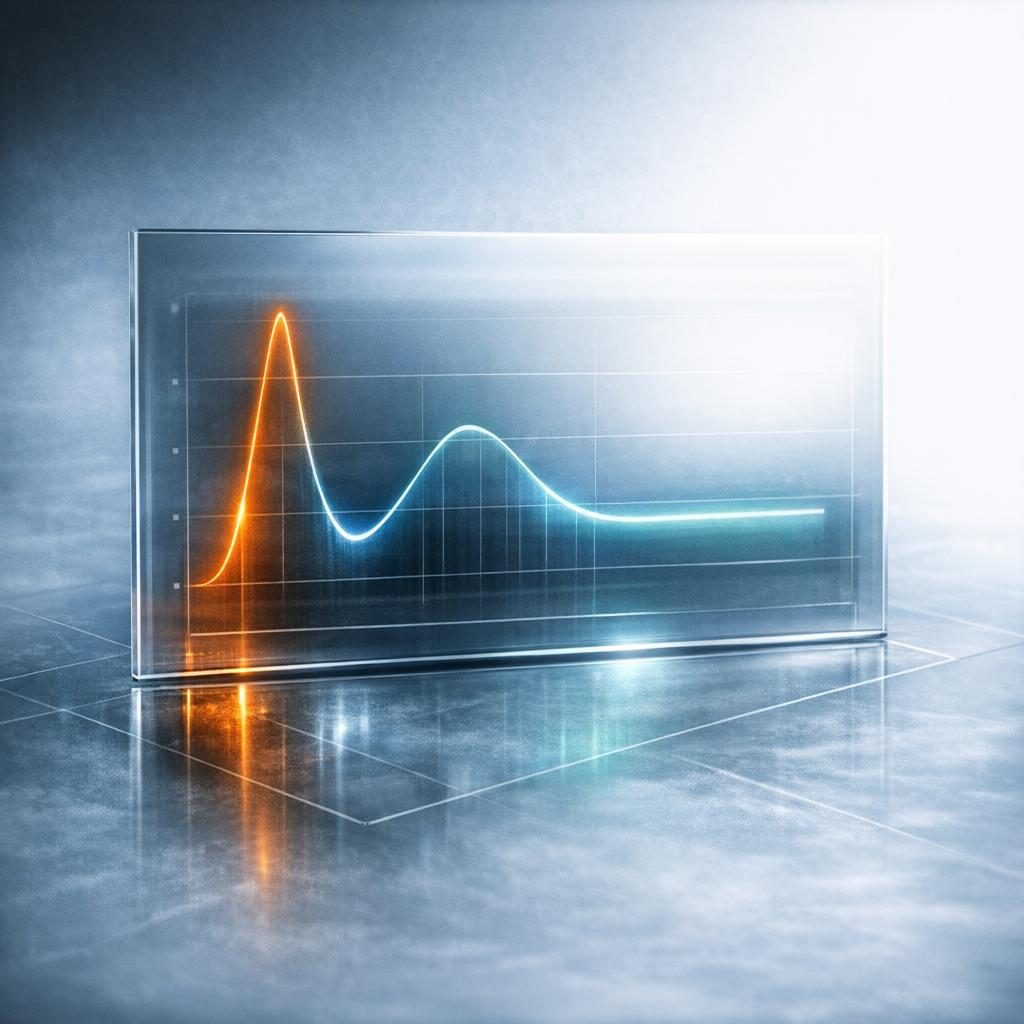
Whether thermal throttling is a problem depends entirely on what the workload’s expectations are. As an exception state, it is rare. As a steady-state governor of sustained performance, it is normal — and the throughput a device delivers early in a run can differ substantially from the throughput it delivers once the clock has settled into whatever the cooling solution can hold. The methodological consequence is that a benchmark report that says nothing about the physical situation it ran in cannot inform a deployment decision about a thermally-constrained system. This is the same observation we developed at hub level in power, thermals, and the hidden governors of performance: the physical envelope is not a footnote to performance, it is one of its primary determinants.
Why thermal throttling matters for any sustained AI workload
Thermal throttling occurs when accelerator firmware deliberately lowers clock frequency or voltage after die temperature exceeds a threshold set by the vendor. It is the mechanism by which the silicon protects itself from operating outside its physical envelope.
Several aspects of that definition matter operationally.
Firmware-implemented, not OS-implemented. Throttling decisions are made by the device’s firmware in response to on-die temperature sensors, not by the operating system or the framework. The OS sees the consequences (lower clocks reported, lower throughput) but does not control the threshold or the response curve. NVIDIA’s NVML interface, AMD’s ROCm SMI, and Intel’s level-zero sysman expose throttle-reason flags but do not arbitrate them — they are reporting surfaces over a firmware decision that has already been made.
Threshold-driven, not gradual. Most modern accelerators implement multiple throttle thresholds — a soft one that begins gradual frequency reduction, a harder one that triggers more aggressive frequency cuts, and an emergency one that powers down the device. Throttle behavior is a step function, not a smooth roll-off, even if the visible effect under varying load looks gradual.
Designed to be reached. The thresholds are calibrated to the silicon’s safe operating region, which means the device is engineered to throttle rather than damage itself. Reaching the throttle threshold is a designed outcome, not an exceptional event.
Distinct from power throttling. Power-budget enforcement (PL1/PL2 on Intel, vendor-specific power caps on GPUs) is a related but distinct mechanism: it limits the device based on a power budget rather than temperature. Both can engage simultaneously. Reports that conflate them produce ambiguous diagnostics, which is why nvidia-smi separates SW Thermal Slowdown, HW Thermal Slowdown, and Power Cap as distinct throttle-reason bits. The interaction between thermals and power belongs in the same physical-envelope frame that GPU utilization as a headline metric hides — both are governors that the headline number does not see.
Why throttling is normal under sustained workloads
An accelerator’s thermal envelope depends on power dissipation, heatsink design, airflow, and enclosure ambient temperature. A device under sustained load dissipates roughly its TDP — the thermal design power the cooling system was sized for. If the cooling system is sized to keep the device below the throttle threshold under sustained TDP, the device runs at its full clock indefinitely. If the cooling system is undersized for sustained TDP — common in dense data-center configurations, common in edge deployments, common in laptops — the device will reach the throttle threshold and stabilize at a lower clock that the cooling system can sustain.
The latter case is not a failure mode. The device is working as designed: it is using its throttle mechanism to stay inside the operating envelope the cooling solution can support. The throughput at the throttled clock is the throughput that hardware-and-cooling combination can actually sustain, and any figure captured before the device reached this equilibrium overstated what the deployment will see. We see this pattern regularly in the dense H100 and L40S nodes our customers operate: identical SKUs in different chassis settle at materially different sustained clocks depending on inlet temperature and per-slot airflow (observed across TechnoLynx engagements; not a published benchmark).
The pattern that matters for interpretation is that transient peak performance is a property of the silicon at uncooled startup; sustained practical performance is a property of the silicon-plus-cooling system at thermal equilibrium, and these can differ substantially. A boost clock is transient by design, so a headline figure can describe a state the machine holds only briefly. The gap between the two is exactly the gap between what the spec sheet says and what production will actually run at.
When does thermal throttling actually indicate a fault?
Throttling becomes a problem — actionable as a system fault — when:
- The throttle is engaging at temperatures below the vendor threshold, indicating a sensor calibration issue or a damaged thermal interface.
- The throttle is engaging at unexpectedly low ambient temperatures, indicating undersized or failing cooling infrastructure.
- The sustained throttled clock is lower than the deployment’s capacity plan accounted for, indicating either the cooling spec was wrong or the workload’s effective TDP was higher than estimated.
- The throttle behavior is intermittent in a way that produces bursty latency tails, indicating cooling system instability rather than steady-state operation.
In all of these cases, the throttle is the symptom, not the underlying issue. Investigating the cooling, the thermal interface, the airflow, or the workload’s effective power profile is what addresses the problem. Disabling the throttle (where vendors permit it) does not address the problem; it removes the protection mechanism while leaving the cause in place.
What throttling implies for reading a performance number
Measurement context determines interpretation: on thermally constrained hardware, the physical conditions during data collection define what the numbers mean. Datasheet power and clock figures are structurally poor predictors of what such a system delivers on a real workload, because the datasheet describes the part and the workload meets the whole assembly.
Cold-start figures describe the silicon’s transient peak. They are the upper bound on what the device can do in the first seconds of a workload — useful for characterizing burst capacity and nominal capability, not for predicting sustained throughput.
Settled-state figures describe the (silicon + cooling) system’s capability under continuous load. These are the ones that track deployment behavior on training runs, sustained inference traffic, and long-running batch jobs.
A report that says nothing about which of the two it is implicitly invites the reader to assume one — usually the more favorable one — and produces a number whose generalization depends on a match the report never established.
| Regime the figure came from | What it characterizes | Useful for |
|---|---|---|
| First seconds, pre-throttle | Silicon’s transient peak | Burst capacity, nominal capability |
| During the throttle transition | Mixed; difficult to interpret | Diagnostic only |
| Settled under continuous load | (Silicon + cooling) sustained capability | Capacity planning, sustained workload prediction |
This is also why a self-run measurement carries more weight here than a published one. A run on your own machine happens in the chassis and cooling you actually have, rather than on a reference system with a different envelope. LynxBenchAI works that way by construction: it discards a warm-up phase, then counts completed iterations inside a continuous declared timed window at a saturated batch size. What it reports is completed work — it does not record power draw, clock behaviour, or temperature, and it waits for no particular thermal or clock condition before it starts counting. The governors described in this article act on the machine while that window runs, whether or not anything watches them.
That boundary is worth stating plainly rather than implying, because it cuts both ways. A low score does not localise the cause to power or thermals; it reports that less work was completed, not why. And the declared window is not guaranteed to be long enough to expose every governor — its integrity comes from being declared, not from being long, and each test is one window rather than a median across repeated trials. Two runs of the same device can therefore differ for reasons no single score separates, which is why a device’s population of submissions on the public leaderboard carries more information than any one result.
The framing that helps
Hardware vendors design thermal throttling as a protective feature, not a failure mode. It is the silicon’s normal response to operating against the boundary of its thermal envelope, and it is what determines the distance between transient peak performance and sustained practical performance. A performance figure belongs to the whole AI Executor and the physical situation it sits in — device, backend, driver, framework, runtime, chassis — rather than to a part number.
The operational expression is that thermals are not a footnote to a measurement, they are part of what any sustained measurement is subject to. Power, thermal, and clock behaviour are facets of the same physical envelope, and treating them together is the only way to reason about sustained performance honestly.
Closing
Validate any sustained-performance benchmark by confirming the test conditions: was the measurement taken during declared observation windows on production-equivalent cooling, or captured during an initial burst the deployment cannot replicate?
Frequently Asked Questions
Which nvidia-smi throttle-reason bits tell thermal throttling apart from a power cap?
nvidia-smi separates SW Thermal Slowdown, HW Thermal Slowdown, and Power Cap as distinct throttle-reason bits, and reading them individually is what keeps the diagnostic unambiguous. Thermal slowdown means on-die temperature crossed a vendor threshold; the power-cap bit means power-budget enforcement engaged instead. Both can be set at once, so conflating them produces ambiguous diagnostics — check each bit rather than assuming a single cause.
Should I disable thermal throttling to recover lost clock speed in a constrained deployment?
No. Disabling the throttle where vendors permit it removes the protection mechanism while leaving the underlying cause in place, so the device then operates outside the envelope its cooling can support. If the sustained throttled clock sits below your capacity plan, the fix is to investigate cooling, the thermal interface, airflow, or the workload’s effective power profile.
Why does the same GPU model settle at different sustained clocks in a laptop versus a data-center node?
Sustained clock is a property of the silicon-plus-cooling system, not of the silicon alone, and laptops, edge boxes, and dense slots cool the same TDP very differently. A laptop’s compact thermal solution is often undersized for sustained TDP, so the device drops to a clock its cooling can hold, while a well-provisioned node may run full clock indefinitely. The headline spec describes the part; the chassis decides where it settles under continuous load.
If a benchmark never records temperature or clocks, can its result still say anything about throttling?
Only indirectly, and that limit is worth being explicit about. A run that counts completed iterations inside a declared window after a discarded warm-up reports work done, not the thermal or clock state that shaped it — so a low result is not a diagnosis. What it does give you is a figure produced on your own hardware in your own chassis, which is where the governors actually act.
How clock speeds collapse under sustained load
Twelve seconds into inference, your chip reaches its thermal limit and cuts frequency by 18 percent to remain below 87 °C—every downstream SLA inherits this penalty. Is that executor close enough to yours for the result to mean anything?