Introduction
Operations teams now wrestle not with whether AI fits the supply chain but with the precise points where deployment returns measurable value. The honest answer is uneven: AI detects malfunctions, forecasts demand, sorts and labels parcels, and reroutes shipments in real time — and it also fails expensively when the data, talent, or governance underneath it is thin. This article walks through the use cases that work in production today, the reported benefits with their sources named, and the constraints that decide whether a deployment actually lands.
We approach this from a practitioner angle. We have built computer vision, deep learning, and generative AI systems for clients across logistics-adjacent industries, and the patterns below are the ones that recur — not the ones that look good in a pitch deck.
Where AI actually shows up in the supply chain
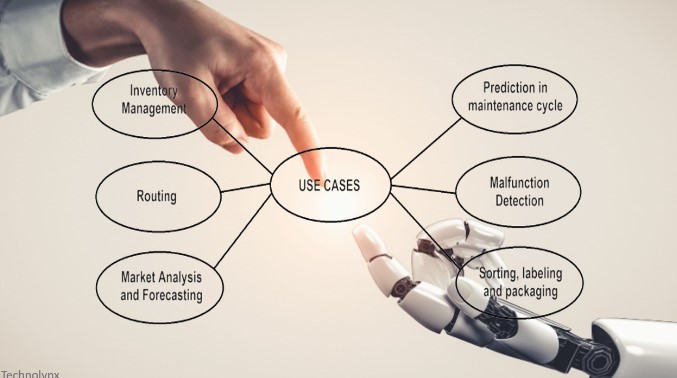
Risk evaporates when AI intercepts the errors, delays, and waste that cascade through distribution networks. The seven use cases below are the surfaces where we see real integration work — not generic “AI for logistics” marketing.
What is predictive maintenance in a supply chain context?
Equipment failure is the most expensive form of disruption because it stops the conveyor, the forklift, or the aircraft engine before the goods reach their next node. Predictive maintenance reframes service from a calendar schedule to a signal-driven trigger. Models trained on vibration, temperature, current draw, and historical failure logs flag a degrading bearing or a drifting motor before it stops the line. Internet of Things (IoT) sensors stream the telemetry; the model assigns a remaining-useful-life estimate; a technician intervenes during a planned window rather than at 3am.
This is an observed pattern across our engagements: the value is not in the model accuracy in isolation but in the closed loop between sensor coverage, labelled failure data, and the maintenance team’s willingness to act on a probabilistic warning.
Malfunction detection with computer vision
Computer vision (CV) and machine learning (ML) close the gap between scheduled inspection and continuous monitoring. A camera watching a packaging line in real time, paired with an anomaly-detection model trained on PyTorch or TensorFlow, catches deviations — a misaligned label, a torn carton, a foreign object in a bin — that a human inspector would miss after the second shift. The model does not need to recognise every possible defect; it needs to recognise normal and flag deviation from it.
Sorting, labelling, and packaging
Sorting and labelling sit at the operational layer where AI savings compound across millions of units. ML-driven vision systems read damaged barcodes, route parcels by destination cluster, and validate labels before they leave the depot. In adjacent industries the same pattern appears: ML in agriculture optimises harvest scheduling so that resources are on hand when needed, which is itself a supply chain inventory problem. In food, generative AI is used to produce personalised formulations and recommendation systems analyse user preferences — apps like Swiggy and Zomato fold this into their fulfilment loop.
Inventory management
Inventory is where forecasting meets physical constraint. ML systems blend demand signals (point-of-sale, weather, marketing calendars) with supplier lead times and shelf life to set reorder points dynamically rather than against a static safety-stock formula. CV adds quality control at the receiving dock — barcode reads, damage inspection, count verification — so that the inventory record matches the physical state. The combination is what shifts an inventory system from a ledger to a decision engine.
Synthetic data generation
Generative AI for synthetic data is now a standard tool for testing routing algorithms, warehouse layouts, and demand scenarios that have not yet occurred in the historical record. A model can produce plausible disruption patterns — port closures, demand spikes, supplier outages — that let an operations team rehearse a response before the real event arrives. This is an observed-pattern benefit; the quality of the synthetic data is bounded by the model that generated it, and naïve use can produce confident but unrealistic stress tests.
Routing with edge computing
Routing is where AI meets latency. A central cloud model can compute an optimal delivery sequence overnight, but the truck’s situation at 11am — traffic, a missed window, a new pickup — needs a decision in seconds. Edge computing on the vehicle or at the depot runs the re-optimisation locally, reducing round-trip latency to a cloud endpoint and producing a re-routing decision that arrives before the next intersection. This is one place where the choice of inference runtime (TensorRT, ONNX Runtime, OpenVINO) matters more than the choice of model architecture.
Market analysis and forecasting
GPU acceleration changes the cadence of forecasting from weekly batch to near-continuous. Faster training and inference on Graphics Processing Units mean a demand model can ingest new signals — promotion launches, competitor moves, macroeconomic releases — and refresh its outputs within the planning cycle. The accuracy gain matters less than the response time: a forecast that updates daily lets buyers and planners act on the change, where a monthly forecast forces them to overreact when reality drifts.
Reported benefits, with sources named
Published-survey claims from named analyst houses and operators underpin the figures below. They are useful as directional anchors, not as operational benchmarks for any specific deployment.
| Benefit area | Reported figure | Source |
|---|---|---|
| Procurement cost reduction | 20–50% | McKinsey (2020), published-survey |
| System cost reduction | >15% | McKinsey (2020), published-survey |
| Order processing time | ~2% faster | DHL (2022), published-survey |
| Revenue from better demand forecasts | 10–20% | PwC (2020), published-survey |
| Warehouse operational cost via robotics | ~20% reduction | Amazon (2022), operator-reported |
| Customer satisfaction (AI in service) | +10% by 2023 | Gartner (2022), published-survey |
| Chatbot response time | −80% | Salesforce (2023), published-survey |
| Forecasting error reduction | 20–30% | Deloitte, published-survey |
| Supply chain disruption reduction | ~50% | Accenture (2022), published-survey |
| Supply chain resilience improvement | 15–30% | World Economic Forum (2023), published-survey |
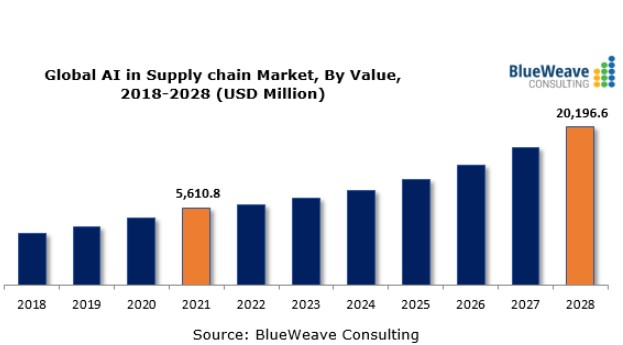
At the market level, AI in supply chain reached USD 5,610.8 million in 2021 and is projected to reach USD 20,196.6 million by 2028 at a 20.5% CAGR. That is a market-direction figure, not an operational benchmark — useful for sizing the category, not for justifying a specific project’s ROI.
Customer service as a logistics function
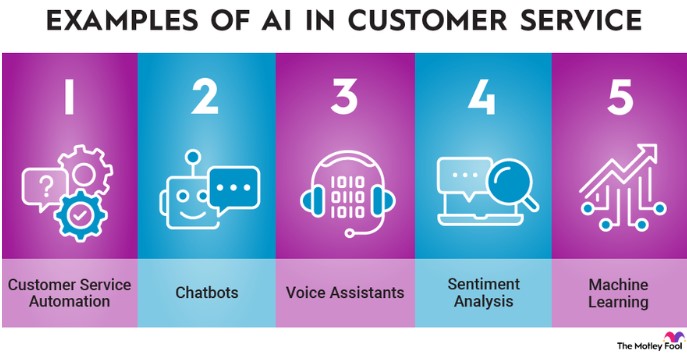
The split between “logistics” and “customer service” is artificial in a modern supply chain. When a parcel is late, the customer service interaction is part of the supply chain event. AI-powered chatbots handle the routine status queries, freeing human agents for the exceptions that actually need judgement. Personalised customer engagement, driven by recommendation models, can lift revenue 6–10% (McKinsey, 2023, published-survey), and proactive issue resolution — flagging a likely delay before the customer asks — can reduce complaint volume substantially (IBM, 2022, published-survey).
Risk management
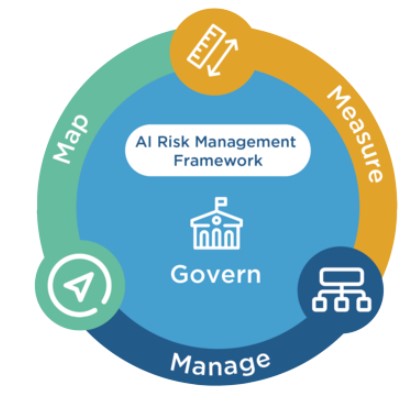
Risk in a supply chain comes from weather, geopolitics, demand shocks, and supplier failure. AI-driven weather models report ~25% better accuracy than traditional numerical forecasts in some classes of severe-storm prediction (NCAR, 2021, published-survey). Real-time monitoring lifts proactive response capability by around 30% (Capgemini, published-survey). The pattern across these figures is that the gains are not from the model alone — they are from compressing the loop between signal, decision, and action. A 25%-better forecast that nobody acts on is operationally worthless.
Why does AI in supply chains fail to land?
Implementation risk remains the financial wild card in any AI deployment. The benefits above are conditional on getting past three constraints that most operators underestimate.
Cost of implementation
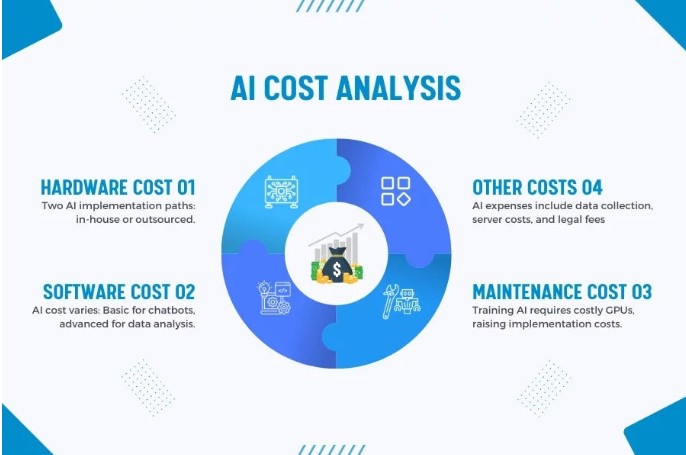
The upfront cost is not the model — it is the integration. Data pipelines, sensor deployment, system integration with existing ERP and WMS platforms, talent acquisition, and regulatory compliance dominate the first-year budget. Maintenance fees and ongoing model retraining add to operational cost. The risk of an unsuccessful deployment — one that delivers a working model into an environment that cannot act on it — is the financial wild card. We have seen this play out: the model works in the lab, the warehouse cannot use it, the project is quietly shelved.
Lack of resources
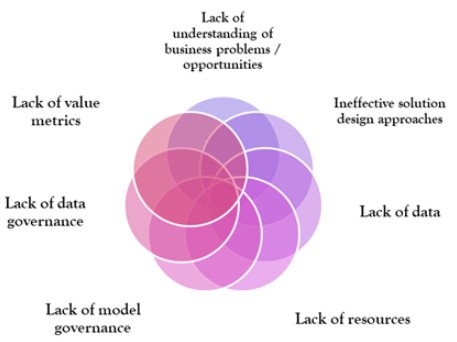
The resource constraint is concentrated in people. Engineers fluent in robotics, ML, and the messy operational data of a real warehouse are scarce. Data quality and quantity are the next constraint: a forecasting model trained on three years of pre-pandemic demand data is not a forecasting model, it is an anchor on yesterday’s regime. Outdated infrastructure — pre-cloud WMS, manual data entry, paper-based exception handling — caps what any AI overlay can achieve. Cybersecurity is a resource line of its own; the more data you stream off the floor, the larger the attack surface.
Privacy and governance
Data protection regulations — GDPR in Europe, similar frameworks elsewhere — apply when customer, employee, or supplier data flows through an AI system. Balancing efficiency against privacy, settling data ownership, ensuring algorithmic transparency, and auditing for bias are now operational concerns, not legal afterthoughts. Models also drift; periodic monitoring is required to ensure that a recommendation system does not inadvertently discriminate by region, demographic, or product category.

How TechnoLynx approaches this
Each supply chain integration at TechnoLynx is scoped to the client’s problem, not packaged as off-the-shelf product. Our work concentrates on refining and extending AI capability — computer vision for visual inspection and warehouse monitoring, generative AI for synthetic data and scenario simulation, and the data infrastructure that lets a model talk to an ERP without manual glue. We pay attention to where the integration meets the operational reality, because that is where most deployments quietly stall. The engineering discipline we apply is the same across industries: name what the model is responsible for, name what it is not, and measure the loop end-to-end.
Conclusion
Transformative Role AI Supply hinges on these details. The use cases that pay back consistently are predictive maintenance, vision-driven defect detection, dynamic inventory, edge-routed delivery decisions, and demand forecasting refreshed at GPU speed. The constraints that decide whether they pay back are implementation cost, talent depth, data quality, and governance. Operators that respect both sides of that ledger get the reported gains. Operators that read only the benefit column tend to fund the cost column without realising it.
Frequently Asked Questions
How is AI used in supply chain management today?
Predictive maintenance on equipment, computer-vision malfunction and defect detection, ML-driven sorting and labelling, dynamic inventory management, synthetic data generation for scenario testing, edge-based real-time routing, and GPU-accelerated demand forecasting represent the recurring production use cases. The unifying pattern is compressing the loop between a signal and an operational decision.
What are the measurable benefits of AI in supply chains?
Published-survey figures point to 20–50% procurement cost reduction (McKinsey, 2020), 10–20% revenue uplift from improved demand forecasts (PwC, 2020), ~50% reduction in supply chain disruptions (Accenture, 2022), and 15–30% improvement in supply chain resilience (WEF, 2023). These are directional anchors, not operational benchmarks — actual outcomes depend on data, integration, and execution.
What are the main challenges of adopting AI in supply chain?
The three constraints that decide most deployments are implementation cost (integration, talent, compliance — not the model), resource scarcity (engineers fluent in ML and operational data, sufficient quality data, modern infrastructure), and privacy governance (GDPR-style data protection, algorithmic transparency, bias auditing). A model that works in the lab but cannot act inside the warehouse is the most common failure mode.
How does predictive maintenance reduce supply chain disruption?
Models trained on sensor telemetry — vibration, temperature, current draw — and historical failure logs estimate the remaining useful life of equipment and flag degradation before failure stops the line. The value comes from the closed loop between IoT sensor coverage, labelled failure data, and a maintenance team willing to act on a probabilistic warning, not from model accuracy alone.
Where does edge computing fit in AI-driven logistics?
Edge computing runs inference locally on the vehicle or at the depot rather than round-tripping to a cloud endpoint. This matters for routing and exception handling, where a re-optimisation decision is needed in seconds rather than minutes. The choice of inference runtime (TensorRT, ONNX Runtime, OpenVINO) and the quantisation strategy often matters more than the underlying model architecture.
Works Cited
-
A neural network improves forecasts for severe storm hazards NCAR & UCAR News (no date) (Accessed: 13 February 2024). - Burns, M. (2023) Using AI to Build Stronger Connections with Customers (Accessed: 13 February 2024).
- Das, A.C. et al. (2023) The next frontier of customer engagement: AI-enabled customer service (Accessed: 13 February 2024).
- Gartner reveals three technologies that will transform customer service (2023) (Accessed: 13 February 2024).
- Harrigan, P., Jr (2023) ‘How Amazon Uses AI to Dominate Ecommerce: Top 5 Use Cases,’ 9 January (Accessed: 13 February 2024).
- Optimising Supply Chain Visibility & Efficiency with AI (no date) (Accessed: 13 February 2024).
- PricewaterhouseCoopers (no date) Reimagining tomorrow’s supply chains (Accessed: 13 February 2024).
- Juniper Research (2017) Chatbots, a Game Changer for Banking & Healthcare, Saving $8 billion Annually by 2022, 9 May (Accessed: 13 February 2024).
- Salesforce (2023) Nearly 80% of High-Performing Field Service Organizations Use AI (per the cited survey) (Accessed: 13 February 2024).
- 3 ways technology can help to strengthen supply chains (2023) (Accessed: 13 February 2024).