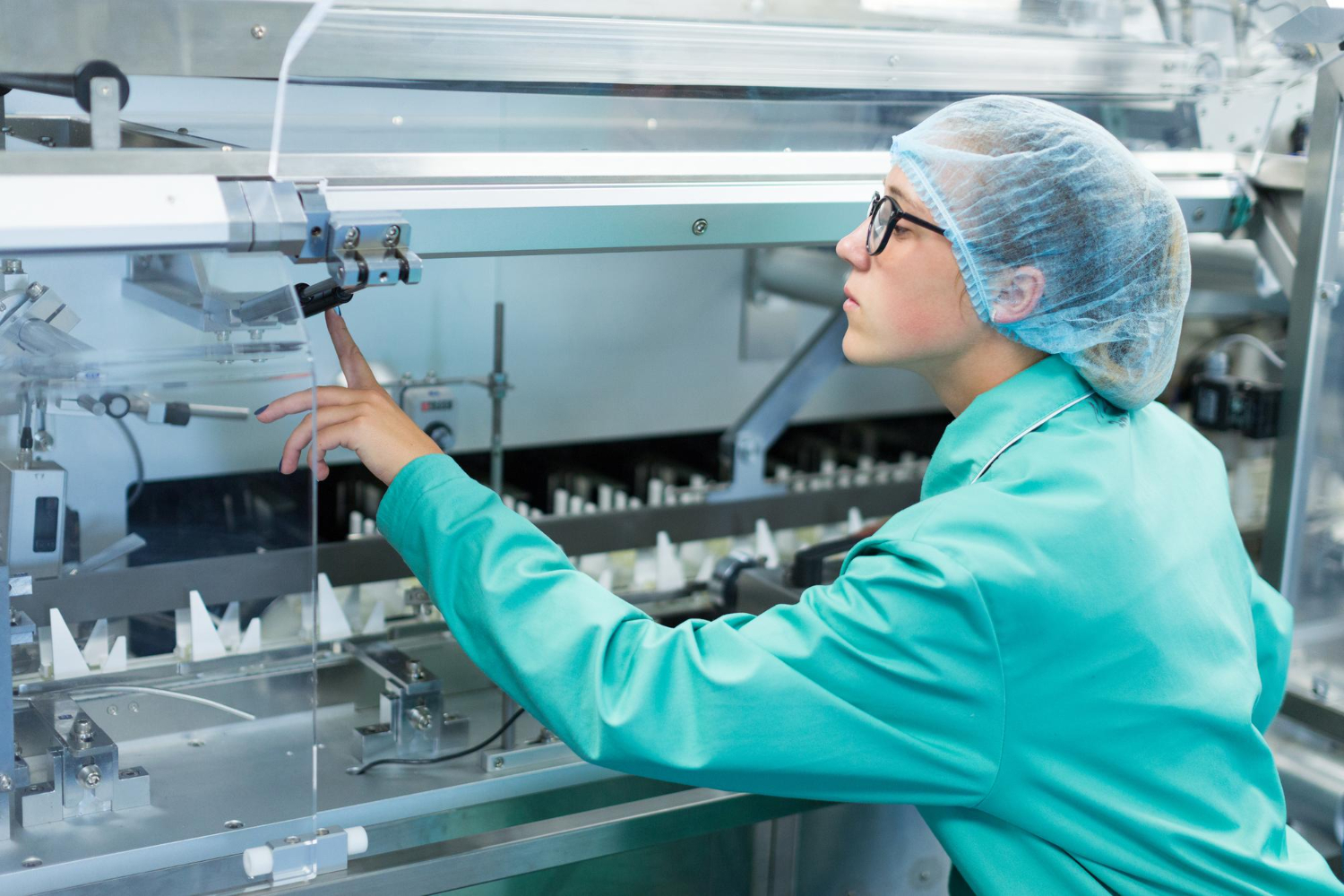
Visual computing earns its keep in life sciences when it shortens the gap between an image being captured and a decision being made. On a pharma manufacturing line, that gap is the difference between catching a defective vial in-process and pulling a whole batch at release. The proven use cases are not the most photogenic ones — they are the ones where real-time image processing replaces a manual check that was already happening, only slower and less consistently. We see this pattern regularly across TK4 engagements: the wins come from instrumenting an existing inspection or monitoring step, not from inventing a new one.
The broader programme context for this is covered in our overview of proven AI use cases in pharmaceutical manufacturing today. This piece zooms in on the visual-computing slice of that programme.
What does “visual computing” actually mean on a pharma line?
Image acquisition, GPU-accelerated processing, and rendering converge in visual computing to extract meaning from visual data. In a pharma context it spans three distinct workloads that often get conflated:
- In-line inspection — high-frame-rate cameras feeding a deterministic classifier (defect / no-defect) on vials, blister packs, or tablets. Latency budget is in the tens of milliseconds.
- Imaging-assay analysis — segmentation and feature extraction on microscopy or high-content screening images, typically TensorRT or PyTorch models running on CUDA. Latency budget is seconds to minutes per well.
- Operator-facing visualisation — rendering 3D structures, batch records, or process telemetry so that a human can act on it. Latency budget is interactive (sub-100 ms refresh, a common HCI threshold and a rule of thumb for responsiveness).
The three have very different hardware footprints and validation profiles. A line camera doing defect classification at 200 fps (illustrative) is a GMP-relevant instrument; a research microscopy pipeline running the same backbone model in OpenCV and PyTorch is not. Conflating them is one reason “AI in pharma” roadmaps stall — the validation cost is computed against the most regulated workload and applied to all of them.
Where on the line does real-time visual computing deliver measurable ROI?
Procurement decisions should hinge on asking this question first. Observed pattern across our manufacturing engagements: the highest-ROI deployments are the ones where a defect detected in-process avoids a downstream rework or a release-time reject. The further along the line the failure is caught, the more value has already been added to the unit being discarded.
| Stage | Visual-computing workload | Operationally relevant measure | Evidence class |
|---|---|---|---|
| Fill / finish inspection | Particulate and cosmetic defect classification at line speed | Reject rate parity with trained inspectors, false-reject rate under 0.5% | observed-pattern across multiple TK4 engagements; not a benchmarked rate |
| In-process imaging (bioreactor, granulation) | Real-time morphology or particle-size feedback to process control | Reduction in deviations per batch | observed-pattern; depends on process variability |
| Release-time batch records | Automated reading of printed serials, barcodes, batch identifiers | Read accuracy at line speed, exception rate routed to human review | observed-pattern; varies with print quality |
| Microscopy and HCS | Segmentation and feature extraction for assay readout | Time-to-result per plate, reproducibility across batches | benchmark when measured on a named assay; otherwise observed-pattern |
Sustained throughput under realistic line speed — not peak burst on a synthetic test set — is the operationally relevant measure for any of these. A model that processes a single image in 8 ms (illustrative) in a notebook can stall the line when it has to handle 200 images per second with concurrent I/O, model warm-up, and exception logging. We pay close attention to this distinction in early validation.
What separates the proven use cases from the still-experimental ones?
Three structural tests, applied in order:
- Is there a deterministic ground truth? Defect classes on a vial, a barcode read, a particle size — yes. “This batch looks anomalous” — not yet. Visual computing is proven where the labels are stable and the operator already agrees on them.
- Does the existing workflow already include the check? Replacing a manual inspection with an automated one is a deployment problem. Inventing a check that no one was doing is a workflow-design problem, and orders of magnitude harder to validate under GMP.
- Is the failure mode visible in the image? Some defects (contamination at low concentration, certain potency deviations) do not present visually no matter how many megapixels you throw at them. Real-time visual computing cannot detect what is not in the signal.
Use cases that pass all three are deployable now. Use cases that fail any one belong in research, not on the line. For the broader frame of how these decisions are structured, our piece on AI in pharmaceutics and automation covers the assessment-first methodology.
How do real deployments satisfy GMP and GxP?
Validation requirements shape pharma adoption of visual computing more than any hardware limitation. A workable pattern, observed across multiple engagements:
- Lock the model. Visual-computing models in GMP scope are deployed as fixed artifacts — versioned, signed, and re-validated on change. Continuous learning loops live in a parallel research pipeline, not in production.
- Make the decision auditable. Every classification carries the model version, the input image hash, and the confidence score into the batch record. TensorRT or ONNX runtime telemetry is logged the same way an instrument reading would be.
- Keep the human in the loop where it matters. Low-confidence decisions route to an operator. The visual-computing system is then a triage tool, not an unattended judge — which keeps the regulatory surface tractable.
This is also why the rendering and visualisation layer matters as much as the model. If the operator cannot see why the system flagged a unit, the audit trail collapses to “the algorithm said so”, which is not a defensible position with inspectors.
What about the parts that are not on the manufacturing line?
Research and clinical applications—molecular modelling, microscopy, MRI/CT analysis—also depend on visual computing infrastructure. These are real applications with real value, but they sit outside the manufacturing scope where ROI is most directly measurable. We treat them as adjacent rather than central in the TK4 frame; the structural difference is that manufacturing applications have a deterministic measure of success (defects caught, deviations reduced, throughput sustained) and clinical applications are validated against patient outcomes on a much longer timeline.
For the imaging-assay slice specifically, batch-effect handling is the limiting factor on reproducibility, which we cover in cell painting and fixing batch effects for reliable HCS.
What does a credible 12-month visual-computing roadmap look like?
Phased rollouts beat monolithic deployments every time. A staged sequence:
- Months 1–3 — instrument one existing inspection step. Choose the one with the highest current rework or reject cost. Measure baseline manually for two weeks before any model is trained.
- Months 4–6 — deploy a locked model in shadow mode alongside the manual check. Compare disagreement rates. This is the only honest way to know whether the model is ready.
- Months 7–9 — promote to primary decision-maker for the high-confidence band; keep human review for the low-confidence band. This is where ROI starts to materialise.
- Months 10–12 — extend to a second inspection step using the validation and audit infrastructure already built. The second deployment is always cheaper than the first.
The roadmap that fails is the one that starts with “deploy AI across the plant” instead of “instrument one step”. We have seen this consistently, and it tracks with the broader Pharma 4.0 manufacturing intelligence experience. It also tracks with the staged-rollout discipline behind our wider life-sciences AI practice.