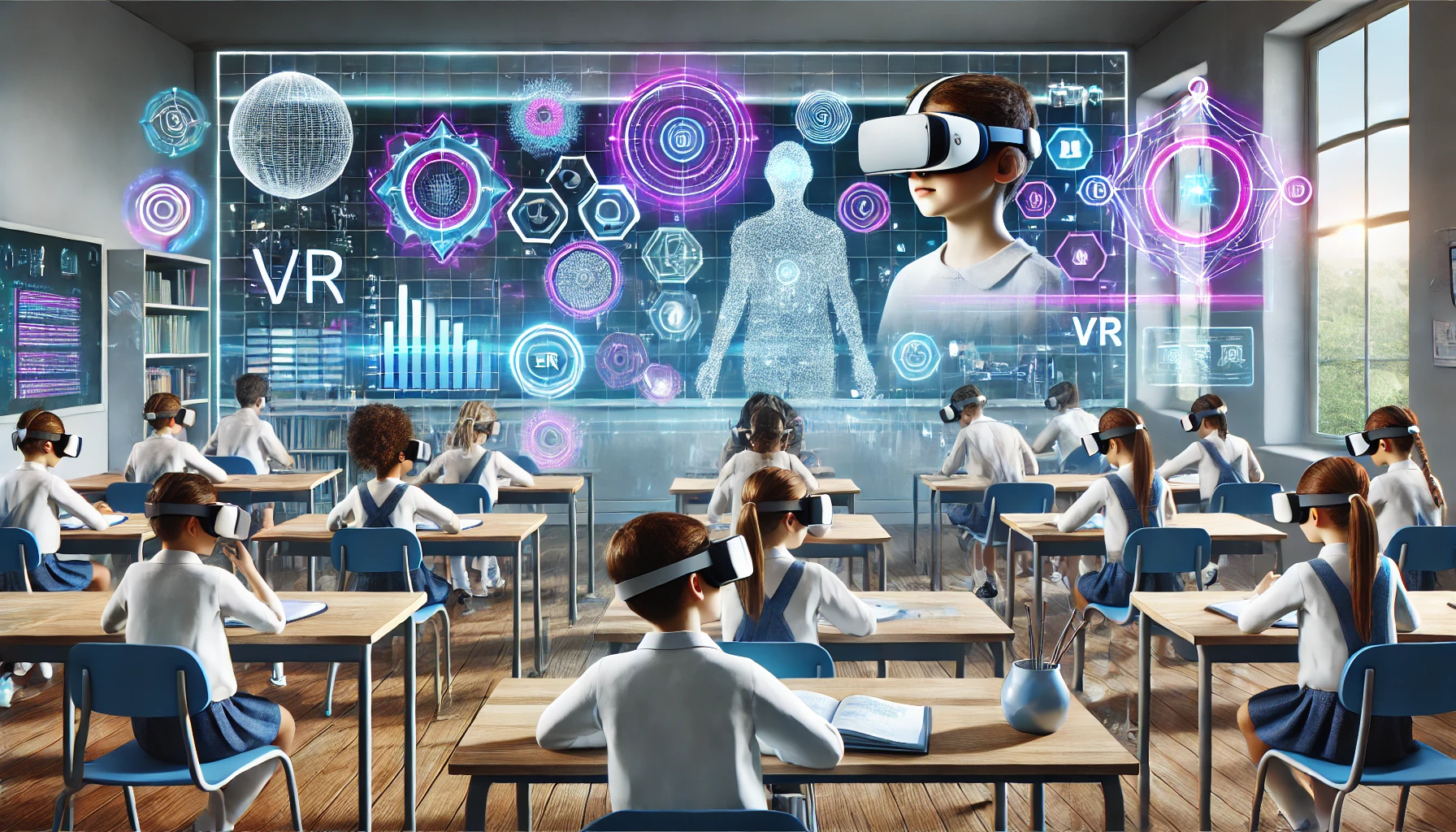
VR for Education: Transforming Learning Experiences

Discover the benefits of VR for education, from virtual field trips to enhanced lesson plans, and how VR technology improves student learning in cost-effective ways.

VR for Education: Transforming Learning Experiences
Written by TechnoLynx Published on 18 Oct 2024

Virtual reality (VR) has made waves across various industries, and education is no exception. VR for education opens doors to immersive and engaging learning experiences that traditional methods struggle to match. From virtual field trips to interactive simulations, VR is reshaping the way students interact with content, offering them new ways to explore the real world without ever leaving the classroom.

In this article, we’ll explore how virtual reality in education is transforming the learning landscape, the benefits of VR, and how VR experiences can be seamlessly integrated into lesson plans. We’ll also show how TechnoLynx helps educators embrace this cutting-edge VR technology.

The Rise of VR in Education

Traditional teaching methods have relied heavily on textbooks, lectures, and visual aids. While these methods are effective, they can sometimes lack the engagement needed to capture students’ attention. Enter virtual reality. With VR technology, students can step inside a virtual environment where they can see, hear, and sometimes even interact with the subject matter.

VR for education allows learners to explore complex concepts in a more hands-on way. Imagine a biology class where students can examine the inside of a cell, a history class that lets them walk through ancient Rome, or a geography lesson where they take a virtual field trip to the Grand Canyon. These experiences make learning more tangible and memorable, offering students a deeper understanding of the subject matter.

VR experiences in education help bridge the gap between theory and practice. Instead of simply reading about the subject, students can engage with it in a real-world context. This makes the content more relatable and easier to grasp.

Virtual Field Trips: Bringing the World to the Classroom

One of the standout features of VR for education is the ability to take virtual field trips. For many schools, taking students on real-world field trips is often limited by time, budget, and logistics. However, with VR, students can now visit distant locations or even explore places that are otherwise inaccessible.

Whether it’s touring ancient ruins, visiting outer space, or walking through famous museums, virtual field trips offer students a chance to explore the world from their classroom. It gives students exposure to new environments and experiences that can enhance their understanding of different cultures, geographies, and historical contexts.

These trips can complement a wide range of subjects. In a history class, students might tour the Pyramids of Egypt. In science, they could explore the depths of the ocean or journey through the solar system. VR headsets allow students to fully immerse themselves in these environments, turning what would have been an ordinary lesson into an unforgettable experience.

TechnoLynx helps educators design VR experiences that align with their curriculum. We create customised VR content that brings the world closer to students, giving them a front-row seat to the wonders of the real world.

Enhancing Lesson Plans with Virtual Reality

Virtual reality in education isn’t just about offering cool experiences. It also plays a key role in enhancing lesson plans. Teachers can use VR to simulate real-life scenarios that would be impossible to recreate in a classroom setting.

Take science lessons, for instance. With VR technology, students can simulate chemical reactions, dissect virtual frogs, or study the human body in intricate detail. This not only improves student learning but also offers a safe, cost-effective alternative to traditional lab equipment.

VR also benefits subjects like mathematics and engineering. Complex structures and equations can be visualised in three dimensions, helping students understand difficult concepts more easily. In literature or language studies, students can explore the settings of famous novels or practice speaking in a simulated foreign environment.

Teachers can integrate VR experiences directly into their lesson plans, offering students interactive lessons that complement traditional methods. This combination of hands-on and theoretical learning leads to better retention and understanding of concepts.

The Benefits of VR for Student Learning

The benefits of VR for student learning are vast. One of the primary advantages is the level of engagement it fosters. Students, particularly younger ones, are naturally drawn to technology. When learning becomes interactive and fun, students are more likely to participate actively and retain information better.

VR content also caters to different learning styles. Visual learners can benefit from the immersive graphics, while kinesthetic learners thrive on interacting with the virtual environment. This makes virtual reality in education an excellent tool for personalising learning experiences.

Another key advantage of VR is its ability to simplify complex ideas. Many subjects, such as physics or anatomy, involve abstract concepts that can be difficult to explain with words alone. VR can break down these ideas visually, making them easier to understand.

VR for education also encourages collaboration among students. Many VR applications allow multiple users to interact within the same virtual environment. This promotes teamwork, communication, and problem-solving skills.

Read more: What are the best future applications of virtual reality?

Cost-Effective Learning with VR Technology

While VR headsets and VR technology may sound expensive, they can actually provide a cost-effective solution for schools in the long term. Traditional methods of teaching often require physical resources, such as lab equipment, art supplies, or field trips, all of which come with their own costs. VR offers a digital alternative that can be reused multiple times.

In addition, schools that adopt vr technology can reduce the need for physical materials. For example, biology lessons that once required expensive lab setups can now be conducted virtually. History lessons that once required textbooks and visual aids can now be taught through interactive VR content.

While the initial investment in VR headsets and software might seem high, the long-term savings in materials and travel costs make it a worthwhile investment. Plus, as technology advances, the cost of VR equipment continues to drop, making it more accessible for schools worldwide.

VR Technology Beyond the Classroom

The use of virtual reality doesn’t stop in the classroom. It extends beyond, offering benefits to teachers and administrators as well. Teachers can use VR technology to create custom learning experiences tailored to the needs of their students. They can also access professional development programs that use VR to simulate classroom scenarios, helping them improve their teaching techniques.

Administrators, on the other hand, can use VR to simulate school layouts and test different configurations for maximum efficiency. This use of reality technologies can help schools optimise their spaces and resources, ensuring a more efficient learning environment for students.

TechnoLynx works closely with educators to implement VR beyond the traditional classroom. We assist in designing training programs for teachers and creating virtual environments that schools can use for planning and development.

The Future of VR in Education

The future of VR for education looks promising. As VR technology becomes more advanced and affordable, we can expect to see wider adoption in schools worldwide. With the ability to offer cost-effective solutions and create immersive, engaging learning experiences, VR will likely become a staple in education.

As virtual and augmented reality technologies continue to evolve, students will have even more access to interactive learning. From simulating dangerous chemical reactions in a science class to taking an art tour in Paris, the possibilities are endless. VR will make the real world more accessible, improving student learning in ways that were once unimaginable.

How TechnoLynx Supports VR in Education

At TechnoLynx, we’re passionate about helping schools gain the power of virtual reality in education. We specialise in creating customised VR solutions that align with school curriculums. Our team works closely with educators to design VR experiences that enrich their lessons, making learning more immersive and engaging.

Whether you’re looking to implement virtual field trips, enhance your lesson plans, or simply explore how VR can improve student learning, TechnoLynx is here to help. We provide the tools, resources, and expertise to bring VR technology into the classroom seamlessly.

Our cost-effective solutions ensure that schools of all sizes can benefit from this cutting-edge technology without breaking the bank. From providing VR headsets to developing custom educational software, we make it easy for schools to adopt VR.

By partnering with TechnoLynx, you’re not only enhancing the learning experiences of your students but also future-proofing your school with the latest in reality technologies.

Continue reading: AI Smartening the Education Industry

Image generated by DALL-E.

Cost, Efficiency, and Value Are Not the Same Metric

Cost, Efficiency, and Value Are Not the Same Metric

17/04/2026

Performance per dollar. Tokens per watt. Cost per request. These sound like the same thing said differently, but they measure genuinely different dimensions of AI infrastructure economics. Conflating them leads to infrastructure decisions that optimize for the wrong objective.

Precision Is an Economic Lever in Inference Systems

Precision Is an Economic Lever in Inference Systems

17/04/2026

Precision isn't just a numerical setting — it's an economic one. Choosing FP8 over BF16, or INT8 over FP16, changes throughput, latency, memory footprint, and power draw simultaneously. For inference at scale, these changes compound into significant cost differences.

Precision Choices Are Constrained by Hardware Architecture

Precision Choices Are Constrained by Hardware Architecture

17/04/2026

You can't run FP8 inference on hardware that doesn't have FP8 tensor cores. Precision format decisions are conditional on the accelerator's architecture — its tensor core generation, native format support, and the efficiency penalties for unsupported formats.

Steady-State Performance, Cost, and Capacity Planning

Steady-State Performance, Cost, and Capacity Planning

17/04/2026

Capacity planning built on peak performance numbers over-provisions or under-delivers. Real infrastructure sizing requires steady-state throughput — the predictable, sustained output the system actually delivers over hours and days, not the number it hit in the first five minutes.

How Benchmark Context Gets Lost in Procurement

How Benchmark Context Gets Lost in Procurement

16/04/2026

A benchmark result starts with full context — workload, software stack, measurement conditions. By the time it reaches a procurement deck, all that context is gone. The failure mode is not wrong benchmarks but context loss during propagation.

Building an Audit Trail: Benchmarks as Evidence for Governance and Risk

Building an Audit Trail: Benchmarks as Evidence for Governance and Risk

16/04/2026

High-value AI hardware decisions need traceable evidence, not slide-deck bullet points. When benchmarks are documented with methodology, assumptions, and limitations, they become auditable institutional evidence — defensible under scrutiny and revisitable when conditions change.

The Comparability Protocol: Why Benchmark Methodology Defines What You Can Compare

The Comparability Protocol: Why Benchmark Methodology Defines What You Can Compare

16/04/2026

Two benchmark scores can only be compared if they share a declared methodology — the same workload, precision, measurement protocol, and reporting conditions. Without that contract, the comparison is arithmetic on numbers of unknown provenance.

A Decision Framework for Choosing AI Hardware

A Decision Framework for Choosing AI Hardware

16/04/2026

Hardware selection is a multivariate decision under uncertainty — not a score comparison. This framework walks through the steps: defining the decision, matching evaluation to deployment, measuring what predicts production, preserving tradeoffs, and building a repeatable process.

How Benchmarks Shape Organizations Before Anyone Reads the Score

How Benchmarks Shape Organizations Before Anyone Reads the Score

16/04/2026

Before a benchmark score informs a purchase, it has already shaped what gets optimized, what gets reported, and what the organization considers important. Benchmarks function as decision infrastructure — and that influence deserves more scrutiny than the number itself.

Accuracy Loss from Lower Precision Is Task‑Dependent

Accuracy Loss from Lower Precision Is Task‑Dependent

16/04/2026

Reduced precision does not produce a uniform accuracy penalty. Sensitivity depends on the task, the metric, and the evaluation setup — and accuracy impact cannot be assumed without measurement.

Precision Is a Design Parameter, Not a Quality Compromise

Precision Is a Design Parameter, Not a Quality Compromise

16/04/2026

Numerical precision is an explicit design parameter in AI systems, not a moral downgrade in quality. This article reframes precision as a representation choice with intentional trade-offs, not a concession made reluctantly.

Mixed Precision Works by Exploiting Numerical Tolerance

Mixed Precision Works by Exploiting Numerical Tolerance

16/04/2026

Not every multiplication deserves 32 bits. Mixed precision works because neural network computations have uneven numerical sensitivity — some operations tolerate aggressive precision reduction, others don't — and the performance gains come from telling them apart.

Throughput vs Latency: Choosing the Wrong Optimization Target

16/04/2026

Throughput and latency are different objectives that often compete for the same resources. This article explains the trade-off, why batch size reshapes behavior, and why percentiles matter more than averages in latency-sensitive systems.

Quantization Is Controlled Approximation, Not Model Damage

16/04/2026

When someone says 'quantize the model,' the instinct is to hear 'degrade the model.' That framing is wrong. Quantization is controlled numerical approximation — a deliberate engineering trade-off with bounded, measurable error characteristics — not an act of destruction.

GPU Utilization Is Not Performance

15/04/2026

The utilization percentage in nvidia-smi reports kernel scheduling activity, not efficiency or throughput. This article explains the metric's exact definition, why it routinely misleads in both directions, and what to pair it with for accurate performance reads.

FP8, FP16, and BF16 Represent Different Operating Regimes

15/04/2026

FP8 is not just 'half of FP16.' Each numerical format encodes a different set of assumptions about range, precision, and risk tolerance. Choosing between them means choosing operating regimes — different trade-offs between throughput, numerical stability, and what the hardware can actually accelerate.

Peak Performance vs Steady‑State Performance in AI

15/04/2026

AI systems rarely operate at peak. This article defines the peak vs. steady-state distinction, explains when each regime applies, and shows why evaluations that capture only peak conditions mischaracterize real-world throughput.

The Software Stack Is a First‑Class Performance Component

15/04/2026

Drivers, runtimes, frameworks, and libraries define the execution path that determines GPU throughput. This article traces how each software layer introduces real performance ceilings and why version-level detail must be explicit in any credible comparison.

The Mythology of 100% GPU Utilization

15/04/2026

Is 100% GPU utilization bad? Will it damage the hardware? Should you be worried? For datacenter AI workloads, sustained high utilization is normal — and the anxiety around it usually reflects gaming-era intuitions that don't apply.

Why Benchmarks Fail to Match Real AI Workloads

15/04/2026

The word 'realistic' gets attached to benchmarks freely, but real AI workloads have properties that synthetic benchmarks structurally omit: variable request patterns, queuing dynamics, mixed operations, and workload shapes that change the hardware's operating regime.

Why Identical GPUs Often Perform Differently

15/04/2026

'Same GPU' does not imply the same performance. This article explains why system configuration, software versions, and execution context routinely outweigh nominal hardware identity.

Training and Inference Are Fundamentally Different Workloads

15/04/2026

A GPU that excels at training may disappoint at inference, and vice versa. Training and inference stress different system components, follow different scaling rules, and demand different optimization strategies. Treating them as interchangeable is a design error.

Performance Ownership Spans Hardware and Software Teams

15/04/2026

When an AI workload underperforms, attribution is the first casualty. Hardware blames software. Software blames hardware. The actual problem lives in the gap between them — and no single team owns that gap.

Performance Emerges from the Hardware × Software Stack

15/04/2026

AI performance is an emergent property of hardware, software, and workload operating together. This article explains why outcomes cannot be attributed to hardware alone and why the stack is the true unit of performance.

Power, Thermals, and the Hidden Governors of Performance

14/04/2026

Every GPU has a physical ceiling that sits below its theoretical peak. Power limits, thermal throttling, and transient boost clocks mean that the performance you read on the spec sheet is not the performance the hardware sustains. The physics always wins.

Why AI Performance Changes Over Time

14/04/2026

That impressive throughput number from the first five minutes of a training run? It probably won't hold. AI workload performance shifts over time due to warmup effects, thermal dynamics, scheduling changes, and memory pressure. Understanding why is the first step toward trustworthy measurement.

CUDA, Frameworks, and Ecosystem Lock-In

14/04/2026

Why is it so hard to switch away from CUDA? Because the lock-in isn't in the API — it's in the ecosystem. Libraries, tooling, community knowledge, and years of optimization create switching costs that no hardware swap alone can overcome.

GPUs Are Part of a Larger System

14/04/2026

CPU overhead, memory bandwidth, PCIe topology, and host-side scheduling routinely limit what a GPU can deliver — even when the accelerator itself has headroom. This article maps the non-GPU bottlenecks that determine real AI throughput.

Why AI Performance Must Be Measured Under Representative Workloads

14/04/2026

Spec sheets, leaderboards, and vendor numbers cannot substitute for empirical measurement under your own workload and stack. Defensible performance conclusions require representative execution — not estimates, not extrapolations.

Low GPU Utilization: Where the Real Bottlenecks Hide

14/04/2026

When GPU utilization drops below expectations, the cause usually isn't the GPU itself. This article traces common bottleneck patterns — host-side stalls, memory-bandwidth limits, pipeline bubbles — that create the illusion of idle hardware.

Why GPU Performance Is Not a Single Number

14/04/2026

AI GPU performance is multi-dimensional and workload-dependent. This article explains why scalar rankings collapse incompatible objectives and why 'best GPU' questions are structurally underspecified.

What a GPU Benchmark Actually Measures

14/04/2026

A benchmark result is not a hardware measurement — it is an execution measurement. The GPU, the software stack, and the workload all contribute to the number. Reading it correctly requires knowing which parts of the system shaped the outcome.

Why Spec‑Sheet Benchmarking Fails for AI

14/04/2026

GPU spec sheets describe theoretical limits. This article explains why real AI performance is an execution property shaped by workload, software, and sustained system behavior.

Visual Computing in Life Sciences: Real-Time Insights

6/11/2025

Learn how visual computing transforms life sciences with real-time analysis, improving research, diagnostics, and decision-making for faster, accurate outcomes.

AI-Driven Aseptic Operations: Eliminating Contamination

21/10/2025

Learn how AI-driven aseptic operations help pharmaceutical manufacturers reduce contamination, improve risk assessment, and meet FDA standards for safe, sterile products.

AI Visual Quality Control: Assuring Safe Pharma Packaging

20/10/2025

See how AI-powered visual quality control ensures safe, compliant, and high-quality pharmaceutical packaging across a wide range of products.

AI for Reliable and Efficient Pharmaceutical Manufacturing

15/10/2025

See how AI and generative AI help pharmaceutical companies optimise manufacturing processes, improve product quality, and ensure safety and efficacy.

Barcodes in Pharma: From DSCSA to FMD in Practice

25/09/2025

What the 2‑D barcode and seal on your medicine mean, how pharmacists scan packs, and why these checks stop fake medicines reaching you.

Pharma’s EU AI Act Playbook: GxP‑Ready Steps

24/09/2025

A clear, GxP‑ready guide to the EU AI Act for pharma and medical devices: risk tiers, GPAI, codes of practice, governance, and audit‑ready execution.

Cell Painting: Fixing Batch Effects for Reliable HCS

23/09/2025

Reduce batch effects in Cell Painting. Standardise assays, adopt OME‑Zarr, and apply robust harmonisation to make high‑content screening reproducible.

Explainable Digital Pathology: QC that Scales

22/09/2025

Raise slide quality and trust in AI for digital pathology with robust WSI validation, automated QC, and explainable outputs that fit clinical workflows.

Validation‑Ready AI for GxP Operations in Pharma

19/09/2025

Make AI systems validation‑ready across GxP. GMP, GCP and GLP. Build secure, audit‑ready workflows for data integrity, manufacturing and clinical trials.

Edge Imaging for Reliable Cell and Gene Therapy

17/09/2025

Edge imaging transforms cell & gene therapy manufacturing with real‑time monitoring, risk‑based control and Annex 1 compliance for safer, faster production.

AI in Genetic Variant Interpretation: From Data to Meaning

15/09/2025

AI enhances genetic variant interpretation by analysing DNA sequences, de novo variants, and complex patterns in the human genome for clinical precision.

AI Visual Inspection for Sterile Injectables

11/09/2025

Improve quality and safety in sterile injectable manufacturing with AI‑driven visual inspection, real‑time control and cost‑effective compliance.

Predicting Clinical Trial Risks with AI in Real Time

5/09/2025

AI helps pharma teams predict clinical trial risks, side effects, and deviations in real time, improving decisions and protecting human subjects.

Generative AI in Pharma: Compliance and Innovation

1/09/2025

Generative AI transforms pharma by streamlining compliance, drug discovery, and documentation with AI models, GANs, and synthetic training data for safer innovation.

AI for Pharma Compliance: Smarter Quality, Safer Trials

27/08/2025

AI helps pharma teams improve compliance, reduce risk, and manage quality in clinical trials and manufacturing with real-time insights.

Back See Blogs
arrow icon