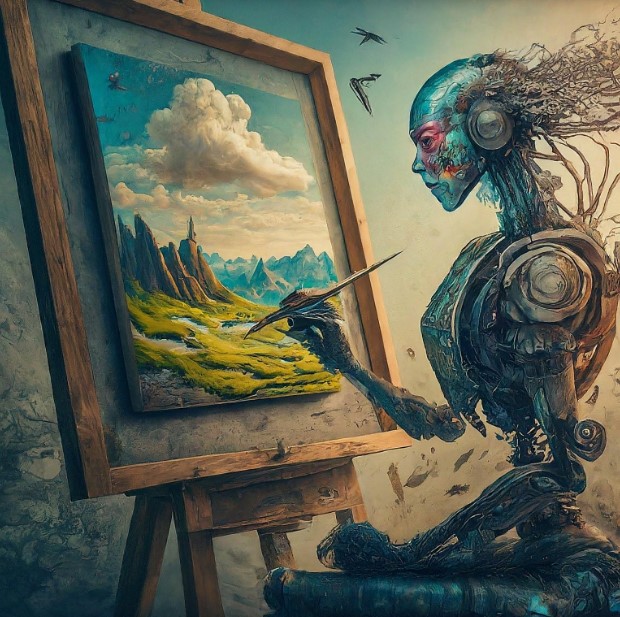

AI Art Use Cases: Generative AI on Creative Workflows

Learn about the various use cases for AI art, how generative AI is changing creative industries, and how AI art generators are being used in software development to improve user experience.

AI Art Use Cases: Generative AI on Creative Workflows
Written by TechnoLynx Published on 27 Aug 2024

Artificial Intelligence (AI) is no longer limited to traditional software development or problem-solving tasks. With the rise of generative AI, we’re witnessing the emergence of AI art, a fascinating blend of technology and creativity. From creating visually stunning artwork to enhancing software user experience, AI art has quickly become a key player in the world of digital innovation. In this article, we’ll explore various use cases for AI art, its impact on the development process, and how it is shaping the future of creative industries.

The Rise of AI Art

AI art is the creation of artwork generated by AI models. Unlike human-created art, AI generated images are often produced by machines using large sets of data and complex algorithms. These AI systems can generate art that ranges from abstract compositions to photorealistic representations.

AI art is typically created using generative AI, a subset of machine learning that can produce new content by learning patterns from existing data. For example, an AI art generator might take thousands of digital paintings as input and use that training data to generate images that mimic the styles or elements of those paintings.

The ability of AI to generate images has created new possibilities for artists, businesses, and developers. It has expanded creative horizons and enabled tasks that were once considered time-consuming or impossible.

Use Cases for AI Art

AI art has found applications across multiple sectors, demonstrating its versatility and utility in various creative processes. Below are some prominent use cases where AI art has made an impact.

Enhancing User Experience in Software Development

One of the exciting ways AI art can be applied is in software development. When designing apps, websites, or games, developers need visually appealing content to engage users. By incorporating AI art generators, developers can quickly generate art for backgrounds, icons, and other interface elements. This improves the user experience, as high-quality visuals can enhance how a user interacts with the system.

For example, a developer working on a gaming app may use an AI image generator to create unique in-game assets or avatars. Instead of manually designing each asset, the AI can automatically create diverse options, reducing the workload and speeding up the development process.

Generating Customised Marketing Content

Another use case for AI art is in the realm of marketing. Companies are increasingly using AI generated images to create high-quality visuals for social media posts, advertisements, and promotional materials. With generative AI, marketers can easily tailor visuals to specific demographics or campaigns, ensuring their messaging resonates with the target audience.

For instance, a fashion brand might use an AI art generator to create customised artwork for different product lines, helping to maintain a cohesive but unique visual identity across various platforms.

AI Art in Game Development

AI art is becoming increasingly popular in the game development industry. Developers can use AI to create computer-generated environments, character designs, or even entire game worlds. Instead of spending months designing every aspect manually, AI models can produce numerous variations in much less time.

This allows game developers to experiment with different art styles or designs while reducing production costs. AI art can also be used for procedural generation, where the game environment changes dynamically based on player input, offering a more interactive and personalised experience.

Automating Artistic Production for Retail

Retail companies are also finding ways to utilise AI art to streamline their operations. From customising product designs to generating unique packaging visuals, AI art generators can automate many of the tasks that human designers would typically handle.

For example, companies can use AI to create generated images of product mockups, eliminating the need for physical prototypes. This is particularly useful for online retail, where customers can visualise how a product might look or fit before making a purchase. The use of AI art helps retailers quickly adapt to trends and seasonal changes in customer preferences.

Augmenting Human Creativity

While some people may see AI art as a threat to traditional artists, many are using it to augment their creative abilities. Artists can collaborate with AI art generators to produce artwork that would be difficult or impossible to achieve alone. AI-generated art can offer inspiration, provide new ideas, and assist in overcoming creative blocks.

AI can take over repetitive tasks, such as creating patterns or resizing images, allowing artists to focus on more creative aspects of their work. Additionally, by using AI-generated elements as a base, artists can add their own touch, blending AI art with human creativity.

Writing a Use Case for AI Art Integration

For businesses looking to integrate AI art into their processes, writing a solid use case is essential. A use case describes how users interact with a system and outlines the steps involved in achieving a specific goal. In the context of AI art, it can demonstrate how the technology can be implemented effectively.

When writing a use case, it’s important to define the key components, such as:

  • Actors: Identify the users who will interact with the AI system (e.g., developers, marketers, or artists).

  • Successful Scenario: Outline the desired outcome, such as generating a set of high-quality images for a marketing campaign.

  • Alternate Flows: Consider possible variations in how users might interact with the system and potential alternative paths for achieving the goal.

  • System Interaction: Define how the AI art system will be integrated into the existing workflow, including how users interact with the system and what data or input is required.

  • Developers and Testers: Identify the roles of developers and testers in ensuring the system works efficiently.

An effective use case helps clarify the implementation process and ensures that everyone involved understands their roles and the system’s functionality.

AI Art in UX/UI Design

A growing use case for AI art is in UX/UI design. AI generated images can help designers create personalised and dynamic interfaces that improve the user experience. For instance, a weather app might use AI art to automatically generate background images that reflect real-time weather conditions, enhancing the user’s connection with the app.

This use of AI art improves both the aesthetics and the functionality of digital products, leading to a more engaging experience for the end-user.

AI Art in Social Media and Smart Marketing

In today’s digital age, social media and smart marketing have become essential tools for brands to connect with their audience. AI art plays a significant role in this landscape by offering innovative ways to create engaging content and personalised marketing strategies. Here are some real-life examples of how AI-generated images and generative AI are being used in social media and marketing.

Social Media Content Creation

Brands like Nike and Coca-Cola have started to integrate AI art generators into their social media strategies. These brands use AI-generated images to create visually appealing content that resonates with their audience. By leveraging text prompts and AI models, they can quickly produce a variety of high-quality visuals that align with their brand identity and messaging.

For instance, Coca-Cola launched a campaign where users could submit their own ideas for designs, and the AI art generator would produce unique artwork based on those ideas. This not only increased user engagement but also showcased the brand’s commitment to innovation.

Similarly, Nike uses AI-generated content to personalise its social media posts. By analysing data from customer interactions, the AI system can create customised visuals that target specific user demographics, making the content more relevant and engaging.

Smart Marketing, Smarter Solutions: AI-Marketing & Use Cases

Personalised Advertising

Another exciting application of AI art is in personalised advertising. Companies like Netflix and Spotify have pioneered the use of AI-generated images to create personalised ads that cater to individual user preferences. By analysing user behaviour and preferences, these platforms use generative AI to produce tailored visuals that appeal to specific segments of their audience.

For example, Netflix uses AI art to generate personalised movie posters for each user. The AI system creates different versions of a movie poster based on what it knows about the user’s viewing habits. If a user prefers action movies, they might see a poster highlighting the action scenes, while a fan of romance might see a poster focusing on the love story.

This personalised approach not only enhances user experience but also increases the effectiveness of marketing campaigns. When users see content that is tailored to their tastes, they are more likely to engage with it, leading to higher conversion rates.

Dynamic Email Campaigns

AI art is also being used to enhance email marketing campaigns. Companies like Adobe and Mailchimp use AI-generated images to create dynamic email content that changes based on user interactions. By integrating AI art generators into their email platforms, these companies can produce personalised visuals that adapt to the recipient’s preferences.

For instance, an e-commerce brand might use AI-generated visuals to showcase products that are similar to items a user has previously purchased. If a user clicks on a specific product in an email, the AI system can generate new images featuring related products in subsequent emails, creating a more engaging and personalised shopping experience.

This dynamic approach to email marketing not only improves user engagement but also increases the likelihood of repeat purchases, as users are more likely to find products that match their interests.

Influencer Collaborations

Influencers are increasingly using AI art to stand out on social media. AI art generators allow influencers to create unique and visually striking content that captures the attention of their followers. By collaborating with brands, influencers can use AI-generated images to create content that aligns with the brand’s aesthetic while also maintaining their personal style.

For example, an influencer working with a fashion brand might use an AI art generator to create customised outfit visuals that blend the brand’s clothing with the influencer’s own creative vision. This not only enhances the visual appeal of the content but also helps the brand reach a wider audience through the influencer’s followers.

Social Media Filters and Effects

Platforms like Instagram and Snapchat are incorporating AI art into their filters and effects, allowing users to create and share unique content. These platforms use AI-generated visuals to develop new filters that users can apply to their photos and videos, making their content more engaging and interactive.

For example, Instagram uses AI art to create filters that transform a user’s selfie into a stylised artwork, mimicking famous art styles or creating entirely new visual effects. This use of AI-generated content encourages users to share their creations, driving more engagement on the platform.

These filters not only provide entertainment but also serve as a powerful marketing tool for brands. By sponsoring AI-powered filters, brands can reach millions of users, who then share branded content with their followers, amplifying the brand’s reach.

How TechnoLynx Can Help

At TechnoLynx, we specialise in integrating AI solutions into various business workflows. Whether you need AI-generated visuals for marketing, game development, or UX design, we have the expertise to help. Our team of developers and testers work with the latest AI technologies to ensure that your business can benefit from high-quality and cost-effective AI solutions.

We can help you define and implement use cases for AI art, guiding you through the entire development process to ensure a successful outcome. Reach out to us to learn more about how we can assist with your AI art integration.

Read more: AI in Digital Visual Arts: Exploring Creative Frontiers

Image credits: Freepik

Cost, Efficiency, and Value Are Not the Same Metric

Cost, Efficiency, and Value Are Not the Same Metric

17/04/2026

Performance per dollar. Tokens per watt. Cost per request. These sound like the same thing said differently, but they measure genuinely different dimensions of AI infrastructure economics. Conflating them leads to infrastructure decisions that optimize for the wrong objective.

Precision Is an Economic Lever in Inference Systems

Precision Is an Economic Lever in Inference Systems

17/04/2026

Precision isn't just a numerical setting — it's an economic one. Choosing FP8 over BF16, or INT8 over FP16, changes throughput, latency, memory footprint, and power draw simultaneously. For inference at scale, these changes compound into significant cost differences.

Precision Choices Are Constrained by Hardware Architecture

Precision Choices Are Constrained by Hardware Architecture

17/04/2026

You can't run FP8 inference on hardware that doesn't have FP8 tensor cores. Precision format decisions are conditional on the accelerator's architecture — its tensor core generation, native format support, and the efficiency penalties for unsupported formats.

Steady-State Performance, Cost, and Capacity Planning

Steady-State Performance, Cost, and Capacity Planning

17/04/2026

Capacity planning built on peak performance numbers over-provisions or under-delivers. Real infrastructure sizing requires steady-state throughput — the predictable, sustained output the system actually delivers over hours and days, not the number it hit in the first five minutes.

How Benchmark Context Gets Lost in Procurement

How Benchmark Context Gets Lost in Procurement

16/04/2026

A benchmark result starts with full context — workload, software stack, measurement conditions. By the time it reaches a procurement deck, all that context is gone. The failure mode is not wrong benchmarks but context loss during propagation.

Building an Audit Trail: Benchmarks as Evidence for Governance and Risk

Building an Audit Trail: Benchmarks as Evidence for Governance and Risk

16/04/2026

High-value AI hardware decisions need traceable evidence, not slide-deck bullet points. When benchmarks are documented with methodology, assumptions, and limitations, they become auditable institutional evidence — defensible under scrutiny and revisitable when conditions change.

The Comparability Protocol: Why Benchmark Methodology Defines What You Can Compare

The Comparability Protocol: Why Benchmark Methodology Defines What You Can Compare

16/04/2026

Two benchmark scores can only be compared if they share a declared methodology — the same workload, precision, measurement protocol, and reporting conditions. Without that contract, the comparison is arithmetic on numbers of unknown provenance.

A Decision Framework for Choosing AI Hardware

A Decision Framework for Choosing AI Hardware

16/04/2026

Hardware selection is a multivariate decision under uncertainty — not a score comparison. This framework walks through the steps: defining the decision, matching evaluation to deployment, measuring what predicts production, preserving tradeoffs, and building a repeatable process.

How Benchmarks Shape Organizations Before Anyone Reads the Score

How Benchmarks Shape Organizations Before Anyone Reads the Score

16/04/2026

Before a benchmark score informs a purchase, it has already shaped what gets optimized, what gets reported, and what the organization considers important. Benchmarks function as decision infrastructure — and that influence deserves more scrutiny than the number itself.

Accuracy Loss from Lower Precision Is Task‑Dependent

Accuracy Loss from Lower Precision Is Task‑Dependent

16/04/2026

Reduced precision does not produce a uniform accuracy penalty. Sensitivity depends on the task, the metric, and the evaluation setup — and accuracy impact cannot be assumed without measurement.

Precision Is a Design Parameter, Not a Quality Compromise

Precision Is a Design Parameter, Not a Quality Compromise

16/04/2026

Numerical precision is an explicit design parameter in AI systems, not a moral downgrade in quality. This article reframes precision as a representation choice with intentional trade-offs, not a concession made reluctantly.

Mixed Precision Works by Exploiting Numerical Tolerance

Mixed Precision Works by Exploiting Numerical Tolerance

16/04/2026

Not every multiplication deserves 32 bits. Mixed precision works because neural network computations have uneven numerical sensitivity — some operations tolerate aggressive precision reduction, others don't — and the performance gains come from telling them apart.

Throughput vs Latency: Choosing the Wrong Optimization Target

16/04/2026

Throughput and latency are different objectives that often compete for the same resources. This article explains the trade-off, why batch size reshapes behavior, and why percentiles matter more than averages in latency-sensitive systems.

Quantization Is Controlled Approximation, Not Model Damage

16/04/2026

When someone says 'quantize the model,' the instinct is to hear 'degrade the model.' That framing is wrong. Quantization is controlled numerical approximation — a deliberate engineering trade-off with bounded, measurable error characteristics — not an act of destruction.

GPU Utilization Is Not Performance

15/04/2026

The utilization percentage in nvidia-smi reports kernel scheduling activity, not efficiency or throughput. This article explains the metric's exact definition, why it routinely misleads in both directions, and what to pair it with for accurate performance reads.

FP8, FP16, and BF16 Represent Different Operating Regimes

15/04/2026

FP8 is not just 'half of FP16.' Each numerical format encodes a different set of assumptions about range, precision, and risk tolerance. Choosing between them means choosing operating regimes — different trade-offs between throughput, numerical stability, and what the hardware can actually accelerate.

Peak Performance vs Steady‑State Performance in AI

15/04/2026

AI systems rarely operate at peak. This article defines the peak vs. steady-state distinction, explains when each regime applies, and shows why evaluations that capture only peak conditions mischaracterize real-world throughput.

The Software Stack Is a First‑Class Performance Component

15/04/2026

Drivers, runtimes, frameworks, and libraries define the execution path that determines GPU throughput. This article traces how each software layer introduces real performance ceilings and why version-level detail must be explicit in any credible comparison.

The Mythology of 100% GPU Utilization

15/04/2026

Is 100% GPU utilization bad? Will it damage the hardware? Should you be worried? For datacenter AI workloads, sustained high utilization is normal — and the anxiety around it usually reflects gaming-era intuitions that don't apply.

Why Benchmarks Fail to Match Real AI Workloads

15/04/2026

The word 'realistic' gets attached to benchmarks freely, but real AI workloads have properties that synthetic benchmarks structurally omit: variable request patterns, queuing dynamics, mixed operations, and workload shapes that change the hardware's operating regime.

Why Identical GPUs Often Perform Differently

15/04/2026

'Same GPU' does not imply the same performance. This article explains why system configuration, software versions, and execution context routinely outweigh nominal hardware identity.

Training and Inference Are Fundamentally Different Workloads

15/04/2026

A GPU that excels at training may disappoint at inference, and vice versa. Training and inference stress different system components, follow different scaling rules, and demand different optimization strategies. Treating them as interchangeable is a design error.

Performance Ownership Spans Hardware and Software Teams

15/04/2026

When an AI workload underperforms, attribution is the first casualty. Hardware blames software. Software blames hardware. The actual problem lives in the gap between them — and no single team owns that gap.

Performance Emerges from the Hardware × Software Stack

15/04/2026

AI performance is an emergent property of hardware, software, and workload operating together. This article explains why outcomes cannot be attributed to hardware alone and why the stack is the true unit of performance.

Power, Thermals, and the Hidden Governors of Performance

14/04/2026

Every GPU has a physical ceiling that sits below its theoretical peak. Power limits, thermal throttling, and transient boost clocks mean that the performance you read on the spec sheet is not the performance the hardware sustains. The physics always wins.

Why AI Performance Changes Over Time

14/04/2026

That impressive throughput number from the first five minutes of a training run? It probably won't hold. AI workload performance shifts over time due to warmup effects, thermal dynamics, scheduling changes, and memory pressure. Understanding why is the first step toward trustworthy measurement.

CUDA, Frameworks, and Ecosystem Lock-In

14/04/2026

Why is it so hard to switch away from CUDA? Because the lock-in isn't in the API — it's in the ecosystem. Libraries, tooling, community knowledge, and years of optimization create switching costs that no hardware swap alone can overcome.

GPUs Are Part of a Larger System

14/04/2026

CPU overhead, memory bandwidth, PCIe topology, and host-side scheduling routinely limit what a GPU can deliver — even when the accelerator itself has headroom. This article maps the non-GPU bottlenecks that determine real AI throughput.

Why AI Performance Must Be Measured Under Representative Workloads

14/04/2026

Spec sheets, leaderboards, and vendor numbers cannot substitute for empirical measurement under your own workload and stack. Defensible performance conclusions require representative execution — not estimates, not extrapolations.

Low GPU Utilization: Where the Real Bottlenecks Hide

14/04/2026

When GPU utilization drops below expectations, the cause usually isn't the GPU itself. This article traces common bottleneck patterns — host-side stalls, memory-bandwidth limits, pipeline bubbles — that create the illusion of idle hardware.

Why GPU Performance Is Not a Single Number

14/04/2026

AI GPU performance is multi-dimensional and workload-dependent. This article explains why scalar rankings collapse incompatible objectives and why 'best GPU' questions are structurally underspecified.

What a GPU Benchmark Actually Measures

14/04/2026

A benchmark result is not a hardware measurement — it is an execution measurement. The GPU, the software stack, and the workload all contribute to the number. Reading it correctly requires knowing which parts of the system shaped the outcome.

Why Spec‑Sheet Benchmarking Fails for AI

14/04/2026

GPU spec sheets describe theoretical limits. This article explains why real AI performance is an execution property shaped by workload, software, and sustained system behavior.

Visual Computing in Life Sciences: Real-Time Insights

6/11/2025

Learn how visual computing transforms life sciences with real-time analysis, improving research, diagnostics, and decision-making for faster, accurate outcomes.

AI-Driven Aseptic Operations: Eliminating Contamination

21/10/2025

Learn how AI-driven aseptic operations help pharmaceutical manufacturers reduce contamination, improve risk assessment, and meet FDA standards for safe, sterile products.

AI Visual Quality Control: Assuring Safe Pharma Packaging

20/10/2025

See how AI-powered visual quality control ensures safe, compliant, and high-quality pharmaceutical packaging across a wide range of products.

AI for Reliable and Efficient Pharmaceutical Manufacturing

15/10/2025

See how AI and generative AI help pharmaceutical companies optimise manufacturing processes, improve product quality, and ensure safety and efficacy.

Barcodes in Pharma: From DSCSA to FMD in Practice

25/09/2025

What the 2‑D barcode and seal on your medicine mean, how pharmacists scan packs, and why these checks stop fake medicines reaching you.

Pharma’s EU AI Act Playbook: GxP‑Ready Steps

24/09/2025

A clear, GxP‑ready guide to the EU AI Act for pharma and medical devices: risk tiers, GPAI, codes of practice, governance, and audit‑ready execution.

Cell Painting: Fixing Batch Effects for Reliable HCS

23/09/2025

Reduce batch effects in Cell Painting. Standardise assays, adopt OME‑Zarr, and apply robust harmonisation to make high‑content screening reproducible.

Explainable Digital Pathology: QC that Scales

22/09/2025

Raise slide quality and trust in AI for digital pathology with robust WSI validation, automated QC, and explainable outputs that fit clinical workflows.

Validation‑Ready AI for GxP Operations in Pharma

19/09/2025

Make AI systems validation‑ready across GxP. GMP, GCP and GLP. Build secure, audit‑ready workflows for data integrity, manufacturing and clinical trials.

Edge Imaging for Reliable Cell and Gene Therapy

17/09/2025

Edge imaging transforms cell & gene therapy manufacturing with real‑time monitoring, risk‑based control and Annex 1 compliance for safer, faster production.

AI in Genetic Variant Interpretation: From Data to Meaning

15/09/2025

AI enhances genetic variant interpretation by analysing DNA sequences, de novo variants, and complex patterns in the human genome for clinical precision.

AI Visual Inspection for Sterile Injectables

11/09/2025

Improve quality and safety in sterile injectable manufacturing with AI‑driven visual inspection, real‑time control and cost‑effective compliance.

Predicting Clinical Trial Risks with AI in Real Time

5/09/2025

AI helps pharma teams predict clinical trial risks, side effects, and deviations in real time, improving decisions and protecting human subjects.

Generative AI in Pharma: Compliance and Innovation

1/09/2025

Generative AI transforms pharma by streamlining compliance, drug discovery, and documentation with AI models, GANs, and synthetic training data for safer innovation.

AI for Pharma Compliance: Smarter Quality, Safer Trials

27/08/2025

AI helps pharma teams improve compliance, reduce risk, and manage quality in clinical trials and manufacturing with real-time insights.

Back See Blogs
arrow icon