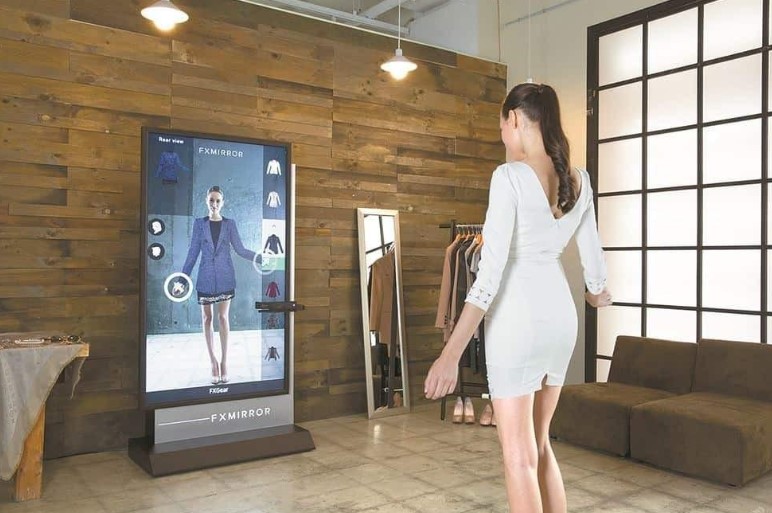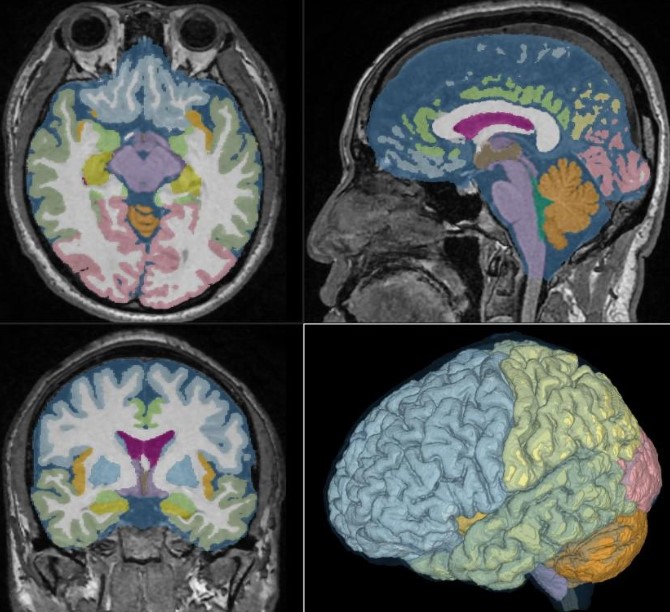
Introduction
Applied AI in cosmetology stacks vision, augmented reality, inference at the edge, and language understanding in ways few other sectors replicate. The interesting work is not the obvious “filter your selfie” layer — it is the operational use of these technologies inside salons, dental practices, and dermatology clinics, where the stakes shift from entertainment to clinical decision support.
We work across industries where vision systems have to behave under real-world variance — different lighting, different faces, different skin tones, different camera sensors. Cosmetology surfaces every one of those constraints at once, which is why it makes a useful lens on where computer vision is currently strong and where it still hands the final call back to a trained human.
Mirror, Mirror on the Wall
Choosing a hairstyle serves as an accessible example. The traditional answer is hours in front of a mirror, a stack of reference photos, and a stylist’s best guess. The modern answer is a virtual try-on driven by augmented reality — a subcategory of extended reality that has become familiar through online glasses retailers.
Eyewear was the early proof case because the problem is unforgiving. No two faces are identical, and small differences in cheekbone width, jawline angle, and pupillary distance change how a frame sits. A virtual try-on overlay has to track those landmarks in real time, render the frame with plausible occlusion and lighting, and update at a frame rate that doesn’t betray the illusion. The same machinery transfers cleanly to hairstyles, makeup, and accessories.
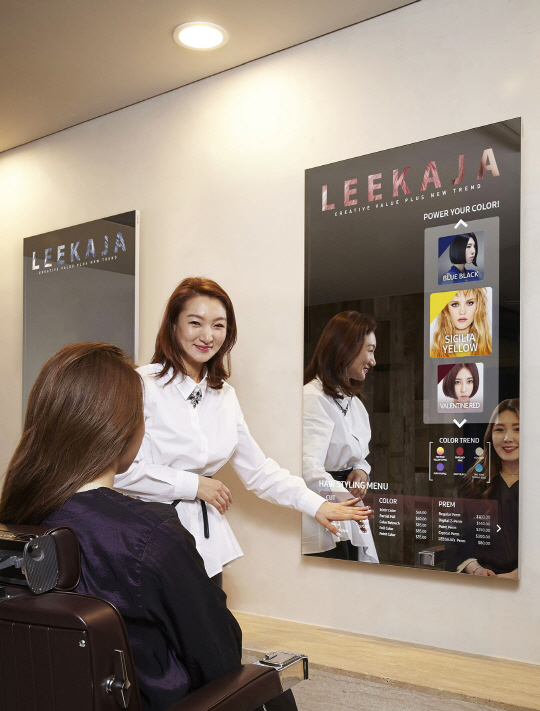
What pushes this further is the IoT-loaded smart mirror. Samsung and others have built prototypes where the mirror is no longer a passive surface but a compute node with a camera, a GPU-accelerated AR pipeline, and a connection to manufacturer catalogues. Edge computing matters here: the latency budget for AR overlay tracking is tight, and round-tripping every frame to a cloud GPU would be visible to the user. Keeping inference local — on-device or on a nearby edge box — is what makes the experience feel like a mirror instead of a video call.
What is a smart mirror, in engineering terms?
A smart mirror is a display panel behind a semi-reflective surface, paired with a camera, a face-tracking model, and an AR rendering layer. The face-tracking model extracts landmarks (typically 68 to several hundred points). The AR layer warps the chosen asset — hairstyle, frame, makeup tone — onto those landmarks each frame. The mirror is “smart” only because that pipeline runs at interactive speed on commodity hardware, which is a recent development.
For practitioners — hair stylists, makeup artists — the value is not the novelty but the reduction in iteration cost. Showing a client three plausible options on their own face is faster and more honest than describing them.
Smile With Your Eyes
The term derives from two Greek components: κοσμητικός (beautifying) and λογία (systematic inquiry). One of its less glamorous corners is dental aesthetics, which connects directly to overall health. Teeth shape speech, signal health, and — for better or worse — change how strangers respond to a face.
Four reasons this matters in practice:
- Misaligned teeth affect speech clarity.
- A smile is one of the first features people register socially.
- Oral hygiene is a visible proxy for broader health risks like periodontal disease.
- Confidence in social settings tracks closely with how someone feels about their teeth.
Studies cited by dental practices report that children smile up to 400 times per day, happy adults 40–50 times, and average adults around 20 (Dental Clinic in Delhi, 2023). Whatever the exact number, the asymmetry is the point.
Flash Me a Smile
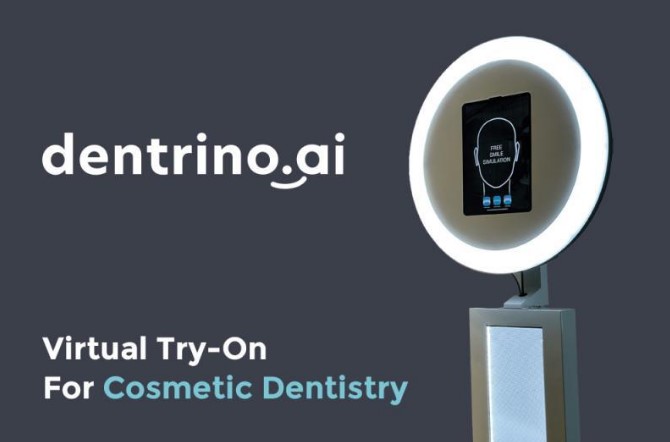
The same vision pipeline that drives hairstyle previews works for dental aesthetics, and a few companies have built it out. Dentrino.ai offers the “ToothBooth,” a virtual try-on photo booth designed to sit in a dentist’s waiting room. A patient places their face in the frame, picks from whitening, orthodontic, and cosmetic simulations, and walks out with a personalised preview. No training, no operator required.
The clinical-marketing logic is straightforward: a visual preview converts a routine cleaning into a conversation about whitening or alignment. For practices that don’t want a kiosk, dentrino.ai also runs the same pipeline as a pay-per-use cloud service from an uploaded smile photo.
Let Me See
Inside the mouth, the work shifts from cosmetic preview to diagnostic support. Dentists already use loupes to magnify the oral cavity. Computer vision adds a layer on top: a properly trained classifier can flag candidates for dental abscess, gingivitis, periodontitis, bruxism, and caries. AR-enhanced loupes can project filling boundaries onto the tooth in situ, giving the practitioner a real-time alignment reference.
Intraoral scanners are the other natural integration point. They already produce dense 3D meshes. Adding a downstream model that segments and orders the components needed for treatment — crowns, bridges, custom abutments — closes a loop that currently runs through manual chair-side notes and follow-up calls. This is a clean instance of edge-computing-backed IoT removing administrative latency from a clinical workflow.
Funny You Should Say That
Dentists spend long stretches talking with patients whose mouths are open. The conversation is awkward by design. A natural language processing model trained on muffled, mid-procedure speech is a genuinely useful prosthetic — not a replacement for the dentist’s interpretive skill, but a real-time translator that helps newer practitioners catch what is being said without asking the patient to repeat themselves around suction tubing. Generative AI can plausibly take this from a research curiosity to a chair-side feature within the next product generation.
Touch — The Skin Layer
Dermatology introduces the third dimension. Skin is the largest organ and the most visible health indicator, and skin conditions are common enough that most adults will see a dermatologist at least once.
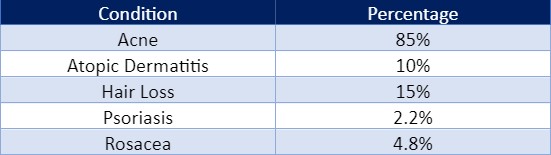
The reflex of searching online for symptoms is universal and almost universally unhelpful. What computer vision does well — and what self-diagnosis does badly — is comparison against a large reference set. This is where “digital dermatology” earns its name.
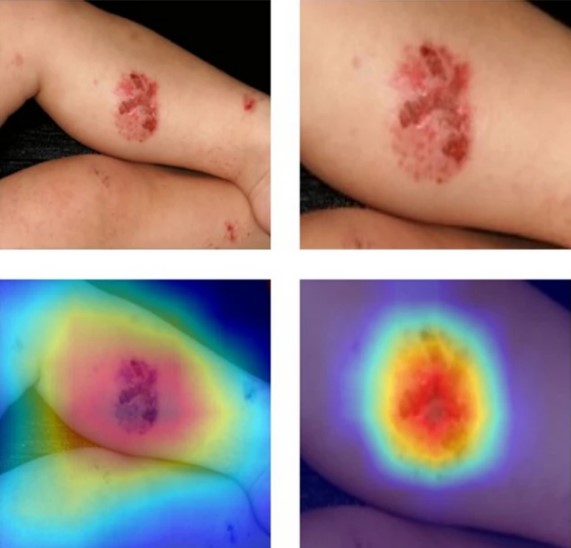
Smartphone cameras and on-device processors are now strong enough to run inference for common skin abnormalities — acne, atopic dermatitis, melanoma candidates, erythema, ichthyosis. The honest framing is that these apps do not diagnose. They triage. A patient gets a probability-weighted “this looks like it warrants a clinician” signal, and a clinician gets a flagged image with localisation overlays that would otherwise have required a higher-resolution dermatoscope.
The deployment pattern that holds up best is the hybrid: a cloud-backed application where the patient captures the image at home, the model produces a structured report, and a clinician reviews the result remotely. This is telemedicine in the form that actually scales — see our piece on the Internet of Medical Things for how the device side of that picture is converging.
Decision Surface — Where AI Fits Across Cosmetology
| Layer | Technology | Decision support role | Final authority |
|---|---|---|---|
| Hair / makeup / eyewear preview | AR + face landmarks, edge GPU | Visual try-on, option iteration | Client + stylist |
| Smile aesthetics preview | CV + generative simulation | Marketing + treatment planning | Dentist + patient |
| Intraoral diagnosis | CV classifier on loupe / scanner feed | Candidate flagging, alignment overlay | Dentist |
| Chair-side communication | NLP / generative speech recovery | Speech disambiguation | Dentist |
| Dermatological screening | On-device CV + cloud reference DB | Triage, anomaly localisation | Dermatologist |
One pattern repeats: AI winnows possibilities, skilled humans finalize outcomes.
What Limits This
Practical limits deserve explicit mention. Training a general AI system across skin tones, lighting conditions, dental morphologies, and hair types requires a dataset that genuinely represents that variance. Most public datasets do not. Models trained on narrow distributions fail visibly on the populations they underrepresented, and in cosmetology that failure is both technically embarrassing and socially harmful. Curation is a larger share of the engineering effort than model architecture, and any team claiming otherwise has either not deployed at scale or is hoping no one will check.
The other constraint is regulatory. A virtual hairstyle preview is a consumer product. A dermatological triage tool is, depending on jurisdiction, a medical device. Confusing the two during product design is a common mistake and an expensive one.
What We Offer
TechnoLynx builds vision and edge pipelines for clients facing these exact constraints—uncontrolled lighting, physical sensors, strict latency, and real stakes for errors. Cosmetology is one of several domains where we have seen that the interesting engineering work is rarely the model itself. It is the integration: edge compute, data pipeline, calibration, and the boundary between what the system surfaces and what a trained professional decides. If you have a project at that boundary, we would be glad to discuss it.
Frequently Asked Questions
How is AI actually used in cosmetology beyond filters?
It runs three workloads: AR-based virtual try-ons for hair, makeup, and accessories; CV-driven diagnostic support in dentistry and dermatology; and edge-compute integrations inside smart mirrors and intraoral scanners. The common ingredient is real-time inference on local hardware against a reference database.
Can AI replace a dermatologist or dentist?
No. The deployment pattern that holds up clinically is triage and decision support — the model flags candidates, localises anomalies, and surfaces reference comparisons. The trained clinician keeps the diagnostic and prescribing authority. Apps that claim otherwise are operating outside their regulatory footing.
What is a smart mirror, technically?
A semi-reflective display panel with a camera, a face-tracking model, and an AR rendering layer running on local GPU hardware. The “smart” part is that landmark extraction and asset warping happen at interactive frame rates on commodity edge hardware, which is what makes the experience feel like a mirror rather than a video stream.
Why is dataset coverage the main limit?
Vision models inherit the biases of their training data. Across cosmetology — skin tones, hair textures, dental morphologies, lighting conditions — narrow datasets produce models that fail visibly on underrepresented users. Closing that gap is curation and labelling work, not architecture work, which is why it is often the dominant cost in a real deployment.
List of references
- Bizwire, K. (2016) ‘Korean Hair Salon Introduces Smart Mirror’, Be Korea-savvy, 19 May. (Accessed: 23 March 2024).
- Dental Clinic in Delhi - Best Dentists in South Delhi (2023). (Accessed: 24 March 2024).
- Skin conditions by the numbers (no date). (Accessed: 24 March 2024).
- Smile Simulation (no date) Dentrino AI (Accessed: 23 March 2024).
- Son, H.M. et al. (2021) ‘AI-based localization and classification of skin disease with erythema’, Scientific Reports, 11(1), p. 5350.