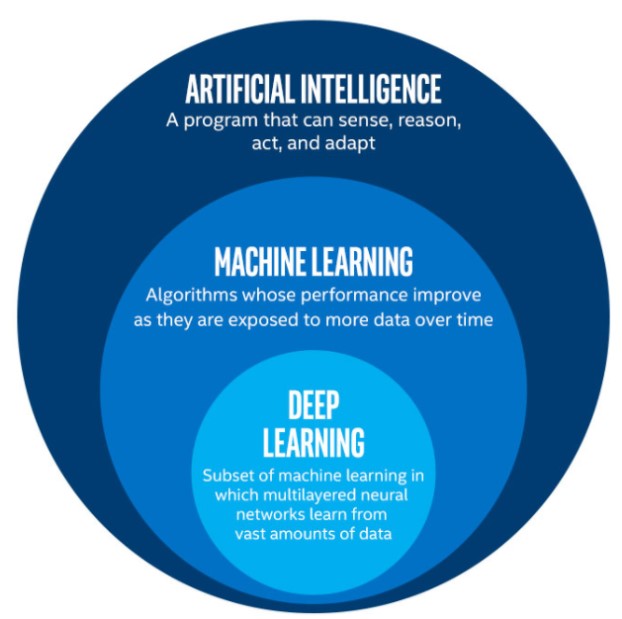
When a leadership team comes to us asking for “an AI project”, the work almost never starts where the brief says it does. It starts with a quieter conversation about which family of system is actually being commissioned — a perception model, a retrieval-augmented language application, an optimisation layer for an existing pipeline, or something genuinely bespoke. Deep learning sits at the centre of that map, but it is not the answer to every problem on it. The taxonomy matters because the wrong family costs weeks of misdirected work before anyone notices.
We treat deep learning as one tool among several. It is the right tool when the input is high-dimensional and unstructured — images, audio, long text, multi-sensor streams — and when there is enough representative data to train against. Below that threshold, classical machine learning often wins on accuracy, latency, and cost, and we say so. Our role is to scope the system that fits the problem, not to defend a category.
What deep learning solutions actually look like in practice
Four recognisable project archetypes emerge consistently from our client work. Naming them up front shortens the discovery phase considerably, because clients can point at the shape that matches their problem instead of negotiating the vocabulary.
| Engagement family | Typical inputs | Frameworks and runtimes | When it fits |
|---|---|---|---|
| Perception systems | Camera, lidar, multispectral, OCR streams | PyTorch, OpenCV, TensorRT, ONNX Runtime | Detection, segmentation, tracking, biometric, industrial inspection |
| Generative and language | Documents, transcripts, structured queries | PyTorch, Hugging Face, vLLM, SGLang | RAG applications, document AI, structured-output extraction, voice |
| GPU performance and inference | Existing trained models | CUDA, TensorRT, Triton, quantisation toolchains | Latency, throughput, or cost ceilings on an already-working model |
| Custom model training | Small-data, novel sensors, specialised domains | PyTorch, JAX, in-house data pipelines | Off-the-shelf models do not transfer or the data distribution is uncommon |
This is an observed pattern across our R&D engagements rather than a market survey — the boundaries are softer than the table suggests, and most projects touch two of the four families during their lifecycle. But the shape of the conversation changes once a project is anchored to a family. Discovery stops drifting between “we want an LLM” and “we want a vision system” and starts asking the operational questions: what data exists, what latency target the production environment imposes, what failure mode is acceptable.
When deep learning beats classical machine learning — and when it doesn’t
Conditional on context, the answer demands precision rather than generalities. Deep learning beats classical methods when the task involves high-dimensional unstructured inputs and there is enough data to learn representations end-to-end. That typically means thousands of labelled examples for supervised tasks, or large amounts of unlabelled data for self-supervised pretraining. Transformer-based architectures have pushed that boundary further across modalities, which is part of why they keep dominating in vision, language, and audio benchmarks.
Below that data threshold, the picture inverts. Gradient-boosted trees on engineered features will out-perform a small neural network on tabular data nine times out of ten, run faster, and explain themselves more easily. We have walked clients out of deep-learning briefs into XGBoost or LightGBM solutions more often than the reverse — not because deep learning is uninteresting, but because it is the wrong shape for the problem. An observed range we see in scoping work: somewhere between 30% and 40% of inbound “AI” briefs are better served by classical ML or by a hybrid pipeline where a small deep model does feature extraction and a classical model does the decision. This is a planning heuristic, not a benchmark.
The decision flips again when the input modality is genuinely high-dimensional. Once you are working with images, audio waveforms, free-form text, or fused sensor streams, classical methods do not have a comparable representation-learning story, and deep learning is the operationally relevant choice.
How a deep-learning engagement actually runs
Bounded engagements with defined outcomes form the basis of how we structure projects, not rolling retainers. The structure is the same across families:
- Discovery — data audit, success metrics, infrastructure plan, and a written go/no-go on whether deep learning is the right family at all.
- Delivery — model build, evaluation harness, and production integration. The evaluation code ships alongside the model so success or failure is measurable against the criteria agreed in discovery.
- Handover — documentation, monitoring, a retraining plan, and a defined boundary for when the system needs to be revisited.
The evaluation harness is the part that most distinguishes a deep-learning engagement from an exploratory notebook. Without it, every disagreement about whether the model is “working” becomes a debate about anecdotes. With it, the conversation moves to the numbers and to the failure modes the harness is designed to catch.
Hardware and framework choices, briefly
Framework choices follow from problem requirements; we maintain no platform allegiance. PyTorch is the primary training framework across our work, with JAX and TensorFlow used when a client stack requires them. Hugging Face is the standard wrangling layer for pretrained language and vision-language models. For inference we pick the runtime that fits the deployment surface: NVIDIA TensorRT and TorchScript for high-throughput GPU inference, ONNX Runtime for cross-platform portability, vLLM and SGLang for serving large language models, ExecuTorch and TFLite when the target is on-device.
Hardware follows the same logic. NVIDIA H100, H200, and B200 for training-class workloads; RTX 6000 Ada and Blackwell-class workstations for development and small-batch inference; Jetson Orin and Thor for embedded and edge; AMD MI300X and MI325X where the client’s ROCm stack is mature enough to justify it. None of these choices are religious. The right hardware is the one whose memory bandwidth, interconnect, and software support match the model and the latency budget — a decision we make explicit during discovery rather than after a year of training runs.
For the architectural map this fits into — symbolic, generative, and traditional ML as three working families practitioners actually reach for — see Symbolic vs Generative vs Traditional ML: A Working Taxonomy for Practitioners. For broader programme context across our engagements, our Generative & Agentic AI R&D practice covers the engagement-shape side of the picture.
FAQ
What kinds of deep-learning solutions does TechnoLynx build?
Four broad categories: perception systems — object detection, segmentation, tracking, OCR, face and biometric, multispectral CV for industry; generative and language systems — retrieval-augmented LLM applications, document AI, structured-output extraction, voice and translation; GPU performance and inference optimisation — kernel-level work, quantisation, multi-GPU and multi-node, edge deployment; and custom model training for tasks where off-the-shelf models do not fit, including specialised domains, small-data regimes, and novel sensors.
When does deep learning beat classical machine learning?
When the task involves high-dimensional unstructured inputs (images, audio, long text, sensor streams) and you have enough representative data — typically thousands of labelled examples or large amounts of unlabelled data for self-supervised pretraining. Below that data threshold, or for low-dimensional tabular data with strong feature engineering, classical methods (gradient-boosted trees, linear models) often win on accuracy, latency, and cost.
How does a typical TechnoLynx deep-learning engagement run?
A bounded discovery phase (data audit, success metrics, infrastructure plan), a delivery phase split into model build, evaluation harness, and production integration, and a handover phase with documentation, monitoring, and a retraining plan. We work in fixed deliverable windows rather than open-ended retainer arrangements, and we ship the evaluation code alongside the model so success or failure is measurable.
What hardware and frameworks are involved?
Frameworks: primarily PyTorch (with JAX and TensorFlow when client stacks require it), Hugging Face for model wrangling, NVIDIA TensorRT / TorchScript / ONNX Runtime / vLLM / SGLang for inference, ExecuTorch and TFLite for edge. Hardware: NVIDIA H100 / H200 / B200 for training-class workloads, RTX 6000 Ada / Blackwell for workstation work, Jetson Orin / Thor for embedded, AMD MI300X / MI325X where the client stack supports ROCm.