
Introduction
Neural networks are the substrate of generative AI in a literal sense: every frontier text, image, audio, and video model in production today is a stack of neural-network primitives — attention blocks, feedforward layers, normalisation — trained on enough data and compute to make the learned distribution interesting. The reason “neural network” keeps being named as the foundation is not metaphorical. There is no other thing underneath. Diffusion is a training recipe applied to a neural network. A large language model is a neural network with a particular tokeniser and a particular objective. Asking what makes generative AI work is mostly asking what makes deep neural networks work at scale.
That framing matters because the term generative AI is now used loosely enough to confuse scoping conversations. Stakeholders mix “AI”, “machine learning”, “deep learning”, “LLMs”, and “generative AI” interchangeably, and engineering teams routinely spend the first week of a project agreeing on which family of system is actually being built. A working taxonomy — one that ties each family to the problems it solves, the data it needs, and the failures it shows — lets the conversation start at the problem instead of the label. The deeper context for that taxonomy lives in our companion piece on symbolic AI vs generative AI and how they shape technology; this article focuses on the neural-network substrate underneath the generative half of that map.
What a neural network actually is
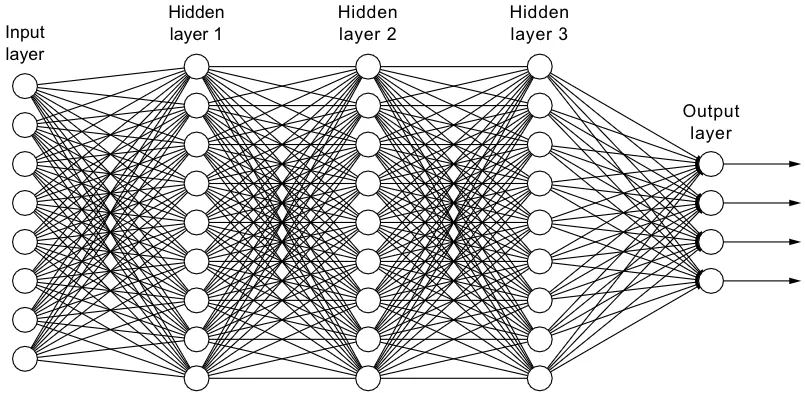
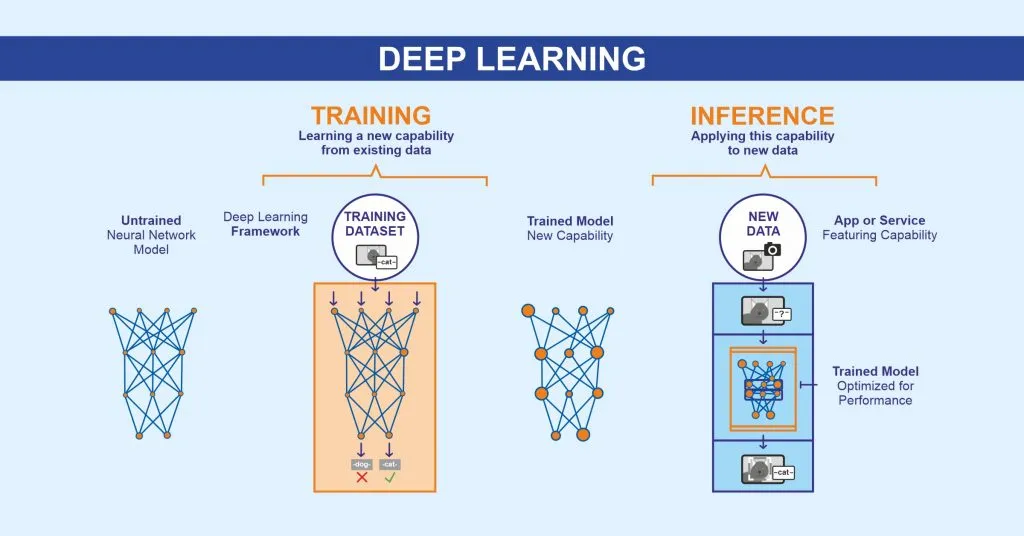
A neural network is a parameterised function. It takes a vector of inputs, transforms them through a sequence of layers of simple mathematical units, and produces a vector of outputs. Each layer applies a linear transformation (a matrix multiplication plus a bias) followed by a nonlinearity. Training adjusts the matrices — the weights — using gradient descent on a loss function that measures how wrong the output is compared to the target.
Two things in that description matter more than the metaphor of neurons. First, the function is differentiable end-to-end, which means we can compute, for every weight, the direction in which it should move to reduce the loss. That is what backpropagation does, and it is what made deep networks trainable in the first place. Second, the architecture — how the layers are connected, what the nonlinearities are, what kind of attention or convolution sits where — encodes prior assumptions about the data. A convolutional network assumes spatial locality. A recurrent network assumes temporal order. A transformer assumes that any token can attend to any other token, mediated by learned weights.
Depth is a tool, not a virtue. Shallow models with one or two hidden layers can outperform deep models on tasks where the structure of the problem is shallow, and where interpretability or latency matters. One study from Scientific Reports in 2023 — observed-pattern, monocular depth estimation — showed shallow learning architectures performing competitively with deep networks on the specific task, with the trade-off that they sacrifice some of the representational flexibility deep models bring. The right depth follows the problem.
Where neural networks fit in the taxonomy
A working taxonomy for scoping conversations distinguishes four families: classical machine learning, deep learning, large language models, and generative AI as a usage mode. The boundaries are not crisp, but they map to real engineering decisions.
| Family | What it is | When you reach for it | Failure mode |
|---|---|---|---|
| Classical ML | Logistic regression, random forests, gradient-boosted trees, SVMs | Tabular data, well-specified features, interpretability required | Underfits structured data like images, language, audio |
| Deep learning | Multi-layer neural networks trained with gradient descent | Perceptual data (image, audio, video), language, dense embeddings | Needs large data and compute; failure modes are opaque |
| Large language models | Deep networks (transformers) trained on text at scale, predicting the next token | Open-ended language tasks, code, structured extraction from prose | Hallucination, prompt sensitivity, calibration drift |
| Generative AI (mode) | Any model used to produce novel outputs in the training distribution | Content creation, synthetic data, simulation, augmentation | Quality, safety, provenance, copyright |
The last row is the important one to read carefully. Generative AI is not a separate architecture family — it is a usage mode of deep networks. An LLM used to extract entities is classification; the same LLM used to draft a clinical letter is generative. A GAN used to synthesise training images for a downstream classifier is generative. A diffusion model conditioned on a text prompt is generative. The substrate is the same neural network primitives.
This is why C3 in our claim canon — that the key feature of generative AI is learned conditional sampling from a high-dimensional distribution rather than any specific architecture — is the load-bearing distinction for a production team. The architecture is an implementation choice; the generative behaviour comes from the training objective and how the model is used at inference.
Architectures that matter for generative work in 2026
Four architecture families currently carry most of the load. None of them is new in the last 24 months; what has changed is the engineering around them.
Transformers
The transformer is the dominant generative architecture across modalities. It is the backbone of every frontier language model (GPT, Claude, Gemini, Llama families), most modern image and video generators (DiT, MM-DiT, and Sora-class systems), and a growing share of audio models. The reason it travelled across modalities is the attention mechanism: any token can attend to any other token, mediated by learned weights, which lets the network model long-range relationships without the architectural commitments convolution or recurrence bake in.
Two engineering facts about transformers matter for scoping. They scale predictably with compute and data — the so-called scaling laws — which is why frontier-model spend keeps climbing. And they are quadratic in sequence length at inference, which is why long-context, on-device, and latency-sensitive deployments are increasingly pushing hybrid or alternative architectures.
Diffusion models
Diffusion is the dominant approach to generative image and video. It is a training recipe — learn to reverse a gradual noising process — applied to a neural network backbone, typically a U-Net or, increasingly, a transformer. Diffusion models are slower at inference than GANs were, because they iterate the denoising step many times, but they are far easier to train stably and they produce higher-fidelity, more controllable outputs.
For a production team this matters because the cost-and-latency profile of diffusion is fundamentally different from a language model’s. Image generation is a batched, throughput-bound workload; LLM token generation is a latency-bound autoregressive workload. The hardware utilisation profile differs, and so does the cost model the finance team should be planning against.
State-space and hybrid models
State-space architectures (Mamba, Mamba-2, RWKV) and hybrid transformer-SSM stacks are a growing pattern in long-context and on-device generation. They trade some of the transformer’s representational flexibility for linear-time inference, which is the right trade in settings where context windows are long or where latency and memory budgets are tight. They are not displacing transformers at the frontier; they are filling out the deployment surface.
GANs and the legacy generative families
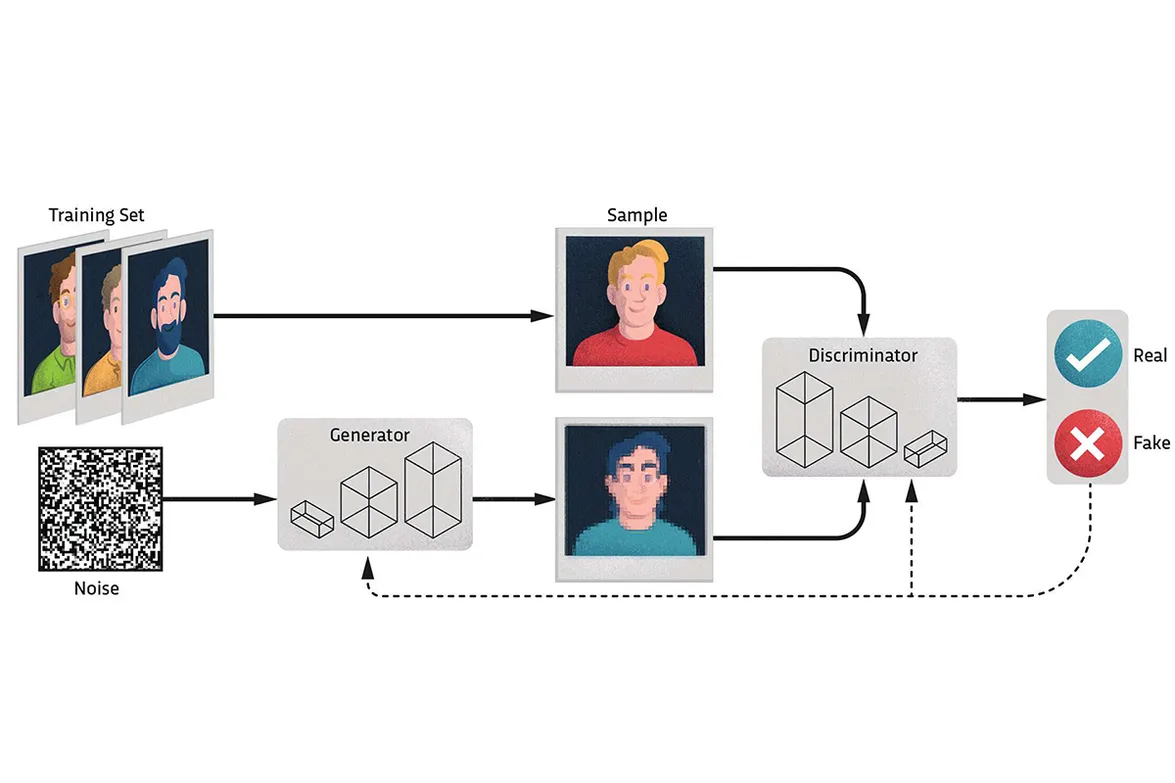
Generative adversarial networks — two networks, a generator and a discriminator, trained in opposition — were the dominant generative architecture from 2014 through roughly 2021. They still have a real role in narrow generative tasks: fast inference, controllable synthetic-data generation, image-to-image translation. But for general-purpose generative work they have largely been displaced by diffusion (for image and video) and transformers (for everything else). A team starting a new generative project in 2026 reaches for a GAN only when the inference budget is too tight for diffusion or the task is narrow enough that the GAN’s instability is manageable.
Convolutional and recurrent architectures are still the right tools for many discriminative jobs — image classification, segmentation, time-series forecasting — but for generative tasks they have been largely displaced.
Training: what a generative neural network actually learns
Training a generative neural network has three high-level steps, regardless of modality.
- Collect a dataset large enough to cover the target distribution. For frontier LLMs this means trillions of tokens; for a domain-specific image generator it might mean a few million labelled or weakly labelled samples.
- Define a self-supervised objective. For text, this is usually next-token prediction. For images under diffusion, it is denoising a noised version of the image. For audio, it is masked prediction or autoregressive waveform prediction. The objective is what teaches the network the structure of the data.
- Optimise at scale using gradient descent — typically AdamW or a variant — on accelerated hardware. Frontier-scale training adds a post-training phase: supervised fine-tuning on instruction data, then reinforcement learning from human feedback (RLHF), constitutional AI methods, and increasingly RL on verifiable rewards (RLVR) for reasoning models.
The quality of the training data sets the ceiling. Clean, well-curated, diverse data produces models that generalise; messy or biased data produces models that memorise the wrong things. This is the most consistently observed pattern in our experience across generative engagements — the dataset work is where the project lives or dies, not the architecture choice.
The compute story is the second constraint. Training a frontier-scale model requires GPU or TPU clusters running for weeks. GPU acceleration is non-optional at this scale: the parallel arithmetic profile of a deep network’s forward and backward pass is exactly what a GPU is built for, and what a CPU is not. For smaller fine-tuning runs and inference, the same hardware logic applies — generative inference, particularly diffusion image generation and LLM serving, is GPU-bound in production.
Where the abstraction actually matters
A product team can build useful applications on the OpenAI, Anthropic, or Google APIs without ever opening up the neural-network abstraction. That is genuinely true, and it is part of what has made generative AI a viable surface for non-ML teams.
But the abstraction starts to matter as soon as the questions get harder. Choosing the right model for a task — when does a smaller model with longer prompting beat a frontier model? Debugging failure modes — why does this prompt drift on long inputs? Fine-tuning effectively — what data shape, what learning rate, how many epochs before catastrophic forgetting? Estimating cost-and-latency trade-offs — what does adding 4k tokens of context actually cost at serving time? Evaluating model output meaningfully — what does it mean for a generative model to be “good”, and how do you build an eval set that catches the failure you care about?
Every one of those questions is easier to answer with a working understanding of how transformers and the surrounding training pipeline operate. The teams we see shipping generative AI reliably are the teams that treat the neural-network layer as inspectable rather than opaque.
Practical applications
The applications follow the architecture map predictably. Vision and synthetic-data workflows lean on diffusion and, for narrow tasks, on GANs. Tools like NVIDIA Omniverse Replicator generate labelled synthetic imagery for downstream computer vision models — useful when collecting real-world images is expensive, dangerous, or privacy-restricted. The architectural division of labour is consistent: a heavy generative model (a diffusion model or GAN) produces the training data; a lighter discriminative model (typically a CNN) runs on the edge device.
Game environments use procedural generation augmented with LLM-driven non-player-character dialogue. Content workflows use text generators for drafting and diffusion models for imagery. Healthcare research uses GANs and diffusion models to generate synthetic medical imagery that supports diagnostic model training without exposing patient data — a pattern documented in Nature Digital Medicine on privacy-preserving synthetic medical data generation.
What unifies these is the same neural network substrate doing different jobs depending on the training objective and the way it is wired into the product.
Challenges that scale with the model
As generative neural networks grow, certain failure surfaces grow with them.
- Data bias. Models inherit the distribution of their training data. Curation discipline and explicit evaluation against under-represented slices are how teams catch this before it ships.
- Interpretability. Deep networks are opaque by default. Mechanistic interpretability and circuit-level analysis are improving, but for most production teams the practical answer is rigorous evaluation rather than internal inspection.
- Content safety and provenance. Realistic generated content can be misused. Watermarking, detection, and content-provenance standards (C2PA) are the emerging mitigations.
- Privacy. Training on real-world data has privacy implications, especially in regulated domains. Anonymisation, differential privacy, and federated training all have a place; none of them is free.
FAQ
What are neural networks and how do they power generative AI?
Neural networks are layered systems of simple mathematical units (neurons) that transform inputs through learned weights. They are ‘the foundation’ of generative AI in the literal sense: every modern generative model — LLMs, diffusion image models, audio models, video models — is built from neural network primitives (attention, feedforward layers, normalisation) stacked into deep architectures. The 2010s ‘deep learning revolution’ was about figuring out how to train very deep neural networks reliably; 2020s generative AI is the consequence.
Which neural network architectures matter most for generative AI in 2026?
The transformer dominates: it is the backbone of every frontier LLM (GPT-5, Claude 4, Gemini 2.5, Llama 4 / 5), most modern image-and-video models (DiT, MM-DiT, Sora-class, Veo-class), and many audio models. Diffusion models (built on transformer or U-Net backbones) dominate image and video generation. State-space models (Mamba, Mamba-2, RWKV) and hybrid transformer-SSM architectures are growing in long-context and on-device settings. Pure convolutional and recurrent architectures have largely been displaced for generative work.
How do you train a neural network for generative tasks?
Three high-level steps: (1) collect a large unlabelled or weakly-labelled dataset matching the target distribution; (2) define a self-supervised objective (next-token prediction for text, denoising for images, masked prediction for audio); (3) train at scale with gradient descent (typically AdamW or variants) on GPU or TPU clusters. Frontier-scale training adds reinforcement learning from human feedback (RLHF), constitutional AI methods, and increasingly RL on verifiable rewards (RLVR) for reasoning models.
Do you need to understand neural networks to use generative AI effectively?
Not to use it; yes to deploy it well. A product team can build useful applications on the OpenAI, Anthropic, or Google APIs without understanding the underlying networks. But to choose the right model for a task, to debug failure modes, to fine-tune effectively, to estimate cost-and-latency trade-offs, and to evaluate model output meaningfully, a working understanding of how neural networks (and specifically transformers) operate is what separates the engineers who ship reliably from those who don’t.
How TechnoLynx can help
We work with teams whose generative AI investments need to land — moving from a working notebook to a system the rest of the business can rely on. That usually involves architecture choices (transformer or diffusion, fine-tune or prompt, on-device or hosted), training-data discipline, evaluation harnesses that catch real failure modes, and GPU-aware deployment. Our work spans research and prototyping, MLOps, optimisation, and custom integration with the production stack a team already runs. If a generative AI project is at the scoping stage and the taxonomy conversation is taking too long, that is exactly the conversation we are good at shortening. That scoping conversation is the front door to our Generative & Agentic AI R&D practice, regardless of which architecture the project eventually lands on.
Sources for the images
Deployment requires three structural decisions: how to version prompts, where to cache embeddings, and whether to fine-tune or retrieve. Peter Bentley, 2023. How do machine learning GANs work? Science Focus
- NVIDIA Developer, 2024. Theory Behind Training with Synthetic Data. Omniverse Replicator
- Oliver Dürr, Beate Sick, and Elvis Murina, 2020. Neural Network Architectures. Medium
- Xpresso AI, 2021. The Difference Between AI Training and Inference. Medium
References
Infrastructure constraints shape every architecture choice once the prototype leaves the notebook. Privacy-Preserving Synthetic Medical Data Generation. Nature Digital Medicine
- Yuval Meir et al., 2023. Shallow architectures for monocular depth estimation. Scientific Reports
- NVIDIA Developer, 2024. Omniverse Replicator Documentation