When we consider the entire universe, our planet, Earth, is just a little speck. And that’s what intrigues us to fuel our efforts toward space exploration. Humans have been curious about outer space since ancient times. But the mid-20th century is when things really kicked off, and the first human-made object journeyed into space. Since then, we’ve come quite far. Space stations, astronauts spending months in outer space, anti-gravity chambers, rovers exploring Martian terrain, and the list of what has become possible goes on.
The challenges, though, are extreme. Vast distances, communication delays measured in minutes or hours, environments that no human can survive without heavy life support, and floods of telemetry that no operations team can read in real time. Decisions often need to happen where humans cannot intervene. That is the gap artificial intelligence is filling — not as a replacement for mission control, but as a layer that lets spacecraft and rovers act sensibly when the next command from Earth is twenty minutes away.
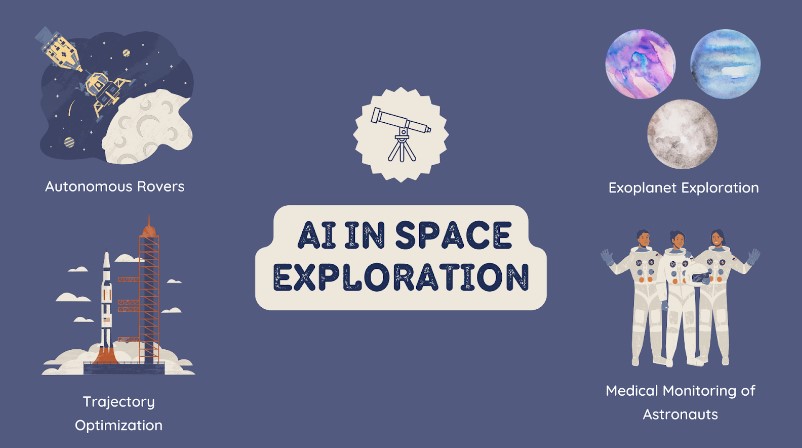
AI is already woven into space operations across several distinct surfaces:
- Mission planning and decision making — schedule optimisation, trajectory refinement, and onboard reprioritisation when conditions change.
- Space debris management — tracking and conjunction analysis to keep satellites and crewed vehicles in safer orbits.
- Autonomous rovers — perception and navigation systems that let surface vehicles traverse terrain without ground-in-the-loop control.
- Exoplanet discovery — classifiers and signal-detection pipelines that sift transit photometry from telescopes like Kepler and TESS.
The market scale reflects how seriously the aerospace sector takes this. Starting from 135.20 billion USD in 2022, the space exploration AI market is expected to grow at an annual rate of 35.6%, with projections reaching around 1798.76 billion USD by 2030 — a market-direction estimate, not an operational benchmark, but a useful signal that the underlying R&D is no longer experimental. The technologies driving that growth are familiar: computer vision, generative AI, IoT and edge computing, and GPU acceleration. Each one plays a specific role in space, and each comes with constraints that ground-based engineers rarely have to think about.
How does computer vision support space missions?
Machines learn to interpret visual information from images and video through the AI subdomain known as computer vision. For space missions, it is the difference between a rover that needs a human in the loop for every metre traversed and one that can pick its own path across hazardous terrain. The Mars Exploration Rover (MER) programme — Spirit and Opportunity, landed in January 2004 and active until 2018 — remains one of the clearest demonstrations of what computer vision in space actually buys you.
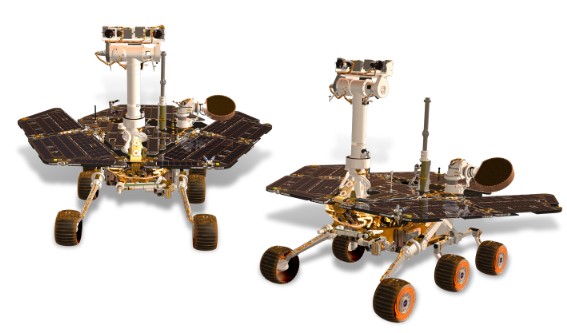
The MER rovers carried a downward-facing monocular descent camera and three stereo camera pairs, including hazard cameras and navigation cameras. The imagers captured 1024 × 1024 grayscale frames (as designed, as reported in the mission specification); the vivid colour photographs the public remembers were composited later, on Earth. From those raw frames, three distinct computer-vision functions ran on the rovers themselves:
| Function | What it does | Why it mattered for MER |
|---|---|---|
| Descent motion estimation | Tracks features on the surface during landing to estimate horizontal velocity | Reduced touchdown risk on uneven terrain |
| Hazard detection | Detects rocks, slopes, and holes in front of the rover | Avoided physical damage during traverses |
| Visual odometry | Computes traversed distance and orientation from stereo image pairs | Gave mission control accurate position estimates for path planning |
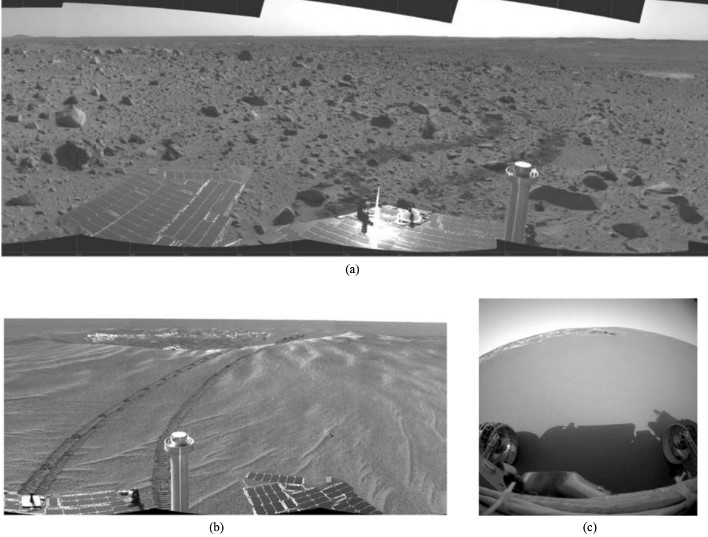
Visual odometry is the one most engineers underestimate. Wheel odometry on loose Martian regolith drifts badly — wheels slip, sometimes by tens of percent. Without a vision-based correction, the rover’s belief about its own position would diverge from reality fast enough to make every plan uploaded from Earth dangerous. Stereo matching plus feature tracking gave the rovers a way to anchor their position in what they actually saw, rather than what their motors thought they had done.
The MER mission ultimately produced evidence of past water activity on Mars — mineralogical signatures and geological formations that argued for a wetter early planet capable of sustaining microbial life. Computer vision did not discover that on its own, but the mission would not have travelled far enough or long enough to find it without onboard perception.
The role of generative AI in space
Generative models that produce new content from learned distributions are now being threaded into space operations from a different angle. Instead of perception, it targets the interface between humans and spacecraft. NASA is developing a ChatGPT-style AI assistant intended to let astronauts talk to their vehicles conversationally. The assistant may form part of the Artemis programme’s Lunar Gateway space station.
The project, led by Dr. Larissa Suzuki, frames the long-term goal in unusually direct terms:
“The idea is to get to a point where we have conversational interactions with space vehicles and they [are] also talking back to us on alerts, interesting findings they see in the solar system and beyond. It’s really not like science fiction anymore.”

The feature set NASA has discussed publicly clusters around four capabilities:
- Conversational interaction — astronauts query the spacecraft in natural language instead of paging through technical manuals.
- Alerts and discovery updates — the system surfaces interesting observations proactively rather than waiting to be asked.
- Interplanetary communication network — an AI layer that detects and, where possible, repairs communication faults across long-distance links.
- Natural-language interface to experiments — astronauts can run procedures by describing what they want rather than executing scripted commands.
The technical substrate is almost certainly a large language model adapted to mission-specific data. That implies the same hard constraints we see in any serious LLM deployment: compute budget, latency, hallucination risk, and the question of where the model actually runs. Suzuki has been candid about the last point — moving large machine-learning workloads off-planet is genuinely difficult, because the computational resources available on a spacecraft are nowhere near what a ground data centre provides. That is precisely the gap that edge computing tries to close.
IoT and edge computing: a new frontier in space exploration
Processing location shifts from cloud to edge when IoT and distributed computing enter the picture. The internet of things connects sensors and devices so they can collect and exchange data; edge computing pushes the analysis to the device itself instead of round-tripping every byte to a distant server. In space, the latency argument writes itself. A temperature reading from the Moon can take 5–20 minutes to reach Earth, and high-resolution images take longer. By the time a decision propagates back, the moment is gone.
Pushing inference to the edge — on the satellite, on the rover, on the descent stage — collapses that loop. The decision is made where the data is generated, and only the result needs to travel.
KaleidEO Space Systems, a Bengaluru-based startup, became the first Indian company to demonstrate edge computing in space. Working with hardware support from Spiral Blue, KaleidEO ran deep-learning workloads directly on a satellite to perform cloud detection, road-network mapping, and change detection on captured imagery. The reported numbers are worth reading carefully:
- Processing efficiency: an 80-fold improvement reported by the company — a single-project measurement, not a benchmarked rate across vendors.
- Data-volume reduction: 99% less data sent to ground, because filtered, classified outputs replace raw frames.
- Roadmap: four further satellites equipped with edge computing planned by 2025.
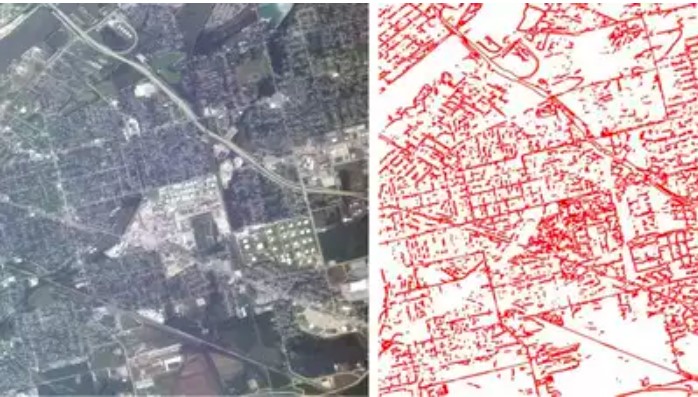
The pattern generalises. Earth-observation constellations produce far more raw imagery than their downlinks can carry; choosing what to send is itself an AI problem, and one that has to be solved on-orbit. Combined with GPU acceleration and modern inference runtimes — TensorRT, ONNX Runtime, and similar stacks adapted for radiation-tolerant hardware — the practical effect is more autonomous, more responsive, and considerably more data-efficient missions.
For a closer look at how these patterns translate into atmospheric flight, see our companion piece on propelling aviation to new heights with AI.
Understanding GPU acceleration in space exploration
GPU-accelerated clusters provide the computational horsepower that makes large-scale space data analysis tractable. GPUs let scientists work through massive datasets from space telescopes and probes in timescales that match operational needs rather than research timescales. The same parallelism that trains computer-vision models on the ground also lets rovers run inference on stereo images at navigation rates.
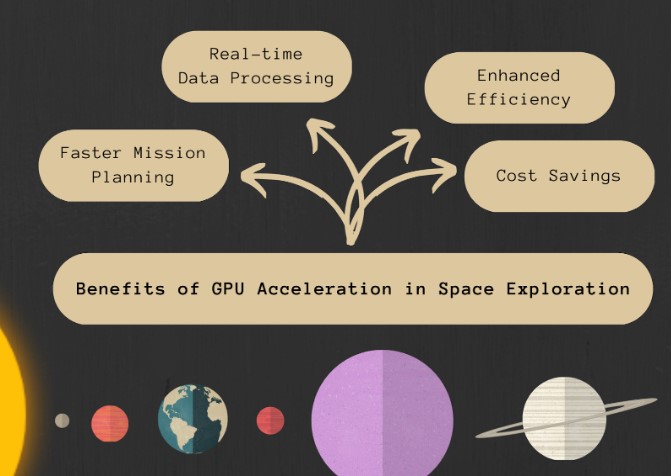
Space environments, though, do not treat GPUs kindly. Three constraints dominate the design conversation:
- Radiation. Galactic cosmic rays and solar events cause single-event upsets and, eventually, cumulative damage. Operational missions use radiation-hardened or at least radiation-tolerant variants of consumer silicon, often at a generation or two behind the commercial state of the art.
- Thermal management. GPUs dissipate substantial heat, and in vacuum the only sink is radiation. Thermal design — heat pipes, radiator plates, duty-cycling — becomes part of the inference architecture rather than a separate concern.
- Power budget. A spacecraft’s total power is fixed by its solar arrays or RTG. Every watt drawn by the GPU is a watt not available to instruments or propulsion, which forces aggressive optimisation of model size, precision, and scheduling.
When those constraints are respected, GPU acceleration meaningfully expands what a mission can do without expanding what it has to send home. That is the through-line for almost every AI innovation in space: more decisions made locally, less raw data shipped back, more science extracted per kilogram of payload.
What we can offer as TechnoLynx
At TechnoLynx, we help businesses solve hard engineering problems through tailored research and development. We work with high-tech startups and SMEs to advance their technology and intellectual property across the full R&D arc — prototyping, development, optimisation, and integration into production systems.
Our expertise spans computer vision, generative AI, IoT and edge computing, and high-performance computing on GPU. We see the same patterns described in this article — perception under constrained compute, language interfaces over technical systems, edge inference under latency pressure — in domains far less exotic than aerospace, and we bring that cross-domain perspective to every engagement. If you are working on something where these capabilities matter, reach out to TechnoLynx.
Conclusion
Space exploration is one of the clearest test cases for what AI is actually for. The distances are too great, the latencies too long, and the data volumes too large for human-in-the-loop control to scale. Computer vision lets rovers navigate without ground guidance. Generative AI is starting to give astronauts a natural interface to systems that used to require thick manuals. IoT and edge computing keep decisions close to where the data is born. GPU acceleration makes all of it run within the power, thermal, and radiation envelopes that space hardware imposes.
None of this removes the need for ground teams or careful mission design. What it does is push the boundary of what a single mission can attempt — and that boundary is now moving fast enough to be worth paying attention to. If you are looking for customised AI solutions to solve your own engineering problems, feel free to reach us at TechnoLynx.
Frequently Asked Questions
How is AI used in space exploration today?
AI is used across mission planning, autonomous rover navigation, space-debris tracking, and exoplanet discovery. The most mature deployments are computer-vision systems on surface rovers and machine-learning pipelines for telescope data analysis.
Why is computer vision important for Mars rovers?
Wheel odometry drifts badly on loose Martian regolith, and the round-trip light delay to Earth makes real-time teleoperation impossible. Computer vision gives rovers descent motion estimation, hazard detection, and visual odometry so they can navigate safely between uplinks from mission control.
What role does edge computing play in space missions?
Edge computing moves inference onto the spacecraft itself, eliminating the multi-minute downlink-uplink round trip for decisions that need to happen now. KaleidEO Space Systems reported a 99% reduction in data volume sent to ground after moving cloud detection and change detection on-orbit, as reported in KaleidEO’s published results.
Why is GPU acceleration constrained in space?
Three pressures dominate: radiation causes single-event upsets and cumulative damage, vacuum makes thermal dissipation harder, and a spacecraft’s power budget is fixed. Mission-grade GPUs are radiation-tolerant variants typically a generation or two behind commercial state of the art, and models are optimised aggressively for size, precision, and duty cycle.
Sources for the images
- Devlin, H. et al. (2023, June 24). ‘It’s not like science fiction any more’: Nasa aiming to make spaceships talk. The Guardian.
- NASA’s Jet Propulsion Laboratory. (n.d.). Mars Exploration Rovers Overview.
- Matthies, L. (2007). Computer Vision on Mars. Carnegie Mellon University, The Robotics Institute.
- Times of India. (2023, September 12). Bengaluru firm becomes first Indian Co to demonstrate edge computing in Space.