
Introduction
Notebook success without production deployment signals precisely when MLOps architecture becomes non-negotiable. The contribution MLOps makes is specific and bounded: it turns the notebook artifact into a production-serving system by adding CI/CD for models, monitoring for production behaviour, retraining triggered by data signals, and a registry that knows which model version is serving which traffic. Stripped to essentials, MLOps is the engineering practice that lets the second model deployment cost less than the first — without it, every deployment is a custom project; with it, deployment becomes a workflow. See services for the broader engagement framing this applied example lives inside.
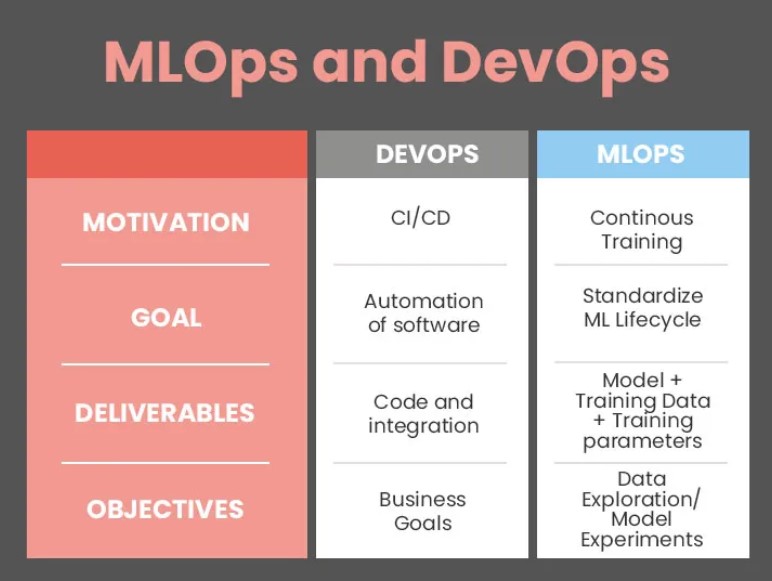
The naive read is that MLOps is “DevOps with extra tools.” The expert read is that MLOps adds a small number of model-specific concerns (drift, retraining, data-pipeline reproducibility, model-registry lineage) to the existing DevOps practice — and that the contribution to AI application development is decisive precisely because those few additions are what make the difference between a notebook and a production system.
What this means in practice
- MLOps’ contribution is not “more tools” — it is the workflow that turns a notebook into a serving system.
- The smallest viable stack matters more than the comprehensive one; comprehensive stacks rarely ship.
- Drift, retraining, and rollback are the model-specific additions; the rest is DevOps practice applied to model artifacts.
- The second deployment getting cheaper than the first is the metric that says the MLOps investment worked.
What does MLOps actually mean for an organisation that has never operationalised a model?
Workflow systems must connect isolated data science environments to production infrastructure, then sustain model performance across operational lifecycles for organizations starting fresh. The minimum scope: a way to package the model and its dependencies reproducibly, a deployment target (container orchestration, serverless inference, or managed model-serving), a monitoring stack that watches at minimum input distributions and output predictions, and a retraining trigger when something material changes. Everything else (feature stores, lineage graphs, comprehensive experiment tracking, automated promotion) is value-add that the second or third deployment may justify but the first one rarely does.
The contribution to the AI application: without MLOps the application that depends on the model either does not exist (the model is in a notebook), or exists fragilely (the model is deployed by a one-time engineering effort that no team owns). With MLOps the application has a model-serving contract that the platform fulfils — the application team consumes predictions through an interface, the model team maintains the model behind the interface, and the two roles can ship independently.
Which MLOps capabilities (CI/CD for models, monitoring, retraining, registry) does a first project genuinely need, and which are overengineering?
Four specific capabilities define the minimum bar for first projects. Container packaging that includes the model, its preprocessing code, and its runtime dependencies. A deployment pipeline that takes a packaged container and serves it behind a stable interface (the application can call the model without knowing which version is serving). Monitoring that captures at minimum request latency, error rates, input feature distributions, and output prediction distributions — enough to detect that something has changed even if not enough to diagnose what. A simple model registry — a place where each version of the deployed model lives with the metadata required to roll back to it.
Overengineering for the first project: full feature stores (the first project typically has a small number of features the data team can manage without infrastructure), comprehensive experiment-tracking platforms (a spreadsheet plus model-card metadata suffices until the team has many models), automated retraining pipelines (manual retraining with a documented trigger condition serves the first project), policy-driven model promotion across environments (a single production target with a manual promote step works at first). The pattern: ship the smallest capability set that lets you deploy and detect failure, add capability when the missing piece blocks a specific second or third deployment.
Which MLOps tools and frameworks are realistic for a first deployment, and which assume mature data engineering already in place?
Deployment realities have shifted for 2026 timelines. For container packaging: Docker, with the model packaged via standard Python or framework conventions. For deployment: cloud-native model serving (SageMaker, Vertex AI, Azure ML) for teams already on a cloud, or self-hosted (BentoML, KServe, TorchServe) for teams that want the inference layer in their stack. For monitoring: cloud-native observability for the operational metrics; lightweight drift-detection libraries (Evidently, NannyML, Whylogs) for the model-specific metrics. For registry: the model registry built into the chosen platform (MLflow, SageMaker Model Registry, Vertex Model Registry, W&B Models).
Assume mature data engineering already in place. Full feature stores (Tecton, Feast at scale) require a data infrastructure team and a data warehouse practice the first project usually does not have. Comprehensive lineage and governance platforms (Collibra, Alation, Atlan) assume an enterprise data governance posture. Production-grade event-driven retraining (Airflow with custom operators, Kubeflow Pipelines) assumes operations capacity to maintain workflow infrastructure beyond the model. The realistic first-deployment stack avoids these and adds them only when the deployments earn the right to the complexity.
What is the smallest viable MLOps stack that still produces a production-quality deployment?
By 2026, viable stacks shed every non-essential component. One container registry holding versioned model containers. One serving target (managed cloud serving or one Kubernetes cluster with a serving framework). One observability stack capturing operational metrics (latency, error rate, throughput) plus model metrics (input feature distributions, output prediction distributions). One model registry pointing at the currently-serving container and at recent prior versions for rollback. One CI/CD pipeline that builds the container from a committed model artifact, runs evaluation against a frozen test set, and promotes to serving on pass.
This stack is production-quality not because it has every feature but because the deployment is reproducible, the rollback is fast, and the failure is detectable. A team running this stack can ship a model deployment, detect when its performance changes, roll back if needed, and retrain when justified. That is the production-quality bar; everything beyond it is incremental improvement that should be justified per addition rather than adopted upfront.
How does MLOps differ from DevOps in the data-pipeline, drift, and rollback dimensions?
Where DevOps enforces application-owned input contracts, MLOps must track distributional properties established during training—properties that shift regardless of application versioning. The pipeline matters in MLOps because reproducing a deployment requires reproducing the data the model was trained on, not just the code. Drift dimension: DevOps’ “the application works the same way it did yesterday” assumption fails for models — the same model running on the same code can produce different effective behaviour because the input distribution shifted; MLOps must detect this where DevOps does not.
Rollback dimension: DevOps rollback is “deploy the previous container”; MLOps rollback can require “deploy the previous container plus the previous data version” because the model’s behaviour depends on what it was trained on, and inference behaviour shifts as the feature pipeline evolves. The model-specific overlay is small in surface but high in consequence — these three differences are what make MLOps an extension of DevOps rather than a synonym for it. Teams that conflate the two ship a DevOps practice that handles model deployments badly until the first drift incident teaches them the difference.
Why do most ML models never reach production, and which MLOps gaps cause that?
Production evasion follows predictable patterns rooted in a few technical and organizational obstacles. The deployment target was never defined — the model was built before the team decided where it would run, and “we’ll figure it out” did not converge. The model’s input contract does not match any data the application reliably has at inference time — the training data was assembled by a data scientist offline; the production data path either does not produce those features or produces them with unacceptable latency. The model’s output is not actionable for the application — the prediction format does not fit the consuming workflow, and changing it would require retraining.
The MLOps gaps that cause this: no upfront deployment-target decision (the team builds the model, then discovers no place is ready to run it), no input-contract validation (the model is trained on data that production cannot supply at inference time), no output-contract design (the model returns what is convenient for the data scientist, not what the application can consume). The pattern: the gap is at the boundary between the model team and the application team; MLOps’ contribution is the boundary discipline that surfaces these gaps before the model is trained, not after. The first MLOps deployment in an organisation is mostly about establishing this boundary; the second one ships faster because the boundary now exists.
Limitations that remained
Constraints define the perimeter of first MLOps deployments. Monitoring covers operational signals and input/output distributions well, but root-cause diagnosis when something drifts still requires manual investigation; full diagnostic monitoring is later-stage work. Retraining is event-triggered manually for most first projects; automated retraining pipelines arrive when the cadence justifies the engineering investment. Multi-model serving with version routing is rarely worth building for the first deployment; a single serving path with explicit rollback is enough until multiple model versions need to coexist.
Documentation and reproducibility for compliance contexts often lag the first deployment — the team ships the model and circles back to formalise the model card, the data lineage, and the audit trail. Teams in regulated industries should plan the documentation work upfront. The pattern with limitations: ship the production deployment, fix the limits as they bite, resist the temptation to build the comprehensive platform before the first model proves the contribution.
Organisations deploying MLOps need three delivery pillars
TechnoLynx designs resilient deployment pipelines with engineering teams, embedding contract versioning, automated gates, and interface protocols that prevent model iteration from destabilizing live applications. If your team has models that should be in production and wants a deployment scoped to ship rather than overbuild, contact us.
Image credits: Freepik