
Introduction to MLOps

What MLOps is, why organisations fail to move models from training to production, and the tooling and processes that close the gap between experimentation and deployed systems.

Introduction to MLOps
Written by TechnoLynx Published on 04 Apr 2024

Introduction

Often, integrating AI into a solution isn’t a one-shot situation where you just hit ‘run’ and never look back. Realistically, AI models require maintenance and upkeep. That’s where the term MLOps enters the picture. MLOps, or Machine Learning Operations, is a set of practices that helps streamline the process of maintaining and deploying models. From keeping track of different versions of the models and ensuring they work well to managing the systems running the models, MLOps takes care of it all.

MLOps helps businesses extract maximum value from their AI and machine learning investments by ensuring continuous model performance and efficient updates. According to Business Research Insights, the MLOps market will be valued at over $9 billion by 2029. MLOps began as a way to better handle certain ML-related tasks, but over time, it has become its own way of managing machine learning projects.

An infographic on the market value of MLOPs. | Source: Business Research Insights

While MLOps is still relatively new, the AI community is doing a lot of work on this subject. One result is abundant new tools and techniques to help companies use MLOps effectively. We’ll take a deep dive and explore this and more. Let’s get started!

Understanding MLOps

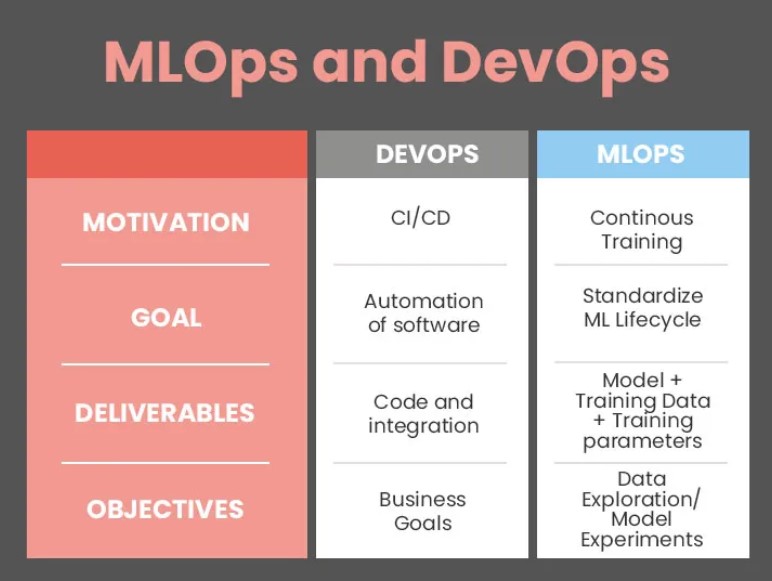
If MLOps sounds familiar, you might be thinking of DevOps, a similar paradigm that’s been around since 2007. While MLOps borrows many principles of DevOps, it also addresses unique challenges specific to machine learning systems.

DevOps focuses on simplifying the software development lifecycle while bringing a rapid and continuously iterative approach to applications. MLOps uses the same principles to take machine learning models to production. In both cases, the outcome is higher software quality, faster patching and releases, and higher customer satisfaction.

A side-by-side comparison of MLOps and DevOps. | Source: Testhouse Blog

Key Components of MLOps

A few key components shape MLOps: data management, model development, model deployment, and monitoring and maintenance. Data management involves handling data from collection to cleaning and organising it for model training and evaluation. It also includes keeping track of different versions of the data.

Model development involves testing different machine learning algorithms and adjusting parameters to find the best one. MLOps tools can help you keep track of these tests and make it easy to repeat them if necessary.

Once a model is ready to use, it can be deployed. It’s also important to ensure the model can work in different production environments, such as the cloud or on devices. Containers are often used to make it easier to move the model around.

Finally, monitoring and maintenance can keep an eye on how well the model is working in the real world. Changes in the data might affect the model’s performance can be identified. Subsequently, updating the model becomes necessary to keep it working well over time. These key components form the basis of the MLOps lifecycle.
Read more: Why AI Performance Changes Over Time

The MLOps LifeCycle

The MLOps lifecycle involves a series of stages and often forms an iterative loop. These stages are as follows:

The MLOps LifeCycle | Source: Fiddler AI Blogs

Problem Definition

The first step in the MLOps life cycle is clearly defining the business problem and the expected outcomes. The clearer the requirements, the easier it is to make the MLOps lifecycle support your business goals.

Data Collection and Processing

Then, data is collected for model training. Data might come from the product, such as user behaviour data, or from an external dataset. Typically, a data warehouse or data lake stores the collected data. To consolidate and clean the data, it is processed in batches or as a stream, depending on the company’s requirements and available tools.

Metrics Definition

Deciding on the right metrics is crucial. It’s about agreeing on how to measure if the model does what it’s supposed to do, and how well it does it. These metrics help everyone stay on target and make sure the final model adds real value to the business.

Data Exploration

This stage is where data scientists get to know the ins and outs of the data. They look for patterns, spot any oddities, and start thinking about what methods might work best for modeling. Groundwork about the data helps make informed decisions down the line.

Feature Extraction and Engineering

Feature extraction and engineering involve identifying and preparing the parts of the data that will serve as inputs to the model.

An example of feature extraction. | Source: Educative.

Data scientists determine which features are relevant, and engineers ensure these features can be consistently updated with new data. It’s a team effort to ensure the model has the best information to learn from.

Model Training and Offline Evaluation

In this phase, models are built and trained using most of the collected and processed data. They are then evaluated to select the best-performing approach. Offline evaluation helps fine-tune model parameters and ensure that the selected model can generalise well to new, unseen data.

Model Integration and Deployment

Once a model is validated and ready, it’s integrated into the product. Deployment usually occurs within a cloud infrastructure, such as AWS, enabling scalable and efficient model operation. This stage marks the transition of the model from development to real-world application, where it begins to deliver business value.

Model Release and Monitoring

After the model goes live, the work isn’t over. It must be watched closely to catch any hiccups or changes in performance over time. Ongoing vigilance helps in figuring out when the model needs a tune-up or a major update.

The lifecycle doesn’t end with monitoring. Insights gained from ongoing monitoring and the model’s operational performance often lead to new questions, adjustments in the model, or even revisiting the problem definition. This feedback loop is what makes the MLOps lifecycle iterative.

Now that we’ve understood how MLOps works and its key components, let’s explore the benefits of using MLOps.

Benefits of MLOps

Using MLOps offers many benefits to organisations working with machine learning and AI technologies. One major advantage is the faster deployment of machine learning models. MLOps automates testing, validation, packaging, and integration, reducing the time required to transition models from the lab to production environments. Another benefit is improved collaboration between data scientists and operations teams. By creating a collaborative environment, these teams can work together more smoothly, breaking down silos and reducing friction, which leads to more efficient project execution.

A collaborative environment is key. | Source: Envato Elements

Adding testing, monitoring, and feedback loops throughout the machine learning lifecycle improves model quality and reliability. MLOps streamlines the early detection and correction of performance issues so that only the most robust and dependable models are put into production. Also, MLOps makes it possible to scale and maintain machine learning systems. It provides the necessary infrastructure and processes to manage growth in dataset sizes and model complexity.

Challenges in Implementing MLOps

Despite the many benefits MLOps offers, implementing MLOps brings its own set of challenges. For starters, integrating MLOps into existing workflows can be tricky. Many companies already have their ways of doing things, and fitting MLOps into the mix means figuring out how to deal with old legacy systems and making sure everything works together smoothly.

Another hurdle is model security and compliance. In regulated industries where data misuse and attacks are major concerns, this hurdle is crucial to get over. Plus, the successful adoption of MLOps requires a special blend of skills across software engineering, data science, and operations, which isn’t always easy to find.

Best Practices to Overcome Challenges

Through trial and error, the AI community has come up with best practices for overcoming these challenges.

Here are some effective strategies:

  • Encourage Team Collaboration - Encourage open communication across all teams involved. Regular meetings and clear documentation can keep everyone on the same page.
  • Streamline with Automation - Use automation to handle repetitive tasks, reducing errors and freeing time for strategic work.
An example of an automated ML model development life cycle. | Source: Solita Data Blog
  • Implement Continuous Monitoring - Keep an eye on your models after deployment to quickly catch and fix any issues.
  • Stay Agile and Flexible - Adapt to the fast-paced nature of tech by staying flexible and ready to pivot as needed. Your models need to remain effective and relevant.

Tools and Technologies in MLOps

To successfully use MLOps, you can rely on specialised tools and technologies that assist with various stages of machine learning. Popular platforms like Amazon SageMaker and Google Cloud Vertex AI can manage the machine-learning process. Tools such as MLflow and Weights & Biases help track experiments and manage models, while DVC and Pachyderm are used for data versioning. Tools like Kubeflow and Seldon are utilised for deploying and serving models. Airflow and Prefect can manage complex ML workflows.

Popular MLOps Tools | Source: NimbleBox Blog

Choosing the right tools is crucial and depends on several factors, such as your organisation’s ML experience, cloud preferences, and existing tech stack. Avoiding tools that lock you into a single ecosystem and choosing flexible solutions instead is important. Integrating MLOps tools with your continuous integration and continuous delivery/continuous deployment (CI/CD) systems can automate testing and deployment processes. Starting with small projects and gradually introducing new tools is a good idea to avoid overwhelming your team.

Applications of MLOps

Here are some case studies of where MLOps are being applied.

Netflix

Netflix is a pioneer in the digital streaming industry. Netflix has led the way in using machine learning for personalised content suggestions. They use MLOps practices like automated model training, testing, and deployment pipelines to handle the complexity of their recommendation systems. They improved their recommendation algorithms consistently and offered customers a personalised viewing experience.

An image of Netflix recommendations. | Source: Medium - The Startup

Uber

Uber is a global leader in ride-sharing and logistics. Uber created Michelangelo, an internal MLOps platform, to simplify how it deploys and manages machine learning models across its services. Michelangelo offers a single interface for data scientists to train, test, and deploy models, as well as monitor and update them easily. This platform has sped up Uber’s process of implementing new machine-learning models.

The Uber app interface. | Source: Uber Blog

DoorDash

DoorDash is a leading food delivery service that uses MLOps to manage machine learning systems that optimise logistics operations, including order dispatching, delivery routing, and demand forecasting. Adopting MLOps has helped DoorDash to rapidly iterate and improve its ML models, delivering superior service to both customers and merchants.

The DoorDash app interface. | Source: The Wall Street Journal

The Future of MLOps

Several key trends are shaping the future of MLOps. One such trend is automation. Automated MLOps pipelines that can automate tasks like data preprocessing, model training, and deployment can simplify the entire machine learning workflow by reducing manual effort and speeding up the model deployment process.

Another trend is the mounting interest in edge computing. Edge computing can process data closer to its source. MLOps that support machine learning deployments at the edge by optimising model size and complexity are gaining traction.

As machine learning becomes more deeply embedded in both business and societal systems, these models must be used responsibly. MLOps is adapting by incorporating tools and processes that monitor models for fairness, transparency, and compliance with legal standards.

The future will focus on making models more efficient or easier to deploy while making them ethically sound and trustworthy. If this sounds like something you are interested in, we at TechnoLynx can help you incorporate MLOps into your solutions.

What We Can Offer as TechnoLynx

At TechnoLynx, we excel at building custom AI solutions for high-tech startups and SMEs. As a leading software research and development consulting company, we strive to solve your unique business challenges with the help of AI. Our expertise includes cutting-edge technologies like computer vision, GPU acceleration, generative AI, and IoT edge computing.

We also have extensive experience integrating Machine Learning Operations (MLOps) practices into our projects. We use MLOps to ensure AI models in our solutions are deployed, monitored and managed at scale.

Our approach is firmly rooted in ensuring legal compliance and advocating for developing safe, sustainable AI systems that stand the test of time and adhere to ethical standards. If you are looking for solutions that push the limits of AI, we can step in and help you out. Feel free to reach out and contact us.

Conclusion

MLOps provides a framework for successfully scaling machine learning initiatives from experimentation to real-world impact. By fostering collaboration, streamlining workflows, and emphasising monitoring and maintenance, MLOps helps models deliver continuous value in production environments.

In the increasingly competitive market of AI-driven businesses, MLOps is definitely a value add-on. The challenges of implementing MLOps are outweighed by the long-term benefits it provides.

By investing in the right tools, processes, and people, organisations can establish a robust MLOps foundation that drives innovation and creates tangible business value. Whether you are beginning your ML journey or loo

Sources for images:

References:

Planning GPU Memory for Deep Learning Training

Planning GPU Memory for Deep Learning Training

16/02/2026

GPU memory estimation for deep learning: calculating weight, activation, and gradient buffers so you can predict whether a training run fits before it crashes.

CUDA AI for the Era of AI Reasoning

CUDA AI for the Era of AI Reasoning

11/02/2026

How CUDA underpins AI inference: kernel execution, memory hierarchy, and the software decisions that determine whether a model uses the GPU efficiently or wastes it.

Deep Learning Models for Accurate Object Size Classification

Deep Learning Models for Accurate Object Size Classification

27/01/2026

A clear and practical guide to deep learning models for object size classification, covering feature extraction, model architectures, detection pipelines, and real‑world considerations.

GPU vs TPU vs CPU: Performance and Efficiency Explained

GPU vs TPU vs CPU: Performance and Efficiency Explained

10/01/2026

CPU, GPU, and TPU compared for AI workloads: architecture differences, energy trade-offs, practical pros and cons, and a decision framework for choosing the right accelerator.

AI and Data Analytics in Pharma Innovation

AI and Data Analytics in Pharma Innovation

15/12/2025

Machine learning in pharma: applying biomarker analysis, adverse event prediction, and data pipelines to regulated pharmaceutical research and development workflows.

Case Study: CloudRF  Signal Propagation and Tower Optimisation

Case Study: CloudRF  Signal Propagation and Tower Optimisation

15/05/2025

See how TechnoLynx helped CloudRF speed up signal propagation and tower placement simulations with GPU acceleration, custom algorithms, and cross-platform support. Faster, smarter radio frequency planning made simple.

Smarter and More Accurate AI: Why Businesses Turn to HITL

Smarter and More Accurate AI: Why Businesses Turn to HITL

27/03/2025

Human-in-the-loop AI: how to design review queues that maintain throughput while keeping humans in control of low-confidence and edge-case decisions.

Optimising LLMOps: Improvement Beyond Limits!

Optimising LLMOps: Improvement Beyond Limits!

2/01/2025

LLMOps optimisation: profiling throughput and latency bottlenecks in LLM serving systems and the infrastructure decisions that determine sustainable performance under load.

MLOps for Hospitals - Staff Tracking (Part 2)

MLOps for Hospitals - Staff Tracking (Part 2)

9/12/2024

Hospital staff tracking system, Part 2: training the computer vision model, containerising for deployment, setting inference latency targets, and configuring production monitoring.

MLOps for Hospitals - Building a Robust Staff Tracking System (Part 1)

MLOps for Hospitals - Building a Robust Staff Tracking System (Part 1)

2/12/2024

Building a hospital staff tracking system with computer vision, Part 1: sensor setup, data collection pipeline, and the MLOps environment for training and iteration.

MLOps vs LLMOps: Let’s simplify things

MLOps vs LLMOps: Let’s simplify things

25/11/2024

MLOps and LLMOps compared: why LLM deployment requires different tooling for prompt management, evaluation pipelines, and model drift than classical ML workflows.

Streamlining Sorting and Counting Processes with AI

Streamlining Sorting and Counting Processes with AI

19/11/2024

Learn how AI aids in sorting and counting with applications in various industries. Get hands-on with code examples for sorting and counting apples based on size and ripeness using instance segmentation and YOLO-World object detection.

Maximising Efficiency with AI Acceleration

21/10/2024

Find out how AI acceleration is transforming industries. Learn about the benefits of software and hardware accelerators and the importance of GPUs, TPUs, FPGAs, and ASICs.

How to use GPU Programming in Machine Learning?

9/07/2024

Learn how to implement and optimise machine learning models using NVIDIA GPUs, CUDA programming, and more. Find out how TechnoLynx can help you adopt this technology effectively.

AI in Pharmaceutics: Automating Meds

28/06/2024

Artificial intelligence is without a doubt a big deal when included in our arsenal in many branches and fields of life sciences, such as neurology, psychology, and diagnostics and screening. In this article, we will see how AI can also be beneficial in the field of pharmaceutics for both pharmacists and consumers. If you want to find out more, keep reading!

Exploring Diffusion Networks

10/06/2024

Diffusion networks explained: the forward noising process, the learned reverse pass, and how these models are trained and used for image generation.

Retrieval Augmented Generation (RAG): Examples and Guidance

23/04/2024

Learn about Retrieval Augmented Generation (RAG), a powerful approach in natural language processing that combines information retrieval and generative AI.

A Gentle Introduction to CoreMLtools

18/04/2024

CoreML and coremltools explained: how to convert trained models to Apple's on-device format and deploy computer vision models in iOS and macOS applications.

Case-Study: Text-to-Speech Inference Optimisation on Edge (Under NDA)

12/03/2024

See how our team applied a case study approach to build a real-time Kazakh text-to-speech solution using ONNX, deep learning, and different optimisation methods.

Case-Study: V-Nova - GPU Porting from OpenCL to Metal

15/12/2023

Case study on moving a GPU application from OpenCL to Metal for our client V-Nova. Boosts performance, adds support for real-time apps, VR, and machine learning on Apple M1/M2 chips.

Case-Study: Action Recognition for Security (Under NDA)

11/01/2023

See how TechnoLynx used AI-powered action recognition to improve video analysis and automate complex tasks. Learn how smart solutions can boost efficiency and accuracy in real-world applications.

Case-Study: V-Nova - Metal-Based Pixel Processing for Video Decoder

15/12/2022

TechnoLynx improved V-Nova’s video decoder with GPU-based pixel processing, Metal shaders, and efficient image handling for high-quality colour images across Apple devices.

Consulting: AI for Personal Training Case Study - Kineon

2/11/2022

TechnoLynx partnered with Kineon to design an AI-powered personal training concept, combining biosensors, machine learning, and personalised workouts to support fitness goals and personal training certification paths.

Case-Study: A Generative Approach to Anomaly Detection (Under NDA)

22/05/2022

See how we successfully compeleted this project using Anomaly Detection!

Case Study: Accelerating Cryptocurrency Mining (Under NDA)

29/12/2020

Our client had a vision to analyse and engage with the most disruptive ideas in the crypto-currency domain. Read more to see our solution for this mission!

Case Study - AI-Generated Dental Simulation

10/11/2020

Our client, Tasty Tech, was an organically growing start-up with a first-generation product in the dental space, and their product-market fit was validated. Read more.

Case Study - Fraud Detector Audit (Under NDA)

17/09/2020

Discover how a robust fraud detection system combines traditional methods with advanced machine learning to detect various forms of fraud!

Case Study - Embedded Video Coding on GPU (Under NDA)

15/04/2020

TechnoLynx developed a customised embedded video coding solution using GPU optimisation, dedicated graphics cards, and discrete GPUs to enhance video compression efficiency, performance, and integration within the client’s pipeline.

Case Study - Accelerating Physics -Simulation Using GPUs (Under NDA)

23/01/2020

TechnoLynx used GPU acceleration to improve physics simulations for an SME, leveraging dedicated graphics cards, advanced algorithms, and real-time processing to deliver high-performance solutions, opening up new applications and future development potential.

Back See Blogs
arrow icon