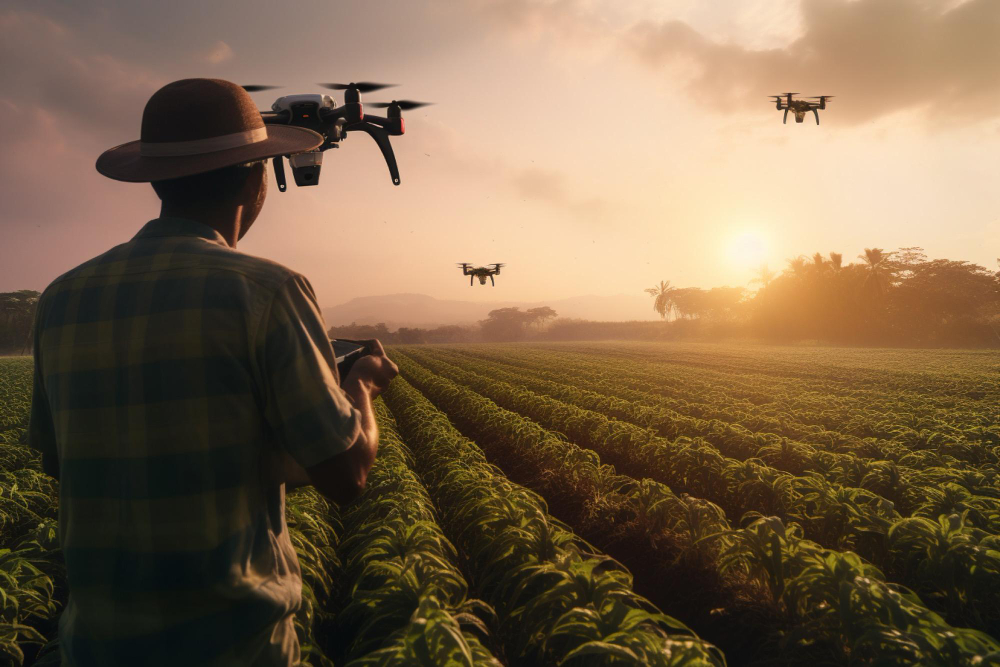
Introduction
Agriculture benefits from computer vision because it converts visual data into structured signals—exactly the same architectural advantage it delivers in retail, manufacturing, and security. But the underlying CV pipeline — detection, alignment, embedding, matching — is the same whether you’re recognising a face at a building entrance or a diseased leaf on a row crop. This article uses the facial-recognition pipeline as the canonical example because it’s the most precisely engineered CV pipeline in production; agriculture and other CV applications inherit the same architectural choices. See the computer vision landing for the broader programme.
The corrected approach is pipeline-decomposition-first: understand the four stages and choose components per stage, rather than treating CV as a monolithic model.
What this means in practice
- The CV pipeline decomposes into detection, alignment, embedding, matching stages.
- MTCNN-class detectors largely replaced Haar cascades; trade-offs are nuanced.
- Facial recognition sits inside the broader CV taxonomy; sibling tasks share architecture.
- Deployment choices (cloud, on-device, edge) drive architectural trade-offs.
How does the facial recognition pipeline decompose — detection, alignment, embedding, matching?
The four-stage pipeline:
Stage 1 — Detection. Find regions in the image containing the object of interest (face, leaf, defect, vehicle). Output: bounding boxes with confidence. Common methods: MTCNN, RetinaFace, YOLO-family, RT-DETR. Choose based on latency, accuracy, training data.
Stage 2 — Alignment. Normalise the detected region to a canonical pose for downstream processing. Output: aligned image patch. For faces: detect keypoints (eyes, nose, mouth), warp to canonical pose. For other objects: keypoint detection, segmentation, or skip if pose-invariant downstream embedding.
Stage 3 — Embedding. Convert the aligned region into a fixed-size vector that captures identity (or content, attribute, class). Output: dense vector, typically 128-2048 dimensions. Common methods: deep embedding networks (FaceNet-style, ArcFace), foundation-model embeddings (DINOv2, CLIP).
Stage 4 — Matching. Compare embeddings to a gallery to find nearest match (or determine “no match”). Output: identity (or class, attribute) with confidence. Common methods: cosine similarity, learned metric, vector database with approximate nearest-neighbour search.
The pipeline is layered:
Each stage has its own training data, evaluation metric, performance characteristic, failure mode.
Each stage can be improved independently.
The interfaces between stages are well-defined (bounding box → aligned patch → embedding → match).
Why this decomposition?
Modularity. Each stage uses methods best suited for it; latest improvements in one stage can drop in.
Evaluation clarity. Per-stage metrics (detection recall, alignment quality, embedding distance, matching accuracy) make debugging tractable.
Deployment flexibility. Stages can be split across hardware (e.g., detection on device, embedding/matching in cloud).
Composability. The pipeline pattern works for face, vehicle, plant, defect, document, product — broadly any “find then identify” task.
The agricultural application. A plant-disease pipeline: detect leaves (stage 1) → align by leaf orientation (stage 2) → compute disease-relevant embedding (stage 3) → match against known disease classes (stage 4). Same architecture, different domain.
Why is MTCNN typically preferred over Haar cascades in modern face detection, and where does that trade-off flip?
Haar cascades:
Origin. Viola-Jones, 2001. Classical machine learning with hand-engineered features.
Strengths. Very fast on CPU; small model; deterministic; well-understood failure modes.
Weaknesses. Lower accuracy than modern deep methods; particularly poor on non-frontal faces, partial occlusion, low light; rigid feature design.
MTCNN (Multi-task Cascaded CNN):
Origin. 2016. Deep-learning approach with three-stage cascade.
Strengths. Higher accuracy across pose, occlusion, lighting; provides facial keypoints needed for alignment; integrates well with downstream deep-learning embedding.
Weaknesses. Higher compute cost; requires GPU for real-time at scale; less deterministic in failure modes.
The trade-off in 2026:
For most production deployments. MTCNN (or its successors — RetinaFace, SCRFD) is preferred: higher accuracy outweighs compute cost; alignment-ready keypoints essential for downstream pipeline.
Where Haar might still apply. Very low-power embedded devices, ultra-low-cost installations, applications where false negatives acceptable; pure presence detection (not recognition).
Modern alternatives. SCRFD, YOLOv8/v9 face variants, RetinaFace — all deep methods. The decision in 2026 is “which deep detector”, not “deep vs Haar”.
The principle. Choose detection method based on: latency budget, compute budget, accuracy requirement, downstream pipeline needs (alignment keypoints), failure mode tolerance.
For agriculture (analogous case). YOLO-family for crop/leaf detection has displaced classical methods; ground truth has shifted to deep methods. Same pattern.
Where does facial recognition sit in the broader CV pipeline (image recognition, pattern recognition, deep learning)?
The taxonomy:
Image recognition. Classify an image into one of a set of classes (“is this a cat?”). Includes facial recognition (classify into identities), object classification, scene classification.
Pattern recognition. Older umbrella term covering classification, clustering, anomaly detection. Subsumes image recognition.
Deep learning. The methodological approach using neural networks; orthogonal to task (covers detection, recognition, segmentation, embedding).
Facial recognition. A specific application of image recognition: classify a face image as one of N identities (or “unknown”). Implementation typically deep-learning-based since ~2014.
Broader CV pipeline hierarchy:
Top-level CV tasks. Classification, detection, segmentation, pose estimation, tracking, action recognition, scene understanding.
Each task. Has standard pipeline architectures.
Facial recognition pipeline. Specific instantiation of the “detect-align-embed-match” pattern.
Related sibling pipelines.
Person re-identification. Same architecture; embeds full body rather than face.
Object recognition (specific objects). Same architecture; SKU recognition, license plate recognition.
Document/form recognition. Adapted architecture for text-bearing objects.
Plant/animal recognition. Same architecture for biological subjects.
The unifying principle. The detect-align-embed-match pipeline is the workhorse for fine-grained recognition across CV. Once a team has built one such pipeline, the second is much faster. The architecture is broadly applicable.
The recent shift. Foundation models (DINOv2, CLIP) provide embedding-stage components that work across many subjects without per-subject training; the per-subject investment is decreasing in many use cases.
What are the realistic accuracy and bias limits of production facial recognition in 2026 deployments?
Accuracy:
In controlled conditions. Top systems achieve >99% rank-1 accuracy on standard benchmarks (LFW, MegaFace), as reported in published results on those benchmarks.
In production. Accuracy degrades with: low resolution, low light, occlusion, age variation, expression variation, demographic shift between training and deployment population.
Real-world rates. Production deployments often see 85-95% recognition accuracy depending on conditions (as reported in industry surveys); significant population-segment variation.
False positive rates. Critically dependent on threshold; at 1-in-10,000 false positive rate, true positive rate varies widely across systems and populations.
Bias:
Demographic disparity. Documented in many systems: lower accuracy on female faces, darker-skinned faces, older faces, younger faces. NIST tests quantify this across systems.
Causes. Training-data imbalance, evaluation-data imbalance, model architecture choices, threshold-setting practices.
Mitigation. Balanced training data, demographic-aware evaluation, per-segment threshold setting, transparent reporting.
Operational considerations. Deployment context shapes acceptable accuracy and bias profile. Border-control: very low false positive critical, accepting more manual review. Building access: acceptable false positive higher, false negative more costly. Police/forensic: high accuracy needed; deployment heavily debated.
Limits in 2026:
Twins and family resemblance. Discrimination near limit.
Severe pose variation. Profile or extreme angles: accuracy degraded.
Occlusion (masks, glasses, hats). Significant accuracy loss; mask-robust methods improved post-COVID but not solved.
Adversarial inputs. Patches, makeup, lighting designed to fool — partial defences, not complete.
Synthetic faces. Diffusion-generated faces; detection of synthetic vs real possible but not perfect.
The honest reporting. Production deployments report per-condition accuracy, per-demographic accuracy, threshold trade-offs, known failure modes. Marketing-headline accuracy figures (e.g., 99.9% accuracy) typically refer to specific benchmarks not production conditions.
Which CV algorithms (eigenfaces, deep embeddings, transformers) are still relevant for face recognition, and which are obsolete?
The 2026 status:
Eigenfaces. Largely obsolete for production face recognition. Historical importance. Still taught.
Local Binary Patterns (LBP). Largely obsolete; surpassed by deep methods.
SIFT/SURF for face. Obsolete.
Geometric features (eigenfaces variants). Obsolete.
Hand-engineered cascade classifiers (Viola-Jones). Detection only; mostly displaced by deep detectors.
Deep CNN embeddings (FaceNet, VGGFace, SphereFace, ArcFace). The standard for production. Continues to be used; iterative improvements.
Vision Transformers for face. Emerging; not yet displacing CNN-based embeddings universally; competitive in some benchmarks.
Foundation-model embeddings (DINOv2, CLIP). Useful for zero-shot or low-data face recognition; not standard for high-accuracy production.
Where each fits in 2026:
Production embedding. ArcFace-style deep CNN with margin-based loss; production standard.
Lower-resource embedding. MobileFaceNet-style small models for on-device.
Specialised. Transformer-based face embeddings emerging; demonstration of competitive performance in some areas.
Anti-spoofing/liveness. Combination of classical and deep methods; multi-modal preferred.
The legacy. Classical methods are part of the historical foundation; for current production work, deep methods dominate; new investment in classical methods is rare.
The agricultural parallel. In agricultural CV, deep methods displaced classical 2018-2022; classical methods remain in narrow ultra-low-power cases.
How does facial recognition deployment differ across cloud, on-device, and edge inference settings?
Cloud deployment:
Architecture. Camera/app captures image; sends to cloud; cloud runs detection, embedding, matching; result returned.
Pros. Latest models; centralised gallery; easy update.
Cons. Network dependency; privacy considerations; latency; cost scales with usage.
Use cases. Backend systems, mobile apps with intermittent connectivity, applications where centralised data wanted.
On-device deployment:
Architecture. Full pipeline runs on device (phone, tablet, embedded computer).
Pros. Low latency; offline; privacy (no data leaves device).
Cons. Constrained model size; device-specific optimisation; gallery management complex.
Use cases. Mobile unlock (Apple Face ID); on-device authentication; privacy-sensitive deployments.
Edge deployment:
Architecture. Pipeline runs at edge (cameras, gateways, dedicated edge servers); local inference; periodic sync to cloud for gallery/model updates.
Pros. Low latency, local autonomy, scalable across many sites, network resilience.
Cons. Distributed maintenance; edge hardware cost; consistency across edge nodes.
Use cases. Access control across many sites; retail/transit recognition; industrial; agriculture where field-deployed equipment runs inference.
Cross-cutting considerations:
Privacy regulations. GDPR, CCPA, sector-specific (BIPA in Illinois). Cloud vs on-device choice often driven by regulation.
Latency budget. Real-time interactive: under 500ms typically wanted (rule of thumb); sub-200ms preferred for fluid UX. On-device often wins.
Throughput. High-volume sites prefer edge or batched-cloud; per-event cloud cost scales.
Model update cadence. Cloud: instant. Edge: periodic. On-device: app updates.
Audit and explainability. Cloud easier for centralised audit; edge/device require distributed audit infrastructure.
The 2026 pattern. Many deployments are hybrid: edge or device for inference (latency, privacy), cloud for gallery management and model updates (consistency, central control). The architectural choice follows requirements (latency, privacy, scale, cost), not technology fashion.
The agriculture parallel. Field-deployed CV (drone-based, tractor-mounted) increasingly runs inference at edge for latency and connectivity reasons; periodic cloud sync for model updates; same pattern.
Agricultural CV pipeline architecture
Production pipelines for field imaging must handle detection under occlusion, alignment across growth stages, embedding for variety classification, and temporal matching for per-plant tracking; TechnoLynx builds these for agricultural, industrial, and biometric deployments, matching backbone and head architectures to compute and latency constraints. We focus on the architectural decomposition that makes pipelines maintainable. If your team is scoping a production CV deployment, contact us.
Image credits: Freepik