Smart Farming: How AI is Transforming Livestock Management

AI is used in livestock management in many ways, making it easy and efficient to manage livestock using GenAI, Computer Vision, and IOT Edge computing.

Smart Farming: How AI is Transforming Livestock Management
Written by TechnoLynx Published on 13 May 2024

Introduction:

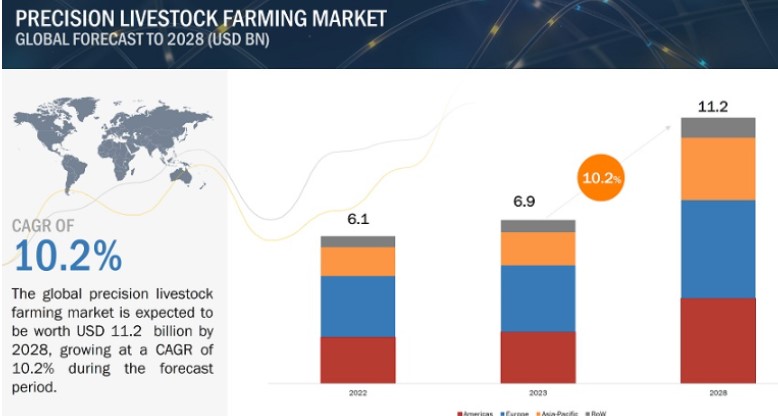
In livestock management, AI (Artificial Intelligence) plays a crucial role in optimising various aspects of animal husbandry. By leveraging advanced technologies such as machine learning, computer vision, and data analytics, AI applications in agriculture are transforming how livestock is raised and managed. From monitoring health and behaviour patterns to improving breeding strategies and optimising feeding practices, AI-driven solutions contribute to the overall well-being of livestock and help farmers make more informed decisions. According to a report by MarketsandMarkets, the Precision Livestock Farming market is projected to reach USD 11.2 billion by 2028, growing at a CAGR of 10.2% (MarketsandMarkets, 2023).

 Graph showing current and predicted precision livestock farming in different markets | Images Source: MarketsandMarkets
Graph showing current and predicted precision livestock farming in different markets | Images Source: MarketsandMarkets

Below are some use cases of how AI is transforming livestock management:

Precision Livestock Monitoring

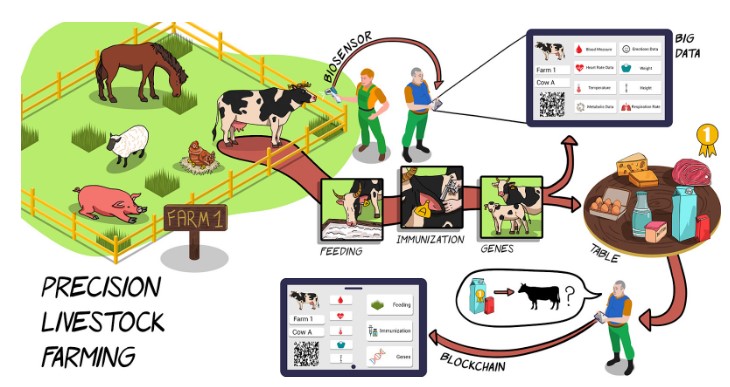
In agriculture, keeping an eye on livestock, like cows, sheep, and pork, is so important. With new technologies, especially artificial intelligence, farmers can now monitor their animals more effectively. They use tools like cameras and sensors to watch over the health and behaviour of the animals. This helps farmers spot potential issues early on, ensuring that the livestock is healthy and happy. It’s like having a smart assistant on the farm, ensuring everything is going well and allowing farmers to take better care of their animals. Here’s an example of how livestock monitoring with artificial intelligence works:

An illustration of how precision livestock farming works.

On a modern farm, cameras and sensors are set up in the barn where the cows are kept. These smart devices are connected to a computer system that uses AI. The cameras constantly watch the cows, and the sensors collect data on things like how much they eat, move, and even their body temperature. The AI system analyses this information in real time. If a cow seems a bit unwell or isn’t eating as much as usual, the system can alert the farmer. This early notification allows the farmer to check on the cow and promptly provide necessary care. It’s a bit like having a virtual farm assistant that helps farmers take quick action to keep their animals healthy and content.

Enhancing Animal Well-Being

Enhancing animal welfare has become an imperative focus in agricultural practices, leading to developing and implementing strategies for the optimal care and well-being of animals. Animal welfare optimisation involves various measures to ensure that animals raised in agricultural settings experience good health, comfort, and humane treatment.

Internet of Things (IoT) edge computing plays a significant role in optimising animal welfare. Here’s how IoT edge computing is utilised to enhance animal welfare in terms of food and drinking optimisation:

  • Automated Feeding Systems (AFSs): IoT sensors placed on feeding equipment can monitor the eating habits of individual animals. These devices track how much each animal eats, and the data is processed locally on the edge, allowing for real-time adjustments in feeding schedules and portion sizes. This ensures that each animal receives the appropriate amount of nutrition tailored to its needs. “The use of automated feeding systems has led to an estimated 5-10% reduction in feed costs, as reported by the Food and Agriculture Organization (FAO). In Nabokov et al.’s study, the regular feeding of the animals increased the farm’s production potential, which resulted in a high return on investment (87.8%).

  • Water Quality Monitoring: IoT sensors can be integrated into water supply systems to monitor the quality and availability of drinking water. Edge computing allows for immediate analysis of factors like water temperature and cleanliness. If any issues are detected, such as pollution or low water levels, automated alerts can be sent to farmers through mobile apps, enabling them to take prompt corrective actions.

Livestock Health Insights: Temperature, Activity, Patterns, Posture

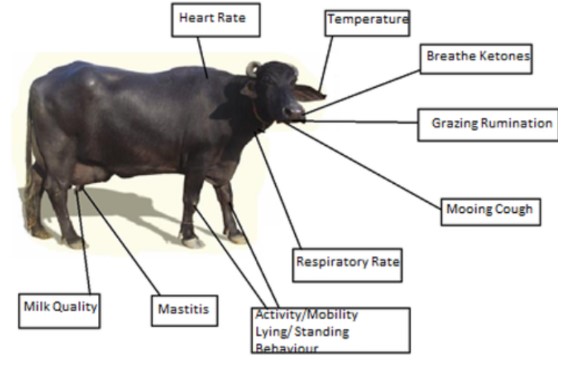
AI is helping farmers keep an eye on livestock’s health by monitoring their body temperature, tracking their movement, observing their behaviour, and their standing posture. All these details help farmers spot if an animal feels unwell or is uncomfortable. IoT Edge computing enables the analysis of animal behaviour related to food and drinking habits.

To develop customised treatment plans for livestock, AI-powered systems can analyse their medical history and data. Decision support is used to identify treatment options for individual cases, and generative AI creates customised treatment plans based on specific conditions. In the veterinary field, Generative AI plays a crucial role in generating treatment scenarios, and contributing to informed decision-making processes. A study in the “Animals” journal demonstrated that machine learning algorithms achieved high accurac

Image highlighting useful data collection points of a cow | Image source: (Sharma and Koundal, 2018)

Faeces detection and identification:

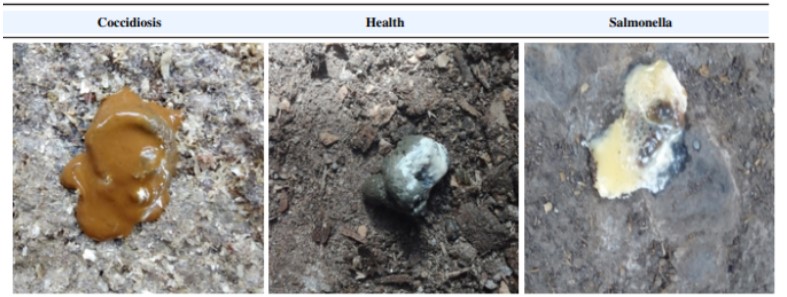
Detecting and identifying faeces, commonly referred to as “dung”, is a significant aspect of animal management, especially in agriculture. Faeces detection and identification play an important role in monitoring the health and well-being of livestock. By studying the characteristics of the dung, such as consistency, colour, and odour, farmers can gain insights into the digestive health and overall condition of the animals.

Sample Images from the Fecal Image Dataset for the cases of coccidiosis, Healthy, and salmonella. Image source: (Degu and Simegn, 2023)

Technological advancements, including computer vision and GPU acceleration, contribute to automating this process. Specialised cameras equipped with computer vision and object detection can be installed in livestock areas. These cameras capture images of the dung, and the software analyses visual characteristics such as colour, shape, and texture to identify the animal source and assess the health indicators present in the faeces.

Detecting damages, pests, and weeds:

The identification of pests in livestock is critical for their well-being. Numerous pests can cause health problems for livestock or even cause death. Early identification is essential for minimising the damage caused by pests like cattle lice, horn flies, and stable flies. The pests lay their eggs on livestock or in their food, causing infestations. However, early detection of pest infestations requires continuous and focused human monitoring.

A pest detection system powered by Computer Vision and GPU acceleration can identify pests by consistently noting any ambiguous marks on their bodies, or swarm of pests in farms and monitoring the quality of their food. The system can effectively pinpoint the occurrence of pest infestations, which proves to be a valuable and efficient method of protecting livestock.

Smart Climate Control in Farm:

Smart climate control systems have revolutionised the approach to optimising living conditions for livestock on modern farms. These innovative systems leverage IoT sensors for continuous environmental monitoring, adjusting key factors like temperature, humidity, and air quality within livestock facilities. By maintaining optimal conditions, such as through precision ventilation and heating mechanisms that respond to changing weather conditions, these systems create a stress-free environment for the animals. This is crucial for overall well-being, preventing respiratory issues, and ensuring a comfortable habitat.

The integration with weather forecasting allows farmers to anticipate climate changes, proactively adjust barn conditions and mitigate the risk of heat stress or cold-related issues. With real-time monitoring and alerts delivered through mobile applications or centralised control systems, farmers can promptly respond to deviations from optimal conditions, addressing potential issues before they escalate.

Hatcher Optimization for Poultry Farmers

Optimised hatchers represent a critical component in poultry farming, designed to ensure efficient and successful incubation of eggs. These specialised machines provide a controlled environment, maintaining precise temperature and humidity levels essential for developing chicks inside the eggs.

Integrating IoT edge computing and computer vision technologies can significantly enhance the functionality and efficiency of optimised hatchers in poultry farming. Here’s how these technologies can be applied:

  • IoT Sensors for Environmental Monitoring: Deploying IoT sensors within the hatcher allows for real-time monitoring of crucial environmental factors such as temperature, humidity, and air quality. These sensors can provide accurate data to be transmitted to a centralised system for continuous monitoring. Any deviations from the optimal conditions trigger alerts, enabling prompt adjustments to maintain an ideal incubation environment.

  • Remote Monitoring and Control: IoT connectivity enables remote monitoring and control of the hatcher through a centralised platform. Farmers can access real-time data, receive alerts, and make necessary adjustments using their smartphones or computers. This feature enhances flexibility and allows for timely responses to changing conditions, even when the farmer is not physically present at the hatchery.

  • Data Analytics for Predictive Maintenance: IoT sensors can collect data on the performance of various components within the hatcher. Utilising data analytics, predictive maintenance models can be developed to forecast potential issues before they occur. This proactive approach minimises downtime, ensures the continuous operation of the hatcher, and extends the lifespan of the equipment.

Automatic Harvesting:

The concept of automatic harvesting in livestock could potentially involve the use of robotics, sensors, and AI to automate tasks associated with livestock management and harvesting. Here are some aspects where automation could be applied:

  • Sorting and Identification: Automated systems could use sensors and image recognition technology to identify individual animals, sorting them based on various criteria such as weight, health, or other specific characteristics.

  • Herding and Movement: Herding means the act of guiding, controlling, or directing a group of animals, typically livestock, to move together in a specific direction or to a particular location. Robotics and autonomous vehicles could facilitate the herding and movement of livestock within a designated area. Drones or ground-based robots could help guide animals without direct human intervention.

  • Slaughter and Processing: Advanced automated systems might be developed to handle the processing of animals for meat production. This could include automated slaughter, cutting, and initial processing stages.

  • Data-driven Decision-making: Integrating data analytics and AI could enable automated decision-making based on real-time data about the livestock’s health, behaviour, and overall conditions. This could contribute to optimised harvesting strategies.

Weather Effects on Livestock: A Vital Forecast for Farm Management

Extreme temperatures, whether hot or cold, impact animal comfort and health. Strategies such as providing shade or adjusting ventilation can be implemented by predicting heat waves or cold snaps. Forecasting rainfall or drought aids in efficient water resource management, which is vital for livestock hydration. Weather directly influences pasture and forage growth, allowing strategic planning for grazing availability and feed adjustments. Disease prevalence among livestock is affected by specific weather conditions, and proactive measures can be taken by predicting such conditions. AI algorithms process vast datasets, including historical weather patterns, real-time sensor data, and satellite imagery. This enables more accurate and localised forecasting, providing early warnings about extreme weather events such as storms, heat waves, or cold snaps.

Optimised Sorting and Storing Farm Products:

Optimised sorting and storing of farm products in livestock management involve the systematic and efficient organisation of various agricultural products derived from livestock farming. This process is crucial for ensuring the quality, safety, and effective management of the harvested or processed items. Here are some key aspects of optimised sorting and storing in livestock:

  • Product Identification and Sorting: Automated sorting systems, powered by computer vision algorithms, can rapidly and accurately categorise farm products based on predefined criteria such as quality, size, and weight. This not only expedites the sorting process but also ensures consistency and precision, improving overall product quality.

  • Temperature and Humidity Control: AI-driven monitoring systems, equipped with sensors and data analytics, enable real-time assessment of storage conditions. Machine learning algorithms can predict optimal temperature and humidity levels for different products, facilitating automated adjustments in climate-controlled environments. This ensures prolonged freshness, minimises spoilage, and extends the shelf life of perishable items.

  • Inventory Management: AI-powered inventory management systems utilise predictive analytics to optimise stock levels. By analysing historical data and current demand patterns, AI can forecast future requirements, preventing overstocking or stockouts. This not only streamlines supply chain logistics but also minimises waste and ensures efficient use of storage space.

  • Packaging and Labelling: AI-driven robotic systems can automate packaging processes, ensuring uniformity and precision. Additionally, computer vision technology can inspect packaging for defects and quality assurance. Integrated with AI, smart labelling systems can dynamically generate and affix labels with accurate product details, enhancing traceability and reducing the risk of errors.

  • Traceability Systems: AI technologies like RFID and barcodes facilitate seamless traceability throughout the supply chain. These systems enable quick and accurate tracking of product origin, movement, and storage conditions. In case of recalls or quality control measures, AI-driven traceability ensures swift identification and isolation of affected products.

What we can offer you as a software company

As a software company, we are excited about the potential of AI solutions to revolutionise livestock management in agriculture. We are eager to explore opportunities to contribute our expertise in cutting-edge technologies such as IoT Edge Computing, Computer Vision, and Machine Learning to support farmers in caring for their animals.

At TechnoLynx, we recognise the growing demand for smart farming solutions and are committed to making AI adoption seamless for our clients. Our team is dedicated to collaborating with farmers to develop customised solutions that address their specific needs and challenges.

We are committed to empowering farmers with data-driven insights and modernising agriculture through innovation. We invite you to partner with us in embracing the future of livestock management, where together, we can create transformative solutions that drive efficiency and sustainability in agriculture.

Conclusion

AI in livestock management is not a luxury; it’s a necessity for sustainable and productive agriculture. It ensures the well-being of livestock, optimises resource utilisation, and empowers farmers to make informed decisions that resonate across the entire agricultural ecosystem. As we step into a future where innovation meets measurable excellence, the importance of AI in livestock management becomes a cornerstone for a smarter, more sustainable, and resilient agricultural sector.

References

  • Nabokov, V. I., Novopashin, L. A., Denyozhko, L. V., Sadov, A. A., Ziablitckaia, N. V., Volkova, S. A., & Speshilova, I. V. (2020). Applications of feed pusher robots on cattle farmings and its economic efficiency. International Transaction Journal of Engineering, Management, & Applied Sciences & Technologies, 11(14), 1-7.

  • Precision Livestock Farming market Size, Share, Industry Report, Revenue Trends and Growth Drivers (no date) MarketsandMarkets.

  • Cockburn, M. (2020) ‘Review: Application and Prospective Discussion of Machine Learning for the Management of Dairy Farms’, Animals, 10(9), p. 1690.

  • Neethirajan, S. and Kemp, B. (2021) ‘Digital Livestock Farming’, Sensing and Bio-Sensing Research, 32, p. 100408.

  • Sharma, B. and Koundal, D. (2018) ‘Cattle health monitoring system using wireless sensor network: a survey from innovation perspective’, IET Wireless Sensor Systems, 8(4), pp. 143–151.

  • Hossain, M. S., Salsabil, U. S., Syeed, M. M., Rahman, M. M., Fatema, K., & Uddin, M. F. (2023, June). SmartPoultry: Early Detection of Poultry Disease from Smartphone Captured Fecal Image. In 2023 20th International Joint Conference on Computer Science and Software Engineering (JCSSE) (pp. 345-350). IEEE.

  • Degu, M.Z. and Simegn, G.L. (2023) ‘Smartphone based detection and classification of poultry diseases from chicken fecal images using deep learning techniques’, Smart Agricultural Technology, 4, p. 100221.
Cost, Efficiency, and Value Are Not the Same Metric

Cost, Efficiency, and Value Are Not the Same Metric

17/04/2026

Performance per dollar. Tokens per watt. Cost per request. These sound like the same thing said differently, but they measure genuinely different dimensions of AI infrastructure economics. Conflating them leads to infrastructure decisions that optimize for the wrong objective.

Precision Is an Economic Lever in Inference Systems

Precision Is an Economic Lever in Inference Systems

17/04/2026

Precision isn't just a numerical setting — it's an economic one. Choosing FP8 over BF16, or INT8 over FP16, changes throughput, latency, memory footprint, and power draw simultaneously. For inference at scale, these changes compound into significant cost differences.

Precision Choices Are Constrained by Hardware Architecture

Precision Choices Are Constrained by Hardware Architecture

17/04/2026

You can't run FP8 inference on hardware that doesn't have FP8 tensor cores. Precision format decisions are conditional on the accelerator's architecture — its tensor core generation, native format support, and the efficiency penalties for unsupported formats.

Steady-State Performance, Cost, and Capacity Planning

Steady-State Performance, Cost, and Capacity Planning

17/04/2026

Capacity planning built on peak performance numbers over-provisions or under-delivers. Real infrastructure sizing requires steady-state throughput — the predictable, sustained output the system actually delivers over hours and days, not the number it hit in the first five minutes.

How Benchmark Context Gets Lost in Procurement

How Benchmark Context Gets Lost in Procurement

16/04/2026

A benchmark result starts with full context — workload, software stack, measurement conditions. By the time it reaches a procurement deck, all that context is gone. The failure mode is not wrong benchmarks but context loss during propagation.

Building an Audit Trail: Benchmarks as Evidence for Governance and Risk

Building an Audit Trail: Benchmarks as Evidence for Governance and Risk

16/04/2026

High-value AI hardware decisions need traceable evidence, not slide-deck bullet points. When benchmarks are documented with methodology, assumptions, and limitations, they become auditable institutional evidence — defensible under scrutiny and revisitable when conditions change.

The Comparability Protocol: Why Benchmark Methodology Defines What You Can Compare

The Comparability Protocol: Why Benchmark Methodology Defines What You Can Compare

16/04/2026

Two benchmark scores can only be compared if they share a declared methodology — the same workload, precision, measurement protocol, and reporting conditions. Without that contract, the comparison is arithmetic on numbers of unknown provenance.

A Decision Framework for Choosing AI Hardware

A Decision Framework for Choosing AI Hardware

16/04/2026

Hardware selection is a multivariate decision under uncertainty — not a score comparison. This framework walks through the steps: defining the decision, matching evaluation to deployment, measuring what predicts production, preserving tradeoffs, and building a repeatable process.

How Benchmarks Shape Organizations Before Anyone Reads the Score

How Benchmarks Shape Organizations Before Anyone Reads the Score

16/04/2026

Before a benchmark score informs a purchase, it has already shaped what gets optimized, what gets reported, and what the organization considers important. Benchmarks function as decision infrastructure — and that influence deserves more scrutiny than the number itself.

Accuracy Loss from Lower Precision Is Task‑Dependent

Accuracy Loss from Lower Precision Is Task‑Dependent

16/04/2026

Reduced precision does not produce a uniform accuracy penalty. Sensitivity depends on the task, the metric, and the evaluation setup — and accuracy impact cannot be assumed without measurement.

Precision Is a Design Parameter, Not a Quality Compromise

Precision Is a Design Parameter, Not a Quality Compromise

16/04/2026

Numerical precision is an explicit design parameter in AI systems, not a moral downgrade in quality. This article reframes precision as a representation choice with intentional trade-offs, not a concession made reluctantly.

Mixed Precision Works by Exploiting Numerical Tolerance

Mixed Precision Works by Exploiting Numerical Tolerance

16/04/2026

Not every multiplication deserves 32 bits. Mixed precision works because neural network computations have uneven numerical sensitivity — some operations tolerate aggressive precision reduction, others don't — and the performance gains come from telling them apart.

Throughput vs Latency: Choosing the Wrong Optimization Target

16/04/2026

Throughput and latency are different objectives that often compete for the same resources. This article explains the trade-off, why batch size reshapes behavior, and why percentiles matter more than averages in latency-sensitive systems.

Quantization Is Controlled Approximation, Not Model Damage

16/04/2026

When someone says 'quantize the model,' the instinct is to hear 'degrade the model.' That framing is wrong. Quantization is controlled numerical approximation — a deliberate engineering trade-off with bounded, measurable error characteristics — not an act of destruction.

GPU Utilization Is Not Performance

15/04/2026

The utilization percentage in nvidia-smi reports kernel scheduling activity, not efficiency or throughput. This article explains the metric's exact definition, why it routinely misleads in both directions, and what to pair it with for accurate performance reads.

FP8, FP16, and BF16 Represent Different Operating Regimes

15/04/2026

FP8 is not just 'half of FP16.' Each numerical format encodes a different set of assumptions about range, precision, and risk tolerance. Choosing between them means choosing operating regimes — different trade-offs between throughput, numerical stability, and what the hardware can actually accelerate.

Peak Performance vs Steady‑State Performance in AI

15/04/2026

AI systems rarely operate at peak. This article defines the peak vs. steady-state distinction, explains when each regime applies, and shows why evaluations that capture only peak conditions mischaracterize real-world throughput.

The Software Stack Is a First‑Class Performance Component

15/04/2026

Drivers, runtimes, frameworks, and libraries define the execution path that determines GPU throughput. This article traces how each software layer introduces real performance ceilings and why version-level detail must be explicit in any credible comparison.

The Mythology of 100% GPU Utilization

15/04/2026

Is 100% GPU utilization bad? Will it damage the hardware? Should you be worried? For datacenter AI workloads, sustained high utilization is normal — and the anxiety around it usually reflects gaming-era intuitions that don't apply.

Why Benchmarks Fail to Match Real AI Workloads

15/04/2026

The word 'realistic' gets attached to benchmarks freely, but real AI workloads have properties that synthetic benchmarks structurally omit: variable request patterns, queuing dynamics, mixed operations, and workload shapes that change the hardware's operating regime.

Why Identical GPUs Often Perform Differently

15/04/2026

'Same GPU' does not imply the same performance. This article explains why system configuration, software versions, and execution context routinely outweigh nominal hardware identity.

Training and Inference Are Fundamentally Different Workloads

15/04/2026

A GPU that excels at training may disappoint at inference, and vice versa. Training and inference stress different system components, follow different scaling rules, and demand different optimization strategies. Treating them as interchangeable is a design error.

Performance Ownership Spans Hardware and Software Teams

15/04/2026

When an AI workload underperforms, attribution is the first casualty. Hardware blames software. Software blames hardware. The actual problem lives in the gap between them — and no single team owns that gap.

Performance Emerges from the Hardware × Software Stack

15/04/2026

AI performance is an emergent property of hardware, software, and workload operating together. This article explains why outcomes cannot be attributed to hardware alone and why the stack is the true unit of performance.

Power, Thermals, and the Hidden Governors of Performance

14/04/2026

Every GPU has a physical ceiling that sits below its theoretical peak. Power limits, thermal throttling, and transient boost clocks mean that the performance you read on the spec sheet is not the performance the hardware sustains. The physics always wins.

Why AI Performance Changes Over Time

14/04/2026

That impressive throughput number from the first five minutes of a training run? It probably won't hold. AI workload performance shifts over time due to warmup effects, thermal dynamics, scheduling changes, and memory pressure. Understanding why is the first step toward trustworthy measurement.

CUDA, Frameworks, and Ecosystem Lock-In

14/04/2026

Why is it so hard to switch away from CUDA? Because the lock-in isn't in the API — it's in the ecosystem. Libraries, tooling, community knowledge, and years of optimization create switching costs that no hardware swap alone can overcome.

GPUs Are Part of a Larger System

14/04/2026

CPU overhead, memory bandwidth, PCIe topology, and host-side scheduling routinely limit what a GPU can deliver — even when the accelerator itself has headroom. This article maps the non-GPU bottlenecks that determine real AI throughput.

Why AI Performance Must Be Measured Under Representative Workloads

14/04/2026

Spec sheets, leaderboards, and vendor numbers cannot substitute for empirical measurement under your own workload and stack. Defensible performance conclusions require representative execution — not estimates, not extrapolations.

Low GPU Utilization: Where the Real Bottlenecks Hide

14/04/2026

When GPU utilization drops below expectations, the cause usually isn't the GPU itself. This article traces common bottleneck patterns — host-side stalls, memory-bandwidth limits, pipeline bubbles — that create the illusion of idle hardware.

Why GPU Performance Is Not a Single Number

14/04/2026

AI GPU performance is multi-dimensional and workload-dependent. This article explains why scalar rankings collapse incompatible objectives and why 'best GPU' questions are structurally underspecified.

What a GPU Benchmark Actually Measures

14/04/2026

A benchmark result is not a hardware measurement — it is an execution measurement. The GPU, the software stack, and the workload all contribute to the number. Reading it correctly requires knowing which parts of the system shaped the outcome.

Why Spec‑Sheet Benchmarking Fails for AI

14/04/2026

GPU spec sheets describe theoretical limits. This article explains why real AI performance is an execution property shaped by workload, software, and sustained system behavior.

Visual Computing in Life Sciences: Real-Time Insights

6/11/2025

Learn how visual computing transforms life sciences with real-time analysis, improving research, diagnostics, and decision-making for faster, accurate outcomes.

AI-Driven Aseptic Operations: Eliminating Contamination

21/10/2025

Learn how AI-driven aseptic operations help pharmaceutical manufacturers reduce contamination, improve risk assessment, and meet FDA standards for safe, sterile products.

AI Visual Quality Control: Assuring Safe Pharma Packaging

20/10/2025

See how AI-powered visual quality control ensures safe, compliant, and high-quality pharmaceutical packaging across a wide range of products.

AI for Reliable and Efficient Pharmaceutical Manufacturing

15/10/2025

See how AI and generative AI help pharmaceutical companies optimise manufacturing processes, improve product quality, and ensure safety and efficacy.

Barcodes in Pharma: From DSCSA to FMD in Practice

25/09/2025

What the 2‑D barcode and seal on your medicine mean, how pharmacists scan packs, and why these checks stop fake medicines reaching you.

Pharma’s EU AI Act Playbook: GxP‑Ready Steps

24/09/2025

A clear, GxP‑ready guide to the EU AI Act for pharma and medical devices: risk tiers, GPAI, codes of practice, governance, and audit‑ready execution.

Cell Painting: Fixing Batch Effects for Reliable HCS

23/09/2025

Reduce batch effects in Cell Painting. Standardise assays, adopt OME‑Zarr, and apply robust harmonisation to make high‑content screening reproducible.

Explainable Digital Pathology: QC that Scales

22/09/2025

Raise slide quality and trust in AI for digital pathology with robust WSI validation, automated QC, and explainable outputs that fit clinical workflows.

Validation‑Ready AI for GxP Operations in Pharma

19/09/2025

Make AI systems validation‑ready across GxP. GMP, GCP and GLP. Build secure, audit‑ready workflows for data integrity, manufacturing and clinical trials.

Edge Imaging for Reliable Cell and Gene Therapy

17/09/2025

Edge imaging transforms cell & gene therapy manufacturing with real‑time monitoring, risk‑based control and Annex 1 compliance for safer, faster production.

AI in Genetic Variant Interpretation: From Data to Meaning

15/09/2025

AI enhances genetic variant interpretation by analysing DNA sequences, de novo variants, and complex patterns in the human genome for clinical precision.

AI Visual Inspection for Sterile Injectables

11/09/2025

Improve quality and safety in sterile injectable manufacturing with AI‑driven visual inspection, real‑time control and cost‑effective compliance.

Predicting Clinical Trial Risks with AI in Real Time

5/09/2025

AI helps pharma teams predict clinical trial risks, side effects, and deviations in real time, improving decisions and protecting human subjects.

Generative AI in Pharma: Compliance and Innovation

1/09/2025

Generative AI transforms pharma by streamlining compliance, drug discovery, and documentation with AI models, GANs, and synthetic training data for safer innovation.

AI for Pharma Compliance: Smarter Quality, Safer Trials

27/08/2025

AI helps pharma teams improve compliance, reduce risk, and manage quality in clinical trials and manufacturing with real-time insights.

Back See Blogs
arrow icon