A carbon footprint is the cumulative greenhouse-gas effect of the choices a person, a process, or a supply chain makes over time. The interesting question is not whether AI can help reduce it — the interesting question is where AI actually changes the operating envelope of a system, and where it just shifts emissions from one column of the ledger to another. In our work with industrial and public-sector teams, we see four AI capabilities doing the real work: computer vision, generative AI, IoT edge computing, and GPU acceleration. Each one fits a specific class of emissions problem, and each one comes with its own resource cost.
The global carbon-footprint-management market is now valued at roughly $11 billion, and a 2022 BCG survey reported that 87% of CEOs with decision authority over AI and climate believe AI is essential for climate efforts. These are directional industry-scale figures, not operational benchmarks — but they explain why every operations leader we talk to has the same question on their desk: where does AI actually move the needle?
What does “reducing carbon footprint with AI” actually mean?
Three distinct definitions coexist under this label, and the most common analytical mistake is conflating them.
The first is measurement: instrumenting a process so the emissions become visible at a useful resolution. The second is prediction: using historical and live data to anticipate where emissions will occur — air-quality spikes, machine failures, inefficient delivery routes — before they happen. The third is optimisation: changing operating decisions in response to the prediction. AI sits across all three, but the value is concentrated in the second and third. Measurement without prediction produces dashboards. Prediction without optimisation produces reports nobody acts on.
This framing matters because the resource cost of running AI is real. Every model that monitors emissions also consumes electricity, GPU cycles, and — in the case of large hosted models — cooling water. The question is whether the emissions avoided exceed the emissions incurred. For narrow, well-scoped industrial applications, the answer is usually yes by a wide margin. For broad consumer-facing deployments, the answer is less obvious.
Air-quality monitoring at the edge
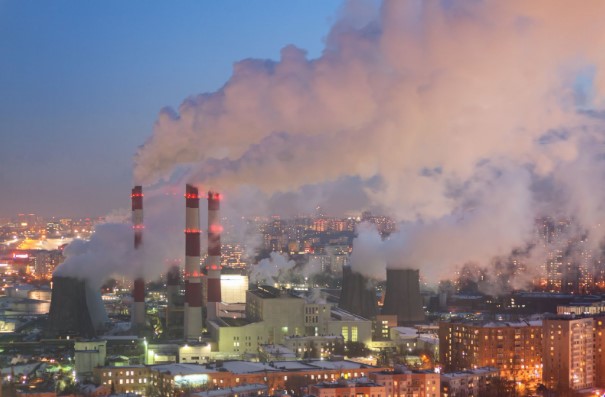
IoT plus AI makes air-pollution management operationally feasible in ways that were previously unattainable. Cities run dense networks of sensors that produce continuous streams of particulate, NOx, and meteorological data. Centralising every reading for analysis is bandwidth-expensive and slow. Running inference at the edge — on or near the monitoring station itself — lets a system react in seconds rather than hours.
The pattern is straightforward. Sensors feed a small model deployed on an edge device. The model fuses pollution readings with traffic counts, factory emissions reports, and weather forecasts to predict which neighbourhoods will exceed air-quality thresholds in the next few hours. Authorities can then act — issuing health warnings, rerouting traffic, asking industrial sites to throttle output during a high-risk window. Generative AI plays a supporting role here: simulating counterfactual scenarios (“what happens to PM2.5 over the next 24 hours if we restrict diesel traffic in zones A and B?”) that planners use to choose between interventions.
The mechanism that makes this work is locality. Edge computing processes data close to where it’s collected, so latency is low and the decision window is short enough to matter. A centralised pipeline that takes six hours to produce the same forecast is operationally useless — by the time it arrives, the bad air has already been breathed.
Predictive maintenance: the under-discussed climate win
Predictive maintenance ranks among the highest-leverage climate applications of AI, yet framing rarely acknowledges its impact.
Traditional reactive maintenance lets equipment run until it fails. Failures don’t just stop production — they push machines into inefficient operating regimes for hours or days before the actual breakdown, burning extra fuel and emitting more than they would in healthy operation. Scheduled preventive maintenance is better, but it tends to over-service equipment that doesn’t need it and miss equipment that does.
Predictive maintenance changes the unit of analysis. Sensors on bearings, motors, compressors, and turbines feed time-series data into models trained to recognise the signatures of incipient failure. Generative AI can synthesise rare-failure data to balance training sets where real failures are too infrequent to learn from, while classical predictive analytics on historical run data flags which machines are drifting toward an unsafe envelope. Operators get a window — sometimes days, sometimes weeks — to schedule maintenance during planned downtime.
The emissions impact comes from three places: machines spend more of their lifetime in their efficient operating range, unplanned shutdowns and restart cycles (both energy-intensive) drop sharply, and the supply-chain emissions associated with emergency parts shipping and overnight engineering call-outs largely disappear. The secondary benefits — lower repair costs, more stable production, fewer safety incidents — are why operations directors fund the work in the first place. The carbon reduction is the part that shows up on the sustainability report.
How is AI used in supply-chain decarbonisation?
Over 90% of an average organisation’s greenhouse-gas emissions originate in its supply chain rather than direct operations, as reported in the US EPA supply-chain guidance. That is the number that should drive prioritisation. If you are spending engineering effort on optimising your office HVAC before you have touched your supply chain, you are optimising the wrong digit.
Two AI capabilities do most of the work here:
| Capability | Where it cuts emissions | Mechanism |
|---|---|---|
| Computer vision in warehousing | Inventory waste, over/under-stocking | Cameras analyse shelf state continuously, surfacing low or excess stock in real time |
| Route-optimisation models | Fuel use, idle miles, empty backhauls | Models combine traffic, weather, and order data to schedule lower-emission delivery patterns |
| Generative AI for demand forecasting | Overproduction, perishable waste | Synthetic scenario generation stress-tests plans against demand shocks |
| GPU acceleration | All of the above, at scale | Lets the optimisation run frequently enough to act on rather than archive |
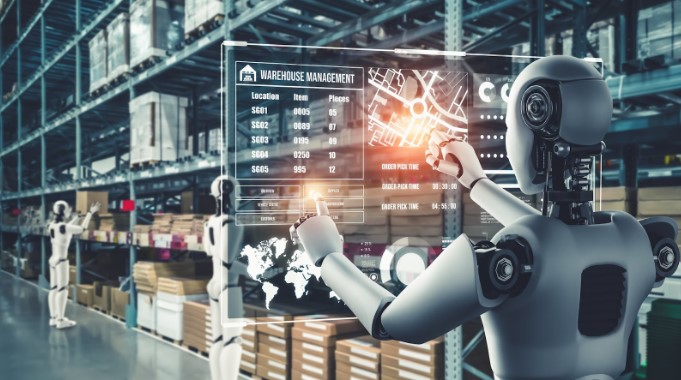
Computer vision matters because warehouse-level inventory mistakes cascade. Overstocking ties up capital, requires more storage and refrigeration, and — when products are perishable — produces direct waste with embedded emissions. Understocking triggers expedited shipments, often by air. Continuous visual stock monitoring catches both before they propagate. We cover this in more depth in our piece on the transformative role of AI in supply-chain management.
GPU acceleration is the enabling layer. Route optimisation, demand forecasting, and inventory vision all involve large models running over large datasets. Without acceleration, the analysis runs overnight; with it, the analysis runs in time to change the next dispatch decision. Walmart’s supply-chain AI and DHL’s last-mile routing systems are public examples of this pattern in operation at scale.
Emerging directions: closed-loop control and digital twins
Two patterns beyond the established applications deserve close attention.
Closed-loop automation is the natural endpoint of predictive systems. Instead of producing a recommendation that an operator acts on, the system adjusts the process directly within pre-approved bounds. Oil and gas operators using this pattern have reported 10–15% emissions reductions on specific assets — a directional industry-scale figure that comes from industry self-reporting rather than independent audit. The same publication notes flare-monitoring systems contributing an additional 5–10% reduction on top (per the same industry-reported figures).
Digital twins are the second pattern. A digital twin is a continuously updated virtual model of a physical asset or process, fed by the same sensor streams that drive predictive maintenance. The value for emissions work is that a twin lets you simulate the effect of a change — a different operating setpoint, a different feedstock, a different shift schedule — without running the experiment on the real plant. That converts decarbonisation from a series of expensive trials into a search over a model, which is dramatically faster and cheaper.
The honest challenges
Carbon-reduction arguments collapse unless both sides of the ledger—including AI’s own footprint—are accounted for.
The first problem is e-waste. The Global E-waste Monitor 2020 projected 74 million metric tons by 2030. Every wave of AI deployment increases demand for CPUs, GPUs, memory chips, and the supporting infrastructure that ages out of service. Some of this is recoverable through recycling; much of it is not. Hardware lifecycles need to be part of any honest accounting.
The second is data-centre resource use. Training and serving large models consumes electricity and — in the case of evaporative cooling — water. Google reported 5.2 billion gallons of water use across its data centres in 2022. Operators are responding with more efficient cooling, but the trajectory is upward. Smaller, task-specific models running on the edge consume vastly less per inference than general-purpose hosted models, and the architectural choice between the two has real climate consequences.
The third is explainability. Decisions that affect environmental policy, public health interventions, or industrial safety need to be auditable. Deep-learning models that work well but cannot explain themselves create accountability gaps that erode trust faster than the underlying technology can earn it back. We treat verifiability as a first-class requirement rather than an afterthought.
How TechnoLynx approaches this
TechnoLynx tackles the AI engineering side: edge-deployable computer-vision systems for industrial monitoring, GPU-accelerated supply-chain optimisation, generative-AI scenario simulation, and production integration. Our experience cuts across transportation, power-grid management, and industrial operations.
The pattern we see across engagements is consistent: the climate benefit is real, but only when the AI system is scoped to a measurable operational decision rather than a vague optimisation goal. “Reduce emissions” is not a brief we can build against. “Reduce idle-time fuel burn in our delivery fleet by improving route assignments using live traffic data” is. The narrower the scope, the larger the verifiable impact.
Closing thought
Carbon footprints shrink only when AI is applied with precision, not deployed indiscriminately. It reduces them when it is wired into a decision that an operator or a closed-loop controller would otherwise make worse. The interesting engineering question is not “can we apply AI here” — it is “which decision is currently producing the most avoidable emissions, and what data would we need to make it better?” Start there, and the technology choices follow.
Frequently Asked Questions
How does AI help reduce carbon emissions in industry?
AI reduces emissions in three ways: measurement (instrumenting processes so emissions become visible), prediction (anticipating failures, demand shocks, or pollution spikes before they occur), and optimisation (adjusting operating decisions in response). The biggest wins in our experience come from predictive maintenance, supply-chain routing, and edge-deployed air-quality monitoring — narrow problems where the avoided emissions clearly exceed the energy cost of running the model.
Where does AI deliver the most measurable carbon savings?
Supply chains, because over 90% of an organisation’s greenhouse-gas emissions typically come from there. Within supply chains, route optimisation and inventory vision are the two highest-leverage applications. Predictive maintenance is the next tier — it keeps machines in their efficient operating range and avoids the emissions associated with reactive failures and emergency parts shipping.
What are the environmental costs of using AI itself?
Three real costs. Hardware manufacturing and disposal contributes to e-waste, projected at 74 million metric tons by 2030. Data-centre operations consume electricity and water — Google reported 5.2 billion gallons of water use across its data centres in 2022. Model training, especially for large generative models, is energy-intensive. Smaller task-specific models running at the edge consume vastly less per inference than hosted general-purpose models.
What role does edge computing play in environmental monitoring?
Edge computing runs inference close to where data is collected, which is what makes real-time environmental decisions possible. A centralised pipeline that takes hours to produce an air-quality forecast is operationally useless — the bad air has already been breathed. Edge-deployed models on IoT sensors let cities react within minutes, which is the only timescale on which interventions like traffic rerouting or industrial throttling actually work.
How can companies start using AI to reduce their carbon footprint?
Start with the largest controllable emissions source, which for most organisations is the supply chain rather than direct operations. Identify one operational decision currently producing avoidable emissions — fleet routing, inventory levels, maintenance scheduling — and scope an AI engagement around improving that specific decision with measurable before/after data. Narrow scope produces verifiable impact; vague mandates produce dashboards nobody acts on.
Next time Using AI Reduce Our comes up
Scope, constraints, and an honest success metric—decided before the first benchmark runs—separate cost-effective Using AI Reduce Our outcomes from expensive ones.