
Introduction
What we called prompt engineering three years ago bears little resemblance to its 2026 incarnation. The discipline did not disappear — if anything, the dependency on it inside production engineering workflows has grown. But the centre of gravity moved. Clever phrasing tricks have been largely absorbed into the models themselves. What remains valuable is the harder, less photogenic work: deciding what context to retrieve, defining tools and output schemas, and building evaluation harnesses that tell you whether a prompt is actually any good.
This guide is for engineering teams who inherited a pile of 2023-era prompt advice and need to know which parts still earn their keep against reasoning-tuned models like the o-series, Claude 4 Sonnet/Opus, and Gemini 2.5 Pro Deep Think — and which parts have quietly become noise.
What prompt engineering means now
Finding the magic phrase that coaxed consistent model behavior defined the 2023 playbook. “You are an expert in X. Take a deep breath. Think step by step.” Some of those tricks measurably moved scores on benchmarks of the day. Most of them do not move scores on current frontier models, because the models were trained on the tricks and now apply them implicitly.
What survived the model upgrades is structural, not stylistic:
- Role and audience framing — telling the model who it is talking to and what voice to use. This is not a trick; it is information the model genuinely lacks.
- Few-shot examples — when the output has a specific shape (a particular JSON schema, a particular code style, a particular tone), examples beat description.
- Decomposition — naming the sub-steps of a complex task in the prompt itself, so the model produces them in order rather than mashing them together.
- Structured-output prompting — JSON Schema, tool definitions, OpenAI’s structured outputs, Anthropic’s tool use. The model emits machine-parseable output the first time, every time. This is the single largest reliability gain available in 2026.
- Retrieval-augmented generation (RAG) — for any factual question whose answer is not stable training-time knowledge.
Chain-of-thought prompting, the marquee technique of 2023, is the most prominent casualty. On a reasoning-tuned model, asking it to “think step by step” is roughly a no-op — it is already doing extended reasoning internally, and the visible “thinking out loud” you get back is often a worse trace than the hidden one. In our experience across generative-AI engagements, removing chain-of-thought scaffolding from prompts targeted at reasoning models is a small but real quality improvement, not a regression.
The shift from prompt engineering to context engineering
Context engineering now describes what practitioners actually build in production. The phrase is not marketing — it names a measurably different activity.
A prompt is what you write. Context is everything that ends up inside the model’s input window: the system message, the retrieved documents, the tool schemas, the prior conversation, the user’s current turn, the metadata you attached. In a serious production system, the prompt itself is a small fraction of the total context tokens. Most of the engineering work — and most of the bugs — live in how the rest is assembled.
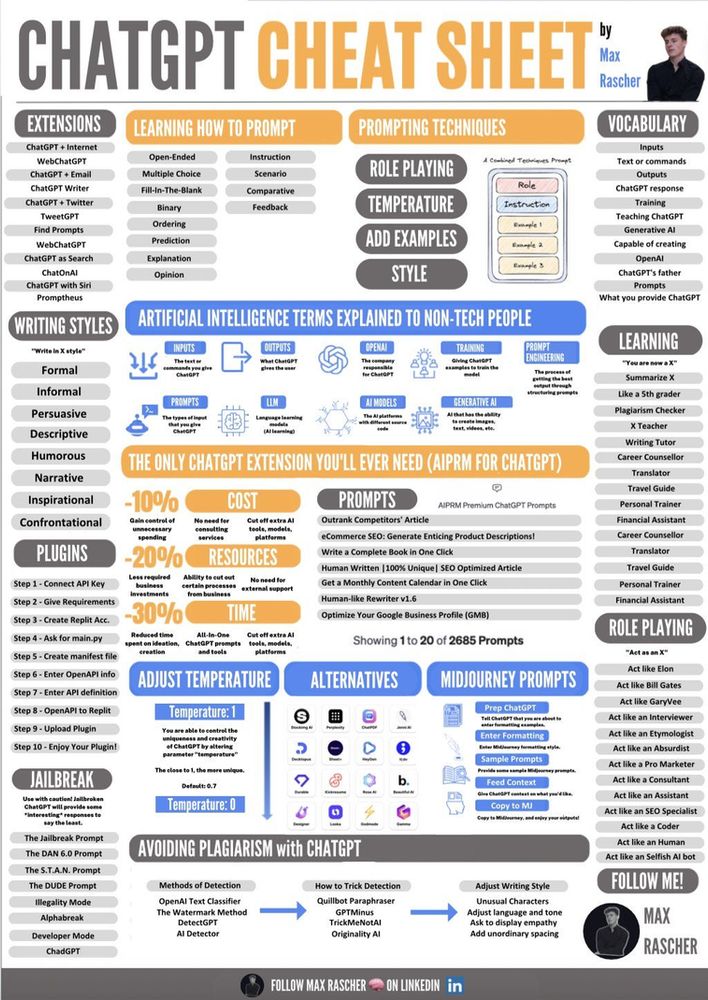
Context engineering is the production-engineering version of a ChatGPT cheat sheet. The questions it asks are:
- What information does this task actually require, and where does it live?
- How do we retrieve it without flooding the window with irrelevant text?
- How do we deduplicate, rank, and truncate when the retrieved set exceeds the budget?
- How do we represent tools so the model picks the right one and fills the arguments correctly?
- How do we cache the stable parts of the context so token costs stay sane?
None of these questions are answered by a better prompt phrase. They are answered by a retrieval pipeline, a schema, and a cache policy. This is why we treat the prompt cheat sheet and the practitioner’s quick reference for engineers as two layers of the same problem: the cheat sheet covers the visible surface, the context-engineering layer underneath is where the production wins actually accrue.
What an engineering-grade prompt looks like in 2026
Modern prompts comprise four architectural elements: system messages defining role and boundaries, tool definitions, output schemas, and retrieval-augmented user inputs.
A minimal example, written for a code-review assistant wired into a CI pipeline:
[SYSTEM]
You are a senior code reviewer at a Python shop. You comment only on
correctness, security, and concurrency issues. You ignore style — a
separate linter handles that. If you have nothing substantive to say,
return an empty findings array.

[TOOLS]
- read_file(path: string) -> string
- list_callers(symbol: string) -> string[]

[OUTPUT SCHEMA]
{ "findings": [
    { "file": "string",
      "line": "integer",
      "severity": "low|medium|high",
      "category": "correctness|security|concurrency",
      "message": "string" } ] }

[USER]
Review the diff in pull request #4821. Focus on the changes to
billing/refunds.py.
What is doing the work here is not the wording of any individual sentence. It is the explicit role boundary (correctness/security/concurrency only, not style), the tool definitions that let the model pull additional context on demand, and the output schema that guarantees the result is parseable by the CI script that called it. Swap “review the diff” for any other engineering task and the same four-part structure holds.
Where ChatGPT and its peers measurably help engineering teams
LLM productivity metrics suffer from inconsistent measurement and survivorship bias. The honest answer is that gains concentrate in a small number of task shapes, and engineering teams that target those shapes outperform teams that try to apply LLMs uniformly. From operational measurement across deployed generative-AI engagements, the consistent winners are:
- Code scaffolding and boilerplate — generating tests, fixtures, type definitions, migration scripts. Time-savings here are real and reproducible.
- Log and trace triage — summarising a 2,000-line incident log into a candidate root cause, with the original log still on hand for the engineer to verify.
- Spec and documentation drafting — turning bullet-point intent into a first-draft technical spec or API doc, which the engineer then edits.
- Data wrangling — one-off scripts for parsing, joining, or reshaping data the engineer would otherwise write by hand.
- Code review augmentation — flagging candidate issues for human review, not replacing the reviewer.
This is an observed-pattern result across our engagements, not a benchmarked rate, and the magnitude varies considerably by team and codebase. Notice what is not on the list: open-ended architectural decisions, debugging of subtle concurrency or memory bugs, anything where the failure cost of a hallucinated specific is high. Those workflows look productive in a demo and fail quietly in production — which is the failure mode the practitioner cheat sheet is built to surface.
What should not be asked of an LLM in production engineering
A short, honest list of jobs where the current generation of frontier models is structurally a poor fit:
| Workflow | Why it fails |
|---|---|
| Exact numerical reasoning at scale | LLMs are unreliable arithmetic engines beyond small operands. Call a calculator tool or run the computation in code. |
| Authoritative legal or medical advice | Hallucinated specifics in a domain where specifics are load-bearing. Use the model to draft, never to authorise. |
| Real-time database queries against live production | Latency, cost, and the risk of the model fabricating a column name. Generate the query in dev; run it through a parameterised pipeline. |
| Long-horizon agentic tasks without checkpoints | Compounding error: a 30-step agent run is 30 places to drift. Decompose with explicit hand-offs and verification gates. |
| Anything requiring a guaranteed deterministic answer | Temperature-zero is not determinism. Use rule-based systems for invariants. |
The pattern is the same in each row: the LLM is being asked to be the authoritative source for a fact that needs to be auditable. That is not the job the model is good at. The job it is good at is generating, summarising, and transforming text and code, with a human or a deterministic verifier in the loop.
How to evaluate whether a prompt is actually good
Failure analysis in production systems traces back overwhelmingly to this neglected component—one that 2023 tutorials rarely addressed. A prompt that performs well on three hand-picked examples and ships to production will start failing in ways the author cannot reproduce within the week.
The minimum viable evaluation harness:
- Build a labelled set of 20–100 inputs that reflect the realistic distribution of what users actually send — not the inputs the engineer would design to make the prompt look good.
- Define pass/fail criteria per output, preferably automatic. Regex matches, JSON-schema validation, exact-match on extracted fields, or an LLM-judge with a strict rubric.
- Run every candidate prompt against the full set and compare aggregate pass rate, not example-by-example impressions.
- Re-run when models update. A prompt that scored 92% on GPT-4o may score 84% on the model that silently replaced it (illustrative degradation).
Tools that help operationalise this: Braintrust, LangSmith, Promptfoo, Inspect, and DSPy for prompts that compile from declarative specifications. Vibes-based prompt tuning — “this output feels better” — is the dominant failure mode of production LLM systems we are called in to fix. The fix is almost always to build the harness the team skipped at the start.
From a cheat sheet to a governed prompt library
Teams that master prompt design evolve toward versioned, tested, composable prompt libraries—not longer tip sheets. It is a versioned, governed prompt library: prompts stored in source control, tagged with the model and date they were validated against, attached to their evaluation sets, and rotated when the model behind them changes. The cheat sheet is a starting point; the library is the asset.
The transition is structural, not stylistic. It involves three commitments:
- Treat prompts as code. Reviewed, versioned, deployed, and rolled back like any other production artefact.
- Treat evaluation as a build step. A prompt change that does not pass its eval set does not ship.
- Treat the model as a moving dependency. Pin the version where you can; re-validate when it moves.
This is also the layer at which prompt engineering merges into the broader practitioner reference for engineering teams — once the library exists, the cheat sheet becomes its index, not a separate document.
What this means for the “prompt engineer” job title
The pure “prompt engineer” position that spiked in 2023 has fragmented into hybrid roles by 2026. What replaced it is a cluster of titles — AI engineer, context engineer, applied ML engineer, LLM platform engineer — that share a common centre: people who can wire models into systems, design retrieval and tool layers, and build evaluation pipelines. The pure-prompting skill survives inside that role; it does not stand alone any longer.
The trajectory is consistent with how previous waves played out. The skill remains valuable. The job title moves up the stack. Building that context-engineering discipline into a client’s workflow is standard scope inside our generative AI practice.
FAQ
What is prompt engineering and is it still relevant in 2026?
By 2026, LLM prompt engineering has evolved beyond simple instruction-writing into a systematic practice combining chain-of-thought scaffolding, few-shot exemplars, and retrieval-augmented context management. It is still relevant in 2026, but the shape has changed: less attention on clever phrasing, more on context engineering (what information to retrieve and inject), tool definition, structured-output schemas, and evaluation harnesses. The ‘prompt whisperer’ archetype has largely been replaced by the ‘context engineer’ archetype.
Which prompting techniques actually improve LLM output quality?
Five with consistent empirical support: (1) explicit role and audience framing; (2) few-shot examples for tasks with a specific style or schema; (3) decomposition (break complex tasks into named steps); (4) structured-output prompting with JSON schemas or tool definitions; (5) retrieval-augmented generation for any factual question. Chain-of-thought prompting matters less on reasoning-tuned models (o-series, Claude 4 Sonnet/Opus, Gemini 2.5 Pro Deep Think) than on the previous generation.
How do you evaluate whether a prompt is actually good?
Build a small evaluation set of 20–100 inputs covering the realistic distribution; define clear pass / fail criteria per output (preferably automatic via regex / JSON-schema / LLM-judge); run candidate prompts and compare. Vibes-based prompt tuning is the dominant failure mode in production. Tools that help: Braintrust, LangSmith, Promptfoo, Inspect, and DSPy for compiled prompts.
What is the future of prompt engineering as models get better?
The trajectory is clear: model improvements are eating the easy prompt-engineering tricks (the model just figures it out), while the hard work shifts to context engineering, agentic workflow design, tool-calling reliability, and evaluation. The skill remains valuable but renames itself: ‘AI engineer’, ‘context engineer’, ‘applied ML engineer’. The standalone ‘prompt engineer’ job title has not survived contact with the 2026 hiring market in the form it had in 2023.
Why AI Prompt Engineering 2026 deserves your attention now
Structured prompt infrastructure built now scales efficiently as both models and organizational requirements expand. That answer is workload-specific, and it is worth writing down before you build.
Image credits: Freepik