Why AI Belongs in the Control Room, Not Above It
Air traffic control is one of the most demanding decision environments in industry. Controllers track aircraft positions, speeds, altitudes, and headings while reconciling weather, runway state, and pilot communications under hard time pressure. Artificial intelligence does not replace that work — it compresses the data load so the human decision stays well-informed. In our experience with safety-critical computer vision and decision-support systems, the value of AI in air traffic control comes from a specific division of labour: machine learning models read the streams that overload human attention, and controllers keep the authority to act.
That framing matters because the term “AI” still carries science-fiction baggage. The systems deployed in real airspace today are concrete: neural network models for conflict prediction, speech recognition for clearance verification, computer vision for runway and ground monitoring, and simulation engines built on generative AI for training. Each addresses a known bottleneck. None of them is autonomous in the sense of taking the controller out of the loop.
For the broader context on AI-driven aviation operations, we cover the maintenance side in AI in Aviation Maintenance: Smarter Skies Ahead.
How AI Systems Process Real-Time Flight Data
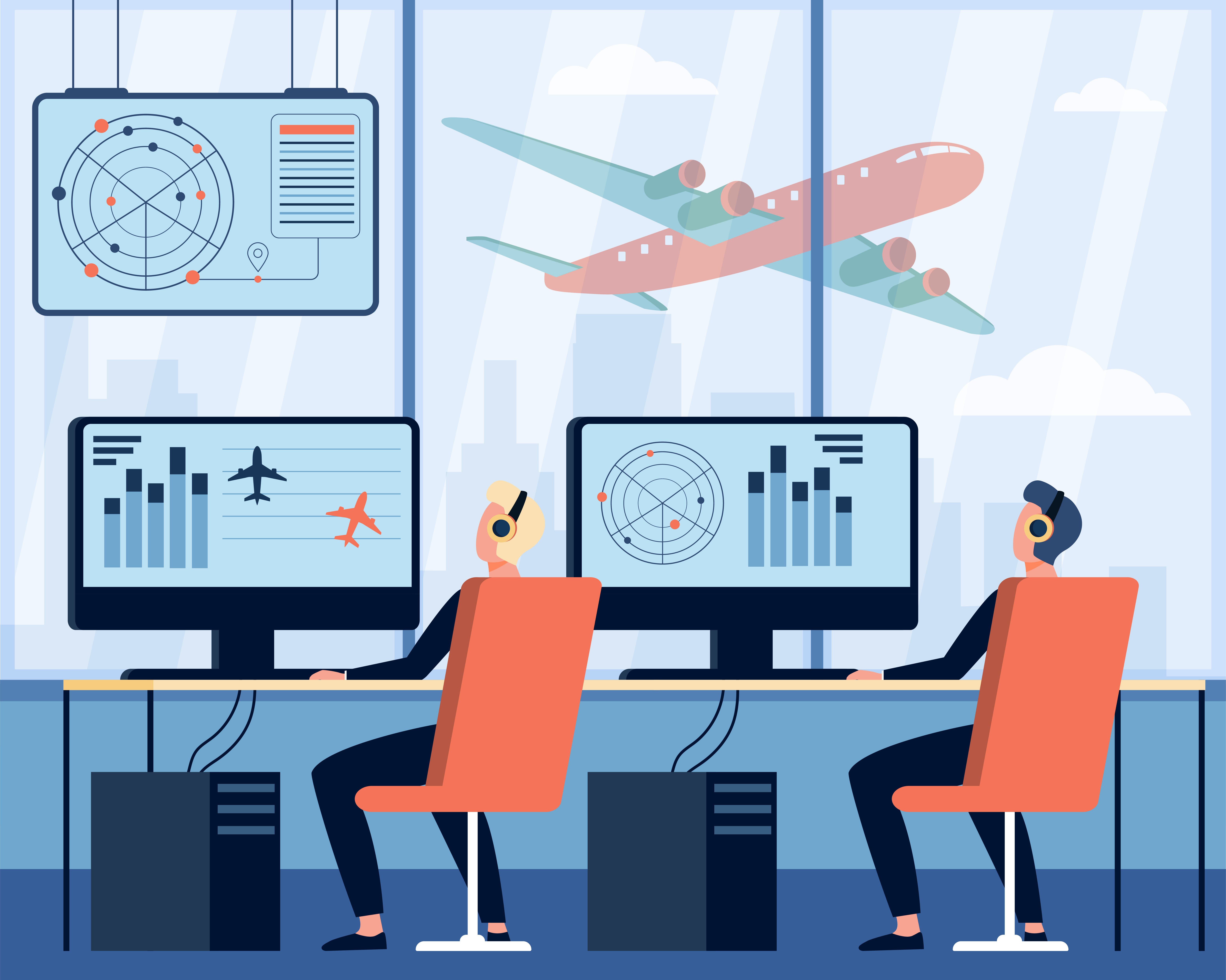
A controller’s screen is the visible tip of a much larger data stream. Behind each tracked aircraft there are radar returns, ADS-B broadcasts, flight plan updates, weather feeds, and inter-centre coordination messages. AI systems sit between those raw streams and the controller’s display, filtering for what matters in the next few minutes.
Deep neural networks trained on historical flight tracks and incident reports learn the shape of routine traffic. When current trajectories drift away from that shape — a closing pair, a hold pattern stretching past its planned duration, a flight descending earlier than its profile predicts — the model raises the salience of those tracks on the controller’s display. The model is not predicting collisions in some absolute sense; it is reducing the number of tracks the human has to actively monitor at any given moment.
Two practical consequences follow. First, traffic spikes become more manageable without adding staff. Second, advisory routing suggestions are visible alongside the alert, so the controller can compare options instead of constructing them from scratch under pressure.
Neural Network Decision Support
Decision support is the most mature application area. A neural network ingests radar feeds, flight plans, and current weather, then ranks the available options for resolving a developing conflict. The output is not a single “do this” command — it is a ranked set of choices with the relevant constraints surfaced next to each.
Controllers see consolidated visuals rather than raw multi-screen data. Time-sensitive conflicts are flagged with their estimated time-to-loss-of-separation. Outcomes are logged for retraining, which closes the loop between deployment and model improvement. The systems we design follow this same pattern: the model proposes, the human disposes, and the trace is preserved.
For the underlying recurrent-network architecture often used for sequence-of-tracks reasoning, see Recurrent Neural Networks (RNNs) in Computer Vision.
Deep Learning in Conflict Prediction
Airspace conflicts arise when two aircraft risk a loss of separation or an unstable approach geometry. Conflict prediction models are trained on years of track data plus incident histories, so they learn the time-altitude signatures that typically precede an intervention. The model output is an estimated time-to-conflict plus a set of avoidance options — vectoring, altitude changes, speed adjustments — each annotated with its downstream impact on other traffic.
The key constraint is explainability. A controller cannot act on a model prediction unless the reasoning is visible enough to confirm or override quickly. Production conflict-prediction systems therefore expose the contributing factors — relative geometry, closure rate, current clearances — rather than only the verdict. The controller’s authority remains intact precisely because the model’s reasoning is legible.
Generative AI for Simulating Scenarios
Training and resilience testing rely on a different family of models. Generative systems synthesise traffic scenarios that combine routine load with weather events, equipment failures, or emergency declarations. The simulator can vary thousands of parameters — wind shifts, runway closures, simultaneous emergencies — and run them against trainees or against the production decision-support stack.
This solves two problems. Rare-event coverage in real training is naturally thin; simulated rare events are cheap to generate. And stress testing of decision-support models against synthetic worst-case scenarios surfaces failure modes before they appear in live operations. We cover the broader pattern in our generative AI work.
Computer Vision for Runway, Apron, and Surveillance
Ground operations are where computer vision becomes most directly useful. Camera networks monitor runways for foreign object debris and wildlife incursions. Vision models track aircraft and ground vehicles on the apron. Some installations use vision to corroborate radar tracks at low altitude where radar coverage degrades.
The discipline is the same as in any operational computer vision system: latency budgets, lighting variation, weather-robust models, and clear handover rules to human operators. Detections are presented as alerts with bounding evidence — a clip, a still, a track — so controllers can verify rather than blindly trust. For an adjacent application, see AI-Powered Computer Vision Enhances Airport Safety.
Speech Recognition for Clearance Verification
Pilot-controller voice communication is structured but not rigid. Speech recognition models trained on aviation phraseology can transcribe clearance exchanges in real time and check them against the issued clearance in the flight data system. When a readback drifts from the clearance, the system flags the discrepancy for the controller to verify.
This is a narrow but high-value application: read-back errors are a known contributor to runway incursions and altitude busts. The model does not replace the controller’s ear; it provides a second listener that never fatigues.
What AI in Air Traffic Control Actually Solves
AI in air traffic control is best understood as a set of bounded augmentations to specific decision points, not as a single system. The current operational footprint includes:
| Capability | Decision point | Primary model class |
|---|---|---|
| Conflict prediction | Strategic and tactical separation | Sequence models on track data |
| Decision support | Resolution option selection | Constraint-aware ranking models |
| Voice verification | Clearance readback check | Domain-tuned speech recognition |
| Runway monitoring | Ground-incident detection | Computer vision (detection + tracking) |
| Traffic flow advisory | Sector load balancing | Forecasting + optimisation hybrid |
| Training simulation | Controller skill development | Generative scenario synthesis |
Each row corresponds to a measurable workload reduction or a specific error class being caught earlier. None of them transfers the final authority away from the controller.
Cross-Centre Coordination
Flights routinely pass through several control sectors and centres. AI systems improve handover quality by maintaining a consistent view of the flight across the centres it touches — updated flight intent, current constraints, downstream weather impact. When a delay accrues in one sector, downstream centres receive an updated arrival profile early enough to adjust holding patterns or runway sequencing instead of reacting at the boundary.
This kind of coordination is not new conceptually; what is new is the latency. Models that run continuously over the live picture surface changes within seconds rather than at fixed planning cycles.
Learning from Past Events
Post-incident learning has always been part of air traffic control’s safety culture. AI changes the cadence. Models can ingest millions of historical tracks and incident reports to find patterns that are too thin to spot through individual case review — a particular intersection geometry that produces near-misses under specific wind conditions, a sector load threshold above which deviations accumulate, a phraseology pattern correlated with read-back errors. These findings feed back into procedures, training, and the models themselves.
Handling Emergency Situations
Probe these systems and latency constraints emerge as the binding design constraint. AI systems detect abnormal flight behaviour — unexpected altitude loss, deviation from cleared route, transponder code changes — and surface the relevant context immediately: nearest suitable airports, terrain, current weather along candidate diversion routes, and other traffic in the path. The controller still chooses; the system removes the lookup time.
Integration with Unmanned Aircraft
Why do trajectory models fail during rapid descent phases? Radar is unreliable below a certain cross-section; cameras and acoustic sensors fill some of the gap. AI models fuse those inputs into a single picture and apply geofencing logic to keep drones out of controlled airspace. The same picture supports planned drone corridors for delivery and survey operations. For the adjacent autonomous-vehicle perception problem, see Computer Vision Applications in Autonomous Vehicles.
Training and Skill Assessment
Integration with legacy radar feeds forces architectural compromises at every protocol boundary. AI extends this in two directions. Scenario generators produce more varied training material than a human instructor can author. Performance assessment models measure time-to-resolution, communication clarity, and decision quality consistently across trainees. Where a trainee struggles — weather-driven re-routing, simultaneous emergencies, high-density arrival sequencing — the system biases scenario selection toward that gap.
Regulatory Compliance and Auditability
Consider how alert fatigue shapes acceptable false-positive rates in separation tools. Decisions, recommendations, the inputs that produced them, and the controller’s response are logged in formats that regulators can replay. Weight, altitude, and separation constraints are checked continuously, with violations flagged before they propagate. The system itself does not relax constraints; it makes them visible.
Balancing AI Against Human Oversight
Anomaly detection across handoff transitions requires context that spans multiple control positions. The answer that holds up under operational scrutiny is the narrow one: AI provides information, ranking, and early warning. Controllers act. The decision authority does not migrate.
The reason is not sentimental. It is that the failure modes of machine learning models — distributional shift, silent degradation under unusual conditions, miscalibrated confidence — are exactly the cases where a human’s situational judgement matters most. The controller is the safeguard against the model’s edges.
Privacy, Cybersecurity, and System Integrity
Traffic-control data is sensitive: flight plans, radar tracks, communication logs, and identifying information about passengers and crews. AI components inherit the operational system’s encryption and access-control posture. They also become additional attack surfaces, which means model integrity monitoring — detecting tampered inputs, anomalous output distributions, or suspicious access patterns — becomes part of the security stack. For the broader pattern in connected infrastructure, see IoT Cybersecurity: Safeguarding against Cyber Threats.
Hardware and Integrated Infrastructure
Model drift monitoring becomes operationally essential when retraining cycles reach monthly cadence. Air traffic control centres deploy GPU-accelerated servers for deep neural network inference, redundant networking between sensors and processing nodes, and storage tiered for both live data and long-term audit retention. Sensor inputs — radar, ADS-B, voice radio, satellite links — feed into the AI stack through interfaces engineered for bounded latency. Redundancy is non-negotiable: hot swaps, failover paths, and continuous performance monitoring are part of the baseline, not an upgrade.
Scaling Across Regions and Languages
Voice-to-text systems tuned for one airspace struggle when deployed to geographically distinct control centres. Production systems are built with a consistent core architecture and a configuration surface for regional rules, language models, and approach patterns. Speech recognition models in particular are tuned per region to handle accent and phraseology differences without losing the standard-aviation backbone. For the underlying vision-algorithm work that supports much of the runway and surveillance side, see Core Computer Vision Algorithms and Their Uses.
Economics of Deployment
Scenario generation for controller training must reflect seasonal traffic patterns and equipment outages. It is built on capacity. Adding controllers to handle growing traffic is expensive and slow; augmenting existing staff with decision support is faster. Reduced delays, fewer incidents, and lower fuel burn from better routing all enter the cost-benefit ledger. Simulation-based training reduces instructor hours. These savings compound, but they are second-order to the capacity argument.
Maintenance and Model Lifecycle
Root-cause analysis now leverages trajectory clustering to identify systemic coordination failures. New aircraft types, changing route structures, evolving weather patterns, and new phraseology all shift the input distribution. AI maintenance in air traffic control therefore looks more like ongoing engineering than periodic deployment: continuous monitoring of model performance, scheduled retraining with recent data, offline validation before deployment, and staged rollouts. IT teams, model engineers, and operational staff coordinate on these cycles. Downtime is not acceptable, so redundant systems carry the load during updates.
What Comes Next
Surface surveillance fuses multiple sensor modalities, each with different failure modes and calibration drift. The number of decisions per controller per hour will continue to rise. AI is the practical mechanism for absorbing that growth without proportional staffing increases, and without compromising the human authority structure that gives the system its safety record.
The trajectory is incremental. Each year a few more decision points gain machine assistance, the assistance gets more reliable, and the controller’s job shifts a little further toward supervision and exception handling. That is what AI in air traffic control actually looks like in practice.
How TechnoLynx Can Help
At TechnoLynx, we build AI systems for safety-critical operational environments, including the kinds of components that appear in air traffic control: neural-network decision support, computer vision for ground and approach monitoring, speech recognition tuned to constrained phraseology, and generative-AI simulation for training and stress testing. We design these systems around the same principle that holds in the control room — the model proposes, the human decides, and the trace is preserved. We work alongside operational specialists rather than around them. Let TechnoLynx support your journey toward safer, smarter skies.
Frequently Asked Questions
How is AI used in air traffic control today?
Controllers receive algorithmic support through conflict prediction across live flight tracks, ranked resolution options during congestion, voice recognition that verifies clearance read-backs, computer vision monitoring runways and taxiways, and generative simulation environments for procedural training. None of these systems take final authority away from the human controller.
Does AI replace human air traffic controllers?
No. AI reduces the cognitive load on controllers by filtering data, flagging conflicts earlier, and surfacing resolution options, but the final decision authority remains with the human. This is a deliberate design constraint — model failure modes such as distributional shift and miscalibrated confidence are exactly the situations where human situational judgement is most needed.
What models are used for conflict prediction in air traffic control?
Deep neural networks — typically sequence models trained on historical track data combined with incident reports — learn the patterns that precede a loss of separation. They output a time-to-conflict estimate and a ranked set of avoidance options, with the contributing factors made visible so the controller can verify the reasoning rather than blindly accept the verdict.
How does AI handle drones and unmanned aircraft near airports?
AI fuses inputs from radar, cameras, and acoustic sensors to track small unmanned aircraft that conventional radar may miss. It applies geofencing logic to keep drones out of controlled airspace, manages planned drone corridors for delivery and survey work, and alerts tower staff to incursions in real time so coordinated responses can begin before the drone interferes with manned traffic.
Regulatory hurdles facing AI in aviation safety
Certification frameworks designed for deterministic software cannot yet accommodate machine learning systems whose decision boundaries shift with retraining, creating a compliance gap that no major aviation authority has resolved. Image credits: Freepik