Cinematic VFX AI: Transforming the World of Filmmaking
Filmmaking has always relied on creativity and advanced tools to captivate audiences. Today, cinematic VFX AI is at the heart of modern film production, taking the quality and speed of visual effects to new levels. By incorporating AI into visual and sound effects during post-production, filmmakers achieve striking results while shortening schedules and reducing costs.
Cinematic VFX AI lets creators blend reality with imagination at a speed traditional pipelines cannot match. Its capabilities enable real-time adjustments on set and in the edit suite, giving directors room to experiment without rebuilding shots from scratch. This is reshaping the way films get made and the visual quality audiences expect. The sections below look at where the gains actually come from — and where the technology still leaves human craft in charge.
What does cinematic VFX AI actually do?
The phrase covers a cluster of distinct models, not a single tool. In our work with studios and post houses, we see four recurring categories: segmentation and rotoscoping models (often built on architectures like Mask R-CNN or SAM-style transformers), generative models for textures and environments, neural rendering for relighting and view synthesis, and audio models for sound design and dialogue cleanup. Each one slots into a different point of the pipeline, and each has different failure modes.
Two facts shape the practical picture:
- Rotoscoping and matte generation are the most reliable wins today. Frame-by-frame masking that once consumed days of artist time can be reduced to a review-and-correct workflow, where the model proposes masks and a compositor cleans the failures. The labour saving is real, but the model still misses on motion blur, hair, and transparent objects.
- Generative video and full-scene synthesis remain a different category of risk. Temporal coherence — keeping a generated element stable across frames — is unsolved at production fidelity. Studios use these tools for previs and ideation, not for final pixels, except in narrow shots.
These are operational observations from current pipelines, not benchmark numbers from a single test. Treat them as the shape of the field, not as universal limits.
How cinematic VFX AI improves visual effects
Visual effects are essential for the immersion that audiences now take for granted. AI-driven VFX lets studios produce complex shots with less manual labour, but the gain is concentrated in specific tasks rather than spread across the whole pipeline.
Automated rotoscoping and clean-up
In traditional VFX, artists roto each frame in a sequence by hand. Modern segmentation networks — built on architectures like SAM, Mask R-CNN, and DeepLab variants, often deployed through PyTorch or TensorRT — propose masks that compositors refine instead of authoring from zero. The same models drive automated clean-up: removing rigs, microphones, and tracking markers that used to be painted out frame by frame. The result is a shift from authoring labour to review labour, which is faster but still skilled.
Real-time rendering and on-set previs
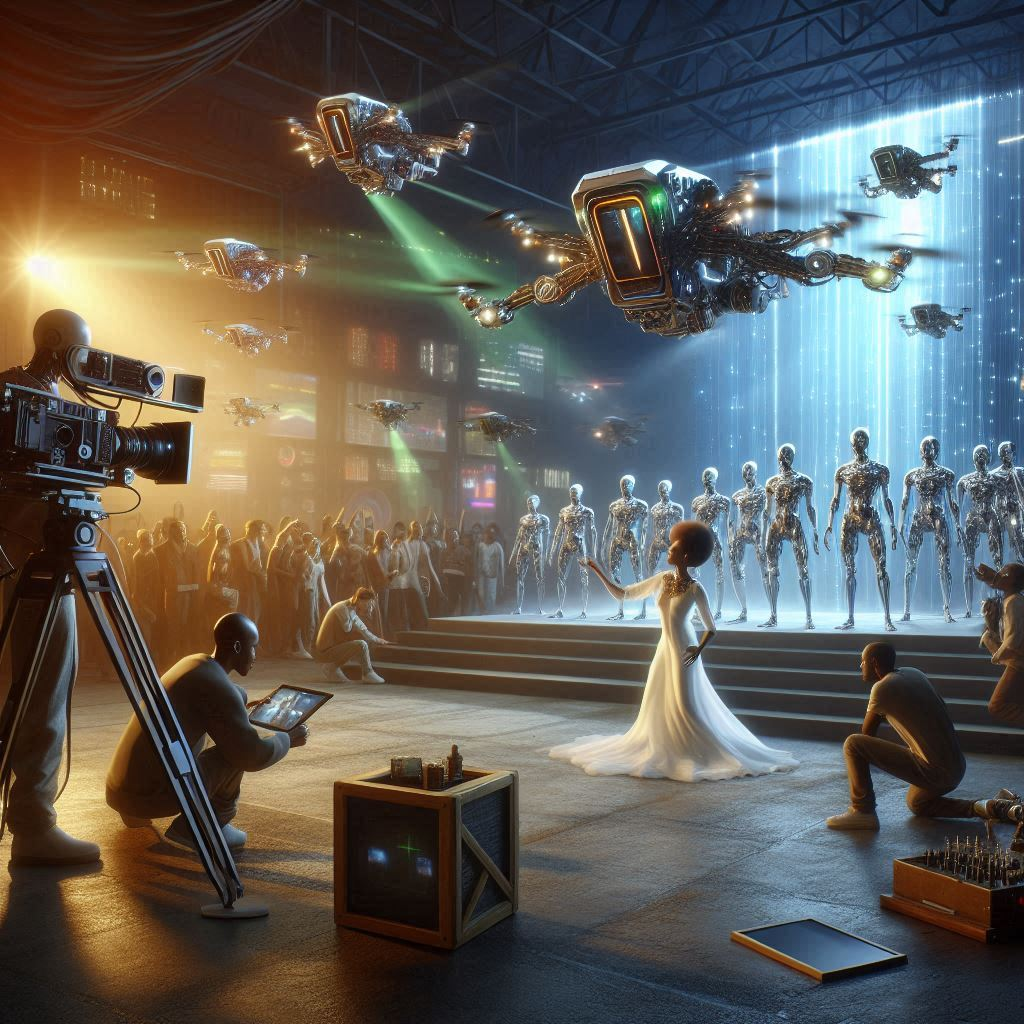
Real-time rendering is one of the most visible shifts. LED-volume productions running Unreal Engine, combined with neural relighting and view-synthesis models, let directors see a near-final composite while the camera rolls. This compresses a feedback loop that used to span days. Actors get a real backdrop to react to, and DPs can light the scene against the actual virtual environment instead of guessing what the comp will look like.
The cost is upfront: building the virtual asset, calibrating the volume, and running the GPU farm that drives the wall. For productions willing to absorb that cost, the schedule savings further down the pipeline tend to justify it.
AI in sound effects: creating immersive audio for films
Sound is half the picture, and it is where AI-assisted tooling has matured quietly. Read more on the broader audio side in AI’s influence on musical composition.
Generating and modifying sound effects with AI
AI-driven sound software can synthesise effects from text prompts or reference clips — rainfall in a quiet forest, an explosion in a cityscape, the hum of a fictional engine. Diffusion-based audio models and neural vocoders have made this practical for sound designers as a starting point, not a finished asset. The output gets layered, processed, and mixed alongside conventionally recorded material.
The bigger win is in dialogue and noise reduction. Tools built on neural source separation can isolate dialogue from unusable production audio, recovering takes that would previously have demanded ADR. This is where AI most directly saves money: a usable take is worth more than a perfect one re-recorded weeks later.
Adaptive scoring and ambience
AI can shift ambience based on what is happening on screen — a horror scene moving from neutral room tone to a low, unsettling drone as tension rises. This remains a tool for the sound designer to direct, not a replacement for one. The model proposes; the human chooses.
Where cinematic VFX AI sits in post-production
| Pipeline stage | AI contribution | Human role |
|---|---|---|
| Rotoscoping / masks | Auto-segmentation, propagation across frames | Review, correct edges, hair, transparency |
| Clean-up / paint | Object removal, inpainting | Validate temporal stability, fix artefacts |
| Compositing | Neural relighting, depth estimation | Art direction, final integration |
| De-ageing / face work | Identity-preserving generative models | Performance fidelity, ethical review |
| Sound design | Generative SFX, dialogue isolation | Selection, mixing, mood |
| Colour | Look transfer, scene-detection assist | Final grade, creative intent |
The pattern is consistent: AI compresses the mechanical work and leaves the judgment work intact. Studios that try to remove the human entirely from any of these rows tend to ship visible artefacts.
Editing and colour correction
AI tools can detect scene boundaries, suggest rough cuts, and propose colour treatments aligned to a reference look. For colour, look-transfer models trained on reference grades give a workable starting point that a colourist refines. This is most valuable on shorter formats — episodic content, commercials — where the volume of decisions outweighs the depth of any single one.
Facial recognition and de-ageing
De-ageing has become one of the most visible applications, and one of the most scrutinised. Identity-preserving generative models can adjust apparent age across a performance while keeping the actor’s expressions intact. The technical bar has risen sharply over the last few years, but the failure mode remains the same: the uncanny valley shows up under close inspection, especially around the eyes and mouth in dialogue scenes.
The honest framing is that de-ageing works when the audience is not asked to look too closely. In a long, static close-up, current tooling still struggles.
Case studies: where cinematic VFX AI shows up
A few patterns recur across recent productions:
- De-ageing in franchise films. Several Marvel and Lucasfilm productions have used AI-assisted de-ageing or digital recreation. The technical execution is impressive; the audience reaction is mixed, which is itself a useful data point about the limits of the technique.
- Virtual-production environments. Productions including The Mandalorian and successors have used LED-volume workflows with real-time engine renders, supported by neural relighting and view synthesis to maintain consistency between virtual and physical elements.
- Dialogue rescue. Across episodic television, neural noise reduction and source separation now routinely recover takes that would previously have required reshoots or ADR sessions.
These are observable industry patterns rather than measurements from a specific benchmark — the underlying tooling varies between vendors, and few studios publish their pipeline details.
Benefits for independent filmmakers
Independent productions face the sharpest budget constraints, and they are where AI-assisted post tools have the largest relative impact. A small team can now produce shots that previously demanded a dedicated VFX house, provided the ambition is matched to what the tooling actually does well — clean-up, masking, dialogue recovery, look development — rather than to the hardest cases like full character work or long generative sequences.
The realistic framing is that AI raises the floor of what is achievable on a small budget. It does not yet close the gap to top-tier VFX work, and it requires operators who understand both the creative goal and the model’s failure modes.
Social media, short-form, and the expanding audience
Social platforms have integrated AI-driven effects directly into capture, putting cinematic-style tools into the hands of every creator. This has two effects on professional filmmaking: it raises audience literacy about what AI effects look like (including their tells), and it creates pressure on professional work to be distinguishably better. The bar moves, in other words, but it moves in both directions — and that has consequences for what professional cinematic VFX AI has to demonstrably do better than what is now available on a phone. Read more on the marketing-adjacent side in our piece on AI marketing and use cases.
TechnoLynx’s role in cinematic VFX AI
Real-world implementations reveal strengths and failure modes that benchmarks miss. Off-the-shelf models cover the easy 70% of any task; the remaining 30% — the edge cases that ship in the final cut — is where bespoke training, integration with existing tools, and careful evaluation matter most (as a rule of thumb in deployment). Our work focuses on that last segment: making AI components reliable enough that compositors and sound designers can trust them inside a deadline-driven schedule.
The future of cinematic VFX AI
Rotoscoping, depth estimation, and style transfer each demand different model characteristics. It is toward compressing the mechanical layer of the work so that judgment, taste, and direction get more of the schedule. Real-time rendering will keep improving. Generative video will eventually cross the threshold where temporal coherence is reliable. De-ageing will keep narrowing the uncanny gap.
What stays constant is the role of the human in the loop. Every step of the post-production pipeline still has a failure mode where a model produces something that is technically correct and creatively wrong. Catching that is not an automation problem. It is what filmmaking is.
Continue reading: Harnessing AI for next-level cinematography.
Frequently asked questions
What is cinematic VFX AI used for in filmmaking?
Cinematic VFX AI covers a cluster of models used across post-production: segmentation networks for rotoscoping and clean-up, neural rendering for relighting and view synthesis, generative models for textures and environments, and audio models for sound design and dialogue cleanup. Each one targets a specific task — none replaces the full pipeline.
Does AI replace VFX artists?
No. Current tooling compresses the mechanical layer of the work — masking, paint-outs, noise reduction — while leaving judgement work (art direction, performance fidelity, final integration) with the artist. Studios that try to remove the human from any of these decisions tend to ship visible artefacts.
How does real-time rendering change on-set work?
Real-time rendering, combined with LED-volume productions and neural relighting, lets directors and DPs see a near-final composite while filming. This compresses a feedback loop that used to span days into one that runs while the camera rolls — at the cost of significant upfront investment in the volume, virtual assets, and GPU infrastructure.
Can AI-generated sound effects replace traditional sound design?
Not as a finished asset. Generative audio models produce useful starting material — synthetic SFX, ambience, dialogue cleanup — that sound designers then layer, process, and mix alongside conventionally recorded sound. The clearest direct saving is in dialogue rescue, where neural source separation can recover takes that would otherwise need ADR.
Image credits: Freepik