
Introduction
MLOps consulting for a manufacturer that has never operationalised a model is a specific applied example with a specific failure mode: the consultant arrives with a reference stack designed for an organisation with mature data engineering, the manufacturer’s first project drowns in CI/CD, model-registry, and monitoring scaffolding before producing a deployed prediction, and the project becomes an artefact in the long history of ML investments that never reached production. The useful MLOps engagement does the opposite: scopes the smallest viable stack against the first project’s genuine requirements, defers the capabilities that do not yet apply, and produces a deployed model alongside the just-enough operational surface that lets it survive. See services for the broader consulting framing that backs this applied example.
The naive read is “MLOps is best practice, deploy the full stack.” The expert read is that the full stack is overengineering for a first project and the right scope is the smallest viable subset, with the rest deferred until the second or third deployment justifies the investment.
What this means in practice
- First MLOps deployment needs the smallest viable stack, not the reference architecture.
- Specific capabilities (CI/CD for models, monitoring, retraining, registry) are valuable; together as upfront investment they overshoot.
- Tool choice for first deployment is the one the team can absorb, not the one a mature organisation would standardise on.
- Most ML models never reach production because the operational gap is not budgeted; budgeting it from the start is the discipline.
What does MLOps actually mean for an organisation that has never operationalised a model?
MLOps for the first-time deployer is “the operational scaffolding that lets one model run reliably in production”: a deployment surface (where the model serves predictions), a data path (where prediction inputs and outcomes flow), a monitoring surface (the team sees when the model degrades), and a re-deployment path (when the model needs updating, the path exists and is rehearsed). That is the minimum.
What it is not, for the first deployment: a model registry covering hundreds of models, CI/CD with full lineage tracking across experimental branches, a feature store serving multiple consumers, an automated retraining pipeline triggered by drift detectors. Those are valuable at scale; for a first deployment they are infrastructure built before the requirement that justifies them exists. The mature MLOps engagement frames the first deployment as the artefact that earns the right to invest in the next layer of scaffolding, not as the first step in a top-down enterprise rollout.
Which MLOps capabilities does a first project genuinely need, and which are overengineering?
Genuinely needed for the first deployment: a deployable model artefact (a serialised model with a documented inference contract); a deployment target (an inference service, a batch job, an edge device — whatever fits the use case); a data path into the model (the production data the model needs is reliably available); a feedback path back from the model (predictions are logged with enough context to evaluate later); a basic monitoring view (the team can answer “is the model still working” without spelunking through raw logs).
Overengineering for the first deployment: a feature store before the team understands which features need centralising; full CI/CD for models before the team has more than one model; automated retraining before the team has measured drift on the deployed model; a model registry before the team has multiple models to register. The pattern: the capability is genuinely valuable; the timing of the investment is wrong. Build the capability when the third or fourth deployment makes the absence painful; do not build it before the first deployment exists.
Which MLOps tools and frameworks are realistic for a first deployment?
Realistic for first deployment: a model-serving framework the team can operate (FastAPI plus a containerised inference service for a Python-fluent team; a managed inference endpoint from a cloud provider for a team with cloud capability and no operations bandwidth); a logging and metrics stack the team already uses (Prometheus, Grafana, CloudWatch, Datadog — whatever the rest of the platform runs on); a CI pipeline the team already uses (GitHub Actions, GitLab CI — adapted to the model artefact, not replaced).
Unrealistic for first deployment: a full MLflow or Kubeflow installation without the team capacity to operate it; SageMaker or Vertex AI’s full feature set before the team can use the basic deployment endpoint; a feature store (Feast, Tecton) before the data engineering supports it. The pattern: pick tools the team already knows or can absorb in days, not weeks of training. The reference MLOps stack assumes mature data engineering that the first-time deployer does not yet have; building the reference stack on a thin data-engineering foundation produces a stack that nobody can operate.
What is the smallest viable MLOps stack that still produces a production-quality deployment?
Five components, each at minimum. (1) Model artefact: trained model serialised, with a documented inference contract (input schema, output schema, expected latency, expected error modes). (2) Deployment: the model runs at the deployment target with health checks, logging, and a rollback path. (3) Data: production inputs flow reliably to the model; the data quality at production matches the data quality at training. (4) Monitoring: the team sees the model’s prediction volume, prediction distribution, and basic error indicators. (5) Lifecycle: the team has rehearsed the path to deploy a new model version when one is needed.
That is the minimum viable stack. It will look austere compared to MLOps reference architectures. It is what most organisations actually need for their first production model. The capabilities deferred (registry, automated retraining, feature store, full lineage) are added when subsequent deployments make their absence costly — which they will, but only after the first deployment exists.
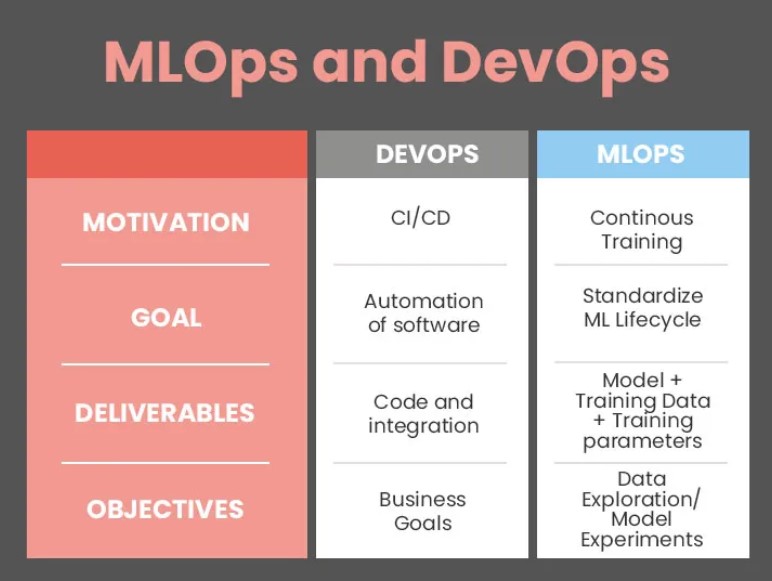
How does MLOps differ from DevOps in the data-pipeline, drift, and rollback dimensions?
DevOps deploys code; the deployed artefact’s behaviour is fully determined by the code. MLOps deploys code plus model plus data dependencies; the deployed artefact’s behaviour depends on the input data distribution as much as on the code. Three specific differences. Data pipeline: MLOps deployments depend on production data quality that DevOps deployments do not — the same code with different data produces different predictions, and the data-quality monitoring is a first-class concern.
Drift: a deployed model can degrade silently as the production data distribution shifts away from the training distribution; DevOps code does not have a drift analogue. Drift monitoring (data drift, prediction drift, ground-truth drift when feedback is available) is the new operational surface. Rollback: MLOps rollback is more complex because rolling back a model also requires rolling back the feature definitions and possibly the data pipeline that produced them; a partial rollback can produce a worse state than either version alone. The honest MLOps engagement treats these three dimensions as first-class engineering concerns, not as add-ons to a DevOps pipeline.
Why do most ML models never reach production, and which MLOps gaps cause that?
The dominant pattern: the model is trained, the team demonstrates it on a test dataset, the project celebrates the technical achievement, and the operational gap to production deployment is left unbudgeted and unscoped. The model sits in a notebook. The operational gap is the work that this article describes — deployment surface, data path, monitoring, lifecycle — and it is real engineering work, not a small follow-on task.
The MLOps gaps that produce the failure pattern: no deployment target identified before the model is trained; no plan for production data delivery to the deployed model; no plan for prediction logging or evaluation against ground truth; no plan for who operates the model after deployment. Each gap is preventable; the team that scopes them into the project plan from the start deploys; the team that does not deploy joins the population of ML projects that never reached production. MLOps consulting’s value is making these gaps explicit at project start, not solving them retroactively after the model is trained.
Limitations that remained
Even the well-scoped first MLOps deployment carries limits. The minimum viable stack does not cover the model-discoverability problem that emerges at multi-model scale — finding which model is deployed where, who owns it, when it was last retrained. It does not solve the data-quality problem at scale — a small number of carefully-curated inputs is feasible; broad input coverage from many upstream sources requires the data-engineering investment that follows. It does not eliminate model drift; it only makes drift visible — the retraining strategy is a separate project that the first deployment earns the right to commission. The honest framing is that the minimum stack is the foundation for incremental investment, not a finished destination.
The MLOps Consulting useful Manufacturing takeaway
Here the MLOps Consulting useful Manufacturing picture narrows. We scope the deployment surface, data path, monitoring, and lifecycle for the first project, defer the capabilities that do not yet apply, and earn the right to invest in the next layer through the success of the first deployment. If your team is scoping a first ML deployment and needs the operational gap budgeted from the start, contact us.
Image credits: Freepik