A container ship leaving a deep-water port today is steered by more software than a 1990s commercial airliner. Hull shape, route plan, engine wear curves, deck surveillance — every layer now has an AI component sitting next to the human operator. The interesting question is not whether to adopt AI for maritime transportation systems, but which layers actually repay the integration cost and which ones quietly add fragility.
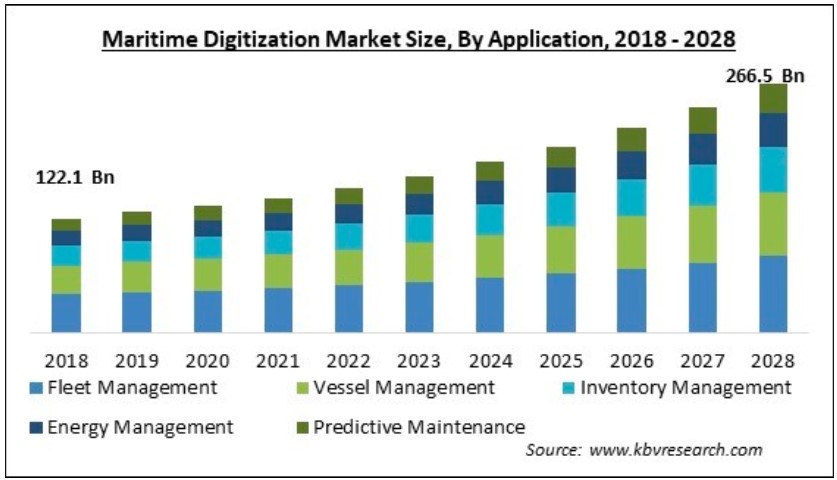
Maritime transportation systems cover the interconnected components that move goods, passengers, and cargo by water — vessels, ports, navigation infrastructure, scheduling, customs, and the data exchange that ties them together. AI touches each of those layers differently. Some applications, such as generative hull design and machine-vision collision avoidance, are already operational. Others, such as fully autonomous deep-sea voyages, remain a research direction. The global maritime digitisation market is projected to reach $266.5 billion by 2028, which is a market-direction figure rather than an operational benchmark — useful as framing, not as a justification for any single deployment.
The rest of this article walks through four concrete layers — ship design, autonomous navigation, predictive maintenance, and safety/security — then steps back to the environmental and integration trade-offs that determine whether any of it survives contact with a working fleet.
How does AI change ship design and construction?
Naval architecture has historically been a long iteration loop. A hull form is drafted, evaluated in tow-tank or CFD simulation, refined, re-evaluated, and eventually frozen. Generative models compress part of that loop by proposing candidate geometries directly. ShipHullGAN, introduced in April 2023, is a deep convolutional generative model trained on 52,591 ship-hull designs spanning container ships, tankers, bulk carriers, tugboats, and crew supply vessels. It can produce candidate hulls across that design space, including regions a human designer might not explore by hand.
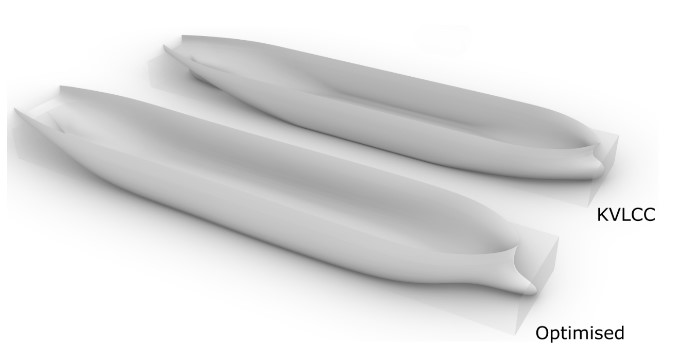
In one part of the published study, ShipHullGAN was used to optimise hulls for a container ship and an oil tanker, targeting reduced wave resistance at constant cargo capacity. The optimised forms differed from the reference KVLCC hull most visibly at the stem and stern, which is where wave-making resistance is dominated in slow-moving merchant vessels. The figure below shows the geometric comparison.
A generated hull is only a starting point. It still needs CFD validation, finite element analysis (FEA) for structural margins, and class-society review. This is where GPU acceleration matters more than the generative model itself. FEA over a fine mesh of a ship hull is computationally heavy by construction — millions of degrees of freedom, multiple load cases, multiple sea states. GPU-accelerated solvers using CUDA and frameworks such as PyTorch or domain-specific tools shorten the inner loop enough that several candidate designs can be evaluated in the time previously required for one. In our experience with simulation-heavy R&D workflows, the bottleneck is rarely the model — it is the evaluation cost per candidate, which is exactly what parallel hardware addresses.
For deeper context on the simulation side, see AI’s role in electrical and mechanical design.
Autonomous navigation: what AI actually adds at sea
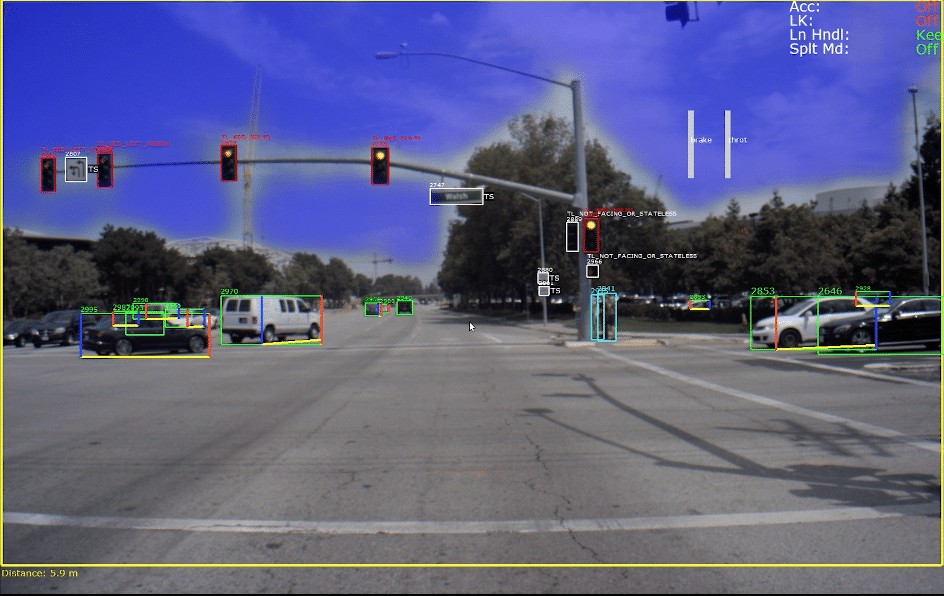
Autonomous navigation in maritime systems is a different problem from autonomous road driving. The objects of interest are sparser, the closing speeds are lower, and the regulatory environment (COLREGs) is explicit about right-of-way. The hard part is detection in conditions where Radar and AIS give partial information — small craft without transponders, debris, ice, fishing gear.
Computer vision is being used to close that gap. Robosys Automation and SEA.AI have built a machine-vision-based collision avoidance system that fuses thermal and low-light camera feeds with a database of over 9 million annotated marine objects to detect and classify objects around a vessel. The combined sensor stack provides 360° situational awareness and feeds the Voyager AI System, which integrates the vision data with conventional tracking sources (Radar, AIS, ECDIS) and can recommend or execute manoeuvres.
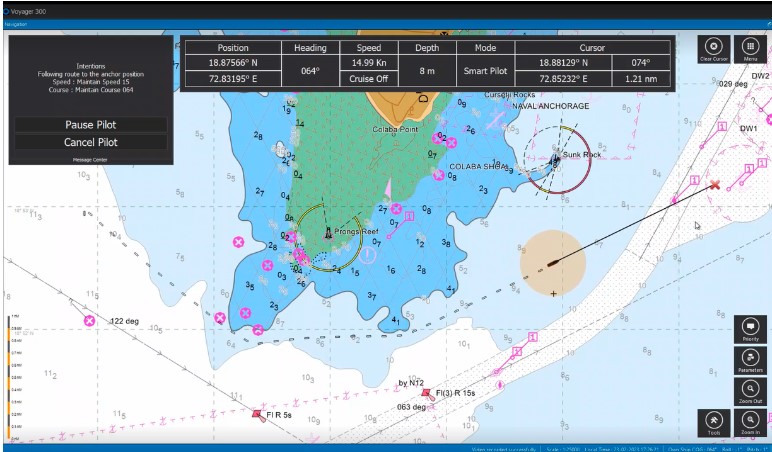
The interface above shows the vessel’s position, heading, speed, and surrounding water depth, with a planned course threading between other vessels, navigational buoys, and hazards. The crew retains the option to adjust or halt the automated piloting at any point. That is the operational pattern that matters: the AI provides a consistent visual lookout that does not tire, while the human keeps command authority. This is a meaningful claim — a continuous, fatigue-free visual lookout is structurally hard to staff with humans on long passages, and that is where the system earns its place.
| Sensor / system | Best at | Blind spot |
|---|---|---|
| Radar | Large metal targets, long range | Small wooden craft, debris near water line |
| AIS | Cooperating vessels with transponders | Non-AIS craft, fishing gear |
| Thermal camera | Warm objects at night, persons in water | Cold debris, ice at sea temperature |
| Low-light camera | Visual classification, buoys, small craft | Heavy fog, spray |
| Voyager AI fusion | Combined situational picture | Sensor-disagreement handling under load |
For the adjacent automotive treatment, see AI for autonomous vehicles; for the routing layer, reinventing pathfinding with AI-driven navigation systems covers the optimisation side.
Predictive maintenance on board
Vessels are expensive idle. Unplanned downtime for a drillship can run up to $12 million per year — a published-survey figure from a single asset class, not a fleet-wide benchmark, but indicative of the order of magnitude. Predictive maintenance shifts intervention from calendar-based or failure-driven to condition-driven, which only works if the condition signal is reliable.
IoT sensors are placed on engines, shafts, fuel systems, HVAC, and structural members to record temperature, vibration, pressure, and humidity continuously. Edge computing on board pre-processes the streams — bandwidth to shore via satellite is constrained, so anomaly detection often runs locally on edge devices before only the salient events are forwarded.
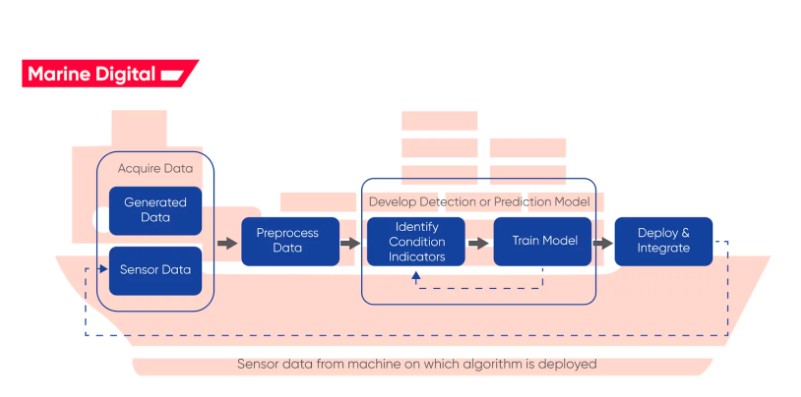
The model layer compares live signals against historical baselines and known failure signatures. Vibration spectra are particularly informative: bearing wear, misalignment, and cavitation each have distinct frequency-domain fingerprints. The honest constraint is the labelled-failure dataset — most vessels do not experience enough catastrophic failures to train a supervised model end-to-end. The practical pattern we observe is a mix of physics-based residuals, unsupervised anomaly detection on multivariate sensor streams, and supervised classifiers trained only where the failure mode is common enough to label.
AI for maritime safety and security
Safety and security cover a wider surface than navigation alone. Port facilities, restricted areas on board, crew health, and emergency response all carry AI components now.
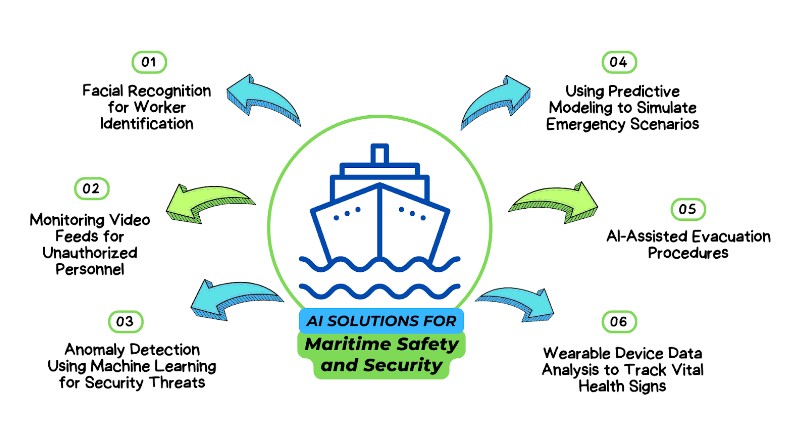
Computer vision on dock and on-board cameras handles access control — identifying authorised personnel and flagging unauthorised presence in restricted zones. The same video infrastructure supports anomaly detection: a crew member entering a hazardous area without the right protective equipment, an unexpected object on a cargo deck, an unattended bag in a passenger terminal.
Wearable devices feed a separate layer. Vital-sign monitoring on crew members can flag fatigue, heat stress, or cardiac events early. This is a domain where false positives matter — an alert system that cries wolf is ignored within a week — so the calibration of the model to the actual physiology of the crew under operational stress is the engineering work, not the algorithm choice.
Emergency simulation is the third strand. Predictive modelling can rehearse evacuation routes under different damage scenarios (flooding compartment X, fire in section Y) and the resulting model can be used both for crew training and for live recommendation if an incident occurs.
Challenges and environmental implications
The integration story is rarely clean. Several constraints recur across maritime AI projects:
- Data quality at sea. Sensor drift, salt corrosion, intermittent connectivity, and harsh vibration all degrade the input stream. Models trained on clean datasets often miscalibrate against real shipboard data.
- Cybersecurity. Each additional networked subsystem expands the attack surface. A vessel whose navigation, engine control, and cargo management are all software-mediated is also a software target.
- Regulatory and ethical scope. Maritime law is international, and questions about liability when an AI-recommended manoeuvre contributes to a collision are still being worked out.
- Cost and scale. Smaller operators rarely have the capital for full sensor retrofits and onboard compute. Most of the published case studies come from large fleets.
- Legacy integration. Many vessels in service today run control systems designed before TCP/IP was common at sea. Bridging old PLCs and new AI stacks is non-trivial.
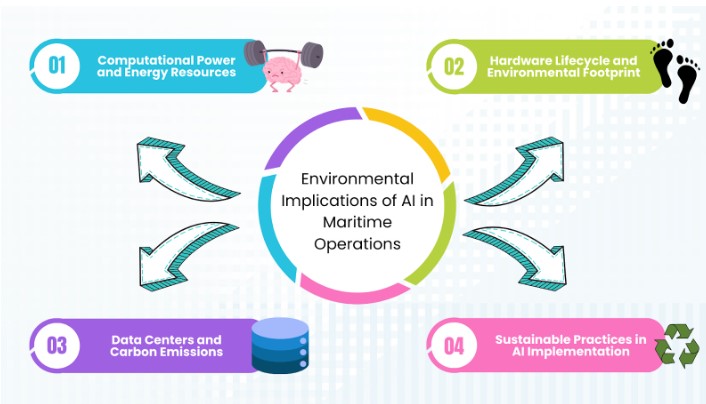
The environmental footprint is the part most often missed. AI workloads consume compute, which consumes electricity, which on most grids still implies carbon. Sensor hardware and onboard servers have manufacturing and end-of-life footprints. Data centres running shore-side analytics are energy-intensive unless powered by renewables. A maritime AI deployment that improves fuel efficiency by 2% (illustrative threshold) but adds substantial shore-side compute is not automatically a net environmental win — the accounting has to be honest at both ends.
Where TechnoLynx fits
At TechnoLynx we build R&D engagements scoped to specific maritime problems — sensor fusion for collision avoidance, GPU-accelerated simulation pipelines for hull and structural analysis, predictive maintenance models trained against real shipboard data, and computer-vision systems for port and on-board security. Our work spans early prototyping, optimisation, and integration into existing control stacks, with explicit attention to where AI helps and where it adds risk without payoff. We pay close attention to the integration boundary with legacy systems, because that is usually where projects succeed or fail.
The honest framing
Real deployments demand precision across sensor fusion architectures, retrofit constraints, and regulatory compliance frameworks that vary by flag state. It is a set of distinct layers — generative design, sensor fusion, predictive analytics, vision-based security — each with its own evidence base and its own failure modes. The shipping companies that get the most out of the current wave are the ones that pick the layer where their constraint actually binds, instrument it properly, and resist the temptation to deploy across the stack at once. The question worth asking is not “where can we add AI?” but “which decision on this vessel is currently made with bad information?”. Start there.
Frequently Asked Questions
What does AI for maritime transportation systems actually cover?
It covers four distinct layers: generative ship design (e.g. hull-form GANs), autonomous navigation and collision avoidance using computer vision, predictive maintenance using IoT sensor streams and edge computing, and safety/security using video analytics and wearables. Each layer has different data requirements and different failure modes; they are rarely deployed all at once.
How mature is autonomous navigation at sea today?
Sensor-fusion-based collision avoidance is operational on commercial vessels — the Robosys/SEA.AI Voyager system is one deployed example using thermal and low-light cameras plus a 9-million-object database. Fully autonomous deep-sea voyages remain experimental. The standard operational pattern keeps human command authority while the AI provides a continuous lookout and recommended manoeuvres.
Is predictive maintenance worth the sensor investment?
It depends on the asset class. For high-value assets where downtime cost is measured in millions per incident — drillships, large LNG carriers, deep-sea trawlers — the sensor and analytics investment usually pays back. For smaller vessels with simpler systems, scheduled maintenance and visual inspection are often still the better operational choice.
What are the main risks in deploying AI on a vessel?
Three recur: data quality (salt, vibration, intermittent connectivity degrade sensor streams), cybersecurity (each networked subsystem widens the attack surface), and integration with legacy control systems that predate modern networking. A fourth, often underweighted, is the carbon cost of the shore-side compute that supports onboard models.
Does AI in shipping actually reduce environmental impact?
Sometimes. Route optimisation and hull design can reduce fuel burn meaningfully. But AI workloads themselves consume electricity, and onboard sensor hardware has a manufacturing and end-of-life footprint. A deployment that improves fuel efficiency by a few percent while adding substantial shore-side compute is not automatically a net environmental win — the calculation has to include both ends.
Sources
- KBV Research. (2023). Global Maritime Digitization Market Size, Share & Industry Trends Analysis Report, 2022–2028.
- Khan, S., Goucher-Lambert, K., Kostas, K., & Kaklis, P. (2023). ShipHullGAN: A generic parametric modeller for ship hull design using deep convolutional generative model. arXiv:2305.00210.
- Marine Digital. (n.d.). Predictive Maintenance for Marine Vessels.
- Robosys Automation. (n.d.). Robosys and SEA.AI combine pioneering technologies with world’s first machine vision-based maritime autonomous surface collision avoidance system.
- The Maritime Executive. “The changing tides of marine operation”.