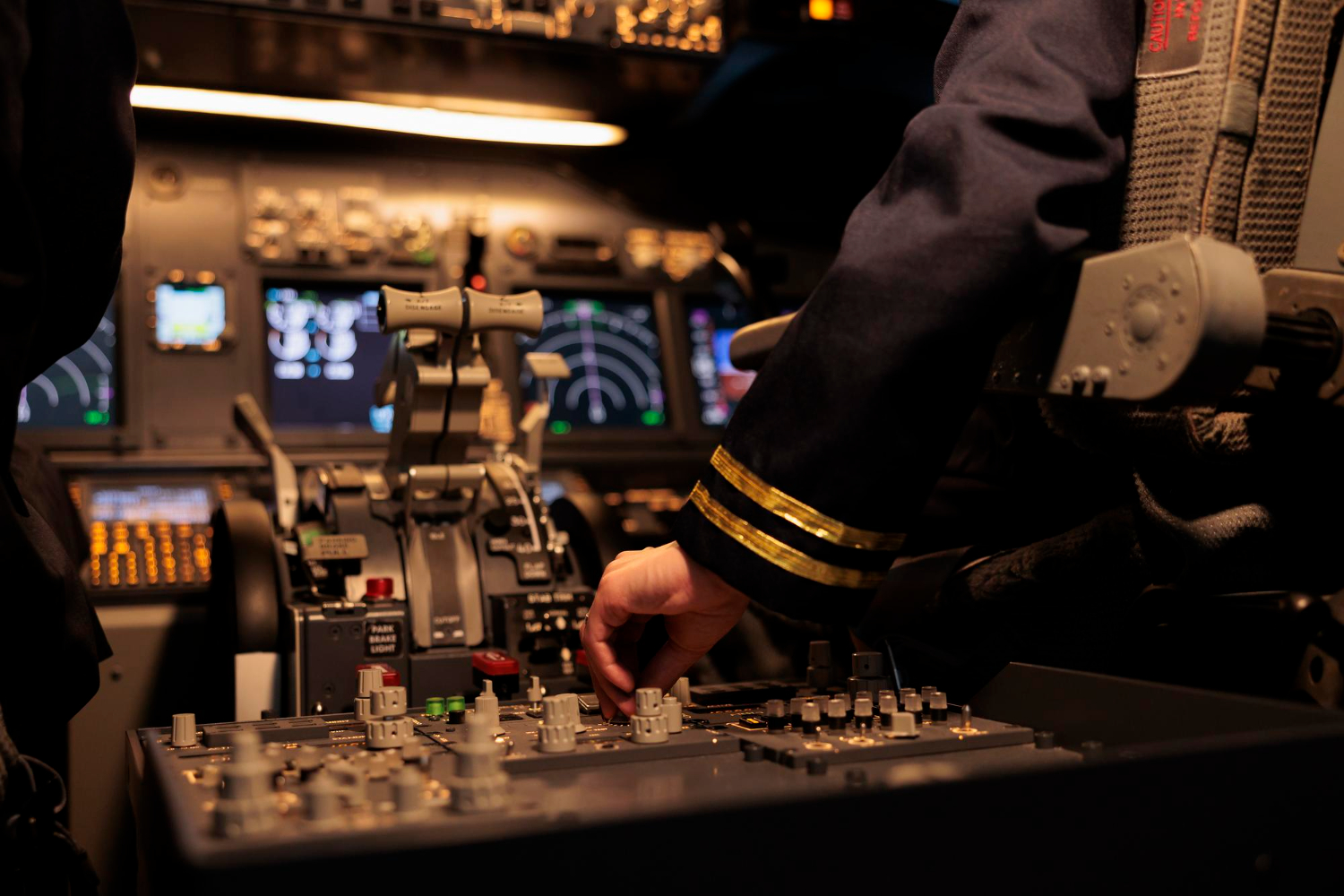
Real-Time Data Analytics for Smarter Flight Paths
Operators in aviation balance a dual optimization: minimizing fuel consumption per flight while reducing emissions per route. Real-time data analytics has become the lever that moves both without waiting for a new airframe generation. The interesting question isn’t whether analytics helps — it’s which architecture decisions make a streaming flight-data pipeline genuinely operational, and which keep it stuck in a dashboard demo.
We see the same pattern in adjacent video pipelines we build for broadcast and surveillance: collecting telemetry is the easy part. Scoring it at latency, calibrating thresholds against real-world rates, and keeping models from drifting once they go live — that’s the engineering work. Aviation analytics inherits the same structure. We run that same broadcast-and-surveillance work under our media and telecom practice.
How analytics actually changes flight-path planning
Traditional flight-path planning mirrors the architecture of legacy batch systems—static inputs, predetermined outputs, and updates on a fixed schedule. A route was selected on the ground, filed with air-traffic control, and re-planned only when weather or congestion forced the issue. Real-time analytics changes the cadence rather than the destination.
A modern dispatch pipeline ingests three streams continuously: aircraft telemetry (engine state, altitude, ground speed, fuel flow), atmospheric data (winds aloft, turbulence reports, convective forecasts), and air-traffic state (sector congestion, ground-stop signals). A solver re-evaluates the active path against these inputs every few minutes. When the projected fuel saving from a re-route exceeds a threshold — and the new path clears traffic constraints — the change is proposed to the dispatcher.
This is closer to model-predictive control than to traditional flight planning. The reasoning is structurally similar to how we approach video pipeline optimisation in broadcast environments: a streaming system that re-evaluates its working hypothesis as new data arrives, with explicit thresholds for when an action is worth taking.
What is real-time video analytics, and how does the same pattern apply here?
When the latency between sensor reading and actionable decision tightens enough that timing determines value, you’ve crossed into real-time analytics. For broadcast video pipelines we treat sub-200ms as the working ceiling for frame-level inference; for in-flight route optimisation the equivalent budget is on the order of minutes, because the controllable variable — fuel burn over the remaining flight — accumulates slowly.
The architecture pattern is the same regardless of domain:
| Layer | Aviation analytics | Video analytics |
|---|---|---|
| Edge | Aircraft sensors, ACARS, ADS-B emitters | On-camera or edge-gateway inference |
| Aggregation | Ground stations, ATC feeds | Stream ingestion at edge cluster |
| Decision | Dispatcher / autopilot guidance | Operator console / automated action |
| Drift control | Periodic re-tuning of route-cost models | Re-training against newly observed normals |
The cross-domain point matters because the engineering pitfalls travel with the pattern. A pipeline that looks fine on curated test data fails the moment real-world distribution shifts arrive — anomalous weather in aviation, content-distribution shifts in video. In our experience across both, the projects that hold up are the ones where threshold calibration is treated as an ongoing operational discipline, not a one-time tuning pass.
Data collection, processing, and the four analytics layers
Telemetry from one long-haul oceanic flight produces multiple gigabytes of structured data. Useful flight-path decisions need a small fraction of it, surfaced at the right moment. The processing stack usually splits into four roles:
- Descriptive — what is the flight doing now? Position, fuel state, deviation from filed route.
- Diagnostic — why did the last deviation happen? Headwind shift, traffic re-route, weather avoidance.
- Predictive — what is the projected fuel burn under the current path vs. two alternatives?
- Prescriptive — which alternative should the dispatcher propose, and what is the confidence?
Each layer has a different tolerance for latency and for error. Descriptive must be near-instant and exact. Prescriptive can take longer but must explain itself — a recommendation without a defensible rationale gets ignored.
Data engineers and analysts build the dashboards that surface these layers. Python carries most of the modelling work (NumPy, pandas, scikit-learn for classical pieces; PyTorch where deeper sequence models help); R still appears in statistical modelling for fuel-burn regressions. Power BI and Tableau are common on the presentation side, though operations centres increasingly run custom dashboards built on streaming frameworks because off-the-shelf BI tools struggle with sub-minute refresh.
Why analytics matters for safety, not just fuel
Fuel savings and emission cuts drive the business case, yet the safety argument presents harder technical challenges. Real-time analytics gives pilots and planners a continuously updated view of turbulence, convective activity, and traffic conflicts. Adjustments happen with seconds of lead time rather than minutes.
The regulatory environment reinforces this. In the United States and the European Union, emissions tracking is now granular enough that airlines benefit operationally from running analytics that an auditor would also recognise. The same telemetry that drives fuel optimisation feeds compliance reports. That dual-use property is what makes the business case sustainable.
Read more: AI in aviation: boosting flight safety standards
Flight data and environmental impact
Incremental adjustments to routing parameters accumulate across fleet operations. A modern long-haul flight burns roughly 80 to 100 tonnes of fuel; a 1% fuel saving from better routing translates directly to a comparable carbon reduction. Aggregated across thousands of daily flights, the directional industry-scale impact is significant — though we’re careful to label this as macro estimate rather than as a per-flight operational benchmark.
A typical comparison engine evaluates ten or more candidate paths for a single transatlantic leg, scoring each against wind, temperature, traffic, and fuel-flow models. The optimal path shifts by hour of day, by season, and by jet-stream behaviour. The interesting analytics output isn’t just “use route B today” — it’s “route B is consistently better than route A in this wind regime”, which becomes input to schedule design for the following season.
Read more: 5 ways AI helps fuel efficiency in aviation
Predictive analytics in daily operations
Route planning is not the only layer where predictive models operate. They underpin maintenance scheduling, fuel loading, gate assignment, and crew rostering. Each of these is a small optimisation by itself; together they determine whether an airline’s daily operation runs tight or loose.
The maintenance case is the clearest. Predictive models trained on engine-health telemetry suggest when a check is due, before a fault forces an unscheduled stop. This is structurally the same pattern as anomaly detection in video pipelines: the model learns what “normal” engine behaviour looks like over thousands of flight hours, and flags deviations. We’ve explored the generative side of that problem in depth in our work on production anomaly detection in video data pipelines — the architecture lessons port across domains more directly than people expect.
Frequently asked questions
How do I build production video anomaly detection that doesn’t drown operators in noise?
Threshold calibration against real anomaly base rates, not curated benchmarks, is the single highest-leverage step. Generative scoring without calibration produces too many low-confidence flags; calibration tied to the operator’s actual review capacity keeps the queue useful.
When does a generative approach to video anomaly detection beat a classifier-based one?
When labelled anomalies are scarce, which is the common case in broadcast and surveillance. A generative model trained on normal frames scores deviations at inference without needing an anomaly dataset to exist first. Classifiers win only when both classes have meaningful training volume.
What is real-time video analytics, and what latency/accuracy targets should I hold it to?
Real-time means the decision arrives inside a latency budget where it still matters — typically under 200ms (a rule of thumb for frame-level inference in broadcast). Accuracy targets are set against real-world anomaly rates and operator review capacity, not against published benchmark splits.
How do I evaluate a video-analytics system on real-world anomaly rates, not curated benchmarks?
Hold out a representative production window, label retrospectively against operator actions, and measure precision at the recall point that matches the operator’s capacity. Benchmarks built on balanced datasets systematically overstate performance on the long tail.
Which deployment patterns (on-camera, edge gateway, cloud) fit which video-anomaly use cases?
On-camera fits fixed scenes with strict bandwidth limits. Edge gateway fits multi-camera sites where cross-feed reasoning matters. Cloud fits archival re-scoring and model retraining, not latency-bound decisions.
How do I keep a generative anomaly model from drifting once it goes live?
Periodic re-fitting against rolling windows of recently observed normals, with explicit drift metrics that surface to operators. Drift control is an ongoing operational discipline, not a one-time tuning pass.
Where this leads
Flight-path optimization demonstrates real-time analytics at its most coherent: streaming ingestion, threshold logic you can defend, models that track their own drift, and final authority left with human operators. The same shape recurs across our computer vision R&D work, where the variables change but the discipline doesn’t. The interesting question for any operator is no longer whether to instrument the pipeline — it’s which decisions are worth automating and which still need a person on the loop.