
The Future of Insurance: Exploring the Influence of AI

Explore the game-changing role of Artificial Intelligence in the modern insurance industry.

The Future of Insurance: Exploring the Influence of AI
Written by TechnoLynx Published on 04 Feb 2024

Introduction

In the high-stakes race for insurance dominance, the traditional players resemble the struggling old cars, while AI-first insurers zoom ahead like sleek supercars. Why? Artificial Intelligence and machine learning are fueling a revolution, giving these forward-thinking companies a clear and decisive edge over their rivals.

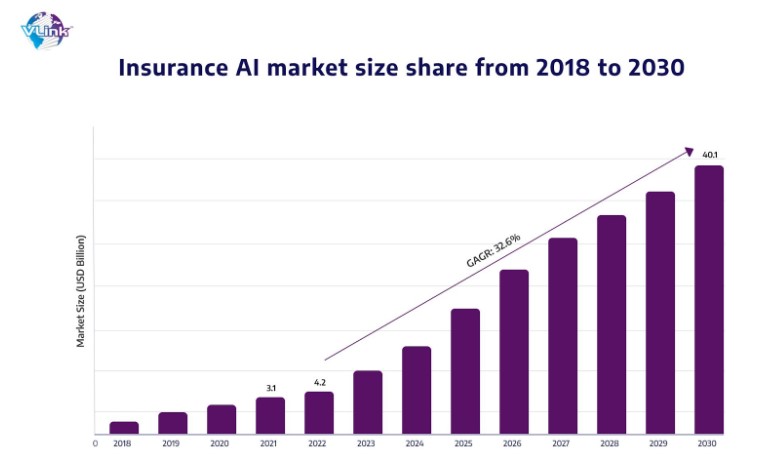
The numbers speak for themselves: the market share of AI in insurance is expected to soar from 4.2 billion USD in 2022 to an astounding 40.1 billion USD by 2030, or an annual growth rate of 32.6%! (Market Research Future, 2023) That’s faster than a Formula One car on nitro!

Predicted Growth of the Insurance Sector under the Influence of AI from 2018 to 2030 | Source: Vlink

Benefits of Incorporating AI in Insurance

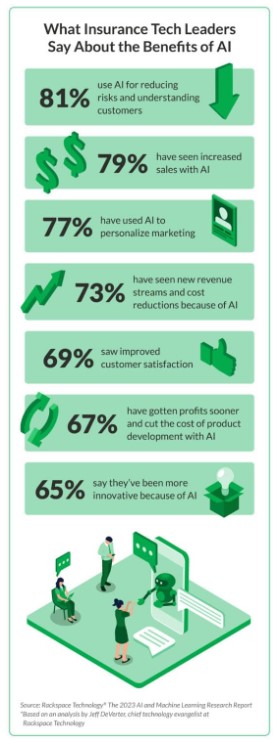
What Insurance Tech Leaders Say about the Benefits of AI | Source: Market Watch

Speed Demon Efficiency:

Claims settle in seconds, not weeks, while processes streamline like a Formula One pit stop.

Tailored Protection:

AI creates personalised policies that fit your unique risk profile like a bespoke suit, with no more coverage gaps or bloat.

Proactive Guardian:

Before losses strike, AI anticipates and mitigates risks, keeping you ahead of the curve like a chess grandmaster.

Fraud Foiler:

Forget cat-and-mouse games. AI sniffs out fraudulent activity faster than a bloodhound on a hot trail.

Customer Delight:

24/7 AI chatbots answer questions instantly, while drones assess storm damage before the first raindrop falls. In the insurance race, AI-powered companies are blazing past the competition. Embrace the revolution and join the ride!

Use Cases of AI in the Insurance Market

These are some of the top Fintech companies that have embraced AI and have skyrocketed their growth.

Fintech Companies Using AI in the Insurance Sector | Source: Appenventiv

But what are these groundbreaking advancements, and how are they translating into real-world business wins? Buckle up because we’re about to take a high-speed tour of the latest AI innovations in the insurance landscape and see how they’re rewriting the game’s rules:

I. AI-Enabled Underwriting

Traditional underwriting was plagued by mountains of data, inaccurate risk assessments, and painfully slow turnaround times. This resulted in inconsistent pricing, dissatisfied customers, and time-consuming operations.

However, artificial intelligence is transforming the game. AI-powered document processing can reduce the underwriting time by up to 80% (Sahai, 2023). Here’s how -

Computer Vision Takes Flight:

AI meticulously assesses property risks such as flood zones or fire hazards by flying through satellite imagery and aerial photos, resulting in far more accurate risk assessment.

Quotes in a Flash Using Generative AI:

Generative AI harnesses the power of big data, analysing demographics, driving habits, and even social media activity. This enables it to generate personalised quotes in seconds. Not only that, but it can create risk profiles in the blink of an eye. No more weeks-long waits for an estimate!

GPU Performance Engineering gives AI a turbo boost:

Complex AI models need powerful engines, and GPUs provide just that. With lightning-fast computing, AI models train and deploy in record time, ensuring the underwriting dance never slows.

Social Media Whispers Secrets Through Sentiment Analysis:

AI listens closely to the online chatter, analysing customer social media activity to identify potential risks and adjust underwriting decisions. It’s like having a digital guardian angel watching over every policy.

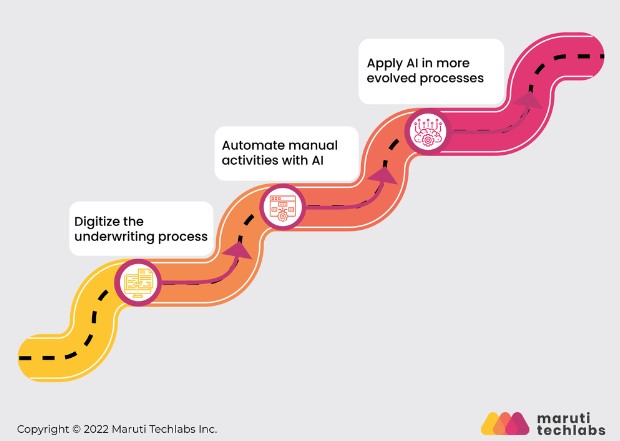
Sounds interesting? Here’s how you can integrate AI into insurance underwriting:

A Roadmap to Integrate AI in Insurance Underwriting | Source: Maruti TechLabs

II. Claims Processing

Mountains of paperwork slow down claims, manual assessment leaves room for error, and fraud haunts every process. But AI offers a powerful counterpoint:

The arrival of IoT Edge Computing:

Time-consuming inspections become a relic. Smart sensors attached to insured assets like cars or factories capture damage data in real time, streamlining the claims filing process.

Natural Language Processing lends its ear:

This AI genius extracts important data and precisely automates claim assessment by analysing text and audio from police statements, accident reports, and witness interviews.

Blockchain adds a secure melody:

A tamper-proof digital ledger securely shares claim data among various stakeholders, minimising fraud and expediting the claims resolution process.

Predictive Maintenance adopts a proactive approach:

AI can anticipate possible failures and notify policyholders before they occur, averting expensive claims and downtime, by evaluating sensor data from insured assets.

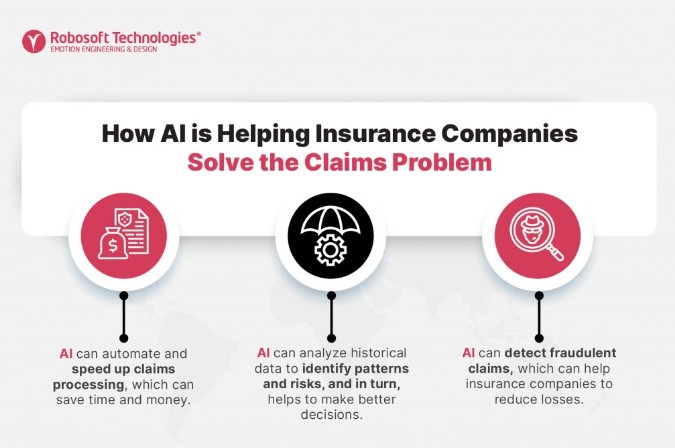
How AI is Helping in Claim Processing | Source: Robosoft

The result? A smooth operation with shorter processing times, cheaper expenses, and happier clients. Claims dance to a quick resolution in this AI concerto, with each note a laser-sharp detail, ensuring peace of mind for both insurers and the insured.

III. Fraud Detection in Insurance

Insurance promises protection, a shield against life’s uncertainties. However, devious schemes and intricate networks drain millions from the system, undermining trust and leaving honest customers vulnerable.

But fear not! From the digital realm emerges a powerful ally: artificial intelligence (AI).

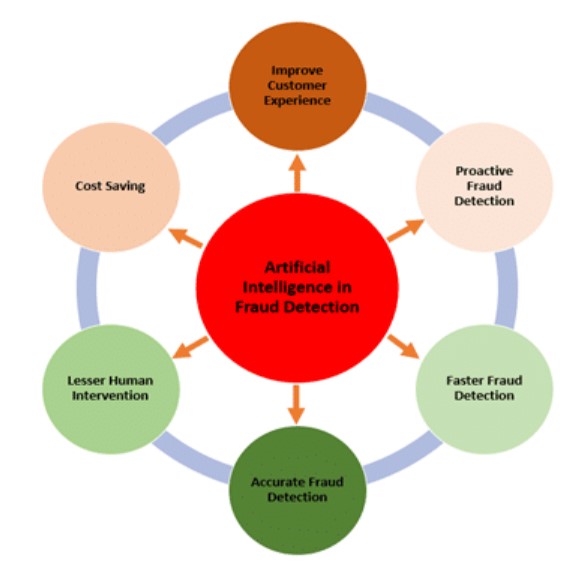
Benefits of Using AI for Fraud Detection in the Insurance Sector | Source: Cigniti

Here’s how AI uses powerful tech solutions to unmask fraudsters:

Computer Vision:

Analyze medical images, car damage photos, and property claims for inconsistencies with AI, and flag suspicious cases for further investigation. (GPU performance engineering for real-time analysis)

Generative AI:

AI can be used to create synthetic datasets of diverse fraud scenarios. These synthetic datasets can be used to train AI models to enable your insurance firm to stay ahead of evolving fraud. This will also help in proactively adapting to detection strategies.

IoT Edge Computing:

Install smart sensors in vehicles that collect real-time data on speed, location, and impact forces.

AI algorithms on the edge can detect suspicious patterns in real time, potentially alerting authorities to staged accidents.

Behavioral Anomaly Detection:

Analyse policyholder data, such as online activity, communication patterns, and claims history, for any unusual deviations that could indicate fraud.

Thus, with AI as a companion, insurance companies no longer need to worry about any fraud. This will not only save the company millions but will also reinforce a feeling of safety among the clients.

IV. Risk Management

The future of insurance is hyper-personalized, powered by AI’s remarkable ability to anticipate and mitigate risk. Buckle up, because we’re diving into the tech toolbox transforming how we stay protected:

1. Hyper-personalized Risk Assessment:

Satellite Imagery & Drone Footage Using Computer Vision:

AI analyses the digital scans and incorporates real-time weather and environmental data to generate dynamic risk models for your specific property. Flood threats? Storm warnings? You’ll be covered before the clouds even gather.

IoT Edge Computing and Behavioural Anomaly Detection:

Smart sensors embedded in your car or factory equipment warn of potential problems. AI at the Edge analyses this data in real time, flagging risky behaviours such as hazardous driving patterns or equipment overuse. Accidents and breakdowns? Prevented before they happen.

2. Collaborative Risk Sharing Platforms:

Blockchain:

Blockchain creates a secure platform on which insurers can transparently share risk data and insights. This collective knowledge powers Collaborative Risk Sharing Platforms, allowing them to optimise coverage and pricing for everyone while distributing responsibility and benefits.

Natural Language Processing and Generative AI:

The world talks and AI listens. AI scans news articles, social media buzz, and even legal contracts to identify emerging risks and trends before they occur.

This foresight lets insurers stay ahead of the curve, adapting to regulatory changes, environmental threats, and social movements that might impact their portfolio.

There will be no more guesswork or blind spots. AI unlocks a future where your protection is as unique as you are, where risks are identified before they materialize, and where the burden of security is shared fairly. This is more than just insurance; it is a smart collaboration for a safer, more confident future.

V. Customer Experience

Generic policies, reactive service that keeps you waiting, and impersonal channels that feel like you are talking to a wall are all echoes from the past.

Ever since AI has been incorporated to enhance the customer experience, insurers have not looked back. Here’s how:

Chatbots that Actually Converse:

Conversational AI chatbots are always there for you, patiently answering any questions you have about your policy. They use natural language processing to understand your needs and provide instant, personalized support.

Recommendations Tailored Just for You:

No more general advice. Generative AI analyses your data to create policy recommendations and educational content tailored to your specific needs and risk profile. Consider it a smart friend guiding you through the insurance world.

Marketing that Feels Like Friendship:

Forget about spam! Recommendation Systems powered by AI study your behaviour and preferences, suggesting relevant products and services that actually benefit you. Thus, with AI, cross-selling feels like a helpful tip, not a sales pitch.

AI as Your Defence Partner:

You can rest easy knowing that AI has your back. By analysing your data, AI can predict potential risks like car breakdowns or home security vulnerabilities, sending you proactive alerts so you can stay ahead of the curve.

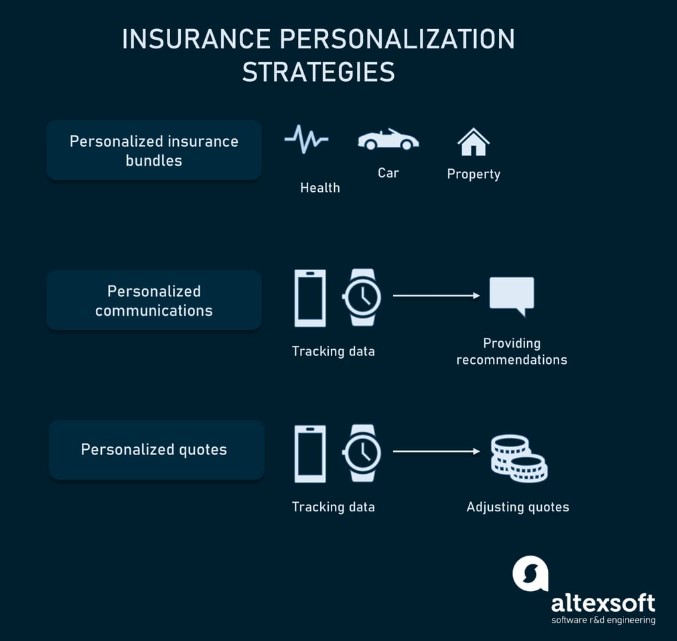
Personalization Strategies in the Insurance Sector using AI | Source: Altexsoft

AI doesn’t just solve problems, it builds relationships. With personalized conversations, smart recommendations, and proactive protection, insurance becomes a partnership, not a hassle. This is the future where customer experience thrives, where trust flourishes, and where insurance truly lives up to its promise: peace of mind, reimagined.

Challenges and Considerations To Keep In Mind

While AI can be a helpful tool in reimagining the insurance landscape, there are a few challenges and considerations that insurers need to keep in mind -

Bias and Fairness:

AI algorithms may inherit discriminatory biases from training data, which can have an unfair impact on pricing and coverage. Careful data selection, bias detection tools, and human oversight are required to ensure fair results.

Explainability and Transparency:

Users struggle to understand how decisions are made with black-box AI models, which creates a trust gap. AI tools must be explainable and communicate effectively to build user confidence and regulatory compliance.

Data Privacy and Security:

Integrating vast amounts of personal data raises concerns about privacy breaches and misuse. Robust security measures, data anonymization techniques, and clear user consent procedures are vital to ensuring responsible data practices.

What TechnoLynx Can Offer

TechnoLynx is your trusted partner in navigating the exciting world of AI-powered insurance. We combine innovative technologies with deep industry expertise to create solutions that address real-world challenges and deliver tangible benefits.

We at TechnoLynx empower insurance companies to see clearly with Computer Vision, personalise protection with Generative AI, accelerate decisions with lightning-speed GPU, and listen to your devices with IoT edge computing.

Conclusion

The future of insurance is not on the horizon; it is right at your doorstep. AI has the potential to completely transform the market, from faster claim processing to personalised protection. Stay ahead of the competition and avoid falling behind. Seize the opportunity, learn about the revolution, and collaborate with TechnoLynx. Let’s unlock the power of AI together, and build a brighter, smarter, and safer future for the insurance industry.

Ready to join the ride? Visit our website or contact us today to see how TechnoLynx can turbocharge your insurance journey with AI.

References:

AltexSoft. (2021, June 14). Personalized Insurance Success Stories. Personalized Insurance: Auto and Telematics, Health, and Other Success Stories.

Market Research Future, G. N. W. (2023, February 22). AI in insurance market to reach USD 40.1 billion with 32.6% CAGR from 2022 to 2030 - report by Market Research Future (MRFR). GlobeNewswire News Room.

Nijhawan, N. (2023, June 7). Integrating Artificial Intelligence (AI) in Insurance apps. Integrating Artificial Intelligence (AI) In Insurance Apps.

Rout, A. K., Peyyeti, S., & Technologies, C. (2023, August 24). Fraud detection in insurance claim process by using Artificial Intelligence: Cigniti. Blog by Cigniti Technologies.

Sahai, A. (2023, October 24). Role of AI in shifting the paradigm in document processing for insurance.

Woodburn, B. (2023, June 22). How AI is Transforming Auto Insurance: Future Car Insurance. MarketWatch.

Cost, Efficiency, and Value Are Not the Same Metric

Cost, Efficiency, and Value Are Not the Same Metric

17/04/2026

Performance per dollar. Tokens per watt. Cost per request. These sound like the same thing said differently, but they measure genuinely different dimensions of AI infrastructure economics. Conflating them leads to infrastructure decisions that optimize for the wrong objective.

Precision Is an Economic Lever in Inference Systems

Precision Is an Economic Lever in Inference Systems

17/04/2026

Precision isn't just a numerical setting — it's an economic one. Choosing FP8 over BF16, or INT8 over FP16, changes throughput, latency, memory footprint, and power draw simultaneously. For inference at scale, these changes compound into significant cost differences.

Precision Choices Are Constrained by Hardware Architecture

Precision Choices Are Constrained by Hardware Architecture

17/04/2026

You can't run FP8 inference on hardware that doesn't have FP8 tensor cores. Precision format decisions are conditional on the accelerator's architecture — its tensor core generation, native format support, and the efficiency penalties for unsupported formats.

Steady-State Performance, Cost, and Capacity Planning

Steady-State Performance, Cost, and Capacity Planning

17/04/2026

Capacity planning built on peak performance numbers over-provisions or under-delivers. Real infrastructure sizing requires steady-state throughput — the predictable, sustained output the system actually delivers over hours and days, not the number it hit in the first five minutes.

How Benchmark Context Gets Lost in Procurement

How Benchmark Context Gets Lost in Procurement

16/04/2026

A benchmark result starts with full context — workload, software stack, measurement conditions. By the time it reaches a procurement deck, all that context is gone. The failure mode is not wrong benchmarks but context loss during propagation.

Building an Audit Trail: Benchmarks as Evidence for Governance and Risk

Building an Audit Trail: Benchmarks as Evidence for Governance and Risk

16/04/2026

High-value AI hardware decisions need traceable evidence, not slide-deck bullet points. When benchmarks are documented with methodology, assumptions, and limitations, they become auditable institutional evidence — defensible under scrutiny and revisitable when conditions change.

The Comparability Protocol: Why Benchmark Methodology Defines What You Can Compare

The Comparability Protocol: Why Benchmark Methodology Defines What You Can Compare

16/04/2026

Two benchmark scores can only be compared if they share a declared methodology — the same workload, precision, measurement protocol, and reporting conditions. Without that contract, the comparison is arithmetic on numbers of unknown provenance.

A Decision Framework for Choosing AI Hardware

A Decision Framework for Choosing AI Hardware

16/04/2026

Hardware selection is a multivariate decision under uncertainty — not a score comparison. This framework walks through the steps: defining the decision, matching evaluation to deployment, measuring what predicts production, preserving tradeoffs, and building a repeatable process.

How Benchmarks Shape Organizations Before Anyone Reads the Score

How Benchmarks Shape Organizations Before Anyone Reads the Score

16/04/2026

Before a benchmark score informs a purchase, it has already shaped what gets optimized, what gets reported, and what the organization considers important. Benchmarks function as decision infrastructure — and that influence deserves more scrutiny than the number itself.

Accuracy Loss from Lower Precision Is Task‑Dependent

Accuracy Loss from Lower Precision Is Task‑Dependent

16/04/2026

Reduced precision does not produce a uniform accuracy penalty. Sensitivity depends on the task, the metric, and the evaluation setup — and accuracy impact cannot be assumed without measurement.

Precision Is a Design Parameter, Not a Quality Compromise

Precision Is a Design Parameter, Not a Quality Compromise

16/04/2026

Numerical precision is an explicit design parameter in AI systems, not a moral downgrade in quality. This article reframes precision as a representation choice with intentional trade-offs, not a concession made reluctantly.

Mixed Precision Works by Exploiting Numerical Tolerance

Mixed Precision Works by Exploiting Numerical Tolerance

16/04/2026

Not every multiplication deserves 32 bits. Mixed precision works because neural network computations have uneven numerical sensitivity — some operations tolerate aggressive precision reduction, others don't — and the performance gains come from telling them apart.

Throughput vs Latency: Choosing the Wrong Optimization Target

16/04/2026

Throughput and latency are different objectives that often compete for the same resources. This article explains the trade-off, why batch size reshapes behavior, and why percentiles matter more than averages in latency-sensitive systems.

Quantization Is Controlled Approximation, Not Model Damage

16/04/2026

When someone says 'quantize the model,' the instinct is to hear 'degrade the model.' That framing is wrong. Quantization is controlled numerical approximation — a deliberate engineering trade-off with bounded, measurable error characteristics — not an act of destruction.

GPU Utilization Is Not Performance

15/04/2026

The utilization percentage in nvidia-smi reports kernel scheduling activity, not efficiency or throughput. This article explains the metric's exact definition, why it routinely misleads in both directions, and what to pair it with for accurate performance reads.

FP8, FP16, and BF16 Represent Different Operating Regimes

15/04/2026

FP8 is not just 'half of FP16.' Each numerical format encodes a different set of assumptions about range, precision, and risk tolerance. Choosing between them means choosing operating regimes — different trade-offs between throughput, numerical stability, and what the hardware can actually accelerate.

Peak Performance vs Steady‑State Performance in AI

15/04/2026

AI systems rarely operate at peak. This article defines the peak vs. steady-state distinction, explains when each regime applies, and shows why evaluations that capture only peak conditions mischaracterize real-world throughput.

The Software Stack Is a First‑Class Performance Component

15/04/2026

Drivers, runtimes, frameworks, and libraries define the execution path that determines GPU throughput. This article traces how each software layer introduces real performance ceilings and why version-level detail must be explicit in any credible comparison.

The Mythology of 100% GPU Utilization

15/04/2026

Is 100% GPU utilization bad? Will it damage the hardware? Should you be worried? For datacenter AI workloads, sustained high utilization is normal — and the anxiety around it usually reflects gaming-era intuitions that don't apply.

Why Benchmarks Fail to Match Real AI Workloads

15/04/2026

The word 'realistic' gets attached to benchmarks freely, but real AI workloads have properties that synthetic benchmarks structurally omit: variable request patterns, queuing dynamics, mixed operations, and workload shapes that change the hardware's operating regime.

Why Identical GPUs Often Perform Differently

15/04/2026

'Same GPU' does not imply the same performance. This article explains why system configuration, software versions, and execution context routinely outweigh nominal hardware identity.

Training and Inference Are Fundamentally Different Workloads

15/04/2026

A GPU that excels at training may disappoint at inference, and vice versa. Training and inference stress different system components, follow different scaling rules, and demand different optimization strategies. Treating them as interchangeable is a design error.

Performance Ownership Spans Hardware and Software Teams

15/04/2026

When an AI workload underperforms, attribution is the first casualty. Hardware blames software. Software blames hardware. The actual problem lives in the gap between them — and no single team owns that gap.

Performance Emerges from the Hardware × Software Stack

15/04/2026

AI performance is an emergent property of hardware, software, and workload operating together. This article explains why outcomes cannot be attributed to hardware alone and why the stack is the true unit of performance.

Power, Thermals, and the Hidden Governors of Performance

14/04/2026

Every GPU has a physical ceiling that sits below its theoretical peak. Power limits, thermal throttling, and transient boost clocks mean that the performance you read on the spec sheet is not the performance the hardware sustains. The physics always wins.

Why AI Performance Changes Over Time

14/04/2026

That impressive throughput number from the first five minutes of a training run? It probably won't hold. AI workload performance shifts over time due to warmup effects, thermal dynamics, scheduling changes, and memory pressure. Understanding why is the first step toward trustworthy measurement.

CUDA, Frameworks, and Ecosystem Lock-In

14/04/2026

Why is it so hard to switch away from CUDA? Because the lock-in isn't in the API — it's in the ecosystem. Libraries, tooling, community knowledge, and years of optimization create switching costs that no hardware swap alone can overcome.

GPUs Are Part of a Larger System

14/04/2026

CPU overhead, memory bandwidth, PCIe topology, and host-side scheduling routinely limit what a GPU can deliver — even when the accelerator itself has headroom. This article maps the non-GPU bottlenecks that determine real AI throughput.

Why AI Performance Must Be Measured Under Representative Workloads

14/04/2026

Spec sheets, leaderboards, and vendor numbers cannot substitute for empirical measurement under your own workload and stack. Defensible performance conclusions require representative execution — not estimates, not extrapolations.

Low GPU Utilization: Where the Real Bottlenecks Hide

14/04/2026

When GPU utilization drops below expectations, the cause usually isn't the GPU itself. This article traces common bottleneck patterns — host-side stalls, memory-bandwidth limits, pipeline bubbles — that create the illusion of idle hardware.

Why GPU Performance Is Not a Single Number

14/04/2026

AI GPU performance is multi-dimensional and workload-dependent. This article explains why scalar rankings collapse incompatible objectives and why 'best GPU' questions are structurally underspecified.

What a GPU Benchmark Actually Measures

14/04/2026

A benchmark result is not a hardware measurement — it is an execution measurement. The GPU, the software stack, and the workload all contribute to the number. Reading it correctly requires knowing which parts of the system shaped the outcome.

Why Spec‑Sheet Benchmarking Fails for AI

14/04/2026

GPU spec sheets describe theoretical limits. This article explains why real AI performance is an execution property shaped by workload, software, and sustained system behavior.

Visual Computing in Life Sciences: Real-Time Insights

6/11/2025

Learn how visual computing transforms life sciences with real-time analysis, improving research, diagnostics, and decision-making for faster, accurate outcomes.

AI-Driven Aseptic Operations: Eliminating Contamination

21/10/2025

Learn how AI-driven aseptic operations help pharmaceutical manufacturers reduce contamination, improve risk assessment, and meet FDA standards for safe, sterile products.

AI Visual Quality Control: Assuring Safe Pharma Packaging

20/10/2025

See how AI-powered visual quality control ensures safe, compliant, and high-quality pharmaceutical packaging across a wide range of products.

AI for Reliable and Efficient Pharmaceutical Manufacturing

15/10/2025

See how AI and generative AI help pharmaceutical companies optimise manufacturing processes, improve product quality, and ensure safety and efficacy.

Barcodes in Pharma: From DSCSA to FMD in Practice

25/09/2025

What the 2‑D barcode and seal on your medicine mean, how pharmacists scan packs, and why these checks stop fake medicines reaching you.

Pharma’s EU AI Act Playbook: GxP‑Ready Steps

24/09/2025

A clear, GxP‑ready guide to the EU AI Act for pharma and medical devices: risk tiers, GPAI, codes of practice, governance, and audit‑ready execution.

Cell Painting: Fixing Batch Effects for Reliable HCS

23/09/2025

Reduce batch effects in Cell Painting. Standardise assays, adopt OME‑Zarr, and apply robust harmonisation to make high‑content screening reproducible.

Explainable Digital Pathology: QC that Scales

22/09/2025

Raise slide quality and trust in AI for digital pathology with robust WSI validation, automated QC, and explainable outputs that fit clinical workflows.

Validation‑Ready AI for GxP Operations in Pharma

19/09/2025

Make AI systems validation‑ready across GxP. GMP, GCP and GLP. Build secure, audit‑ready workflows for data integrity, manufacturing and clinical trials.

Edge Imaging for Reliable Cell and Gene Therapy

17/09/2025

Edge imaging transforms cell & gene therapy manufacturing with real‑time monitoring, risk‑based control and Annex 1 compliance for safer, faster production.

AI in Genetic Variant Interpretation: From Data to Meaning

15/09/2025

AI enhances genetic variant interpretation by analysing DNA sequences, de novo variants, and complex patterns in the human genome for clinical precision.

AI Visual Inspection for Sterile Injectables

11/09/2025

Improve quality and safety in sterile injectable manufacturing with AI‑driven visual inspection, real‑time control and cost‑effective compliance.

Predicting Clinical Trial Risks with AI in Real Time

5/09/2025

AI helps pharma teams predict clinical trial risks, side effects, and deviations in real time, improving decisions and protecting human subjects.

Generative AI in Pharma: Compliance and Innovation

1/09/2025

Generative AI transforms pharma by streamlining compliance, drug discovery, and documentation with AI models, GANs, and synthetic training data for safer innovation.

AI for Pharma Compliance: Smarter Quality, Safer Trials

27/08/2025

AI helps pharma teams improve compliance, reduce risk, and manage quality in clinical trials and manufacturing with real-time insights.

Back See Blogs
arrow icon