Introduction
SIFT, ORB, HOG, classical segmentation, and geometric matching remain production workhorses despite deep learning’s rise. It moved into the parts of production pipelines where deep features are wrong-shaped for the problem, where compute budgets are tight, or where interpretability and determinism matter more than peak accuracy. In 2026, the most reliable CV pipelines are hybrid: classical stages for geometry, calibration, and well-defined feature matching; deep stages for semantic understanding, classification, and unstructured visual reasoning. See computer vision for the broader landing this article serves.
The honest 2026 picture: classical CV is not a fallback for teams who cannot afford GPUs. It is the right tool for a specific class of problems and the hybrid architectures that combine it with deep CV are what production looks like.
What this means in practice
- Classical feature extraction (SIFT, ORB, HOG) still wins for geometric matching, calibration, and structured patterns.
- Hybrid pipelines combine classical feature stages with CNN/ViT embeddings for semantic stages.
- Nixon and Aguado’s framework remains a useful guide because it separates feature extraction from learning.
- The decision is per-stage, not per-pipeline — classical and deep coexist within one production system.
Where does classical feature extraction (SIFT, ORB, HOG) still beat deep features in 2026?
Geometric matching and registration. SIFT and ORB descriptors are designed for repeatability under rotation, scale, and illumination change. For tasks like image stitching, panorama assembly, multi-view registration, and structure-from-motion, classical features remain competitive with or superior to deep features because the deep features were not trained for sub-pixel geometric precision. The classical algorithms have provable invariance properties that learned features approximate.
Camera calibration. Checkerboard, ArUco marker, and circle-grid calibration use classical corner and feature detection. The detection is deterministic, sub-pixel accurate, and the algorithmic guarantees are required for downstream calibration to converge. Deep approaches exist (DeepCalib and similar) but classical pipelines remain the production default because the failure modes are understood.
Low-compute and embedded deployments. ORB runs at hundreds of frames per second on a microcontroller; running a CNN at the same rate requires a GPU or NPU. For embedded vision (robotics, drones, edge sensors with tight power budgets), classical features are often the only option that fits within the compute envelope.
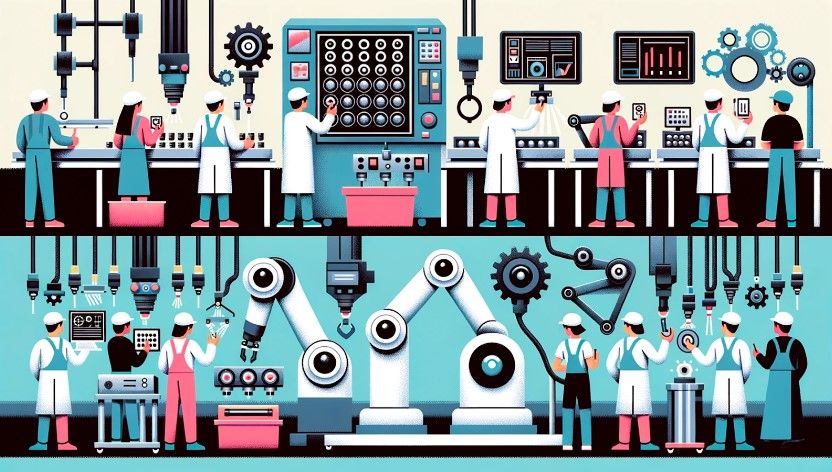
Industrial inspection with controlled imaging. When lighting, geometry, and presentation are controlled (fixtures, conveyors, robotic placement), the visual task often reduces to template matching, edge detection, or geometric measurement. Classical CV solves these to spec with full interpretability and no training data requirement. Deep CV adds complexity without accuracy benefit in this regime.
Interpretable and auditable systems. Regulated industries (medical devices, automotive ADAS, defence) value pipelines where every step has a deterministic algorithm with known failure modes. Classical CV provides that; deep CV’s interpretability story is improving but not yet at parity for safety cases.
How does feature extraction compose with deep CV (CNN features, ViT embeddings) in a hybrid pipeline?
Deploy classical methods first, then add deep learning only where necessary. Classical features handle geometric pre-processing (registration, rectification, region-of-interest extraction); deep features handle semantic interpretation of the rectified region. Example: in document understanding, classical CV detects and rectifies the document boundary; a transformer model then reads the rectified text. Each stage uses the tool that fits its sub-problem.
Deep first, classical second appears in fine measurement. A CNN segments an object of interest; classical edge detection and geometric fitting then measure the segmented region with sub-pixel precision that the CNN’s output mask cannot provide directly.
Parallel hybrid runs both and fuses outputs. Classical feature matching produces high-confidence point correspondences; deep features produce a dense semantic embedding. A downstream stage combines them — high-confidence anchors from classical, dense context from deep — for tasks like visual localisation, content-based retrieval, or 3D reconstruction.
Cascade hybrid uses classical features to gate deep inference. Classical edge detection or motion detection runs on every frame at low cost; the deep model runs only when a region of interest is detected. This is the dominant pattern in surveillance, edge IoT, and battery-powered devices where running a CNN on every frame is not affordable.
What does Nixon and Aguado’s feature-extraction framework get right that deep-only stacks miss?
Nixon and Aguado’s “Feature Extraction and Image Processing for Computer Vision” treats feature extraction as a discrete, analysable stage preceding any learning step. The framework’s contribution is the separation: feature extraction has well-defined properties (invariance, locality, repeatability) that can be reasoned about independently of any classifier. Deep-only stacks fuse extraction and learning, which obscures what the network is actually keying on.
The practical consequences of the separation. Failure analysis is easier when features are explicit: you can inspect what the system saw before classifying. Transfer to new domains is easier when feature properties are known: SIFT’s rotation invariance generalises to any rotated input, whereas a CNN’s invariance depends on its training distribution. Compute budgeting is easier: classical features have known cost, and learning operates on extracted vectors of known dimension.
Deep-only stacks excel where the input is too complex for hand-designed features (natural images, text, audio) and where data is abundant. The Nixon-Aguado framework guides decisions about when to use which: explicit feature extraction for problems where the features are tractable (geometry, structured patterns, well-defined textures); learned features for problems where they are not (general object recognition, scene understanding).
Which feature-extraction techniques translate into ML model inputs versus pure visualization?
Translate into ML inputs. HOG (histogram of oriented gradients) feeds SVM classifiers and is still used for pedestrian detection in some embedded systems. Bag-of-words on SIFT/ORB features feeds classifiers for image categorisation when training data is small. Texture features (Gabor filters, LBP) feed material and defect classifiers. Shape descriptors (Hu moments, Fourier descriptors) feed geometric classification. These produce fixed-length vectors that any ML model (SVM, random forest, shallow MLP) can consume.
Hybrid feature inputs. Concatenation of classical features with CNN embeddings produces a richer input for downstream classification or retrieval. Used when classical features carry information the CNN was not trained to preserve (precise geometry, deterministic colour statistics).
Pure visualisation. Histogram equalisation, contrast stretching, gamma correction, and similar enhancement operations are used to make images interpretable to humans but do not produce ML inputs directly. Edge maps (Canny, Sobel) and segmentation overlays similarly serve visualisation or pre-processing rather than direct feature input. The distinction matters because the design criteria differ: visualisation optimises for human perception, feature extraction optimises for discriminability.
The practical guideline: if the feature is fed to a classifier, evaluate it on classification accuracy. If the feature is for human inspection, evaluate it on perceptual clarity. Confusing the two produces pipelines that look impressive in demos but underperform in production.
When should an engineering team write a classical-CV feature stage instead of fine-tuning a model?
Deterministic geometric or algorithmic structure in a problem signals classical methods. Measuring the diameter of a hole, detecting a crack along an edge, finding a fiducial mark — these are problems with known solutions in classical CV that do not require training data, do not require GPU at inference, and do not have the failure modes of learned models. Fine-tuning a model for these tasks is over-engineering.
When training data is scarce or expensive. Classical CV does not require labelled examples to function. If the problem can be solved with edge detection plus geometric fitting, the path from problem to production is shorter without a data collection programme.
When the deployment target cannot run a model. Microcontrollers, FPGAs without ML accelerators, legacy industrial computers. Classical CV runs where deep CV does not.
When interpretability is required for sign-off. Regulated environments where every algorithmic step must be documented and verifiable. Classical CV’s algorithms have decades of literature; their failure modes are catalogued. Deep CV requires more careful safety analysis.
Fine-tune a model instead when the problem requires semantic understanding (what is this object, not where is the edge), when the visual variation is too large for hand-designed features (lighting, pose, occlusion in natural scenes), or when the deployment target has compute headroom and the team has the data engineering to support model lifecycle.
How does feature extraction sit alongside image segmentation and pattern recognition in a production pipeline?
Feature extraction often feeds segmentation. Classical edge detection produces input for region-growing or graph-cut segmentation. Texture features feed pixel classifiers that produce semantic segmentation. The feature stage decomposes the image into a representation that segmentation operates on.
Segmentation often feeds pattern recognition. After segmenting an object, classical pattern recognition (template matching, shape matching, geometric moment comparison) identifies what the segmented region is. Deep pattern recognition (CNN classifier on the segmented crop) does the same task with different trade-offs.
In hybrid production pipelines the typical flow is: capture, classical pre-processing (denoising, colour conversion, geometric rectification), classical or deep segmentation (depending on whether boundaries are well-defined geometric features or learned semantic regions), feature extraction on segmented regions (classical descriptors plus deep embeddings), pattern recognition or classification, and post-processing (business logic, output formatting).
Each stage uses the tool fit to its sub-problem. Classical CV is not a separate paradigm competing with deep CV; both are sources of stages that compose into the production pipeline. The teams that ship reliable CV systems in 2026 treat them as complementary, not as a choice between paradigms.
When Classical Computer Vision Outperforms Deep Learning
Metrology, alignment, and defect inspection demand calibrated geometry, sub-pixel edge localisation, and deterministic behaviour under domain shift—capabilities where classical feature pipelines excel; TechnoLynx architects hybrid systems that route each image region to the technique best suited to its content. We help teams decide per-stage which approach fits, and deliver the integration that makes hybrid pipelines reliable. If your team is designing or recovering a CV pipeline that needs classical and deep components, contact us.
Image credits: Freepik