The Synergy of AI: Screening & Diagnostics on Steroids!

Sometimes a visit to the doctor for an X-ray is a necessity. Apart from having to endure the long queue, when you are in pain, the time until your results arrive can seem endless. Let’s take a look at how AI can be integrated into medical facilities to automate medical imaging for better screening and faster results.

The Synergy of AI: Screening & Diagnostics on Steroids!
Written by TechnoLynx Published on 03 May 2024

Introduction: AI’s Role in Healthcare and Medicine

The healthcare field is definitely one of the most respected worldwide, which is why the healthcare industry is so big! Physicians and healthcare professionals have been respected since ancient times. How ancient? Well, the world-famous Hippocratic Oath dates back to the 4th century BC. ‘I will use therapy which will benefit my patients according to my greatest ability and judgment, and I will do no harm or injustice to them’, says the Oath (Greek Medicine, no date).

Figure 1 – Concept image of a robot shaking hands with a human (Evaluation of AI for medical imaging: A key requirement for clinical translation, 2022)

We have seen how medicine has changed over the years. Our society has evolved from digesting roots and trepanning for therapeutic purposes to visualising our internals with cutting-edge technology that produces extremely crisp images. What is the next step? The integration of AI into our arsenal for medical decisions, of course! Keep scrolling to find out more.

With Proper Training Comes Great Results

The first thing most people think about when they hear the word AI is something high-tech, and you know what? They would be right! AI is the theory and development of computer systems capable of performing tasks that normally require human intelligence, such as visual perception, speech recognition, decision-making, and language translation. ‘And how is that achieved?’ we hear you ask. The answer is hidden in a method you have probably already heard of that teaches computers to process data in a way inspired by the human brain: Deep Learning (DL). Before we dive deeper, we need to get a little technical, possibly geeky. We know you came here for the main course, but, trust us, you will find the appetiser very interesting.

Figure 2 – Illustration of a robot thinking while trying to solve mathematical calculations (Building smarter machines, 2019)

“I Will Make a ‘Man’ Out of You!”

Each AI algorithm needs proper training to perform its wonders. Optimally, this is achieved by creating an algorithm that can be trained on hundreds of thousands, if not millions, of data. To do that, we first must ensure that the data we feed the algorithm properly. This means that the data must be collected from various sources, such as databases, and that the data are ‘clean’. To do that, we need to check that there are no missing values or inconsistencies, that the classes are meaningful, and the labels are correct. The data are then transformed with techniques that normalise them, reduce their dimensions, or augment the data while ensuring no information is lost or wrongfully duplicated. Finally, the data are divided into train and test sets, and adjustments are made to ensure maximum accuracy with the minimum number of resources used. So far so good? Nice! Let’s move on.

Going beyond human!

We might want to make the most efficient and infallible AI algorithm for medical imaging. But what happens when the data are simply not enough? Well, it is not called AI for no reason! One of the best features of AI is Data Augmentation (DA). Generative AI models can alter existing data to generate new ones, but that is not all! One of the most powerful features of generative AI is Synthetic Image Generation (SIG). The difference between DA and SIG is that, instead of altering existing medical images, SIG can create synthetic medical images using the limited resources it has been provided with. Bless creativity!

The Incorporation of AI in Modern Medical Tech

Deep Learning (DL) and Computer Vision (CV), a GPU-accelerated pipeline of AI, have been used extensively in medical facilities by integrating them into medical Decision Support Systems (DSS). Such systems are embossed in most modern medical tech gear with the sole purpose of helping physicians and medical staff make the right decision at the right time. AI is defined by its ability to learn from large datasets and make decisions. Its computational power on numbers could be analogous to what we humans call ‘experience’. AI algorithms can run through millions of patient records and make decisions about their health status simply by looking at the input data. Although the results can be stunning, there is a way to push this beyond limits, called ‘Edge Computing’. Medical facilities have their servers and databases for the localised processing of data. Having them up to date hardware-wise allows the processing power to be maximised while minimising the time consumption. In this way, we optimise the performance of the AI algorithm with instantaneous results!

I See it All, I Know it All!

Medical imaging is one of the fanciest applications of CV. At least once in your life, you surely have had to have an X-ray, right? If you recall, the doctor would place your X-ray in a view box and carefully try to identify possible abnormalities. That’s ok, for sure, but is it even allowed in the digital age? Modern-age doctors have been shown to prefer DSS algorithms over the standard procedure that has been followed for many years. The reason is very simple: automation. CV can be trained to perform image analysis to automatically detect these abnormalities. Notice that we said ‘detect’. Not only can it identify which image has an abnormality, but it can also pinpoint with extreme precision where the abnormality is located! In one phrase: Computer-Aided Diagnosis (CAD). With a well-trained DSS pipeline, CV‘s benefits are multiple: Time-saving? Check! More accurate? Double check! The best part is that such algorithms can be set to be trained by learning from their mistakes. A doctor would not risk a machine-caused error. By interacting with the algorithm, it can be taught to recognise and never repeat the same mistake in real time!
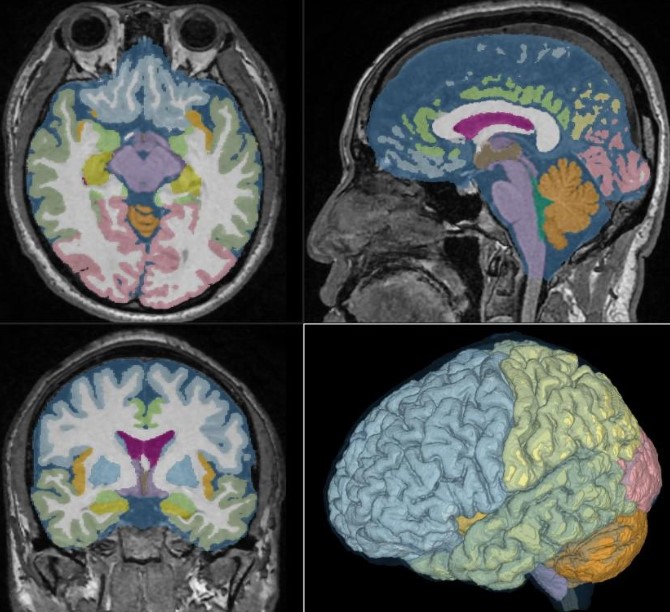
Figure 3 – Cerebrospinal fluid MRI scan where different areas of the brain are colour-coded using DL (‘Aging-related volume changes in the brain and cerebrospinal fluid using AI-automated segmentation - AI Blog - ESR | European Society of Radiology %’, no date)

My Game, my Rules… My Risks?

Although we have shown what practical applications AI can have in medical imaging and CAD, nothing comes without a cost. As mentioned, great training comes with great results, but let us not forget that ‘with great power comes great responsibility’. Such a powerful tool as AI has its risks that must be addressed. And no, we will not talk about AI taking over and leaving us unemployed. The thing is that even though AI is so smart, it can sometimes be challenging to train. The challenges lie mostly in the lack of data, which, surely enough, can be countered with DA and SIG, as we already mentioned. However, the biggest threat to AI is something that you might or might not expect. If your guess was ‘humans’, you would be right. Human error remains a threat to the proper training and use of AI. Think of AI as a recipe for food. Despite executing it word by word, the meal will be a disaster if you add a ton of salt and pepper! Now take this and multiply it by a zillion times. After all, we are talking about human lives. Automation is good and all, but if a tiny issue can mess up one patient’s results, imagine what it would do to an entire medical facility with thousands of them.

Figure 4 – An image of a physician interacting with his AI-loaded portable device (How AI Helps Physicians Improve Telehealth Patient Care in Real-Time | telemedicine.arizona.edu, no date)

Summing Up

AI is a powerful ally in the field of medicine and healthcare. It can perform classification and segmentation tasks on medical images and screening, generate artificial images, and even correct its errors. In a nutshell, AI can undoubtedly almost run the diagnostics of an entire medical imaging facility on its own. By providing enough training information and having the necessary resources, there is no task AI cannot do.

What We Offer

At TechnoLynx, we specialise in delivering custom, innovative tech solutions tailored to any challenge because we understand the benefits of integrating AI into medical applications and healthcare institutions. Our expertise covers improving AI capabilities, ensuring safety in human-machine interactions, managing and analysing extensive data sets, and addressing ethical considerations.

We offer precise software solutions designed to empower AI-driven algorithms in various industries. Our commitment to innovation drives us to adapt to the ever-evolving AI landscape. We provide cutting-edge solutions that increase efficiency, accuracy, and productivity. Feel free to contact us. We will be more than happy to answer any questions!

List of references

CUDA vs ROCm: Choosing for Modern AI

CUDA vs ROCm: Choosing for Modern AI

20/01/2026

A practical comparison of CUDA vs ROCm for GPU compute in modern AI, covering performance, developer experience, software stack maturity, cost savings, and data‑centre deployment.

Best Practices for Training Deep Learning Models

Best Practices for Training Deep Learning Models

19/01/2026

A clear and practical guide to the best practices for training deep learning models, covering data preparation, architecture choices, optimisation, and strategies to prevent overfitting.

Measuring GPU Benchmarks for AI

Measuring GPU Benchmarks for AI

15/01/2026

A practical guide to GPU benchmarks for AI; what to measure, how to run fair tests, and how to turn results into decisions for real‑world projects.

GPU‑Accelerated Computing for Modern Data Science

GPU‑Accelerated Computing for Modern Data Science

14/01/2026

Learn how GPU‑accelerated computing boosts data science workflows, improves training speed, and supports real‑time AI applications with high‑performance parallel processing.

CUDA vs OpenCL: Picking the Right GPU Path

CUDA vs OpenCL: Picking the Right GPU Path

13/01/2026

A clear, practical guide to cuda vs opencl for GPU programming, covering portability, performance, tooling, ecosystem fit, and how to choose for your team and workload.

Performance Engineering for Scalable Deep Learning Systems

Performance Engineering for Scalable Deep Learning Systems

12/01/2026

Learn how performance engineering optimises deep learning frameworks for large-scale distributed AI workloads using advanced compute architectures and state-of-the-art techniques.

Choosing TPUs or GPUs for Modern AI Workloads

Choosing TPUs or GPUs for Modern AI Workloads

10/01/2026

A clear, practical guide to TPU vs GPU for training and inference, covering architecture, energy efficiency, cost, and deployment at large scale across on‑prem and Google Cloud.

GPU vs TPU vs CPU: Performance and Efficiency Explained

GPU vs TPU vs CPU: Performance and Efficiency Explained

10/01/2026

Understand GPU vs TPU vs CPU for accelerating machine learning workloads—covering architecture, energy efficiency, and performance for large-scale neural networks.

Energy-Efficient GPU for Machine Learning

Energy-Efficient GPU for Machine Learning

9/01/2026

Learn how energy-efficient GPUs optimise AI workloads, reduce power consumption, and deliver cost-effective performance for training and inference in deep learning models.

Accelerating Genomic Analysis with GPU Technology

Accelerating Genomic Analysis with GPU Technology

8/01/2026

Learn how GPU technology accelerates genomic analysis, enabling real-time DNA sequencing, high-throughput workflows, and advanced processing for large-scale genetic studies.

GPU Computing for Faster Drug Discovery

GPU Computing for Faster Drug Discovery

7/01/2026

Learn how GPU computing accelerates drug discovery by boosting computation power, enabling high-throughput analysis, and supporting deep learning for better predictions.

The Role of GPU in Healthcare Applications

The Role of GPU in Healthcare Applications

6/01/2026

GPUs boost parallel processing in healthcare, speeding medical data and medical images analysis for high performance AI in healthcare and better treatment plans.

Data Visualisation in Clinical Research in 2026

5/01/2026

Learn how data visualisation in clinical research turns complex clinical data into actionable insights for informed decision-making and efficient trial processes.

Computer Vision Advancing Modern Clinical Trials

19/12/2025

Computer vision improves clinical trials by automating imaging workflows, speeding document capture with OCR, and guiding teams with real-time insights from images and videos.

Modern Biotech Labs: Automation, AI and Data

18/12/2025

Learn how automation, AI, and data collection are shaping the modern biotech lab, reducing human error and improving efficiency in real time.

AI Computer Vision in Biomedical Applications

17/12/2025

Learn how biomedical AI computer vision applications improve medical imaging, patient care, and surgical precision through advanced image processing and real-time analysis.

AI Transforming the Future of Biotech Research

16/12/2025

Learn how AI is changing biotech research through real world applications, better data use, improved decision-making, and new products and services.

AI and Data Analytics in Pharma Innovation

15/12/2025

AI and data analytics are transforming the pharmaceutical industry. Learn how AI-powered tools improve drug discovery, clinical trial design, and treatment outcomes.

AI in Rare Disease Diagnosis and Treatment

12/12/2025

Artificial intelligence is transforming rare disease diagnosis and treatment. Learn how AI, deep learning, and natural language processing improve decision support and patient care.

Large Language Models in Biotech and Life Sciences

11/12/2025

Learn how large language models and transformer architectures are transforming biotech and life sciences through generative AI, deep learning, and advanced language generation.

Top 10 AI Applications in Biotechnology Today

10/12/2025

Discover the top AI applications in biotechnology that are accelerating drug discovery, improving personalised medicine, and significantly enhancing research efficiency.

Generative AI in Pharma: Advanced Drug Development

9/12/2025

Learn how generative AI is transforming the pharmaceutical industry by accelerating drug discovery, improving clinical trials, and delivering cost savings.

Digital Transformation in Life Sciences: Driving Change

8/12/2025

Learn how digital transformation in life sciences is reshaping research, clinical trials, and patient outcomes through AI, machine learning, and digital health.

AI in Life Sciences Driving Progress

5/12/2025

Learn how AI transforms drug discovery, clinical trials, patient care, and supply chain in the life sciences industry, helping companies innovate faster.

AI Adoption Trends in Biotech and Pharma

4/12/2025

Understand how AI adoption is shaping biotech and the pharmaceutical industry, driving innovation in research, drug development, and modern biotechnology.

AI and R&D in Life Sciences: Smarter Drug Development

3/12/2025

Learn how research and development in life sciences shapes drug discovery, clinical trials, and global health, with strategies to accelerate innovation.

Interactive Visual Aids in Pharma: Driving Engagement

2/12/2025

Learn how interactive visual aids are transforming pharma communication in 2025, improving engagement and clarity for healthcare professionals and patients.

Automated Visual Inspection Systems in Pharma

1/12/2025

Discover how automated visual inspection systems improve quality control, speed, and accuracy in pharmaceutical manufacturing while reducing human error.

Pharma 4.0: Driving Manufacturing Intelligence Forward

28/11/2025

Learn how Pharma 4.0 and manufacturing intelligence improve production, enable real-time visibility, and enhance product quality through smart data-driven processes.

Pharmaceutical Inspections and Compliance Essentials

27/11/2025

Understand how pharmaceutical inspections ensure compliance, protect patient safety, and maintain product quality through robust processes and regulatory standards.

Machine Vision Applications in Pharmaceutical Manufacturing

26/11/2025

Learn how machine vision in pharmaceutical technology improves quality control, ensures regulatory compliance, and reduces errors across production lines.

Cutting-Edge Fill-Finish Solutions for Pharma Manufacturing

25/11/2025

Learn how advanced fill-finish technologies improve aseptic processing, ensure sterility, and optimise pharmaceutical manufacturing for high-quality drug products.

Vision Technology in Medical Manufacturing

24/11/2025

Learn how vision technology in medical manufacturing ensures the highest standards of quality, reduces human error, and improves production line efficiency.

Predictive Analytics Shaping Pharma’s Next Decade

21/11/2025

See how predictive analytics, machine learning, and advanced models help pharma predict future outcomes, cut risk, and improve decisions across business processes.

AI in Pharma Quality Control and Manufacturing

20/11/2025

Learn how AI in pharma quality control labs improves production processes, ensures compliance, and reduces costs for pharmaceutical companies.

Generative AI for Drug Discovery and Pharma Innovation

18/11/2025

Learn how generative AI models transform the pharmaceutical industry through advanced content creation, image generation, and drug discovery powered by machine learning.

Scalable Image Analysis for Biotech and Pharma

18/11/2025

Learn how scalable image analysis supports biotech and pharmaceutical industry research, enabling high-throughput cell imaging and real-time drug discoveries.

Real-Time Vision Systems for High-Performance Computing

17/11/2025

Learn how real-time vision innovations in computer processing improve speed, accuracy, and quality control across industries using advanced vision systems and edge computing.

AI-Driven Drug Discovery: The Future of Biotech

14/11/2025

Learn how AI-driven drug discovery transforms pharmaceutical development with generative AI, machine learning models, and large language models for faster, high-quality results.

AI Vision for Smarter Pharma Manufacturing

13/11/2025

Learn how AI vision and machine learning improve pharmaceutical manufacturing by ensuring product quality, monitoring processes in real time, and optimising drug production.

The Impact of Computer Vision on The Medical Field

12/11/2025

See how computer vision systems strengthen patient care, from medical imaging and image classification to early detection, ICU monitoring, and cancer detection workflows.

High-Throughput Image Analysis in Biotechnology

11/11/2025

Learn how image analysis and machine learning transform biotechnology with high-throughput image data, segmentation, and advanced image processing techniques.

Mimicking Human Vision: Rethinking Computer Vision Systems

10/11/2025

See how computer vision technologies model human vision, from image processing and feature extraction to CNNs, OCR, and object detection in real‑world use.

Pattern Recognition and Bioinformatics at Scale

9/11/2025

See how pattern recognition and bioinformatics use AI, machine learning, and computational algorithms to interpret genomic data from high‑throughput DNA sequencing.

Visual analytic intelligence of neural networks

7/11/2025

Understand visual analytic intelligence in neural networks with real time, interactive visuals that make data analysis clear and data driven across modern AI systems.

Visual Computing in Life Sciences: Real-Time Insights

6/11/2025

Learn how visual computing transforms life sciences with real-time analysis, improving research, diagnostics, and decision-making for faster, accurate outcomes.

AI-Driven Aseptic Operations: Eliminating Contamination

21/10/2025

Learn how AI-driven aseptic operations help pharmaceutical manufacturers reduce contamination, improve risk assessment, and meet FDA standards for safe, sterile products.

AI Visual Quality Control: Assuring Safe Pharma Packaging

20/10/2025

See how AI-powered visual quality control ensures safe, compliant, and high-quality pharmaceutical packaging across a wide range of products.

Back See Blogs
arrow icon